AI Software Development Services
Build AI-Powered Products, Tools, and Features
We build custom AI software for companies that need a new product, a smarter internal tool, or AI capabilities in an existing application. Our AI software development services bring together product design, data and AI engineering, application development, and integration, from the first feasibility test through release.
Start with an AI proof of concept to test a use case against your data, or bring us a defined product scope. We can build the interface, connect your business systems, evaluate how the AI performs, and improve the software after launch. WiserBrand can lead the full build or work alongside your team.

4.9/5 client rating

Recognized growth company

Experience with GPT models

Experience with Claude models

AI HR Assistant for a Large IT Company
We deployed an AI HR assistant that cut CV review time by 60% and saved a large IT company’s recruiting team approximately 20 hours per week.

AI Refund and Return Agent for Fashion Retailer
We built an AI refund and return agent that helped a fashion retailer resolve nearly half of routine refund tickets automatically and cut eligible processing time to under 90 seconds.

Zoho and WhatsApp Maintenance Assistant: ~$61,000 in Est. Annual Value
We connected Zoho CRM with WhatsApp to give maintenance teams faster access to property history and reduce return visits.
Our AI Software Development Services
We cover the work required to test an AI opportunity, build the software around it, and keep that software useful after launch. A project can begin with an idea, an existing application, or a validated pilot. You can engage us for a defined service or bring the relevant services together under one delivery scope.

AI Consulting & Solution Architecture
We examine the business goal, users, workflow, data, and existing systems before recommending an approach. Our team compares available models, custom ML, rules, and conventional software against the task, then designs the application and data architecture needed to support it. The output is a buildable scope with success measures and known dependencies.
Includes:
- Use case and workflow assessment
- Data and system readiness review
- Architecture and model options
- Delivery scope, risks, and acceptance criteria

AI PoC & MVP Development
AI PoC development tests a specific technical or business assumption with representative data. When the results support further investment, we build an MVP that real users can try in a limited workflow. Each stage has a distinct question to answer, an evaluation method, and a decision about what comes next.
Includes:
- Feasibility question and target measures
- Focused prototype and representative test data
- Quality, latency, and cost evaluation
- Limited product interface and workflow for the MVP
- Findings, limitations, and next-step recommendation

AI Product & Application Development
We design and build AI-powered products, internal tools, and customer-facing applications. Product work covers the complete user experience: the interface, application logic, AI capability, feedback paths, and the controls needed to use outputs responsibly. We can develop a new product or add AI features to an existing one.
Includes:
- Product discovery and UX design
- Frontend and backend application development
- AI features, APIs, and business logic
- User testing and release preparation

Enterprise AI Software Development
We develop AI software for organizations where several teams, systems, and approval paths must work together. The architecture accounts for shared data and services, role-based access, audit needs, reliability, and support ownership. We can deliver a focused enterprise application or coordinate related capabilities on a common foundation.
Includes:
- Cross-team requirements and ownership mapping
- Shared data and application architecture
- Identity, access, and approval design
- Reusable AI services and interfaces
- Reliability and operational requirements
- Documentation for internal teams

Custom AI Model & ML Development
For tasks that need predictive or classification models, we prepare data, build and compare candidates, and test them against a meaningful baseline. This can include forecasting, recommendations, anomaly detection, document classification, and computer vision. The model is packaged for use in software, with a way to assess its performance after release.
Includes:
- Data preparation and feature engineering
- Model development and comparison
- Task-specific evaluation and error analysis
- Inference interface and versioning
- Performance monitoring plan

Generative AI & LLM Development
We build generative AI capabilities for search, knowledge access, drafting, summarization, extraction, and other language or multimodal tasks. The application combines a suitable model with approved data, retrieval, product logic, and evaluation. We define how users can inspect, correct, or escalate outputs when accuracy matters.
Includes:
- Model and hosting selection
- Retrieval and knowledge-source design
- Prompt and application logic
- Grounding, citation, and permission controls where needed
- Output evaluation and failure testing
- User feedback and review flows

AI Agent & Workflow Automation Development
We develop AI agents for bounded, multi-step tasks that need to interpret inputs, retrieve context, and use approved tools. The workflow specifies permitted actions, handoffs, exception handling, and human approvals. Predictable steps can use rules or conventional automation alongside the agent.
Includes:
- Task and action-boundary design
- Tool connections and workflow orchestration
- State, retries, and exception handling
- Human approval and escalation points
- Task-completion and failure evaluation

AI Integration with Existing Software
We add AI capabilities to the applications and systems your team already uses. That may mean embedding a model in a product, exposing an AI service through an API, or connecting it to CRM, ERP, commerce, support, or proprietary software. Each connection respects the source system’s permissions and defines what happens when data or services are unavailable.
Includes:
- API, webhook, event, database, and file connections
- Authentication and data-access mapping
- Embedded UI or workflow changes
- End-to-end integration testing

AI Infrastructure, Deployment & MLOps
We set up the environments and delivery processes needed to run AI software reliably. The scope can cover data and model pipelines, deployment automation, monitoring, versioning, and release controls. Infrastructure choices follow the expected workload, security requirements, existing cloud standards, and operating cost.
Includes:
- Development, test, and production environments
- Data and model pipelines
- Automated deployment and rollback controls
- Model, application, and integration monitoring
- Secrets, access, and configuration management
- Runbooks and operational handover

AI Optimization, Training & Support
After launch, we use observed quality, user feedback, reliability, response time, and cost to guide improvements. Support can include defect fixes, workflow changes, model updates, documentation, and training for the people who use or maintain the software. Retraining is considered when new data or measured performance calls for it.
Includes:
- Post-launch support and issue resolution
- Performance and cost optimization
- Model or workflow updates
- User training and knowledge transfer
WiserBrand in Numbers
Whether you’re validating a PoC or building a full product, WiserBrand can bring AI specialists together with product designers, application engineers, integration experts, and QA. That puts product, model, and release decisions in one delivery team.
AI Software Development Case Studies
See how clients use the software we built: the task it handles, the applications it connects, and the decisions people still make. Each story pairs the engineering work with an outcome the client can verify.


Tell Us What You’re Trying to Build
AI Software Development by Industry
An AI application takes a different shape in a storefront, a finance team, or a production operation. We design around the user’s task, the systems holding the relevant data, and the decisions the software needs to support.
Retail & eCommerce
eCommerce AI software development can improve product discovery, catalog accuracy, customer support, and returns. We can build fitment-aware search, recommendations, or support tools that use current product, order, and policy data. The application keeps pricing and availability tied to the commerce system and sends uncertain cases to staff.

Finance & Accounting
Finance teams need to see the basis for a recommendation. We develop software that extracts and checks document data, reconciles records, flags anomalies, and prepares items for review. The interface can show source evidence, permissions, and an approval trail before any posting or client-facing decision.

Manufacturing
Manufacturing teams can use AI to read technical documents, assist custom quoting, forecast demand, or flag quality and maintenance issues. We connect the application to ERP, inventory, equipment, and service records so its output reflects current operations. Plant safety and operator control shape where automation stops.

Construction
Construction software can compare supplier quotes, extract contract details, check cost codes, and surface missing information before a bid or purchase decision. We can build review workspaces that link each AI finding to its source file and route exceptions to estimators or project managers.

Logistics
Logistics teams work across shipment records, broker documents, status updates, and exceptions. AI software can turn paperwork into structured data, assist load review, predict delays, or prioritize shipments that need attention. We design for the available transportation and warehouse systems and the timing of the dispatch workflow.

Real Estate
Property managers can use AI software to connect maintenance requests, property history, leases, invoices, and accounting records. Useful products include maintenance assistants, lease abstraction tools, and reconciliation workspaces. Property-level permissions and human approval matter when the software affects tenants, vendors, or financial records.

Professional Services
For law firms, accounting practices, and other client-service businesses, AI applications can support intake, document review, sourced research, and knowledge retrieval. We build around client and matter boundaries so staff see authorized context and can review generated work before it reaches a client.

SaaS
SaaS teams may need AI as a product feature within an existing application. We develop embedded search, copilots, recommendations, analytics, and automation within current interfaces and APIs. Multitenant access, usage limits, latency, and evaluation matter as the feature scales across customers.

Types of AI Software We Build
Our AI software development solutions include catalog search tied to live product data, document review workspaces that surface uncertain fields, and agent workflows that require approval before acting. Each is built with the interface, data connections, and business logic its users need.

Knowledge Copilots & Assistants
Help employees search approved information, ask questions, and draft summaries inside their work. Answers can point back to source records and respect the permissions on those sources.
AI Agents & Task Automation
Complete bounded, multi-step tasks across approved tools, such as gathering information, preparing an update, or routing an exception. The application tracks actions and pauses for review where needed.

Predictive Analytics & Forecasting
Turn historical and current data into demand forecasts, risk signals, or other decision-support outputs. Show predictions in the workflow where people make decisions and monitor performance as conditions change.

Intelligent Document Processing
Classify, extract, compare, and validate information from emails, forms, scans, invoices, and contracts. Route missing, conflicting, or low-confidence details to a person before they enter another system.

AI Search & Recommendation Engines
Help customers or staff find relevant products, content, or records. Combine semantic search or behavioral signals with catalog rules, permissions, and feedback so results stay useful and appropriate.

Computer Vision Applications
Analyze images or video for classification, object detection, inspection, or visual search. Put the findings into a product or operations workflow where someone can review and act on them.

Voice & Conversational Software
Use speech recognition, transcription, and voice interfaces to help people navigate information or complete routine requests. Design for unclear speech, interruptions, and a handoff to a person when the task needs one.

Content Generation & Localization Tools
Draft product copy, support replies, summaries, or multilingual variants using approved source material and brand guidance. Editorial review stays in the workflow before content is published or sent.

Why WiserBrand
We can join when you have an idea, a PoC, or an existing application and carry the work through to a supported release. The team and scope follow what the product actually needs.

Product & AI Specialists in One Team

PoC Validation on Your Data

Business-System Integration Experience

Model Selection Based on Testing
Human Review Built Into Workflows
Documented Handover & Support
Brands We’ve Worked With








AI Software Development Engagement Models
We can work as your AI software development partner in three ways: own a defined build, provide a dedicated team for an ongoing roadmap, or add specialists to your current team. The right fit depends on who will own product priorities, technical decisions, and releases.
Project-Based AI Development
We scope a PoC, feature, MVP, or full application with deliverables, decision points, and acceptance criteria. WiserBrand leads the agreed design and engineering work through release and handover.
Dedicated AI Product Team
A dedicated team works from a shared backlog to build and improve AI features over successive releases. The mix of product, AI/ML, software, data, and QA skills can change as the roadmap evolves.
AI Specialist Augmentation
Add AI/ML engineers, software engineers, data engineers, or QA specialists to a client-led project. They work within your tools, standards, and release process while your team retains technical direction.
Share where the product stands, who owns decisions today, and what you want to release next. We can map the roles, responsibilities, and first milestone that fit your build.
Our AI Software Development Process
We develop AI software as a product: validate its behavior on representative data, design how users review or act on outputs, and connect it to the systems the task depends on. If you already have a PoC or application, we review its code, data, and evaluation results before deciding where to begin. The timeframes below are planning ranges confirmed after scope and access are reviewed.
Users, workflow, and success measures
Data, model options, and technical risks
Experience, architecture, and release plan
Application, AI capability, and systems
Quality, user acceptance, and controlled release
Usage, performance, and feedback
Discover & Scope
1 WeekWe define who will use the software, the task it should improve, and how that change will be measured. We also review the current workflow, available data, connected systems, decision owners, and constraints before committing to a product scope.
- Product brief with users, workflow, target outcome, scope, and decision owners
- Baseline measures and success criteria
- Data and system inventory with access owners
- Dependencies, risks, and acceptance criteria
Test Feasibility
1–2 WeeksWe test the riskiest assumptions with representative inputs. This may be a focused AI PoC, a comparison of model and rule-based approaches, or a review of evidence from a prototype you already have. The results guide what should be built, changed, or investigated further.
- Representative evaluation data and baseline task results
- PoC findings or assessment of existing feasibility evidence
- Quality, error, response-time, and cost findings
- Documented data, access, and technical gaps
- Feasibility recommendation for the next scope
Design the Product
1–2 WeeksWe design the experience and the system behind it together. The blueprint covers user flows, application components, data movement, AI behavior, integrations, human review, evaluation, and the sequence of releases.
- User journeys, interface designs, and review states
- Product and technical architecture with data flows
- Integration and permission design
- Evaluation plan and acceptance tests
- Approved build backlog and release plan
Build & Integrate
2–4 WeeksWe develop the application in working increments, connecting the interface, business logic, AI capability, and source systems as the product takes shape. Testing runs throughout the build so errors in data flow, permissions, or model behavior surface before final acceptance.
- Working frontend, backend, and AI features
- Data pipelines and tested system connections
- User roles, approvals, and exception paths
- Automated tests, logs, and technical documentation
- Integrated release candidate
Validate & Launch
1 WeekWe test the complete product on representative tasks and confirm that users can complete the intended workflow. Release checks cover software quality, AI behavior, integrations, access, security requirements, and operating readiness. Deployment follows the agreed rollout and rollback plan.
- Functional, integration, and AI evaluation results
- User acceptance record and disposition of release issues
- Security and access review findings
- Production monitoring and support runbook
- Controlled production release with named owners and rollback path
Measure & Improve
OngoingAfter launch, we compare usage and performance with the agreed baseline. We review quality, task completion, errors, response time, cost, and user feedback to prioritize product changes and model or workflow improvements.
- Product usage and business outcome report against the baseline
- AI quality, reliability, latency, and cost review
- User feedback and exception analysis
- Prioritized improvement backlog for future releases
Technology Behind Our AI Software
Before choosing a model or platform, we map the data and user action the software must support. A product recommendation in an online store needs different response times and catalog rules from a document review workspace; those requirements drive the stack.
Models & AI Approaches
We use commercial, open source, or custom approaches for generation, classification, prediction, vision, and other tasks. Candidates are tested on representative inputs against quality, response time, data handling needs, and usage cost. Model changes are evaluated before release because behavior can differ even when the interface stays the same.
- OpenAI
- Anthropic Claude
- Google Gemini
- Privately hosted models
Data, Retrieval & Pipelines
The product may need structured records, documents, images, events, or knowledge sources. We design how that data is prepared, refreshed, retrieved, and traced back to its source, while preserving the access rules that apply to it.Event streams
- Relational databases
- Document databases
- Object storage
- Data pipelines
- Event streams
Application Architecture & APIs
We build the interface and application services around the AI capability. Business rules, user identity, product state, and system actions are designed explicitly so model output can be checked before it changes a record or reaches a user.
- Web and mobile interfaces
- Backend services
- APIs
- Authentication
- Queues
- Caching
- Application databases
Agent & Workflow Orchestration
For tasks with several steps, the application coordinates model calls, approved tools, state, retries, and human decisions. Predictable steps can use rules or conventional automation, while the AI handles inputs that require interpretation.
- Workflow engines
- Tool interfaces
- State stores
- Schedulers
- Approval gates
Cloud, Deployment & MLOps
Hosting and delivery choices follow the client’s infrastructure standards, data location, expected load, and operating team. The product’s release design covers environments, versioning, deployment, rollback, and monitoring.
- AWS
- Microsoft Azure
- Google Cloud
Evaluation, Security & Operations
We test software behavior and AI outputs together, including difficult inputs, permission boundaries, failed integrations, response time, and cost. After release, logs, alerts, and evaluation checks help the team detect changes in quality or reliability.
- Evaluation datasets
- Automated tests
- Alerts
- Audit records
- Release controls
AI Software Connected to Your Business Systems
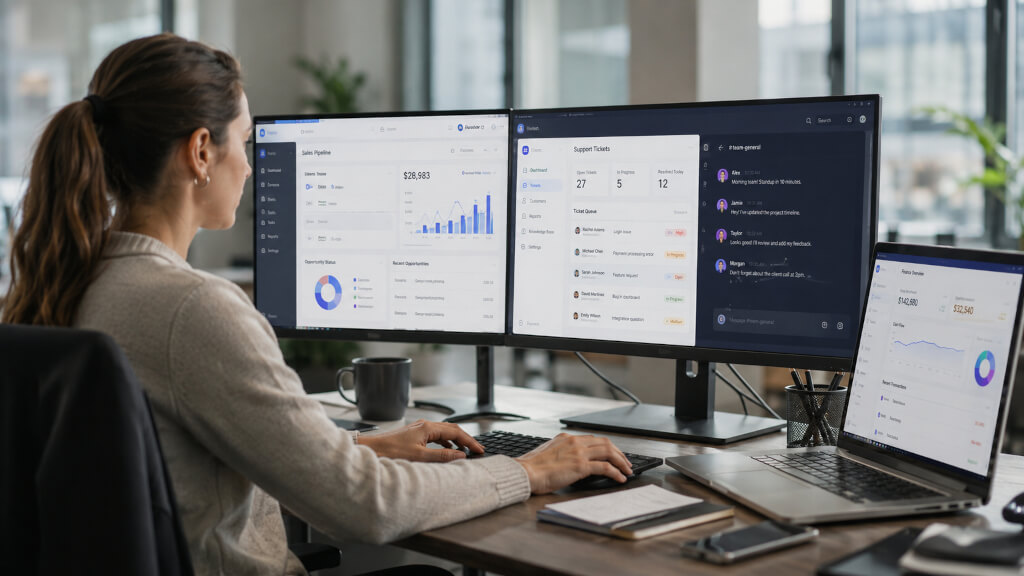
AI development for a working product starts with the systems it must use. A search feature needs catalog and inventory data; a maintenance assistant needs property records and a channel for replies. We define access, permitted actions, and approvals for each connection.
Commerce & Product Data
- Product catalogs
- Information systems
- Inventory, order, and returns systems
CRM, Support & Messaging
- Zoho CRM
- Zendesk
- Email and ticketing platforms
Finance & Property Operations
- Yardi
- QuickBooks
- Invoicing and billing applications
Finance & Accounting
- QuickBooks
- Xero
ERP & Field Operations
- Odoo
- Maintenance and work-order applications
- Warehouse and manufacturing systems
Legal
- Clio
- Filevine
- MyCase
Connection Methods
- REST API
- GraphQL API
- Webhooks
- Secure file exchange
- MCP servers
Get started with WiserBrand
Let’s begin your project journey
Prompt Response
We’ll contact you within 24 business hours to discuss your project
Exploratory Call
A 15-20 minute call to discuss your needs and goals
Tailored Proposal
Receive a custom proposal with recommended next steps
or
Pick a time that works for you, and let’s hop on a call
Frequently Asked Questions
Answers to common questions about AI software scope, feasibility, delivery, cost, and ownership.
AI software development services design, build, test, and support applications with AI capabilities. The work can include product discovery, data preparation, a proof of concept, user experience design, model or API integration, application engineering, evaluation, and deployment. The result may be a new customer product, an internal tool, or an AI feature in software you already use. Scope starts with the user task and the outcome the product should improve.
The phrase can refer to building AI-powered products or using AI tools during engineering. This page covers the first: developing applications and features that use AI for a defined user task. The deliverable includes the interface, data connections, business logic, evaluation, and release plan for working software.
Yes. We review the current architecture, data flow, user roles, available interfaces, and release process, then define the AI feature’s inputs, outputs, and place in the user journey. That could be embedded search, recommendations, document handling, forecasting, or an assistant. Existing systems continue to manage their authoritative records and permissions while the new feature uses approved connections.
A proof of concept (PoC) is useful when the main uncertainty is whether the approach can perform a task with your data. A minimum viable product (MVP) is a limited but usable release for testing the product experience and workflow with real users. We define the question, evidence, and next decision for either stage. An existing validated prototype may let the project begin with an MVP or a later build phase.
For AI/ML software development, we compare rules, existing models, and custom machine learning against representative tasks. Evaluation looks at output quality, difficult cases, response time, data handling, and operating cost, as well as how the capability behaves inside the application. The chosen approach must meet the product’s acceptance criteria; custom training enters the scope when the expected gain warrants its data and maintenance needs.
We define access and review boundaries for the user workflow, then test the complete application against representative and difficult inputs. Checks cover incorrect or missing data, model errors, permission failures, unavailable integrations, and expected load. Monitoring after release tracks quality, errors, latency, and cost. The exact security and approval controls follow the product’s data and business impact.
Ask how the team will validate the AI capability and deliver the complete application. Look for relevant case studies, named product and engineering roles, evaluation with representative data, a plan for integrations and security, and clear ownership and support terms. These details make the proposed scope and delivery responsibilities easier to assess.
A small PoC typically takes 4–6 weeks. A production system with data pipelines, integrations, and a user interface often takes three to four months or more. The schedule depends on product scope, data access and quality, integration complexity, evaluation needs, and release requirements. We confirm the plan and stage timing after reviewing those dependencies.
Cost depends on whether we are building a PoC, adding a feature, or developing a full product; the state of the data and existing software; the number of integrations; model work; interface complexity; testing; and post-launch support. An estimate separates WiserBrand’s delivery work from model usage, cloud, software, and third-party licensing costs. A bounded feasibility stage can clarify a high-risk dependency before committing to a larger build.
For custom AI projects, the client owns the custom code, configurations, and trained artifacts. We hand over repositories, technical documentation, and runbooks, with any third-party dependencies identified in the project scope. After launch, we can help monitor performance, resolve issues, update models or integrations, and train the team that will operate the product.