AI Integration Services
Put AI to Work Inside the Systems You Already Use
We connect AI to your data, applications, and workflows so it can support real operational work, not sit beside the business as another standalone tool.
From initial assessment and architecture to deployment and managed support, WiserBrand builds AI integration solutions with defined access, human control, and measurable outcomes. Your existing applications remain the source of record.

4.9/5 client rating

Recognized growth company

Experience with GPT models

Experience with Claude models
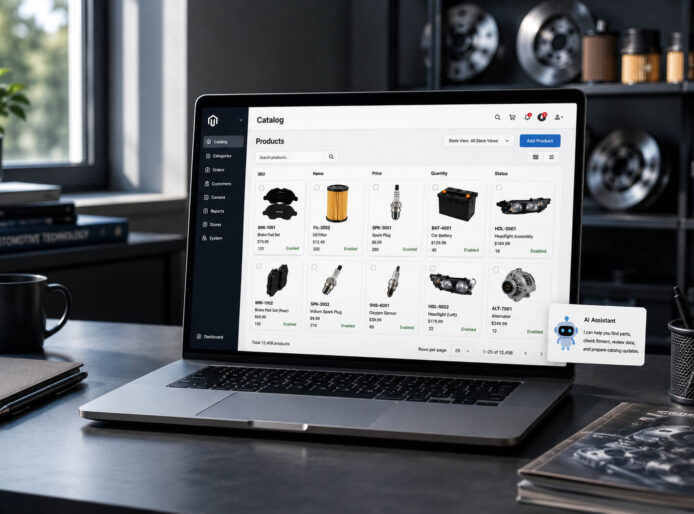
Custom MCP Server for Magento
A custom MCP server connected an AI agent to Magento, cutting parts-search time by 80% and keeping every catalog change under manager approval.

AI HR Assistant for a Large IT Company
We deployed an AI HR assistant that cut CV review time by 60% and saved a large IT company’s recruiting team approximately 20 hours per week.

AI-Assisted Property Reconciliation Across Yardi and QuickBooks
We introduced AI coordinators to reconcile Yardi and QuickBooks data, route exceptions, and prepare close reporting, saving about 210 finance hours annually.

What Is AI Integration?
AI integration is the work of connecting AI models and tools to the systems your business already runs, so they operate on real data and take real actions inside existing workflows. Instead of a standalone tool beside your operations, the AI reads from and writes to the applications your team uses every day.
A working integration usually combines a model, a connection to your data and systems, and a defined set of actions the AI is allowed to perform. Your applications stay the source of record and keep enforcing their own rules and permissions.
We define what the AI can touch, where it must stop, and when a person reviews the result, so that integration extends your stack rather than replacing it or handing over decisions.

Works inside your existing apps and data

Systems stay the source of record

AI gets only the access a use case needs

Actions scoped by user, role, and permission

Human review on sensitive steps

Monitoring, logging, and ongoing support
Our AI Integration Services
Our AI integration services cover the full path from deciding where AI fits to running it in production: assessment, model and data integration, system connections, security, testing, and support. An engagement can start with one workflow or build a reusable AI layer across teams. For enterprise AI integration, we adapt access and controls to your existing policies.

AI Readiness & Integration Assessment
We evaluate where AI adds measurable value before any build, reviewing your workflows, data, and systems. That includes saying where a simpler tool or a process fix would serve you better, and the result is a custom AI integration plan scoped to what your operations can support.
Includes:
- Use-case and workflow review
- Data and system readiness assessment
- Integration approach and effort estimate
- Risk, security, and access considerations
- Prioritized roadmap and success criteria

Model & Generative AI Integration
We connect the right model to a defined workflow: a copilot, an automation, a decision-support step, or a generative task like drafting and summarizing. Model choice follows the task, not a default, and output stays grounded in your own data.
Includes:
- Model and approach selection
- Retrieval from your own data sources
- Tool, action, and prompt configuration
- Guardrails and review steps
- Integration with existing tools

Data Integration & Analytics
We connect fragmented data sources into a form AI can use, then support reporting, machine learning integration, and prediction on top of it. Access is scoped per source, so the model sees only what a use case requires.
Includes:
- Data source connection and mapping
- Cleaning and structuring for AI use
- Machine learning and predictive modeling
- Access and permission boundaries
- Refresh, quality, and monitoring

System & Application Integration
Our AI system integration services connect AI to the platforms you already run, from CRMs and ERPs to commerce, support, and internal tools. Each connection exposes a bounded set of actions rather than open access to the backend.
Includes:
- API, webhook, and data connections
- CRM, ERP, and commerce integration
- Bounded action and capability design
- Authentication and permission setup
- Read, write, and approval boundaries

Security & Access Control
We treat the integration as a boundary between AI and your systems. Access is scoped to the minimum a use case needs, with the AI’s permissions kept separate from the credentials used to reach your systems.
Includes:
- Role- and permission-based access
- Downstream credential boundaries
- Input and action validation
- Approval on sensitive actions
- Audit logging and access review

Testing, Monitoring & Optimization
We test each integration against real conditions before launch: valid operations, bad inputs, unavailable systems, and permission failures. After launch, we track accuracy, latency, usage, and cost.
Includes:
- Functional and permission testing
- Accuracy and output evaluation
- Logging, metrics, and monitoring
- Latency and cost optimization
- Ongoing tuning and review

Deployment & Managed Support
We prepare each integration for its target environment with configuration, release controls, and monitoring. Rollout can be limited by users or actions while the team observes production behavior.
Includes:
- Environment and release configuration
- Controlled, staged rollout
- Monitoring and issue resolution
- Updates as systems change
- Enhancement and scaling support
WiserBrand in Numbers
AI Integration Case Studies
These projects show AI connected to real business systems, with the data access, controls, and human review that keep it dependable in production.



Put AI to Work Across Your Business
AI Integration by Industry
The same integration work exposes very different data and actions depending on the business. We adapt connections, access, and review requirements to the systems and rules of each industry.
Retail & eCommerce
Connect AI to product, order, inventory, and customer-service systems so teams can act on live data. Catalog, pricing, and refund changes stay behind existing approval rules.
- Surface product, stock, and order context from connected systems
- Draft or apply catalog and order updates within set limits
- Route refunds and exceptions for staff review

Financial Services
Integrate AI with research, document, transaction, and reporting systems while preserving user identity and record-level permissions. Accounting, credit, and regulatory decisions stay with qualified people.
- Retrieve permitted account, portfolio, or transaction data with source context
- Support reconciliation and document-review workflows
- Log user, action, and outcome for audit

Logistics & Supply Chain
Connect AI to transportation, warehouse, order, and carrier systems for a consistent view across them. Booking, dispatch, and billing changes stay limited to approved actions.
- Compare order, rate, tracking, and invoice records across systems
- Surface shipment status and exceptions from TMS, WMS, and carriers
- Prepare updates with confirmation on consequential changes

Manufacturing
Connect AI to ERP, inventory, production, and maintenance systems so teams can investigate issues without automatically changing production records. Read and write access are separated by role.
- Find parts, work orders, and equipment data across systems
- Assemble quote, shortage, or maintenance context for review
- Keep purchasing and scheduling updates behind role and approval rules

Professional Services
Integrate AI with matter, client, project, and billing systems without giving every user access to every record. Connections follow the firm’s existing client and role boundaries.
- Assemble approved client or matter context from several sources
- Return source-linked information for specialist review
- Draft tasks, time entries, or follow-ups within permitted scope

SaaS & Technology
Give development, support, and operations teams a consistent AI interface to repositories, documentation, ticketing, and telemetry. Tenant and environment boundaries apply to every connection.
- Retrieve documentation, ownership, and deployment context
- Connect incident work to approved logs, metrics, and traces
- Separate test and production actions by permission

AI Integration Challenges We Solve
An integration can work in a demo and fail in production, depending on how it handles data, access, and real load. We address the gaps that usually appear between a promising pilot and a dependable system.

Unclear Fit and Over-Scoped Projects
Not every workflow needs AI, and starting too broad wastes budget on work that a simpler tool would handle.
We compare the options, define the intended users and use case, and scope the smallest integration that meets the actual need.

Disconnected or Unready Data
Fragmented, inconsistent, or hard-to-access data makes AI output unreliable no matter how good the model is.
We connect and structure the required sources, keep them current and permissioned, and flag where data isn’t ready before building on it.

Over-Permissioned Access
A shared or broad credential can let AI reach records and actions it should never touch.
We map user and system identity to scoped permissions, separate read and write access, and require narrower authorization for sensitive operations.
Prompt Injection and Data Exposure
External content and model outputs can become attack paths, and exposing the whole system just in case creates avoidable risk.
We treat external content as untrusted, validate inputs and actions, limit access to required records and fields, and confirm consequential steps.
Accuracy and Trust in Output
AI that sounds confident but is sometimes wrong erodes trust and creates rework.
We ground output in your own sources, add review steps where accuracy matters, and evaluate results against real cases before and after launch.

Reliability and Cost Under Load
An integration depends on systems, networks, and models with different limits and failure modes that demos never test.
We design rate limits, retries, timeouts, caching, and monitoring around the real workload rather than assuming demo performance holds.
Trusted by Leading Brands








AI Integration Engagement Models
The right model depends on whether the use case is still being validated, how many systems and workflows are planned, and who will own delivery and operations.
Integration Assessment & Pilot
We assess one use case and build a focused integration with real data, one or two live system connections, limited permissions, and agreed test scenarios. The work shows whether AI is the right fit and what production would require.
Dedicated AI Integration Team
A dedicated team works from an ongoing backlog alongside your product, engineering, data, or security leads. Scope can span multiple integrations, shared components, testing, deployment, and maintenance across teams and systems.
End-to-End Implementation
We manage discovery, integration, testing, deployment, documentation, and the agreed post-launch scope for a defined solution. Responsibilities, dependencies, review points, and acceptance criteria are set before implementation.
Talk through your use case, systems, and requirements with our team, and we’ll map a practical path to implementation.
Our AI Integration Process
Our AI integration process runs in five stages, with scope, access, and release decisions reviewed at set points. The schedule is set after discovery, since it depends on the number of use cases, systems, data readiness, and security requirements.
Users, workflows, systems, and success criteria
Connections, data flows, permissions, and safeguards
System connections, access controls, and testing
Accuracy, security, performance, and production readiness
Usage, reliability, cost, and continuous improvement
Discovery & Use-Case Definition
3-5 DaysWe document who will use the integration, which systems hold the data or actions involved, and what outcome it should support. Discovery also tests whether AI is the right fit or a simpler approach would serve better.
- Intended users and workflow
- Systems, data, and permitted actions
- Baseline measures and success criteria
Architecture & Access Design
1-2 WeeksWe design the connections, data flows, permissions, and safeguards, defining what the AI can read, which actions it can take, and where a person stays in control.
- Integration and data-flow design
- Authentication and permission model
- Validation, error, and review behavior
Integration & Development
2-3 WeeksWe build the integration and connect it to approved systems in development and test environments. Automated checks run alongside each capability to catch permission failures, bad inputs, and unavailable systems.
- Working integration and connections
- Access and permission enforcement
- Functional and permission tests
Validation & Controlled Rollout
1-2 WeeksBefore production, we review accuracy, permissions, security, logging, and performance. The first release can limit users or actions while the team observes real behavior.
- Accuracy and permission testing
- Load and failure checks
- Deployment and monitoring setup
Monitoring & Optimization
OngoingAfter launch, we track accuracy, usage, latency, cost, and failures, then adjust models, prompts, access, and connections through the same tested release process.
- Production monitoring
- Reliability and accuracy review
- Prioritized improvement backlog
Tools and Technologies for AI Integration
Technology choices depend on your systems, data environment, security policy, workload, and the use case. We select the stack around the integration rather than fitting your workflow to a fixed toolset.
Models & Providers
We select models by task, accuracy, cost, and data-handling needs, and integrate them as interchangeable parts rather than locking to one provider.
- OpenAI
- Anthropic
- Google Gemini
- Open and self-hosted models
Application & Workflow Layer
The logic that connects a model to a real workflow: retrieval, prompts, tool calls, and the steps where a person reviews or approves.
- Retrieval and RAG
- Function and tool calling
- Workflow orchestration
Data & Connectivity
We connect to your systems through their supported interfaces rather than replacing them, adapting each connection to its data and error contracts.
- REST
- GraphQL
- Databases
- SaaS APIs
- Event streams
Authentication & Access
Access is scoped to the minimum a use case needs, with AI authorization kept separate from the credentials used to reach your systems.
- OAuth
- OpenID Connect
- Role- and scope-based permissions
Deployment & Operations
Runtime and operations tools are chosen around availability, scaling, environment isolation, and support requirements.
- AWS
- Azure
- GCP
- Kubernetes
- Private infrastructure
Testing & Observability
We test integration behavior and contracts, and trace a request through the model and connected systems without logging prohibited data.
- Contract and integration testing
- Logs, metrics, and traces
- Evaluation sets
AI Integrations for Business Systems
Our AI integration services connect approved AI to the systems that hold your customer, commerce, operational, support, document, and financial data. During discovery we confirm available interfaces, authentication, rate limits, data-handling rules, and the read or write actions each user may perform.

CRM & Sales
- Salesforce
- HubSpot
- Zoho CRM
eCommerce
- Shopify
- Adobe Commerce (Magento)
- WooCommerce
- Amazon marketplace workflows
Support
- Zendesk
- Gorgias
- Intercom
- Freshdesk
Finance & Accounting
- QuickBooks
- Xero
ERP & Operations
- Odoo
- Oracle NetSuite
- Internal business applications
Productivity
- Gmail
- Outlook
- Google Sheets
- Microsoft 365
- Slack
Data & Analytics
- Databases
- Data warehouses
- BI and reporting tools
Get started with WiserBrand
Let’s begin your project journey
Prompt Response
We’ll contact you within 24 business hours to discuss your project
Exploratory Call
A 15-20 minute call to discuss your needs and goals
Tailored Proposal
Receive a custom proposal with recommended next steps
or
Pick a time that works for you, and let’s hop on a call
Frequently Asked Questions
Still Have Questions? Talk to Our TeamAI integration services connect AI models and tools to the systems your business already runs, so they work on real data and take real actions inside existing workflows. Typical use cases include copilots, workflow automation, document and data analysis, and decision support. The work covers assessment, model and data integration, system connections, security, testing, and support, with your applications staying the source of record.
Cost depends on the number of use cases, the systems involved, how ready your data is, and the security and oversight each workflow needs. Most engagements start with a focused pilot on one use case, which typically falls between $10,000 and $40,000, so you can validate value before a wider rollout.
Larger programs across multiple systems and teams are scoped after discovery, where we confirm the workflows, integrations, and success measures, then agree a fixed scope and price before any build starts. Any change in scope is priced and agreed with you upfront.
A focused pilot usually takes four to eight weeks, depending on the systems involved, data readiness, and security requirements. The schedule is set after discovery, once the use cases and integrations are confirmed.
Larger programs run in stages rather than one long project, so each integration reaches production and starts returning value before the next begins.
AI integration is a strong fit when teams spend significant time on work that involves data, documents, requests, or coordination between systems, and when that data lives in tools you already use. Good starting points include support, operations, reporting, document processing, and other recurring workflows.
It is a weaker fit when a process runs at low volume, changes constantly, or depends on data that isn’t captured yet. In those cases we say so during discovery, and often a simpler automation or a process fix delivers more.
In most cases, yes. We connect through the interfaces your systems already support, such as APIs, databases, and event streams, so your applications stay the source of record and keep enforcing their own rules and permissions.
Where a system has no suitable interface, we identify that early and propose an alternative rather than forcing a fragile connection.
Access is limited to the records and actions required for each use case. We separate the permissions granted to the AI from the credentials used to connect to operational systems, require additional authorization or human approval for sensitive actions, and validate proposed actions before execution. We also select and configure providers according to agreed requirements for data retention, model training, and logging.
Most integrations use existing models, selected by task, accuracy, cost, and data-handling needs, and connected to your workflows as interchangeable parts. This keeps you free to change providers as models improve.
When a use case requires a dedicated assistant or a custom model, we deliver it through our chatbot and custom AI development services and integrate it in the same way.
After launch, we monitor accuracy, usage, latency, cost, and failures, then adjust models, prompts, access, and connections through the same tested release process. AI integration is not a one-time project, since models, data, and connected systems keep changing.
Support can also extend an integration to new workflows or teams once the initial one has been proven.