MCP Server Development Services
Connect AI to Business Systems Through a Governed MCP Layer
We provide custom MCP server development services for companies that need a standard way to connect AI applications with business data, tools, and workflows. Our team designs and builds Model Context Protocol servers that expose clearly defined tools, resources, and prompts to approved MCP clients.
The MCP layer becomes the governed boundary between AI and your systems: your APIs, databases, and permissions stay in place, and each tool the AI can reach is defined, scoped, and logged. When a project also needs agent orchestration or approval workflows, we build those around the MCP layer with their boundaries kept separate.
Discuss Your MCP Project

4.9/5 client rating

Recognized growth company

Architecture, development, integration
Latest Case Studies View all
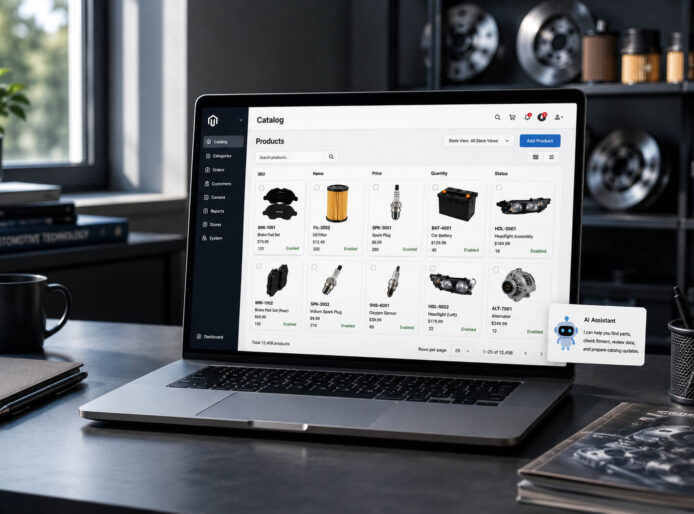
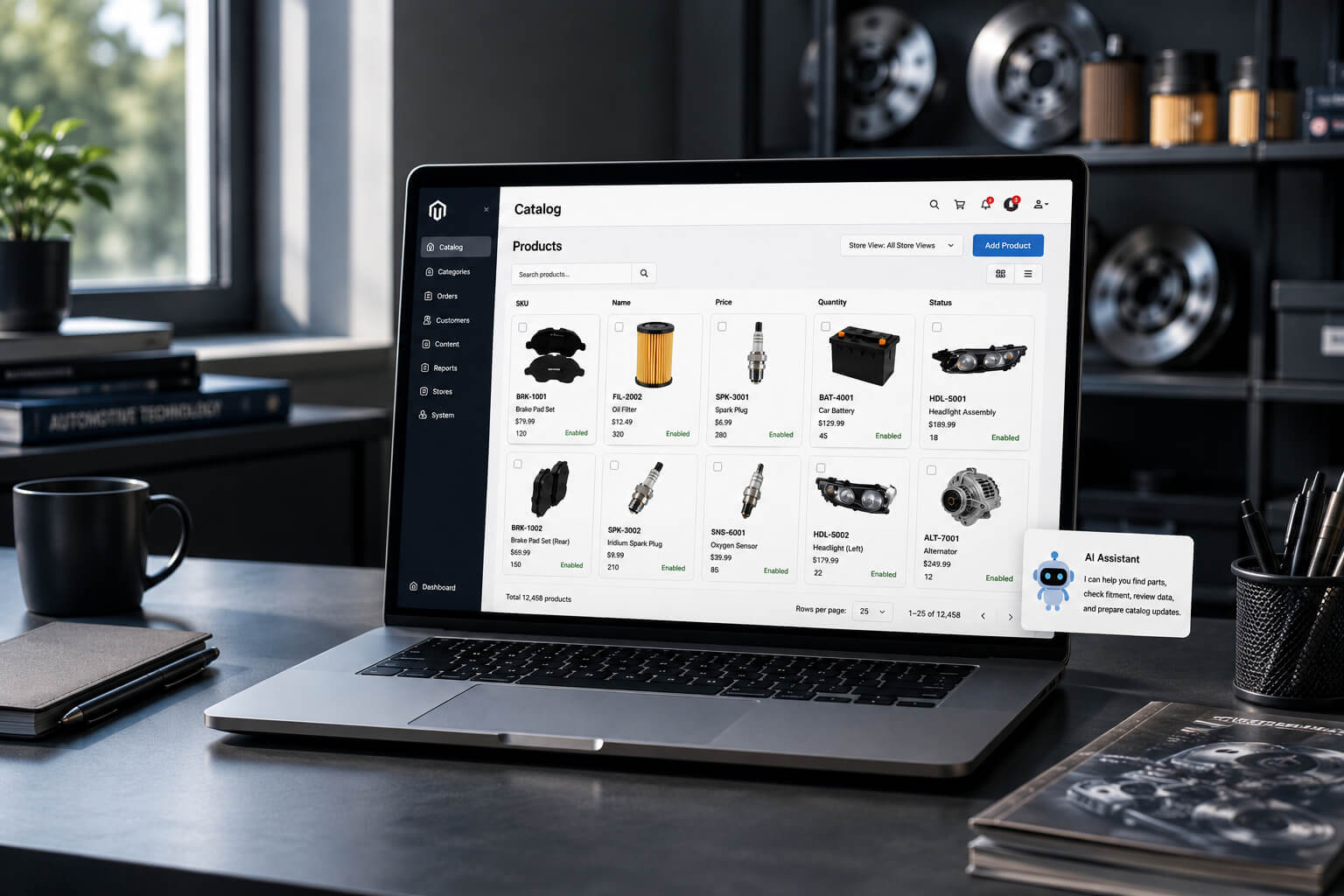
Custom MCP Server for Magento
A custom MCP server connected an AI agent to Magento, cutting parts-search time by 80% and keeping every catalog change under manager approval.

AI HR Assistant for a Large IT Company
We deployed an AI HR assistant that cut CV review time by 60% and saved a large IT company’s recruiting team approximately 20 hours per week.

AI-Assisted Property Reconciliation Across Yardi and QuickBooks
We introduced AI coordinators to reconcile Yardi and QuickBooks data, route exceptions, and prepare close reporting, saving about 210 finance hours annually.
What Is MCP Server Development?
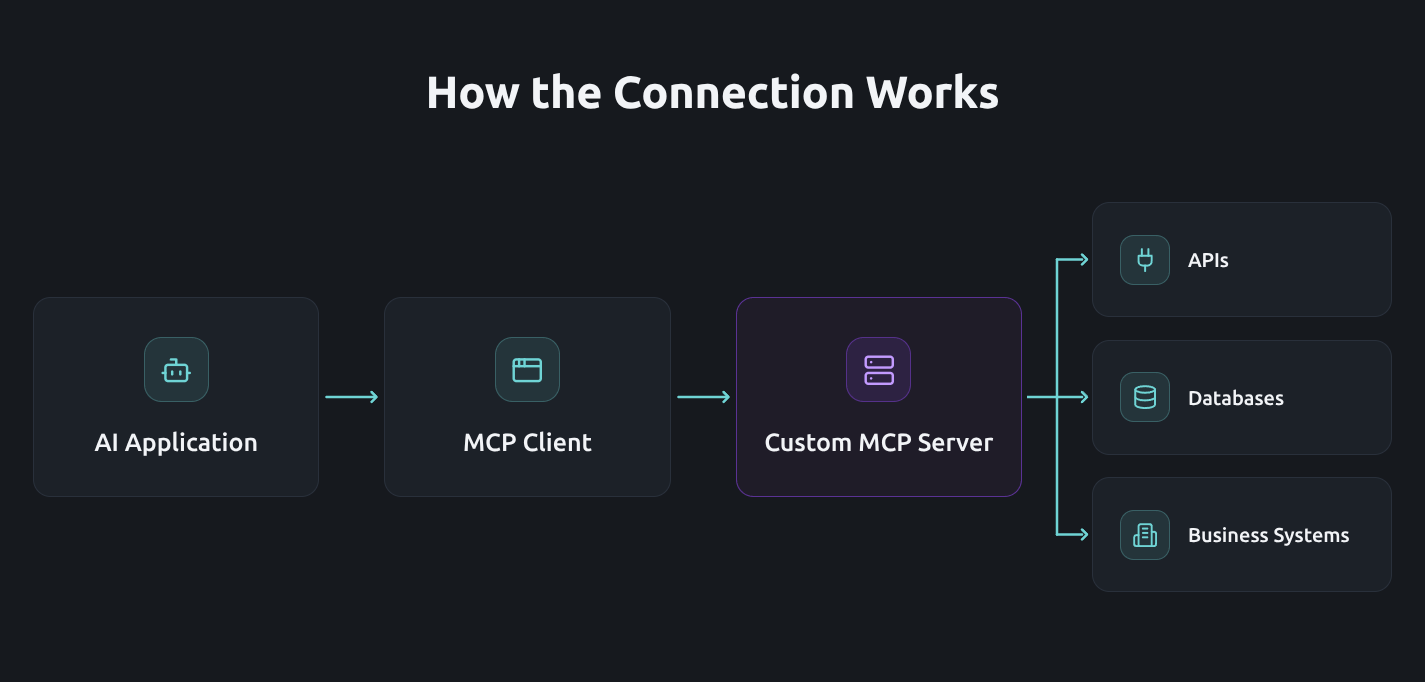
MCP server development is the design and production engineering of a server that gives AI applications a standard way to access approved business data and actions. Instead of placing separate integration logic inside every assistant or agent, the server presents defined capabilities through Model Context Protocol.
An MCP server can expose tools for actions, resources for contextual data, and prompts for reusable interaction templates. It normally connects to existing APIs, databases, SaaS platforms, and internal services rather than replacing them. The underlying business system remains the source of record and continues to enforce its own rules and permissions.
The MCP layer does not provide the model, agent orchestration, memory, or user interface by itself. Those components sit around the protocol and use the capabilities the server makes available.

Reusable access across approved clients

Existing systems remain in place

AI gets only the tools and data needed for the specific use case

User, role, and tenant boundaries

Explicit schemas, structured results, and actionable errors

Centralized logging, monitoring, and capability management
Our MCP Server Development Offerings
Our MCP development services cover the work required to define, build, integrate, secure, deploy, and maintain a custom Model Context Protocol server. An engagement can focus on one connection or establish a reusable MCP layer for several AI applications, business systems, and teams.

MCP Strategy & Architecture Consulting
We assess the intended users, AI applications, systems, data, and actions before recommending an MCP implementation. This includes determining where MCP adds useful standardization and where a direct API integration or an existing connector would be simpler.
The resulting architecture defines server boundaries, exposed capabilities, identity flows, deployment requirements, operational ownership, and the controls needed for each integration.
Includes:
- Use-case and workflow analysis
- MCP suitability assessment
- Client, server, and system boundaries
- Tool, resource, and prompt planning
- Security and deployment requirements
- Implementation roadmap and success criteria

Custom MCP Server Development
We design and build MCP servers around approved business capabilities. The implementation can expose tools for defined actions, resources for contextual data, and reusable prompts where they improve how users interact with the connected system.
Each server includes clear schemas, predictable responses, error handling, and capability declarations appropriate to the supported MCP clients and deployment environment.
Includes:
- Server architecture and implementation
- Tool, resource, and prompt capabilities
- Input and output schemas
- Per-request capability metadata and protocol-version handling
- Error, timeout, and cancellation behavior
- Technical documentation and handover

MCP Integration & Capability Design
We connect MCP servers to APIs, databases, SaaS platforms, internal services, document repositories, and other approved sources. Each exposed capability is designed around a bounded business operation rather than presenting unrestricted backend access to the AI application.
Existing backends usually remain in place. For REST APIs with a usable OpenAPI definition, we can use the documented operations and schemas as a starting point, then narrow and adapt them into MCP capabilities suited to AI use rather than exposing every endpoint automatically.
Integration contracts define accepted inputs, returned data, downstream permissions, failure behavior, and which operations require confirmation or review outside the server.
Includes:
- Business-system and data connections
- Tool and resource contract design
- Structured input and output mapping
- Downstream API and service orchestration
- Rate-limit and dependency handling
- Read, write, and approval boundaries

Authentication & Access Control
We design how MCP clients, users, servers, and downstream systems establish identity and receive permission. Remote deployments can use standards-based authorization flows, while local or internal implementations follow the controls appropriate to their transport and operating environment.
Access is scoped to the minimum capabilities required for the use case. Where an action depends on the end user’s identity or consent, that context is preserved and validated instead of relying on a shared, over-privileged credential.
For multi-tenant deployments, trusted authentication context determines the tenant boundary. That boundary is applied to capability exposure, downstream credentials, and record-level filtering instead of accepting a tenant identifier supplied only by the AI application.
Includes:
- Client and user identity flows
- OAuth and token configuration where applicable
- Role-, scope-, and tenant-based permissions
- Downstream credential boundaries
- Read-only and action-specific access
- Revocation and access-review requirements

MCP Security & Protection
We treat the MCP server as a security boundary between AI applications and operational systems. Threat modeling covers both conventional server risks and MCP-specific paths involving tool metadata, untrusted content, model-generated inputs, and sensitive actions.
Controls are selected according to the capabilities exposed and the surrounding client architecture. MCP protection measures can include strict validation, output sanitization, secrets isolation, rate limits, audit records, and confirmation requirements for consequential operations.
Includes:
- MCP threat modeling
- Prompt and tool-injection testing
- Input validation and output sanitization
- Secrets and token protection
- Network and runtime restrictions
- Security logging and incident preparation

Testing, Observability & Performance
We test the server’s protocol behavior, capability contracts, downstream integrations, permission boundaries, and failure handling before production use. Test scenarios cover valid operations as well as malformed requests, unavailable dependencies, timeouts, authorization failures, and unsafe inputs.
Observability is designed to show which capability was requested, how the server and connected system responded, and where a failure occurred without placing sensitive data in logs. Performance work focuses on the paths that matter for the target workload.
Includes:
- Protocol and contract testing
- Integration and permission testing
- Failure and recovery scenarios
- Structured logs, metrics, and traces
- Load, latency, and concurrency testing
- Rate-limit and response optimization

Deployment & Managed Support
We prepare the MCP server for its target runtime, whether it is launched locally by an approved client or operated as a remote service. Deployment planning covers environment separation, configuration, secrets, monitoring, release controls, and operational ownership.
After launch, we can maintain integrations, investigate failures, add or revise capabilities, and manage compatibility as MCP clients, protocol versions, downstream systems, and business requirements change.
Includes:
- Local or remote deployment configuration
- Environment and secrets management
- Capability and schema versioning
- Compatibility and regression checks
- Monitoring, maintenance, and enhancement support
WiserBrand in Numbers
Our MCP server development work is supported by WiserBrand’s broader consulting, software engineering, data, cloud, QA, and delivery teams.
180+ Dedicated Professionals
70+ Completed Projects
11 Years Hands-On Experience
2.5 Years Average Partnership Duration
MCP Server Development Case Studies
These projects show both direct MCP server implementation and the integration, access-control, and operational engineering involved when AI applications work with business systems.

Need a Custom MCP Server?
Book a Strategy Call Build a Secure MCP for Your Systems
MCP for Industry-Specific Use Cases
The same protocol can expose very different data and actions depending on the operating environment. Our enterprise MCP services adapt server boundaries, capability contracts, identity flows, and approval requirements to the systems and responsibilities of each industry.
Retail & eCommerce
Retail and eCommerce teams can use MCP servers to give approved AI applications structured access to product, inventory, order, customer-service, and merchandising systems. Each capability can reflect existing store roles and keep catalog, refund, promotion, or order changes behind the appropriate approval rules.
- Search product and parts catalogs using current attributes, compatibility data, and availability.
- Retrieve order, shipment, payment, and customer-service context through scoped resources and tools.
- Prepare or execute approved catalog and order actions while routing exceptions for employee review.

Financial Services
MCP for financial services can connect AI applications to approved research, document, transaction, reporting, and operational systems while preserving user identity and record-level permissions. The server provides controlled access; accounting, credit, investment, tax, and regulatory conclusions remain with qualified professionals.
- Retrieve permitted account, portfolio, policy, or transaction information with source context.
- Support reconciliation and document-review workflows through narrowly defined tools.
- Record user identity, requested operation, permission outcome, and result for review and audit.

Professional Services
MCP for professional services can help assistants work with matter, client, project, document, time, and billing systems without giving every user access to every record. Capability design follows the firm’s existing client, engagement, and role boundaries.
- Assemble approved client or matter context from several internal sources.
- Search engagement documents and return source-linked information for specialist review.
- Create draft tasks, time-entry details, or follow-up records within the user’s permitted scope.

Logistics & Supply Chain
Logistics MCP servers can connect AI applications with transportation, warehouse, order, carrier, and communication systems. Teams can retrieve shipment context through a consistent interface while limiting booking, dispatch, billing, or status changes to approved actions.
- Compare order, rate, load, tracking, proof-of-delivery, and invoice records.
- Expose shipment-status and exception data from TMS, WMS, carrier, and internal systems.
- Prepare updates or execute permitted workflow steps with confirmation for consequential changes.

Manufacturing
Manufacturing teams can use MCP servers to expose selected ERP, inventory, production, maintenance, and product-data capabilities to AI applications. Read and write operations can be separated so employees can investigate issues without automatically changing production records.
- Find parts, materials, inventory, work orders, and equipment information across approved systems.
- Assemble quote, shortage, maintenance, or production-exception context for employee review.
- Restrict purchasing, scheduling, inventory, and master-data updates by role and action type.

SaaS & Technology
SaaS and technology companies can use MCP to give development, support, and operations assistants a standard interface to approved repositories, documentation, ticketing, telemetry, and internal services. Multi-tenant and environment boundaries are reflected in every exposed capability.
- Retrieve technical documentation, service ownership, issue, and deployment context.
- Connect incident-investigation assistants to approved logs, metrics, and traces.
- Expose development or support actions with separate permissions for test and production environments.

MCP Implementation Challenges We Help Solve
An MCP server can standardize how AI applications reach external capabilities, but production value depends on what the server exposes and how the surrounding system controls it. We address the architecture, integration, security, and operating gaps that commonly appear between a working demonstration and a dependable implementation.
Unclear Use Case and Architecture Fit
MCP is useful when AI applications need discoverable, reusable access to approved capabilities. It can add unnecessary complexity to a fixed system-to-system workflow that a direct API integration already handles well.
We compare the options, define the intended clients and users, and scope the smallest architecture that meets the actual need.
Brittle Tools and Integration Contracts
Loosely defined inputs, inconsistent outputs, and opaque downstream errors make tool use unreliable.
We design bounded capabilities with explicit schemas, validation, actionable error responses, timeouts, and dependency handling so clients can understand what is available and integrations fail predictably.

Identity Gaps and Over-Permissioned Access
A shared credential can allow users or clients to reach actions they should not have.
We define how client and user identity reaches the server, map it to downstream permissions, separate read and write access, and require narrower authorization for sensitive operations.
Prompt Injection and Data Exfiltration
Tool descriptions, retrieved content, model-generated arguments, and returned data can all become attack paths.
We treat external instructions and content as untrusted, validate inputs, sanitize outputs, isolate secrets, constrain network and runtime access, and coordinate confirmation requirements with the MCP client for consequential actions.
Data Exposure and Governance Boundaries
Exposing an entire backend because the model may need part of it creates avoidable privacy and governance risk.
We limit capabilities to required records and fields, preserve source permissions, define redaction rules, and decide what operational data may appear in logs, traces, caches, or evaluation datasets.
Reliability, Latency, and Cost Under Load
An MCP server depends on clients, networks, and downstream services with different limits and failure modes.
We design rate limits, concurrency controls, caching where appropriate, safe retry behavior, timeouts, and monitoring around the target workload instead of assuming demonstration performance will hold in production.

Version Drift, Evaluation, and Audit Gaps
Changes to schemas, tool behavior, client support, protocol versions, or connected systems can break established workflows.
We use compatibility checks, regression scenarios, versioned contracts, release notes, and activity records so teams can assess changes, investigate incidents, and retire capabilities deliberately.
Trusted by Leading Brands
WiserBrand has delivered consulting, software, AI, and digital services for companies across retail, finance, technology, professional services, manufacturing, and other sectors.








MCP Server Development Engagement Models
The appropriate engagement model depends on whether the target use case is still being validated, how many systems and capabilities are planned, and who will own architecture, delivery, and operations.
Validate Recommended start Best for Use Case Validation
MCP Assessment & Pilot
Assess the proposed use case and implement a focused vertical slice with representative data, one or more real integrations, limited permissions, and agreed test scenarios. The work establishes whether MCP is the appropriate integration approach and what production delivery would require.
Scale Best for Long-term MCP Initiatives
Dedicated MCP Team
A dedicated team works from an ongoing backlog alongside the client’s product, engineering, platform, security, or AI leads. The scope can include multiple servers, business-system integrations, shared components, testing, deployment, maintenance, and additions to an internal MCP capability catalog.
Delegate Best for Defined Business Outcome
End-to-End Implementation
WiserBrand manages discovery, architecture, server development, integrations, testing, deployment, documentation, and the agreed post-launch scope for a defined solution. Responsibilities, dependencies, review points, and acceptance criteria are established before implementation.
Not Sure Which Model Fits Your Project?
Discuss your MCP use case, systems, and requirements with our team. We’ll define the right architecture and a practical path to implementation.
Schedule a call 30-minute discovery call. No commitment.
Our MCP Server Development Process
Our MCP server development process uses five stages, with architecture, access, and release decisions reviewed at defined points. The schedule is set after discovery because it depends on the number of capabilities, downstream integrations, supported clients, security requirements, and deployment environment.
Discuss your project Typical launch: 4-8 weeks
Discovery
Use case, clients, systems, and constraints
Architecture
Capabilities, contracts, identity, and safeguards
Development
Server, integrations, automated checks, and QA
Validation & Deployment
Compatibility, security, and operational readiness
Optimization
Monitoring, versioning, and managed change
Discovery & Use-Case Definition
3-5 DaysWe document who will use the MCP connection, which AI applications will act as clients, which systems hold the required data or actions, and what outcome the implementation is expected to support. Discovery also tests whether MCP is preferable to a direct API integration or an available connector.
Key deliverables
- Intended users, MCP clients, and workflow
- Business systems, data, and permitted actions
- Current access and integration constraints
- Risk, approval, and operational ownership
- Baseline measures and acceptance criteria
Architecture & Trust Boundaries
1-2 WeeksWe design the server topology, supported transports, tools, resources, prompts, schemas, identity flows, and downstream integration contracts. The architecture distinguishes controls enforced by the server from consent, confirmation, and model behavior managed by the MCP client or surrounding application.
Key deliverables
- Client-server and downstream data flows
- Capability and schema definitions
- Authentication and authorization design
- Validation, error, and failure behavior
- Deployment, observability, and test approach
Server & Integration Development
2-3 WeeksWe implement the MCP server and connect it to the approved systems in development and test environments. Automated checks and QA are developed alongside each capability so valid behavior, permission failures, malformed inputs, unavailable dependencies, and unsafe requests can be evaluated continuously.
Key deliverables
- MCP server and capability implementation
- API, database, or platform integrations
- Input, output, and error contracts
- Identity and permission enforcement
- Unit, contract, and integration tests
Validation & Controlled Deployment
1-2 WeeksBefore production use, we review protocol behavior, supported-client compatibility, access configuration, downstream permissions, security controls, logging, performance, and operational readiness. The initial release can limit users, capabilities, environments, or write permissions while production behavior is observed.
Key deliverables
- Protocol and client compatibility checks
- Permission and security testing
- Load and failure testing
- Deployment and monitoring configuration
- Launch checklist, runbooks, and team guidance
Monitoring, Versioning & Optimization
OngoingAfter launch, we review capability use, failures, authorization outcomes, latency, downstream dependencies, and operational feedback. Changes to tools, resources, prompts, schemas, integrations, access rules, or protocol support follow the established test and release process.
Key deliverables
- Production monitoring and issue triage
- Reliability and performance review
- Compatibility and regression testing
- Capability and schema version management
- Prioritized maintenance and enhancement backlog
Tools and Technologies for MCP Server Development
Technology choices depend on the MCP clients, business systems, deployment model, security policies, expected workload, and protocol versions the implementation must support. We use the current MCP specification as the baseline and document any compatibility requirements for older clients or servers.
MCP SDKs & Application Runtimes
We select an SDK and runtime that fit the client’s engineering environment, integration libraries, deployment standards, and support model. Official SDK maturity and protocol-version support are reviewed before implementation rather than assuming every language package has identical coverage.
- TypeScript
- Node.js
- Python
- Go
- C#/.NET MCP SDKs
Protocol Capabilities & Schemas
The server exposes only the MCP capabilities required by the use case. Tools, resources, and prompts use explicit contracts, while optional extensions are introduced only when both the server and intended clients support them.
- JSON-RPC 2.0
- JSON Schema
- Tools, resources, prompts
Authentication, Authorization & Policy
Security components are selected according to whether the server is local or remote, how users and clients are identified, and which downstream actions are exposed. The design separates MCP authorization from credentials used to reach connected business systems.
- OAuth
- OpenID Connect
Business-System & Data Connectivity
The MCP layer connects to systems through their supported interfaces instead of replacing the underlying APIs, databases, or event infrastructure. Adapters translate bounded MCP capabilities into the authentication, data, and error contracts expected by each downstream service.
- REST
- GraphQL
- gRPC
- SaaS APIs
Deployment, Testing & Observability
The runtime and operating tools are chosen around availability, scaling, environment isolation, release, and support requirements. Testing covers protocol behavior and integration contracts, while observability follows a request through the MCP server and its downstream dependencies without recording prohibited data.
- AWS
- Azure
- GCP
- Kubernetes
- Private infrastructure
Adjacent Agent & Model Infrastructure
Model providers, agent orchestration, retrieval, memory, and user-facing approval flows are not supplied by the MCP server itself. When the project includes these components, we select and integrate them as separate parts of the solution so their data, permissions, evaluation, and operating responsibilities remain clear.
- OpenAI
- Anthropic
- xAI
- Google Gemini
- Self-hosted models
MCP Integrations for Business Systems
30+ ready integrations across your operations
Our MCP integration services connect approved AI applications to the systems that hold customer, commerce, operational, support, document, and technical data. During discovery, we confirm available interfaces, authentication, licensing, rate limits, test environments, data-handling requirements, and the read or write actions each user may perform.
CRM & Sales
- Salesforce
- HubSpot
- Zoho CRM
- Zendesk
eCommerce
- Shopify
- Adobe Commerce (Magento)
- WooCommerce
- Shopware
- Amazon marketplace workflows
Support
- Gorgias
- Intercom
- Freshdesk
Finance & Accounting
- QuickBooks
- Xero
ERP & Business Operations
- Odoo
- Oracle NetSuite
- Internal business applications
Productivity
- Gmail
- Outlook
- Google Sheets
- Microsoft 365
- Microsoft Teams
- Slack
Legal
- Clio
- Filevine
- MyCase
Custom MCP Server vs API vs Prebuilt MCP
MCP does not replace the APIs, databases, or services that hold business capabilities. A custom MCP server often sits in front of those interfaces when AI applications need a standardized, discoverable way to use them. A direct integration, prebuilt MCP server, or existing connector remains a better fit in many narrower cases.
| Consideration | API |  Prebuilt MCP | Custom MCP |
|---|---|---|---|
| Primary role | Connect a workflow to a service | Add existing MCP capabilities | Expose custom capabilities through MCP |
| Best fit | Defined integrations | Common supported use cases | Custom AI workflows and tools |
| Typical consumers | Apps and backend services | Supported MCP clients | Approved MCP-compatible clients |
| Capability discovery | API docs and code | Provider catalog and client support | Protocol-based discovery |
| Customization | Client-specific | Limited to provider options | High across tools, schemas, and access |
| Reuse | Requires client integration work | Reusable within supported tools | Reusable across compatible clients |
| Security and access | Managed by the app and API | Shared across provider and platform | Designed across client, server, and systems |
| Delivery and maintenance | Lower overhead | Usually fastest to deploy | More engineering and management |
| Main trade-off | Less reusable for AI clients | Less control | More control, but more responsibility |
Get started with WiserBrand
Let’s begin your project journey
1
Prompt Response
We’ll contact you within 24 business hours to discuss your project
2
Exploratory Call
A 15-20 minute call to discuss your needs and goals
3
Tailored Proposal
Receive a custom proposal with recommended next steps
or
Pick a time that works for you, and let’s hop on a call
Frequently Asked Questions
Answers to questions about MCP server development, integrations, security, delivery, cost, and ongoing support.
What is MCP?
MCP, or Model Context Protocol, is an open protocol for connecting AI applications with external data sources and capabilities through a standard interface. An MCP host contains one or more clients that communicate with MCP servers. A server can expose tools for actions, resources for context, and prompts for reusable interaction templates.
MCP standardizes this exchange; it does not provide the language model, agent orchestration, memory, business permissions, or user interface by itself. Those responsibilities belong to the surrounding application and system architecture.
What does an MCP server do?
An MCP server presents approved capabilities to compatible clients and handles requests to use them. Depending on its scope, it may retrieve a resource, return a prompt, validate and execute a tool call, communicate with a downstream API or database, and return a structured result or actionable error.
The server is also a control point for input validation, downstream credentials, access checks, rate limits, and operational logging. The MCP client or host remains responsible for how capabilities are shown to the model and user, when confirmation is requested, and how results are used.
When should we build a custom MCP server?
A custom MCP server is most useful when one or more AI applications need discoverable, reusable access to business capabilities through MCP. It can also help when the organization needs consistent schemas, permissions, error behavior, and operational controls across several tools or data sources.
A direct API integration is often simpler for a fixed system-to-system workflow with known inputs and one consumer. Discovery should compare both approaches, as well as available connectors, before MCP is selected.
How is MCP different from function calling or tool use?
Function calling or tool use is a model and application capability: the application gives a model tool definitions, the model requests a tool, and application code decides how to execute it. Without MCP, those definitions and execution paths are commonly implemented inside each application or against a provider-specific interface.
MCP standardizes how an AI application’s client discovers and communicates with external capability servers. The two approaches can work together: an MCP client can present tools discovered from a server through the model provider’s function-calling interface, then send an approved invocation to the MCP server and return its result to the model.
Can an MCP server integrate with our existing systems?
Yes, when the required data and actions are available through an approved API, database interface, event stream, file exchange, or another supported connection. Relevant targets can include commerce platforms, CRMs, ERPs, helpdesks, document repositories, databases, internal applications, and technical operations systems.
Integration design covers authentication, permissions, rate limits, data mapping, error handling, test environments, and whether each capability is read-only or may perform an action. Platform licensing and interface limitations can affect the final scope.
Should we build a local or remote MCP server?
A local MCP server is typically launched by an approved client and communicates over stdio. It can suit individual or device-specific workflows that need controlled access to local files, applications, or developer tools. The runtime, configuration, credentials, updates, and machine-level permissions must then be managed on each relevant device.
A remote MCP server operates as a network service and typically uses Streamable HTTP. It is often more appropriate when several users or clients need the same capabilities and the organization wants centralized authentication, deployment, monitoring, revocation, and maintenance. Neither model is automatically safer or less expensive; the decision depends on data location, user count, client support, network policy, availability needs, and operational ownership.
How do you secure an MCP server and its tools?
Security starts by treating the MCP server as a privileged boundary rather than assuming protocol compatibility makes an integration safe. We define client and user identity, least-privilege access, downstream credential scopes, input validation, output sanitization, secrets handling, rate limits, network restrictions, logging, and incident procedures according to the exposed capabilities.
Sensitive operations may also require confirmation or approval in the MCP client or surrounding business workflow. Security testing includes conventional server risks and MCP-specific paths involving untrusted tool metadata, retrieved content, prompt injection, tool abuse, and data exfiltration.
How much does MCP server development cost?
Cost and schedule depend on the number and complexity of capabilities, downstream systems, data quality, supported clients, identity model, security requirements, deployment environment, compatibility needs, testing depth, and post-launch support.
We estimate the work after defining the target use case and reviewing its dependencies. The estimate distinguishes implementation effort from third-party model, platform, cloud, connector, and licensing costs where those costs apply.