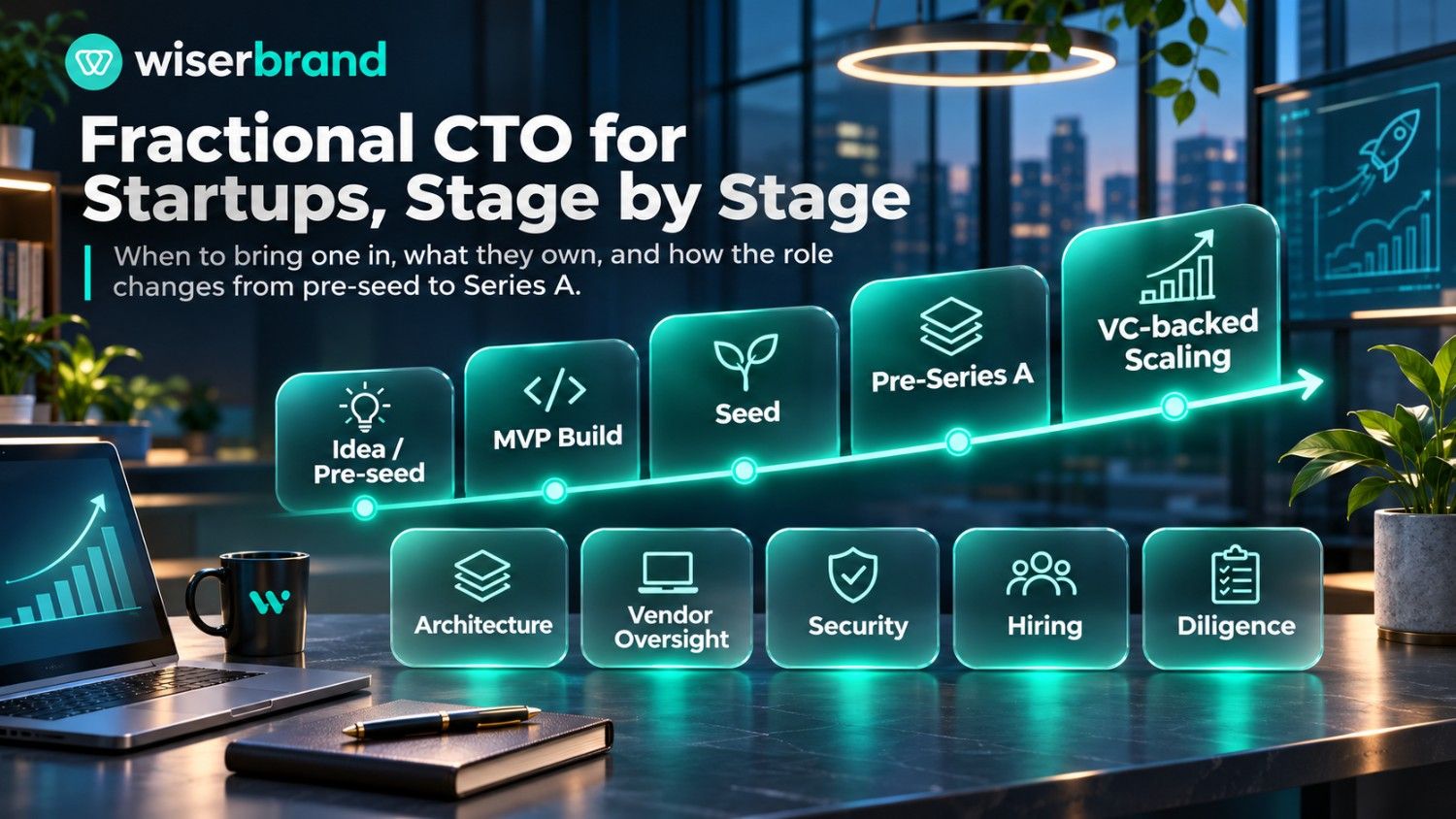
Fractional CTO for Startups, Stage by Stage

Summary
- A fractional CTO for startups owns technical decisions, not daily coding, and pays off most during an outsourced MVP build and before a priced round.
- CB Insights studied 431 VC-backed startups that shut down since 2023; where reasons were known, 43% cited poor product-market fit, and the median time from last raise to shutdown was 22 months, according to CB Insights.
- Average US pre-seed SAFEs and notes on Carta reached $276,000 in Q2 2026, a record for more than four years, according to Carta.
- Own your repository, cloud root account and IP from day one.
- Plan the full-time CTO handover before your Series A process begins.
A fractional CTO for startups is a part-time technology executive who owns the technical decisions a founder cannot judge alone, without the cost and commitment of a full-time hire. The work covers architecture, build-versus-buy calls, vendor oversight, a security baseline, the first engineering hires, and the technical story you take to investors. It does not cover daily coding.
This guide is for founders between pre-seed and Series A who build with an agency or freelancers. The value of the role tracks your stage: often unnecessary before demand is validated, strongest during an outsourced MVP build and before a priced round.
For the background, see what a fractional CTO is and does. What follows includes a stage-by-stage table, an MVP scorecard, a founder checklist, and a 90-day plan.
What a Fractional CTO for Startups Actually Owns
In a startup, a fractional CTO owns architecture, build-vs-buy calls, vendor oversight, a security baseline, the first engineering hires, and the technical story for investors.
What the role owns:
- Architecture and choices that are costly to change later
- Build versus buy versus no-code calls
- Oversight of agency and freelance delivery, including acceptance criteria
- A security baseline: access, secrets, backups, incident contacts
- The first engineering hires, from scorecards to the interview loop
- The technical narrative for fundraising and diligence
What it does not own: daily coding, project management, product decisions, and people management beyond the first hires.
Most of our fractional CTO engagements run 10 to 20 hours a week, are month-to-month, and start with a technology assessment and a 90-day plan.
When Does a Startup Need a Fractional CTO?
A startup needs a fractional CTO when it is about to spend real money on technology it cannot evaluate, but does not yet need a full-time technical executive.
Six situations point the same way:
- You are hiring an agency or freelancers for the MVP and cannot review their code.
- You are about to make your first senior engineering hire.
- You are adding AI features that process customer data.
- You work with regulated data.
- You are preparing for a priced round.
- Production incidents have no named owner.
When to hire a fractional CTO for a tech startup comes down to one test: is a technical decision imminent, and can anyone on the team judge it? If demand is not yet validated, wait.
Fractional CTO for Startups by Stage
The role changes at every stage: scoping and vendor choice before the build, architecture and code review during the MVP, hiring after launch, and diligence readiness and a handover plan before Series A. For early-stage startups, the right intensity rises and falls with what is at stake. The table maps what the fractional CTO owns and the signal that the stage is over.

Fractional CTO for Startups by Stage
Choose your startup stage
Idea / pre-seed
| Founder's question | Can this be built, at what scope, by whom? |
|---|---|
| What the fractional CTO owns | Feasibility, scope cut, build versus buy versus no-code, vendor shortlist |
| Deliverables | Feasibility memo; MVP scope; first ADRs; vendor scorecard; owned accounts |
| Involvement | Low, episodic |
| Exit signal | Demand not validated: pause; no-code enough: advisor hours |
MVP build
| Founder's question | Is the team building the right thing the right way? |
|---|---|
| What the fractional CTO owns | Architecture, vendor code review, release process, security baseline, acceptance criteria |
| Deliverables | Architecture diagram; ADR log; CI/CD; review notes; definition of done; MFA baseline |
| Involvement | Highest during the build |
| Exit signal | MVP stable; a trusted lead can own daily decisions |
Seed (post-launch)
| Founder's question | Who do we hire first, and how do we stop firefighting? |
|---|---|
| What the fractional CTO owns | Hiring plan and loop, roadmap, tech debt register, cloud cost and incident basics |
| Deliverables | Role scorecards; interview loop; two-quarter roadmap; tech debt register; runbook |
| Involvement | Medium, steady |
| Exit signal | First senior engineer hired and onboarded |
Pre-Series A
| Founder's question | Will our tech hold up in diligence and growth? |
|---|---|
| What the fractional CTO owns | Technical data room, scalability review, security gaps, IP chain, investor Q&A |
| Deliverables | Diligence pack; scaling plan; security summary; open-source license inventory; IP register |
| Involvement | Spike before the raise |
| Exit signal | Round closes with budget for a full-time leader |
VC-backed scaling
| Founder's question | Do we need a full-time CTO now? |
|---|---|
| What the fractional CTO owns | Leadership hiring, org design, handover |
| Deliverables | CTO or VP Engineering spec; interview panel; 30-60-90 plan; handover document |
| Involvement | Tapering |
| Exit signal | Full-time leader starts; fractional exits after handover |
Editorial framework, not an industry benchmark.
Pre-Seed: Scope Before Code
Before the first line of code, the job is feasibility, a hard scope cut, and putting every account in the company's name. This is the cheapest moment to stop a vendor from owning your domain, repository, or cloud root account.
Average US pre-seed SAFEs and notes on Carta reached $276,000 in Q2 2026, a record for more than four years, as similar money went into fewer deals.
MVP Build: Architecture and Review
During the build, the fractional CTO sets the architecture, records decisions as ADRs, and reviews the vendor's code against written acceptance criteria.
An architecture decision record, a format Michael Nygard proposed in 2011, captures the context, decision, status and consequences of each technical choice. Our guide on how to build an MVP covers the build approaches this role reviews.
Seed: First Hires and a Roadmap
A fractional CTO for a seed-stage startup turns the roadmap into the first hires, an interview loop, and a tech debt register.
In Carta's Q2 2026 benchmarks, the median seed round was $4.5 million at a $23.9 million post-money valuation.
Pre-Series A: Diligence Readiness
For pre-Series A startups, the work shifts to a clean data room: ownership, IP chain, security posture, and known scaling limits. Investors rarely audit code line by line, but they ask who owns the repository and where customer data lives.
The same benchmarks set a median Series A at $14.7 million on a $76.3 million post-money valuation.
VC-Backed Scaling: Planning the Handover
For VC-backed startups, the fractional CTO's last job is to define, recruit and onboard their full-time replacement.
Handing over means writing the job spec, sitting on the interview panel, and producing a 30-60-90 plan for the incoming leader. Our guide on hiring a full-time CTO covers the search; the fractional role owns the transition into it.
Is It Worth Hiring a Fractional CTO for an MVP?
It is worth it when the founder cannot judge the code being written, the build is outsourced, or the product handles sensitive data; it is rarely worth it for a no-code prototype or a technical founder's own build. The case for a fractional CTO for MVP development rests on one gap: the founder cannot evaluate the work delivered.
Is It Worth Hiring a Fractional CTO for an MVP?
The scorecard scores five factors from 0 to 2. Editorial heuristic, not a validated model.
Select one answer per factor
0 / 5 factors answered
0–3no retained CTO; a one-off review or advisor hours.
4–6scoped engagement: a pre-build audit plus milestone reviews.
7–10retained fractional CTO for the build.
Complete all five factors to see your recommendation.
0–3: no retained CTO; a one-off review or advisor hours.
4–6: scoped engagement: a pre-build audit plus milestone reviews.
7–10: retained fractional CTO for the build.
Override: a regulated-data score of 2 requires an independent architecture and security review before launch.
Regulated data selected. The override applies regardless of your total.
Thresholds:
- 0 to 3: no retained CTO; a one-off review or advisor hours.
- 4 to 6: scoped engagement: a pre-build audit plus milestone reviews.
- 7 to 10: retained fractional CTO for the build.
- Override: a regulated-data score of 2 requires an independent architecture and security review before launch.
An illustrative calculation: a non-technical founder (2), an outside agency (2), personal data (1), AI features (1), and most of the round in the build (2) scores 8, which points to a retained fractional CTO.
AI-generated code sharpens the case. In Veracode's 2025 tests of 80 coding tasks across more than 100 models, AI-generated code introduced security vulnerabilities in 45 percent of cases. A vibe-coded MVP can ship fast while carrying defects nobody can catch. AI companies took a record 82.7% of US venture deal value through Q3 2026, according to the PitchBook-NVCA Venture Monitor. See our guide on building an MVP with AI.
What Non-Technical Founders Should Ask a Fractional CTO
A fractional CTO for non-technical founders should leave you owning every technical asset and able to explain every major decision.
Ask these six questions before you sign:
- Which technical decisions will you make, and which will you leave to me?
- Do you or your firm earn anything from the vendors you recommend?
- What will exist in writing after 30 days?
- How do you review code you did not write?
- What would make you tell me to hire a full-time CTO, or to stop the engagement?
- Who covers an outage when you are with another client?
| Artifact | Why it matters | Proof you own it |
|---|---|---|
| ADR log | Explains why the system looks the way it does | File in the company repository |
| Source code in a company GitHub or GitLab organization | Vendors and contractors come and go | Founder or company admin is the organization owner |
| Cloud accounts | Root access controls everything, including billing | Business-managed group email for root, MFA on, no root access keys |
| Domain and DNS registrar | Losing the domain takes the product offline | Registrar account in the company's name |
| Signed IP assignment and confidentiality from every contributor | Contractor code is generally not a work made for hire | Signed agreements in the data room; confirm with counsel |
| Credentials in a company password manager | Personal vaults leave with people | Company-admin vault |
| Architecture diagram | Onboarding and diligence both ask for it | Updated at each release |
| Open-source license inventory | License terms travel with the code | Generated list in the repository |
| Runbook: deploy, rollback, incident contacts | Outages happen when the CTO is with another client | Shared document, tested once |
| Written scope with disclosed vendor relationships | Removes hidden incentives | Signed engagement letter |
Three have official backing. Under US copyright law, code from an outside contractor is generally not a work made for hire, so startups rely on a signed IP assignment; confirm the wording with counsel. AWS recommends a business-managed group email for root, MFA on root sign-in, and no root access keys. Transferring a GitHub repository requires admin access and moves its issues, pull requests and wiki, so the organization should hold the code.
Getting Ready for Investor Technical Due Diligence
Before a priced round, a fractional CTO should assemble a short technical data room that answers ownership, IP, security, scalability and team questions without the founder improvising. Y Combinator notes that a ready data room will cut as much as a week off of your closing process, while closing an A round can take more than a month.
Getting Ready for Investor Technical Due Diligence
The legal rows below follow Y Combinator's published Series A diligence checklist; the technical rows are our editorial checklist, not an investor standard.
Mark evidence you have ready
| Item | Evidence to have ready | Basis |
|---|---|---|
| Trademarks, copyrights, domain names; assignment documents | Y Combinator, IP | |
| Employee confidentiality agreements; licenses the product depends on | Y Combinator, Material Agreements | |
| Every contractor agreement, including the CTO and dev agency, with IP clauses | Y Combinator; US copyright | |
| If the CTO holds an officer title, list them as not devoting 100 percent of business time | Y Combinator | |
| Current published versions | Y Combinator | |
| Repository, cloud and domain held by the company | AWS and GitHub docs (editorial) | |
| Diagram and decision records | Editorial | |
| MFA, access reviews, offboarding log, backups, incident log | Editorial | |
| Known limits and what breaks first | Editorial | |
| Prioritized list with owners | Editorial | |
| Org chart, hiring plan, who can deploy | Editorial | |
| Where personal data lives, who has access | Editorial |
All 12 items marked ready.
Seed investor Leo Polovets argued in 2016 that for most early startups, investors learn more by testing if the CTO can hire and build than by auditing code. Ownership and IP records still matter, but at seed the priority is a team that can execute. A tech debt register matters because it shows known shortcuts are tracked. In a 2020 McKinsey survey of 50 CIOs at companies with more than $1 billion in revenue, 10 to 20 percent of the new-product technology budget went to resolving tech debt.
Failure Modes and Conflicts of Interest
Most fractional CTO engagements fail for structural reasons: the CTO becomes a part-time coder, owns nothing in writing, or reviews work sold by their own firm.
| Signal | Fix |
|---|---|
| Part-time coder: ships features instead of decisions | Hire a developer separately; put decision rights and deliverables in the contract |
| Conflicted vendor: the firm also sells the build team, or takes referral fees | Written disclosure; right to an independent review; acceptance criteria owned by the company; a second reviewer for the firm's own work |
| Title without ownership: accounts and code sit in the CTO's or agency's name | Use the artifact checklist above until the company holds every account |
| No handover: knowledge lives in one head | ADR log, runbook, and a 30-60-90 plan for the successor |
| Availability mismatch during incidents | Backup contact and escalation rules in the contract |
| Over-engineering before product-market fit | Architecture sized to the current stage; CB Insights found poor product-market fit in 43% of shutdowns where reasons were known |
When Not to Hire a Fractional CTO
Skip it when demand is not validated, you already have a technical co-founder, or you mainly need more hands writing code.
- Demand is unvalidated. CB Insights studied 431 VC-backed startups that shut down since 2023; where reasons were known, 43% cited poor product-market fit, and the median time from last raise to shutdown was 22 months. A fractional CTO cannot fix missing demand.
- A technical co-founder already owns the decisions.
- The main gap is delivery capacity, not judgment.
- The product is a no-code prototype with no sensitive data.
- The engagement would be a status symbol rather than a working role.
Fractional CTO vs Technical Co-Founder vs Agency Tech Lead
A technical co-founder shares ownership and risk, an agency tech lead answers to the agency's delivery, and a fractional CTO answers to the founder for decisions.
| Role | Commitment | Ownership and risk | Accountability | Independence from the vendor | ||
|---|---|---|---|---|---|---|
| Technical co-founder | Full-time, permanent | Equity; shares the downside | The founders and the board | Usually independent | Earliest, when a technical partner is needed | Rarely exits; a departure is a major event |
| Agency tech lead | Part of a vendor contract | No equity; the agency carries delivery risk | The agency's delivery commitments | Not independent; reviews its own work | Build-heavy phases where capacity is the gap | The project or retainer ends |
| Fractional CTO | Part-time, month-to-month | No equity by default; paid for judgment | The founder | Independent, unless the same firm builds | Pre-seed scope through pre-Series A | Planned handover to a full-time leader |
If you are weighing a technical partner, our guide on finding a technical co-founder covers that path.
A 90-Day Plan for Your First Fractional CTO Engagement
Run the first 90 days as three gated phases: audit, decide, and hand over.
| Phase | Actions | Owner | Decision gate |
|---|---|---|---|
| Days 1 to 30: Audit | Move access to company accounts; code and architecture review; risk register; first ADRs | CTO; founder for access; vendor for cooperation | Continue, rescope, or stop |
| Days 31 to 60: Decide | Roadmap; build versus buy decisions; vendor acceptance criteria; hiring plan | CTO with the founder | Founder signs off roadmap and budget |
| Days 61 to 90: Hand over | Hiring loop live; runbook; diligence pack draft; criteria for a full-time CTO | CTO; founder; counsel for IP | Extend, reduce hours, or start the full-time search |
FAQ
What is a fractional CTO for startups?
A fractional CTO for startups is a part-time technology executive who makes and documents the technical decisions a young company cannot yet staff full-time. The work covers architecture, build-versus-buy calls, vendor oversight, a security baseline, early engineering hires, and investor-facing technical questions.
Is it worth hiring a fractional CTO for an MVP?
Yes, when the build is outsourced or AI-generated and nobody on the founding team can review it, and when the product handles personal or regulated data. It is rarely worth it for a no-code prototype or a build led by a technical founder.
Can a fractional CTO replace a technical co-founder?
Not fully. A fractional CTO can own decisions, review code, and run hiring, but they do not share ownership, risk, or full-time commitment. A technical co-founder is a partner who lives with the outcome; a fractional CTO is an advisor with decision rights.
When should a startup replace its fractional CTO with a full-time CTO?
When technical decisions are needed daily, the engineering team needs a full-time leader, or your board or lead investor asks for a full-time technical executive. Other signals include a growing team that needs management and a roadmap that depends on steady hiring.
Can a fractional CTO help a pre-Series A startup prepare for investor due diligence?
Yes. The most useful work is a data room covering ownership, IP assignments, security basics, and known scaling limits, plus written answers to the technical questions investors ask. Y Combinator notes that a ready data room will cut as much as a week off of your closing process.
What should a founder own before a fractional CTO engagement ends?
Every account, repository, domain, and credential, plus signed IP assignments and a written record of major decisions. Confirm that contractors have assigned their code in writing, since contractor work is generally not a work made for hire. Keep the data room current after the engagement ends.
Can the agency building our MVP also act as our fractional CTO?
It can, if the arrangement is disclosed in writing and you keep the right to an independent review of the agency's work. The risk is that the same firm sets the acceptance criteria and grades its own delivery. A second reviewer reduces that risk.
Final Thoughts
Bring in a fractional CTO before you sign a development contract you cannot evaluate, and start the full-time search before your Series A process begins.
The next step is small. Find your stage in the table, list the artifacts you cannot yet prove you own, and open a startup fractional CTO engagement with a defined scope. We provide fractional CTO leadership and MVP development, so you can review our fractional CTO services and MVP development services. We sell both fractional CTO leadership and software development, and our CTOs can bring in WiserBrand engineers, so if you use both, ask for the review rights described above in writing.