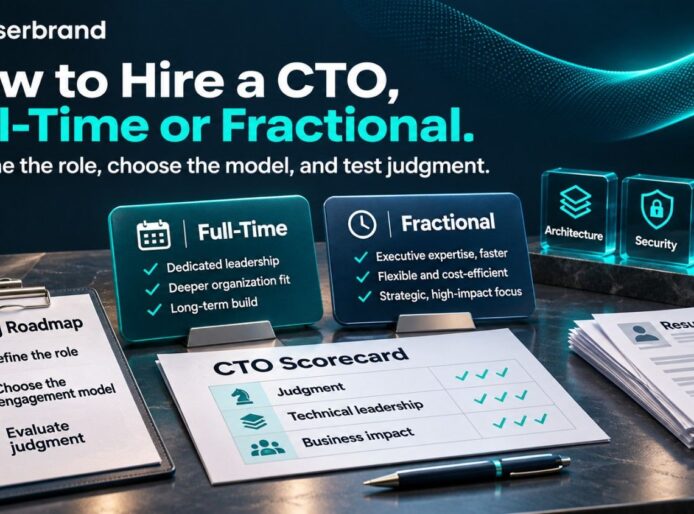
What Is a Fractional CTO and When Do You Need One


- A fractional CTO is a part-time senior technology executive who owns an agreed set of technology decisions, usually while serving other clients.
- Fractional leadership is growing from a small base: Lightcast counted at least 34,000 US workers with "fractional" in a current job title in 2025, up 265% from 2019.
- The full-time benchmark is high: the BLS median for computer and information systems managers, the occupation that includes CTOs, was $175,140 in May 2025, and wages are only 67.5% of employer compensation costs for management occupations.
- The model fits when the work is mostly decisions and fails when the team needs a technology leader present every day.
A fractional CTO is a senior technology executive who works with a company part-time, usually alongside other clients, and owns an agreed set of technology decisions without joining as a full-time employee. The format suits a company with real decisions to make and no one senior enough to make them: a startup past its first release, a small or midsize business that depends on an agency, or a team whose strongest engineer is not ready to run technology.
A founder cannot judge if an agency estimate is fair. A delivery date slips and no one can name the cause. A renewal or a security review arrives, and the technical documentation does not exist. In each case the gap is judgment and ownership, not headcount. This article explains how to tell if your company needs one.
What Is a Fractional CTO?
A fractional CTO holds the CTO role for a defined share of the week and a defined scope, with the authority to make technology decisions inside that scope.
The fractional CTO meaning is about the engagement, not the seniority: the word fractional describes part of a week, not a junior level. The difference from a technical advisor is accountability, because an advisor can recommend while the CTO decides, owns the outcome, and answers for it.
A peer-reviewed study based on interviews with 40 Fractional CIOs in 10 countries describes the closely related role as a part-time executive who serves several clients at once and often holds the authority and responsibility of a full-time CIO.
No government agency tracks fractional CTOs as a separate occupation, so the numbers below come from labor-market data firms that count the word "fractional" in job titles and postings across all functions, from a peer-reviewed interview study of the closely related Fractional CIO role, and from a survey commissioned by a fractional-hiring platform.
Lightcast counted at least 34,000 US workers whose job title mentioned "fractional" in 2025, up 265% from 2019, with finance roles making up 46% of US fractional job postings. Revelio Labs found that 24 of every 1,000 new executive positions advertised in 2026 were fractional, up from nine five years earlier. In a 2026 report commissioned by the hiring platform Fractional Jobs, 64% of surveyed fractional workers said they serve two or more clients.
What it is and is not:
- A part-time executive with decision rights in a mandate.
- Not a consultant who delivers a report and leaves.
- Not a fit when the team needs a leader in the room every day.
What Does a Fractional CTO Do?
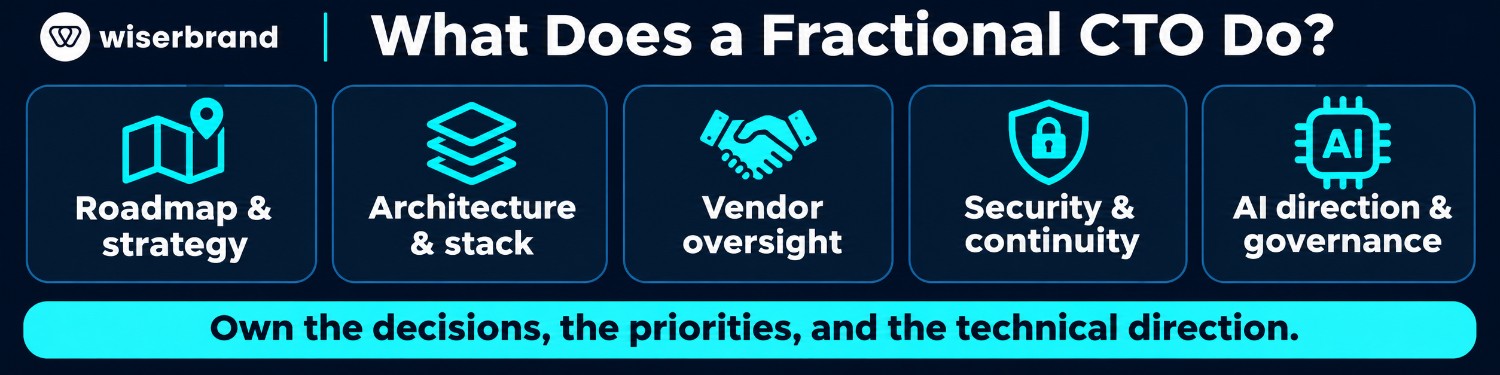
A fractional CTO owns technology direction and the decisions that follow from it: what to build or buy, how the team delivers, which vendors to trust, and which risks to fix first.
| Responsibility | Typical decisions | Deliverable you should see | How to check it |
|---|---|---|---|
| Technology strategy and roadmap | What to build next, what to stop | Quarterly roadmap tied to business goals | Reviewed with the CEO monthly |
| Architecture and stack | Build, buy, configure, integrate | Decision log with options and trade-offs | Every major decision has a written record and an owner |
| Delivery process | Release process, code review, environments | Delivery baseline and improvement plan | DORA metrics: change lead time, deployment frequency, change fail rate, failed deployment recovery time, deployment rework rate |
| Team structure and hiring plan | Roles, seniority, in-house versus outsourced | Org plan and role scorecards | Hiring plan approved by leadership |
| Vendor and agency oversight | Scope, estimates, contract terms, acceptance | Independent review of vendor work and estimates | Change requests and invoices reconciled with delivered scope |
| Security, access, and continuity | Access, multi-factor authentication, offboarding, backups, incident response | Security baseline and remediation list | Critical findings closed; access inventory owned by the company |
| Technical debt and cost | What to fix, refactor, or retire; cloud and SaaS spend | Prioritized debt register and spend review | Share of team time on unplanned work; spend against usage |
| AI direction and governance | Where AI fits, acceptable use, pilot go or no-go | AI use-case shortlist with cost and risk; a usage policy | Pilots have success criteria and a decision date |
| Investor, board, and customer due diligence | Answers on architecture, security, scalability | Technical documentation pack | Due diligence answers ready on request |
Those responsibilities group into four engagement types: strategic IT management, restructuring, rapid scaling, and hands-on support. Name one as the primary mode in the mandate, because the hours and deliverables differ.
Some work sits outside the role: writing production code daily, managing incidents, and running a full hiring cycle are not the core of it, and the hiring process has its own steps, covered in how to hire a CTO step by step.
Fractional CTO vs Full-Time CTO
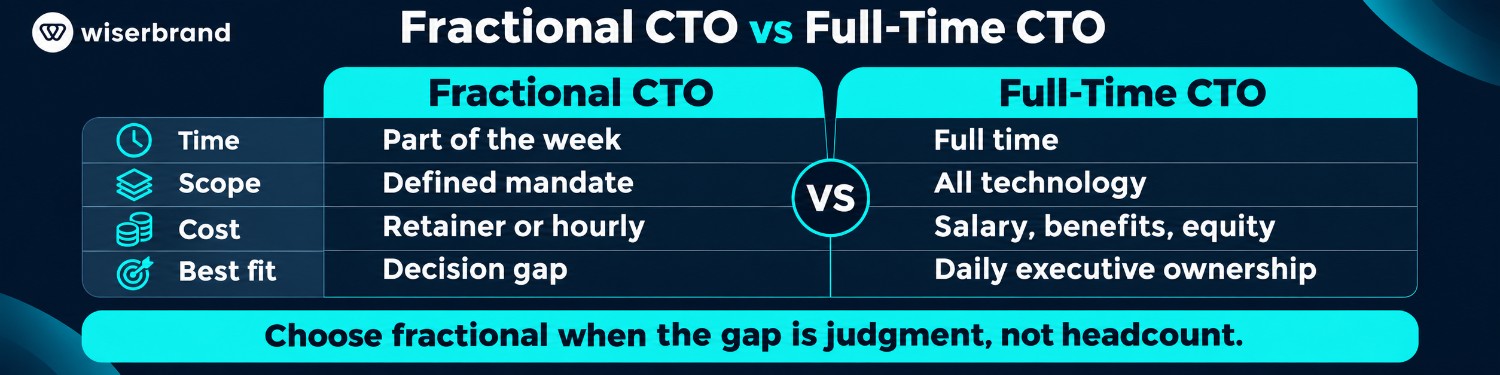
The difference is presence and depth of ownership: a full-time CTO owns all of technology every day as an employee, while a fractional CTO owns a defined scope for part of the week.
| Criterion | Fractional CTO | Full-Time CTO |
|---|---|---|
| Time commitment | Part of the week, agreed hours | Full time; the BLS reports most work full time, and some more than 40 hours a week |
| Ownership | Defined scope in a written mandate | All of technology |
| Decision rights | As written in the mandate | Full executive authority |
| Daily team management | Limited, delegated to a tech lead | Direct |
| Time to start | Depends on access and mandate | Depends on an executive search |
| Cost structure | Hourly, retainer, or project fee; no employee benefits | Salary, benefits, and equity |
| Continuity and knowledge | Risk of dependence; needs a handover plan | Stays in-house |
| Best fit | Decisions outweigh daily management | Technology is core and needs a daily owner |
The median annual wage for computer and information systems managers, the BLS occupation that includes CTOs, was $175,140 in May 2025, with the top 10% earning more than $297,510. For private-industry management, business, and financial occupations, wages made up 67.5% of employer compensation costs in June 2026, and benefits made up the other 32.5%.
Those two figures give a rough formula for total employer cost: base salary divided by the wage share of total compensation. At the BLS median, $175,140 divided by 0.675 is about $259,000 a year, before equity, recruiting, and onboarding. That is arithmetic on general BLS data, not the price of a specific hire.
The fractional structure is hourly, a monthly retainer, or a fixed project fee. Hours, scope, and experience drive the total, and the model can cost less than a full-time hire when the work is mostly decisions; rates belong in a separate cost guide.
When a Full-Time CTO Is the Better Choice
Hire full-time when technology is the product and needs an owner every day.
- Technology is the product, and product and engineering decisions land daily.
- The team needs a leader in the room, not a schedule of syncs.
- The volume of decisions regularly exceeds the agreed hours.
- You want a long-term member of the leadership team with equity.
Fractional CTO Benefits and What They Depend On
The main benefit is senior technical judgment at the moment you need it, paid in proportion to the work.
| Benefit | What it depends on |
|---|---|
| Senior technical judgment before a full-time role is justified | The decisions are strategic rather than daily execution |
| Cost that scales with the work | A clear mandate and a fixed budget of hours |
| Experience from several companies | A relevant stage and domain |
| A fast start | Access and mandate ready on day one |
| A stronger internal team over time | Handover built into the scope |
| Independent checks on vendors and agencies | Commercial ties disclosed in writing |
Read the right column as the condition: a benefit holds only when its condition holds.
Limitations and Risks of the Fractional Model
The model trades daily presence for flexibility, and most failures come from that trade.
| Risk | Early warning sign | Safeguard |
|---|---|---|
| Limited availability | Decisions wait for the next sync; incidents without a response | Agreed hours, response expectations, a named internal incident owner |
| Missing business context | Recommendations ignore revenue or customer constraints | Monthly business review with the CEO; access to business metrics |
| Multi-client conflicts | Clients in the same segment; priority clashes | Conflict disclosure in the contract |
| Dependence on one person | Only the CTO knows the architecture or holds the credentials | Company-owned accounts, documentation, a decision log |
| Blurred accountability | The team is unsure who decides | Written decision rights: decides, recommends, informed |
| Vendor conflict of interest | The CTO recommends their own firm's services without comparison | Written disclosure of commercial ties; independent review of large contracts |
| Worker classification | The contractor is managed like an employee | Review with counsel using the IRS factors |
One risk sits outside the technical work: worker classification. The IRS looks at the entire relationship, grouped into behavioral control, financial control, and the type of relationship, to decide if a worker is a contractor or an employee, so review a long engagement with counsel.
Signs You Need a Fractional CTO
Do you need a fractional CTO? Probably yes if several of the signs below are clearly true at the same time and none of the counter-signs in the next section dominate.
Score each sign from 0 to 2, where 2 is clearly true.
- No one on the leadership team can explain and defend the main technical decisions to investors, the board, or enterprise customers.
- Delivery dates slip repeatedly and nobody can name the root cause.
- You depend on an agency or freelancers and cannot judge their estimates or code quality independently.
- A hard-to-reverse decision is due within two quarters: a platform rebuild, a cloud migration, a core vendor contract, or an AI build versus buy choice.
- Technical debt or incidents take a growing share of team time. In Stack Overflow's 2024 Developer Survey, 62.4% of the 28,251 professional developers who answered named technical debt as their top frustration, and managing technical debt is its own discipline.
- Fundraising, M&A, or customer security reviews are coming and the technical documentation is not ready.
- Security basics have no owner: access reviews, offboarding, backups, incident response.
- Your strongest engineer acts as a de facto CTO while carrying a full delivery load.
- Cloud, SaaS, and tooling spend grows faster than usage, and nobody owns it.
- Your CTO has left or is leaving, and a permanent hire is months away.
| Score | What it suggests |
|---|---|
| 0 to 5 | Not yet; a targeted technical review or an advisor is usually enough |
| 6 to 11 | A fractional CTO fits; part-time ownership with a 90-day mandate |
| 12 to 20 | The scope may exceed part-time; consider an interim or full-time CTO, and if sign 10 scores 2, interim is often the first step |
This is an editorial heuristic, not a validated model, and any counter-sign in the next section outweighs the score.
When You Do Not Need a Fractional CTO
Skip the role when the problem is capacity, not decisions.
- You need more hands, not more decisions: hire developers or add agency capacity.
- The problem is operational or interpersonal: an engineering manager fits better than a CTO.
- No one inside will make decisions alongside the CTO: the role stalls without an internal owner.
- Technology is the core of the product: a technical co-founder or a full-time CTO is the right shape.
- The mandate is vague, such as "fix everything": narrow it.
- You need daily IT support: a managed service provider covers that, not a CTO.
How a Fractional CTO Differs From an Interim CTO, Advisor, or Agency Lead
A fractional CTO is part-time and accountable; an interim CTO is full-time and temporary; an advisor recommends without owning decisions; an agency tech lead serves the agency's delivery.
| Criterion | Fractional CTO | Interim CTO | Technical advisor | Technical co-founder | Agency tech lead |
|---|---|---|---|---|---|
| Time commitment | Part-time, ongoing | Full-time, fixed term | A few hours, occasional | Full-time, permanent | Per project |
| Accountable for outcomes | Yes, within the mandate | Yes, for the term | No, advisory only | Yes, as an owner | For the agency's delivery |
| Manages your team | Within the mandate | Yes | No | Yes | The agency team |
| Typical compensation form | Retainer or hourly | Full-time-equivalent fee for the term | Small retainer or equity | Significant equity | Included in project fees |
| Best use | Decisions outweigh daily management | The seat is empty during a transition | An occasional second opinion | Technology is the product | You need building while someone else sets direction |
A technical co-founder trades significant equity for permanent ownership and is the right answer only when technology is the product, and finding a technical co-founder is a different search. If the gap is digital and customer facing rather than architecture and delivery, a fractional chief digital officer is the closer fit.
A 90-Day Plan for Starting a Fractional CTO Engagement
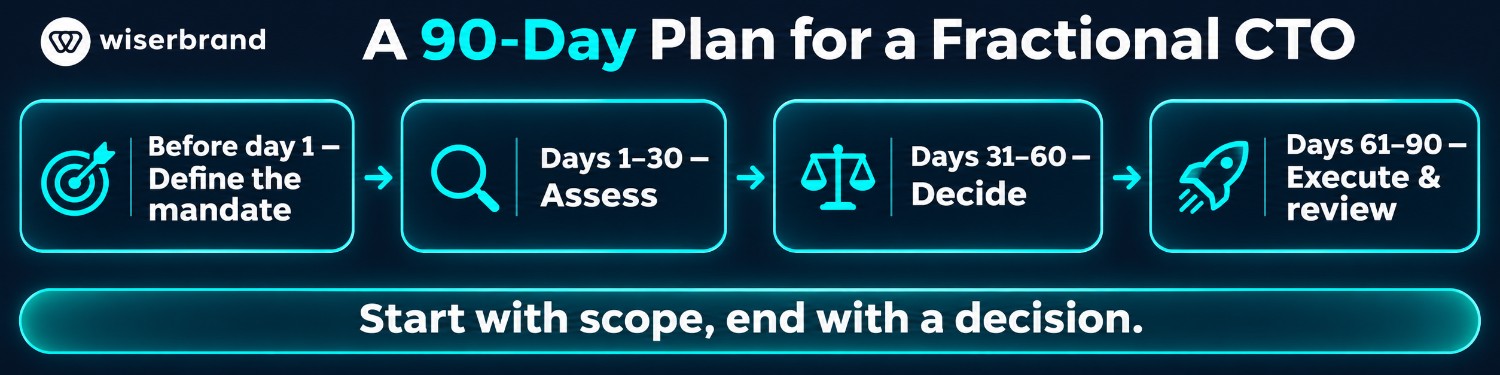
Start with a written mandate, then use the first 90 days to assess, decide, and execute, with a review gate at each step.
| Stage | Owner | Actions | Output | Decision gate |
|---|---|---|---|---|
| Before day 1 | CEO or founder, with counsel | Write the mandate: top three problems, decision rights, hours, reporting line; company-owned access to repositories and contracts; IP assignment and confidentiality | Signed mandate and access list | Gate 0: mandate signed |
| Days 1 to 30: Assess | Fractional CTO with the tech lead and vendors | Architecture and code sample review, delivery baseline, security basics, spend and contract review | Assessment report, risk register, baseline metrics | Gate 1: top three priorities agreed |
| Days 31 to 60: Decide | The CTO and the CEO | Quarterly roadmap, build or buy and vendor decisions, team and hiring plan | Roadmap, decision log, hiring plan | Gate 2: roadmap and budget approved |
| Days 61 to 90: Execute and review | The CTO and the team | Process changes, first fixes, documentation, reporting cadence | 90-day review against KPIs | Gate 3: continue, expand hours, transition to full-time, or end with a handover pack |
The engagement ends, or changes shape, with a handover pack: architecture diagrams, a decision log, an access inventory, the vendor list with contract dates, runbooks, and open risks.
Measure the first 90 days against a small set: the five DORA metrics compared with the day-30 baseline, roadmap items delivered against planned, incidents and recovery time, open critical security findings, and cloud and SaaS spend against usage.
Two features make this plan work. Gate 0 forces the company to name the top three problems and the decision rights before work starts, and Gate 3 forces a real decision. For stage-by-stage guidance from a first release to the transition to a full-time CTO, the startup playbook is a separate article.
FAQ
What Is a Fractional CTO?
A fractional CTO is a senior technology executive who works part-time, usually with several clients, and owns an agreed set of technology decisions. The word fractional describes how much of the week is committed, not the level of the person. The role carries decision rights and accountability.
Is Fractional CTO a Real Role or a Trend?
It is a real role, and it is growing from a small base. Lightcast counted at least 34,000 US workers with "fractional" in their current job title in 2025, up 265% from 2019, and Revelio Labs found that 24 of every 1,000 new executive positions advertised in 2026 were fractional. The figures cover all functions.
How Many Hours a Week Does a Fractional CTO Work?
It depends on the mandate. In a 2026 report commissioned by the hiring platform Fractional Jobs, a typical fractional role was about 10 hours a week, and the peer-reviewed Fractional CIO research found that about one day a week is often enough for hands-on support. Review the hours at the 90-day gate.
Who Does a Fractional CTO Report To, and Can They Manage My Team?
The role typically reports to the CEO or founder, which keeps decision rights clear. Inside the mandate it can set priorities, standards, review work, and meet with team leads, but daily management usually stays with a tech lead or engineering manager. Write the reporting line into the mandate.
Is a Fractional CTO the Same as a Technical Advisor?
No. A technical advisor recommends and explains, while the role decides and answers for the outcome. The distinction shows up in the contract: a fractional engagement should list the decisions it owns, the deliverables you expect, and where the company still approves.
How Much Does a Fractional CTO Cost?
The structure is usually hourly, a monthly retainer for agreed hours, or a fixed project fee. The total depends on hours, scope, and experience, and it can cost less than a full-time hire when the work is mostly decisions. Compare proposals by hours and deliverables, not by rate alone.
When Should a Company Replace a Fractional CTO With a Full-Time CTO?
Move to a full-time CTO when the volume of decisions regularly exceeds the agreed hours, when the team needs a leader present every day, or when technology becomes the core of the product. The current fractional CTO can define the role and hand over the work when the permanent hire starts.
Final Thoughts
If several of the signs are clearly true and the work is mostly decisions rather than daily management, start with a fractional CTO and a 90-day mandate. If the role keeps outgrowing its hours, plan the move to a full-time CTO. The next step is a short technology assessment and a written mandate.
Our fractional CTO services cover part-time leadership for 10 to 20 hours a week, and every fractional and interim engagement starts with a technology assessment and a 90-day plan. When the gap is temporary, we also run interim CTO engagements, and a 4 to 12 week Technology Review & Rescue for stalled projects or rising technology costs. For a US sustainable electronics startup, our work combined infrastructure right-sizing, a development roadmap, better documentation, and additional development resources; the case study reports 25% cost savings through optimized tech infrastructure and 30% faster website development operations. WiserBrand also sells software development, and our fractional CTOs can bring in WiserBrand engineers. With any agency-affiliated fractional engagement, ours included, ask for commercial ties to be disclosed in writing and get a second view on large build contracts.