How to Hire a CTO, Full-Time or Fractional

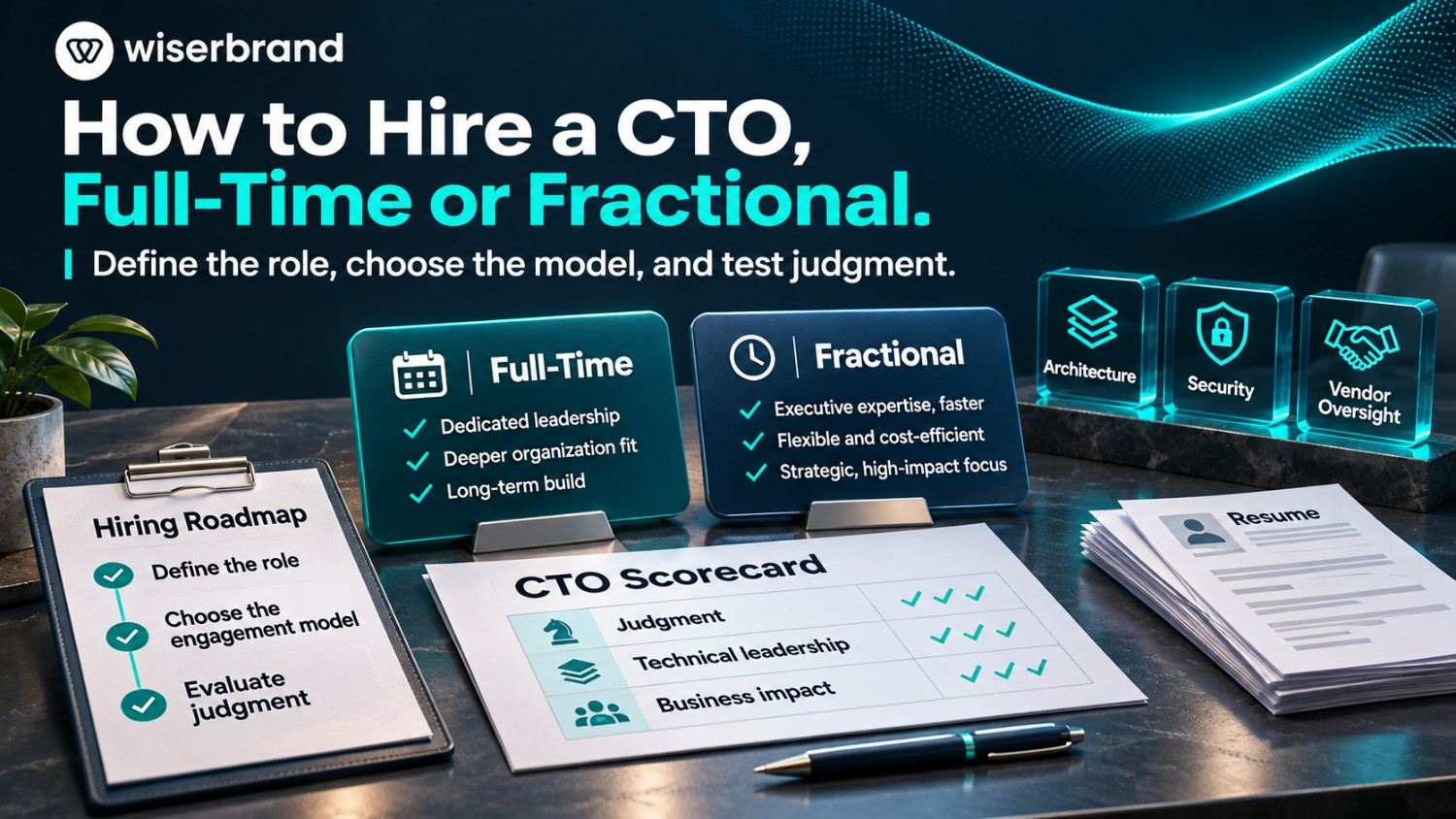
Key Takeaways
- Write three to five outcomes and choose full-time or fractional before you source anyone; the model sets the channel, contract, and timeline.
- The Korn Ferry fiscal 2026 annual report says its executive search fees are generally one-third of the placed candidate's estimated first-year cash compensation.
- A 2022 meta-analysis in the Journal of Applied Psychology ranked structured interviews first among selection procedures for predicting job performance.
- Revelio Labs counted 24 fractional roles per 1,000 new executive postings in 2026, up from 9 five years earlier.
- Sign IP assignment and confidentiality terms before a CTO gets access to your code.
Knowing how to hire a CTO starts before the job post: you decide what the role must deliver, which engagement model fits, and how you will test judgment, then you source, evaluate, sign, and onboard. Those decisions are hard to reverse once a senior technical leader has changed the architecture, the team, and the vendor contracts.
Full-time and fractional CTOs are hired through different channels and under different contracts. A fractional engagement is a scoped retainer; a full-time search often runs through a retained firm and ends in equity and a 90-day plan. The model is chosen before sourcing, not after.
Most CTO hiring problems start earlier, with a role nobody defined, and the order of the steps matters more than the speed of any one of them. This guide gives you the decision matrix, search economics, an evaluation loop, and an eight-step plan with owners and gates at every step.
Define the Role and Scorecard Before You Search
Start by writing the three to five outcomes the CTO must deliver in the next 12 to 18 months; those outcomes tell you if you need a CTO at all.
The title is not the role. A CTO owns technical direction and technical risk: architecture bets, build versus buy, security, and the board story. A VP of Engineering owns execution and people. A tech lead owns one codebase. A fractional CTO covers that ground part time; an interim CTO holds it full time for a period. The way early tech teams are structured decides which you need.
| Situation | Role You Likely Need | Why |
|---|---|---|
| Pre-product, non-technical founders, MVP still to build | Technical co-founder, or a fractional CTO plus an MVP development partner | Ownership risk vs scoped advice |
| A few engineers, periodic architecture, vendor, or security decisions | Fractional CTO | Decisions are periodic |
| Team growing, delivery slipping, technical direction is clear | VP or Head of Engineering | The problem is execution management |
| Technology is the product, several teams, investors expect a technical executive | Full-time CTO | Daily strategic ownership |
| Sudden leadership gap (departure, acquisition, crisis) | Interim CTO | Continuity while you search |
| One technical question (stack choice, audit, due diligence) | Project-based technical review | Time-bound scope |
The U.S. Bureau of Labor Statistics lists chief technology officer among the titles in an occupation it calls computer and information systems managers, which usually requires years of IT experience.
Scorecard fields:
- Mission in one sentence.
- Three to five measured outcomes for 12 to 18 months.
- Competencies and the evidence to look for.
- Must-haves, five or fewer, separated from nice-to-haves.
- Decision rights: budget, hiring, vendors, architecture.
- Reporting line, usually the CEO.
- Engagement model: full-time, fractional, or interim.
Decide Full-Time or Fractional Before You Hire a CTO
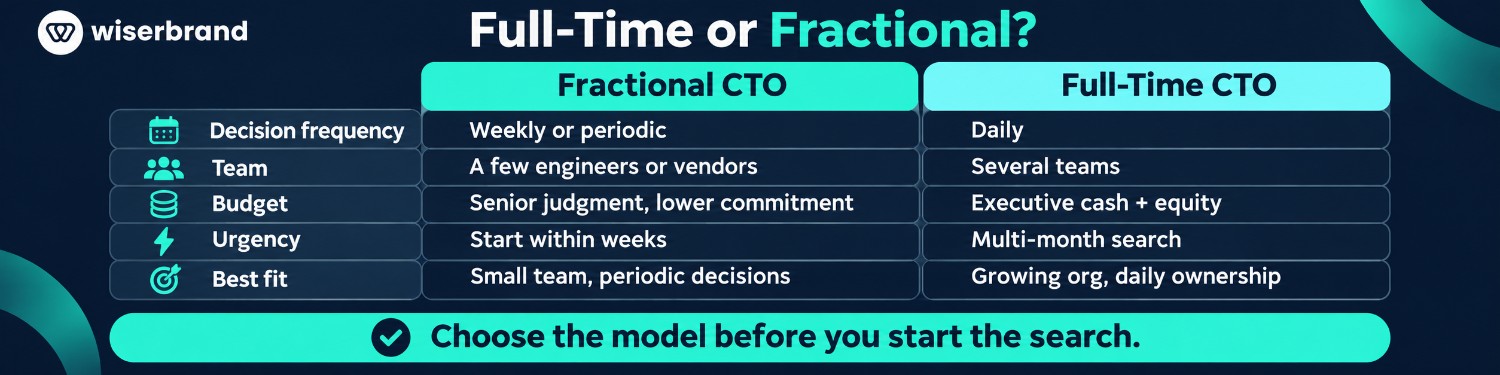
Hire a full-time CTO when technology decisions are needed daily and someone must own a growing team; start fractional when decisions are periodic and the team is small. The model is the second decision in how to hire a CTO, because it sets the channel and contract.
A fractional CTO is a part-time technical executive who works defined hours a month. See what a fractional CTO does for duties and scope.
| Criterion | Lean Fractional When... | Lean Full-Time When... |
|---|---|---|
| Frequency of technology decisions | Weekly or periodic | Daily |
| Team to manage | A few engineers or an external vendor | Several teams with their own managers |
| Accountability for delivery and incidents | Advisory and oversight | Direct, on-call ownership |
| Budget | Senior judgment needed, executive package not affordable yet | Budget for executive cash and equity |
| Investor and board expectations | No formal requirement | Board or round requires a named technical executive |
| Urgency | Help needed within weeks | You can run a multi-month search |
| Continuity and IP | Scoped deliverables with an assignment clause | Long-term architecture ownership |
Editorial rule of thumb: If four or more rows point to full-time, start a full-time search; if most point to fractional, start fractional and revisit the matrix at each funding or team milestone.
Revelio Labs data show that 24 of every 1,000 new executive job postings in 2026 were fractional, up from 9 five years earlier.
Do not hire full-time too early. A CTO with no team and no budget can drift into senior engineering work within a quarter. If decisions are weekly, a fractional engagement can absorb them until you justify a permanent hire.
Where to Find CTO Candidates
To find a CTO, match the channel to the model: full-time CTOs come through networks or retained search; someone looking for a CTO for hire, fractional or interim, comes through referrals, fractional firms, and marketplaces.
| Channel | Best For | Cost Model | Main Risk |
|---|---|---|---|
| Founder and investor network, referrals | Full-time and fractional | No fee | Narrow pool, familiarity bias |
| Retained executive search firm | Full-time CTO | Retainer, commonly about one-third of first-year compensation | Cost; depth of the firm's technical assessment |
| Contingency recruiter | Senior roles below C-level | Fee on placement | Less exclusivity and depth |
| Fractional leadership firms | Fractional or interim CTO | Monthly retainer or fixed scope | Shared availability across clients |
| Vetted talent marketplaces | Fractional or contract CTO | Platform markup | Variable vetting depth |
| Communities, job boards, LinkedIn | Wide reach | Low direct cost | High screening load |
| Internal promotion | VP Engineering or architect stepping up | Low | May lack strategy and board experience |
How to Find a Fractional CTO
Find a fractional CTO for a startup through referrals, fractional leadership firms, and marketplaces, then check availability, other clients, and conflicts of interest.
Before signing, confirm:
- Hours per month and expected response time.
- How many other clients they serve.
- Conflicts: competitors as clients, vendor commissions.
- Ownership of artifacts, assigned in writing.
- If the engagement can convert to full-time.
The IRS says classification depends on the whole relationship and how much the company can direct and control the work, not the contract title.
How to Hire a CTO Through an Executive Search Firm
A retained search firm earns its fee when the role is full-time, the best candidates are not looking, and a mis-hire would be expensive; it is rarely right for a fractional CTO. Retained search means the firm is paid regardless of whom you hire.
Korn Ferry's fiscal 2026 annual report says its executive search fees are generally one-third of the placed candidate's estimated first-year cash compensation, plus a percentage for indirect expenses and an uptick fee when actual compensation exceeds the estimate. Heidrick & Struggles' 2024 annual report describes retained firms as typically paid a retainer of about one-third of estimated first-year compensation, billed in one-third increments over three months, with a replacement guarantee if the placed candidate leaves for performance reasons.
Those figures reflect specific firms, not a price list. As an illustration, one-third of the BLS median occupation pay ($175,140 in May 2025) is about $58,380 before expenses.
Before engaging a firm, ask:
- Which CTO searches have you completed in our industry?
- Who personally runs the search day to day?
- How do you assess technical judgment, and who does it?
- Which companies are off-limits because they are clients?
- What does your replacement guarantee cover, and for how long?
- How is the fee calculated and billed, and when does an uptick apply?
How to Evaluate CTO Candidates
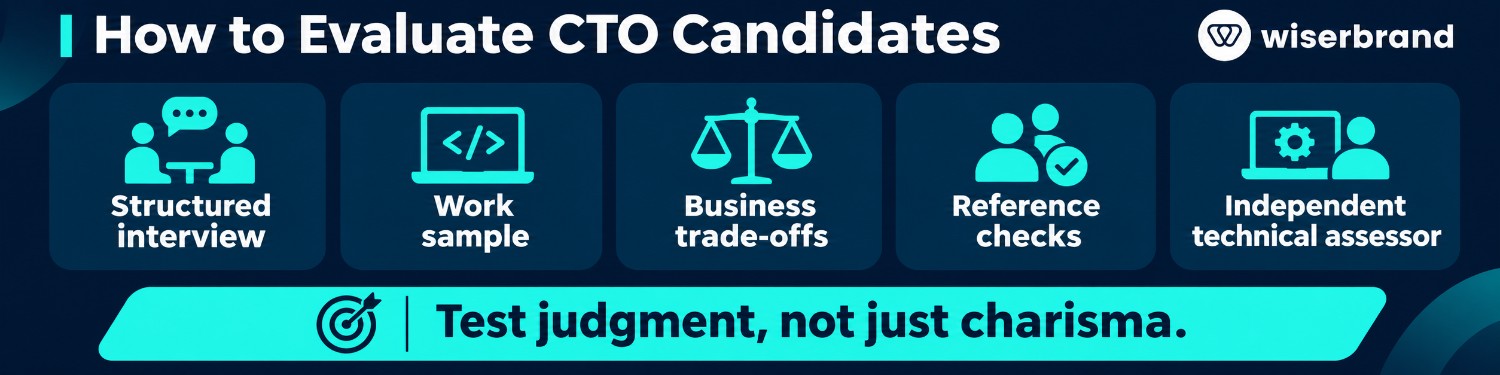
Evaluate a CTO on decisions they have made and would make in your context, using the same questions and scoring for every candidate.
A 2022 meta-analysis in the Journal of Applied Psychology ranked structured interviews first among selection procedures for predicting job performance, with a mean operational validity of .42 in a HumRRO summary. The ranking covers general job performance, not CTOs.
Run every candidate through the same loop:
- The CEO interviews for business translation.
- A board member or investor interviews for risk.
- A senior engineer interviews for technical depth.
- A peer executive interviews for collaboration.
- An independent technical assessor reviews the work sample.
For the work sample, ask for a written review of your real architecture under an NDA, or a 90-day plan. Record scores before discussion.
Interview Questions That Reveal Judgment
Ask about real decisions and score the answers against what a strong answer includes.
| Question | Strong Answer Includes | Warning Sign |
|---|---|---|
| Walk us through a technology decision that changed a business result. What did you trade off? | The business metric, alternatives, cost, what they would change | Technology only, no trade-offs, blame shifted to others |
| What would you need to learn in your first 30 days before changing our roadmap? | Access to systems, people, customers, and costs | Proposes a rewrite before seeing the code |
| You inherit a system that works but slows delivery. Refactor, rebuild, or leave it? | Cost of change, risk, revenue dependency; an incremental path | Default "rebuild in my preferred stack" |
| When do you build, buy, or partner? | Core vs non-core, total cost, lock-in, team capacity | One answer for every case |
| How do you balance speed, quality, and scale at our stage? | Stage-specific quality bars and what they would defer | Enterprise process for a five-person team, or none |
| Tell us about a hire who did not work out. What changed after? | Owns the mistake and the process change | No example, or blames the hire |
| A key deadline will slip. How and when do you tell the CEO and the board? | Early warning with options and business impact | Waits until late, explains only in technical terms |
| What security or compliance risk would you check first here? | Data flows, access, vendors, regulatory context | Generic answer or "we will handle it later" |
| Which hands-on work will you do here, and what will you not? | Honest limits that match the stage | Expects a large org at a startup, or refuses hands-on work |
Technical Evaluation When Founders Are Not Technical
Non-technical founders should borrow technical judgment, the practical answer to how to hire a CTO for a startup: an independent senior engineer, advisor, or non-candidate fractional CTO can run the technical interview and review the work sample.
- Use an independent assessor with no stake; ask them to disclose conflicts.
- Agree the rubric before the first interview.
- Use a work sample on your real system under NDA.
- Ask each candidate to explain a trade-off to a non-technical audience.
- Take references from engineers who reported to the candidate.
For help spotting questions worth escalating, see how teams assess inherited technical debt.
Reference and Backchannel Checks
Call people who worked for, beside, and above the candidate, and ask about specific decisions, not impressions.
Ask:
- Which decision turned out wrong, and what did they do next?
- How did they hire, and how did they handle people who were not working out?
- How did they explain technical risk to the CEO or the board?
- Would you work with them again, and in what role?
- What kind of company would they struggle in?
A backchannel check can add detail; respect confidentiality and do not call the current employer.
Use a Paid Trial or Fractional Engagement to Reduce Hiring Risk
A paid, scoped engagement before a full-time offer lets both sides test working style on real work.
Two forms are common. A fixed project covers one deliverable, such as an architecture review or a hiring plan. A fractional stage with conversion terms, or contract-to-hire, defines the full-time trigger.
One limitation matters: strong candidates in full-time roles often cannot take on a trial, so treat it as an option.
Put these in the trial agreement:
- Scope and deliverables.
- Hours, duration, and fee.
- IP assignment and confidentiality (see the offer section).
- Access levels and how access is revoked.
- Conversion criteria and a decision date.
- What happens if you do not convert.
- Other clients and conflicts of interest.
Offer, Equity, and IP Terms to Settle Before Day One
Agree the compensation mix, decision rights, and IP ownership in writing before the CTO starts.
| Term | Full-Time CTO | Fractional or Interim CTO |
|---|---|---|
| Compensation mix | Salary, bonus, equity | Retainer or fixed fee; equity only if separately agreed |
| Equity and vesting | Time-based vesting with a cliff is common | Advisor-style grant, if any, on its own schedule |
| Reporting and decision rights | Reports to the CEO; budget, hiring, architecture rights written down | Defined scope; which decisions need CEO sign-off |
| IP ownership | Work within the scope of employment belongs to the employer; still sign an invention assignment | Explicit written IP assignment needed |
| Confidentiality and access | Standard employee agreements | NDA, least-privilege access, revocation on exit |
| Classification and exit | Employee; notice and handover terms | Contractor status depends on the real relationship; handover clause |
Carta notes that VC-backed startups usually grant equity on a four-year schedule with a one-year cliff, though only about half of management grants include a cliff.
IP ownership needs its own care. Under U.S. copyright law, work an employee creates within the scope of employment is a work made for hire, but commissioned work from a contractor qualifies only in nine listed categories and only with a signed written agreement, so contractor agreements usually need an explicit IP assignment; confirm with counsel. For fractional and interim CTOs, sign it before code access.
The IRS control test applies here too: how much you direct and control the work decides classification, not the contract title. This is general information, not legal advice; confirm terms with counsel.
Plan the First 90 Days
Set 30-, 60-, and 90-day checkpoints with written outputs.
A 2018 McKinsey article reports that 92 percent of external hires take far more than 90 days to reach full productivity, which argues for patience on outcomes.
| Checkpoint | Written Outputs | Owner |
|---|---|---|
| Day 30 | Access granted; audit of systems, team, vendors, security; list of top risks | New CTO, CEO unblocks access |
| Day 60 | Technical strategy and roadmap draft; team decisions | New CTO, reviewed with CEO |
| Day 90 | Hiring and budget plan; first measured results against the scorecard outcomes | New CTO and CEO, shared with the board |
Common CTO Hiring Mistakes
Most failed CTO hires trace back to an unclear role or an evaluation that tested charisma, not judgment. A 2018 McKinsey article reports that studies put executive transitions regarded as failures or disappointments two years in at 27 to 46 percent.
| Mistake | What It Looks Like Later | How to Prevent It |
|---|---|---|
| Hiring a title instead of outcomes | CTO and CEO disagree on priorities by month three | Written outcomes and decision rights |
| Hiring full-time too early | Senior executive without a team, cost pressure | Decision matrix and a fractional stage |
| Staying fractional too long | Decisions queue for scheduled hours | Revisit the matrix at milestones |
| Evaluating charisma, not judgment | Unstructured, inconsistent interviews | Structured loop and work sample |
| Non-technical founders evaluating alone | Mismatch on technical depth | Independent assessor |
| Skipping IP and classification terms | Code ownership disputes | Assignment clause, classification review |
| No onboarding plan | Slow start, unclear authority | 30/60/90 checkpoints |
Hiring a CTO vs Bringing On a Technical Co-Founder
A hired CTO is an employee or contractor paid mostly in cash for a defined scope; a technical co-founder owns founding risk and holds a founder-level stake.
| Dimension | Hired CTO | Technical Co-Founder |
|---|---|---|
| Ownership | Employee or contractor, optional equity grant | Founder-level stake |
| Compensation | Mostly cash | Mostly equity, often below-market cash early |
| Accountability | Defined scope and outcomes | Shared responsibility for the company |
| When it fits | Product and funding exist, scope is clear | Idea or pre-product stage |
| How you find them | Networks, search firms, fractional firms | Founder networks, accelerators, prior collaborators |
If you need a partner who owns the technical function, that is a founder decision; see finding a technical co-founder.
How to Hire a CTO in Eight Steps With Owners and Gates
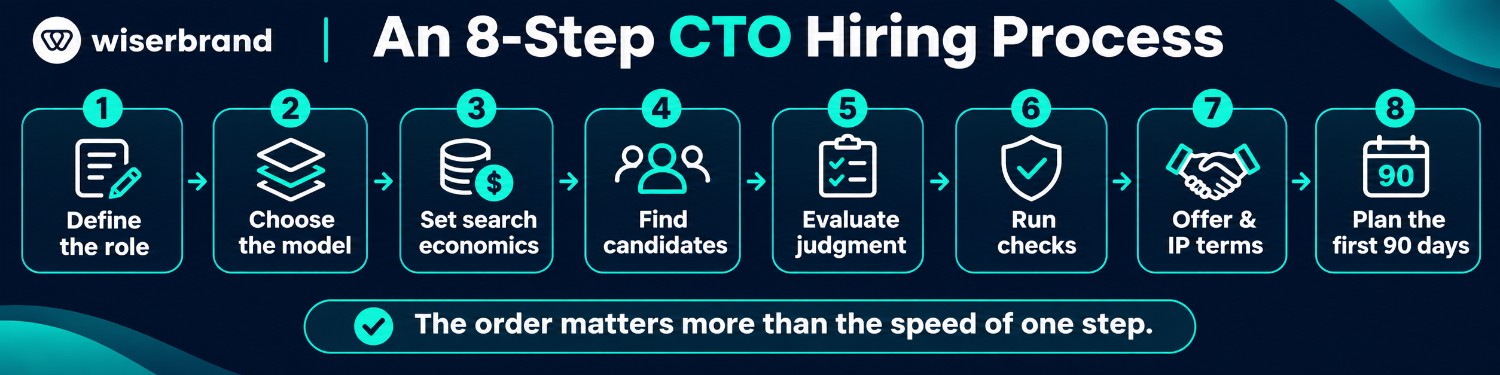
Run the hire as an eight-step project with one owner per step and a go/no-go gate before you spend money on the next one.
| Step | Owner | Output | Gate (Go/No-Go) |
|---|---|---|---|
| 1. Define outcomes | CEO and founders | 3 to 5 outcomes, decision rights | Outcomes agreed with board or co-founders |
| 2. Choose the model | CEO with board or investor | Completed decision matrix | Model chosen, budget approved |
| 3. Write scorecard and brief or SOW | CEO with HR or ops | Scorecard, job description or SOW | Five or fewer must-haves |
| 4. Pick the channel | CEO | Channel plan or firm shortlist | Firm contract signed or first candidates sourced |
| 5. Structured evaluation | Hiring panel and independent technical assessor | Scored interviews, work sample | Candidate meets every must-have |
| 6. References and backchannel | CEO and one board member | Reference notes | No unresolved red flags |
| 7. Offer or trial agreement | CEO and counsel | Offer or SOW with IP, confidentiality, vesting or terms | Signed before access to code |
| 8. Onboard | CEO and new CTO | 30/60/90 plan | 90-day review against outcomes |
FAQ
How to Hire a CTO: What Does the Process Include?
The process is a sequence of decisions, not a resume search. Define the outcomes and the engagement model, write a scorecard, pick a channel, run structured interviews with a work sample, check references, settle offer and IP terms, and set a 90-day plan.
Should I Hire a Full-Time or Fractional CTO?
Match the model to three things: how often technology decisions are needed, the size of the team, and what your budget or board requires. Daily decisions and several teams point to full-time; weekly decisions and a small team point to fractional. A board that requires a named technical executive pulls toward full-time.
Is an Executive Search Firm Worth It When You Hire a CTO?
It can be. A retained firm earns its fee when the role is full-time, the strongest candidates are employed, and a mis-hire is costly. Korn Ferry's fiscal 2026 annual report says its fees are generally one-third of the placed candidate's estimated first-year cash compensation.
How Long Does It Take to Hire a CTO?
Fractional and interim CTOs can often start within weeks. A full-time search typically takes months, because top candidates are employed and notice periods apply. There is no public benchmark for CTO time-to-hire; Heidrick & Struggles' 2024 annual report recognizes search revenue over about six months.
What Is the Typical Salary for a CTO at a Startup?
There is no public benchmark for startup CTO pay. The closest figures are the BLS occupation-wide median and Carta's note that equity grants for VP-level and above hires have shrunk since early 2024. The median for the occupation is $175,140 a year in May 2025.
How Can Non-Technical Founders Evaluate a CTO Candidate?
Borrow technical judgment. An independent assessor with no conflicts can run the technical interview and review a work sample on your real system under NDA. Agree the rubric in advance, ask candidates to explain a trade-off in plain language, and take references from their engineers.
What Is the Difference Between a CTO and a VP of Engineering?
A CTO owns technical direction and technical risk at the business level, including architecture bets, build versus buy, and the board story. A VP of Engineering owns execution, delivery, and people. At an early-stage company, one person can hold both.
Final Thoughts
Hire a full-time CTO when technology decisions are a daily constraint and someone must own a growing engineering team; until then, a scoped fractional engagement can cover the decisions and help you hire the right full-time leader later. Next, write the outcomes and run the matrix.
We run fractional and interim CTO engagements, and when a client needs a permanent CTO, we help define the role, interview candidates, and hand over. We sell fractional and interim CTO services, so weigh our view on the fractional option with that in mind.