Risk Management in Software Engineering

Summary
- Only one in 200 of 6,003 IT projects completed in 2001-2017 delivered the intended benefits on time and within budget (McKinsey and Oxford Global Projects).
- Exploited software vulnerabilities started 31% of breaches in Verizon's 2026 DBIR, overtaking stolen credentials as the top way in.
- The global average data breach cost $4.99 million in IBM's 2026 Cost of a Data Breach Report, up 12% year over year.
- DORA's 2025 research: 90% of respondents use AI at work, and AI adoption has a negative relationship with software delivery stability.
- A 5×5 matrix, named risk owners, and one gate per SDLC phase make risk work routine.
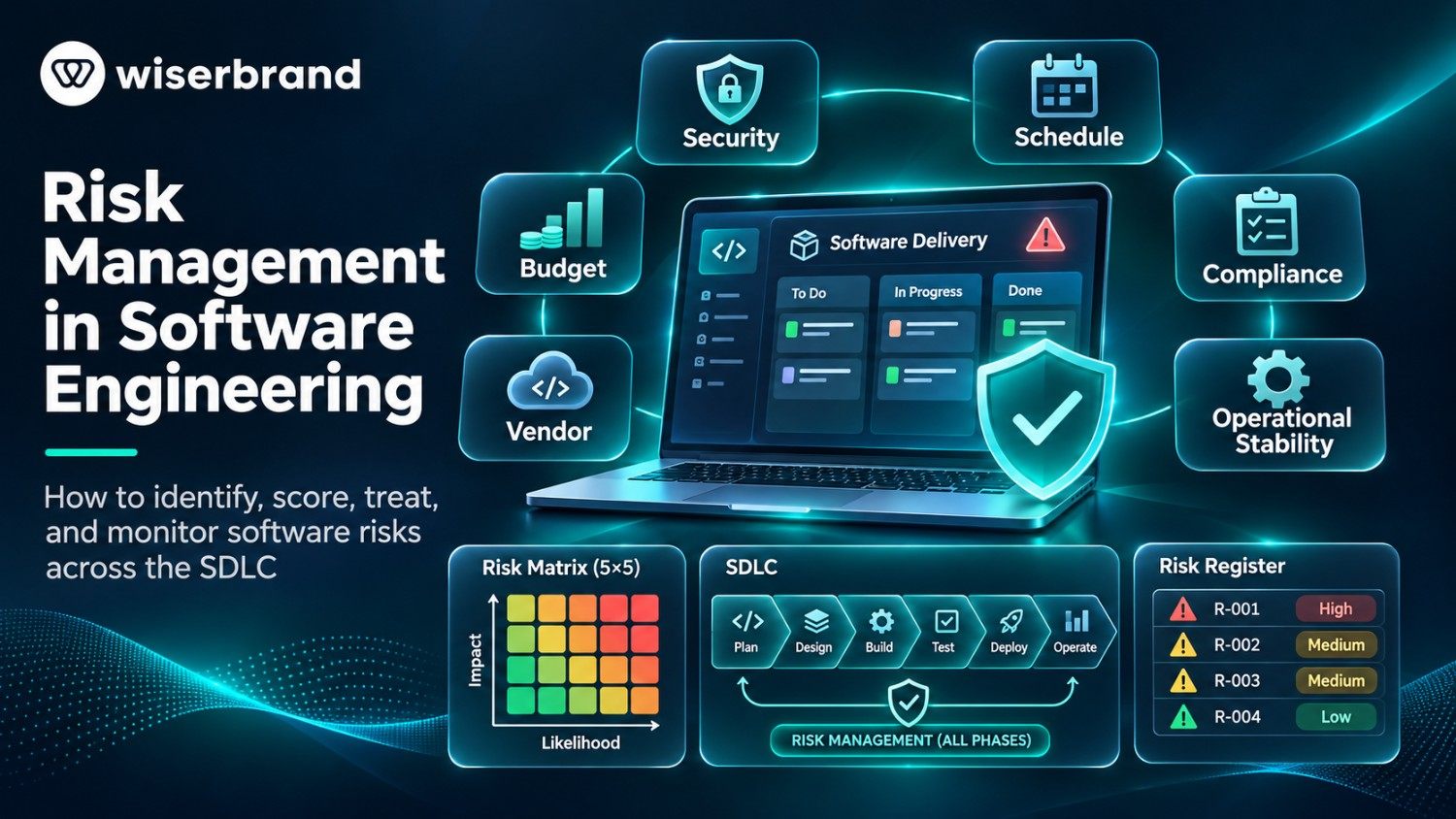
Risk management in software engineering is the ongoing work of finding, scoring, treating, and monitoring uncertainties that could change a product's schedule, cost, quality, security, or business value. In practice it is a register with one owner per row, a shared scale, and early-warning signals.
Projects miss targets often. In the McKinsey and Oxford Global Projects analysis, only 1 in 14 of 6,003 IT projects delivered on budget and on time, and the delivery pipeline is where the newest risks live. This guide covers risk management in software development end to end.
What Risk Management in Software Engineering Covers
Risk management in software engineering covers any uncertainty that can change a product's schedule, cost, quality, security, or business value, and it runs for the whole life cycle, not only during planning. The scope includes an architecture that will not scale, a retired vendor API, and a regulatory deadline. Positive risk counts too.
Three references frame the discipline. ISO 31000:2018 sets out general risk management principles, a framework, and a process; ISO last confirmed it in 2023, a revision is under development, and it is guidance, not a certifiable standard (ISO 31000). ISO/IEC/IEEE 16085:2021 is the software engineering risk management standard: it applies risk management to the systems and software life cycle processes and specifies the information items a team must produce to claim conformance (ISO/IEC/IEEE 16085). PMI's PMBOK Guide, Eighth Edition (November 2025), treats risk as one of seven performance domains of project management (PMI).
| Aspect | Risk | Issue |
|---|---|---|
| Definition | A possible future event with a probability and an impact | A problem that has already occurred |
| Timing | Future | Present |
| What you do | Score it, assign an owner, plan a response | Fix it, assign an owner, track it |
Why Risk Management in Software Engineering Matters Now
Software projects miss targets often and expensively, and the fastest-growing sources of failure, vulnerable components and AI-assisted code, sit inside the delivery pipeline.
In the McKinsey and Oxford Global Projects analysis of 6,003 IT projects, only one in 200 delivered the intended benefits on time and within budget. Projects that miss their targets miss widely: costs balloon by 75%, timelines stretch by 46%, and benefits fall 39% short. CISQ estimated that poor software quality cost the US at least $2.41 trillion in 2022, a modeled macro figure rather than a measured bill (CISQ).
Verizon's 2026 DBIR found that 31% of breaches started with the exploitation of software vulnerabilities, the first time in the report's 19 years that this vector overtook stolen credentials. IBM's 2026 Cost of a Data Breach Report puts the global average cost of a breach at $4.99 million, a 12% increase over the previous year.
The benefits of risk management in software engineering follow from those numbers, and none is a guarantee:
- Slippage becomes visible in the sprint it starts.
- Fixes land earlier, when a design change costs less than an incident.
- Unstable releases and rework decline, because risks with owners get actions.
- Sponsors make go/no-go calls from scores, triggers, and residual risk.
- Evidence is ready for audits and customer reviews.
Types of Risks in Software Engineering
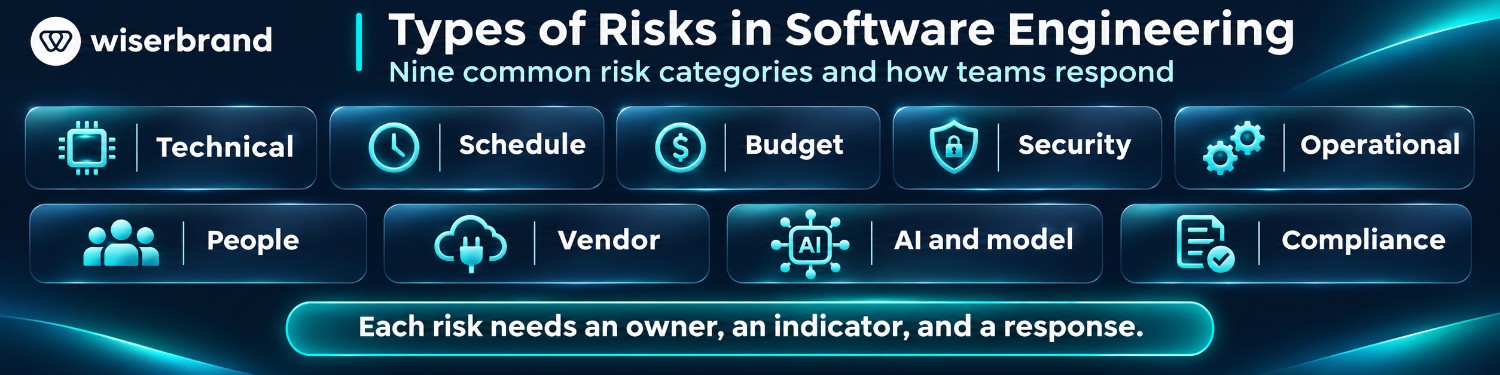
Most software risks fall into nine categories: technical, schedule, budget, security, operational, people, vendor and third-party, AI and model, and compliance. The indicators below are an example calibration.
| Category | Typical risks | Early-warning indicator (KRI) | Main response | Typical owner |
|---|---|---|---|---|
| Technical | Scale, integrations, technical debt | Falling test coverage; rising build time | Architecture spike, ADR, debt budget | Tech lead |
| Schedule | Underestimation, scope creep, dependencies | Velocity below plan two sprints in a row | Buffers, de-scoping, critical-path check | Delivery manager |
| Budget | Overruns, cloud cost growth, licenses | Burn rate above plan | Change control, FinOps limits, staged funding | Sponsor |
| Security | Vulnerable dependencies, misconfiguration, broken access control | Critical vulnerabilities unowned past the window | SAST and SCA in CI, threat modeling, patch SLA | Security lead |
| Operational | Unstable releases, weak monitoring | Rising change fail and rework rates | Feature flags, canary, rollback plan, on-call | DevOps lead |
| People | Single points of knowledge, turnover | Bus factor of 1 on a critical module | Pairing, documentation, cross-training | Engineering manager |
| Vendor and third-party | API deprecation, SaaS outage, lock-in | Deprecation notices; SLA incidents | Contract or SLA, abstraction layer, exit plan | Product owner |
| AI and model | Unreviewed AI code, hallucinations, prompt injection | AI changes merged without review | Mandatory review, evaluation sets, guardrails | Tech lead or ML lead |
| Compliance | GDPR, HIPAA, PCI, EU CRA, SBOM | Regulator deadline under 6 months away | Compliance by design, SBOM, evidence | Compliance officer |
Technical risks in software development are the ones teams feel first: an architecture that does not scale, complex integrations, and accumulated technical debt. Technical debt has its own measurement practice, covered in our guide to technical debt; in a register it is one line with an owner.
Types of Risk Responses
The second meaning of types of risk management in software engineering is the response you choose: avoid, mitigate, transfer, accept, or escalate.
| Strategy | When it fits | Software example |
|---|---|---|
| Avoid | The risk outweighs the value | Drop an unproven library |
| Mitigate | You can lower probability or impact | Feature flag and contract test around a risky integration |
| Transfer | Another party can carry it better | Vendor SLA and contract clause; cyber insurance may transfer some loss |
| Accept | Low score, and the fix costs more than the exposure | Log it with a review trigger |
| Escalate | Beyond the team's authority | A regulatory deadline the team cannot move |
The Software Development Risk Management Process
The process has five repeating steps: identify, analyze, plan responses, act, and monitor, and each step leaves an artifact the team can check.
Identify Risks
A 60-minute workshop beats a blank form. Ask what could stop the release, then write each item as: Because of [cause], [event] may occur, causing [effect]. The SEI's 1993 taxonomy-based method turns risk identification into a structured, repeatable interview rather than an open brainstorm (SEI).
Analyze and Prioritize
Scoring converts opinions into a number a team can rank; the matrix below gives anchors.
Plan Responses
Every risk that scores Medium or above gets a response strategy, one owner, a contingency trigger, and a due date.
Implement Controls
Mitigations become backlog items with acceptance criteria, or they do not happen. Add a risk line to the definition of done.
Monitor, Review, and Communicate
Review frequency follows the score: High and Critical risks every sprint, Medium monthly, Low quarterly. Track residual risk after actions, not the original score, and report open High and Critical risks to the sponsor.
How to Score Software Risks With a Probability and Impact Matrix
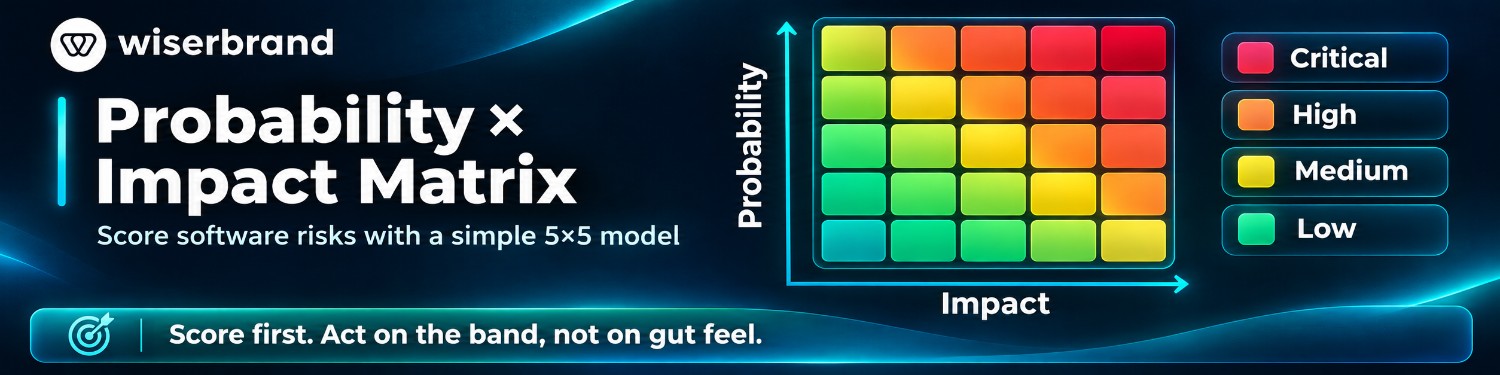
Score each risk as probability (1 to 5) multiplied by impact (1 to 5), then act on the band, not on gut feel. These scales are an example calibration.
Probability: 1 Rare (below 10%), 2 Unlikely (10 to 29%), 3 Possible (30 to 49%), 4 Likely (50 to 79%), 5 Almost certain (80% and above).
| Score | Schedule | Cost | Security and data | Users and customers |
|---|---|---|---|---|
| 1 Negligible | Under 1 day | Under 1% of budget | No data exposure | No user impact |
| 2 Minor | Up to 1 week | 1 to 5% | Internal-only weakness | Internal users only |
| 3 Moderate | 1 to 4 weeks | 5 to 10% | Exploitable vulnerability, no exposure | Degraded service for some users |
| 4 Major | 1 to 3 months | 10 to 25% | Contained exposure of non-sensitive data | Outage of a key flow |
| 5 Severe | More than 3 months | More than 25% | Personal or regulated data exposure | Contract or safety breach, churn |
Action bands (example calibration) follow the score: 1 to 4 Low, accept and review quarterly. 5 to 9 Medium, assign an owner and a backlog action and review monthly. 10 to 16 High, act in the current or next sprint, report to the sponsor, and review every sprint. 20 to 25 Critical, the release or phase does not proceed without a sponsor decision.
Qualitative scoring suits most work. Expected monetary value (EMV) multiplies probability by a cash impact. In an illustrative example, a 30% probability and a $40,000 impact give an EMV of $12,000. A $5,000 mitigation that drops the probability to 5% leaves a residual EMV of $2,000, a net benefit of $5,000. FMEA suits safety-critical products, and a heat map visualizes the same matrix.
Risk Register Template for Software Teams
A useful risk register has one row per risk, a named owner, a measurable early-warning indicator, and a date for the next review.
| Column | What to write |
|---|---|
| ID | R-01, R-02 |
| Risk statement | Because of [cause], [event] may occur, causing [effect] |
| Category | One of the nine above |
| Phase detected | SDLC phase |
| Probability (1 to 5) | Scale above |
| Impact (1 to 5) | Worst dimension (schedule, cost, security, users) |
| Score (P times I) | 1 to 25 |
| Band | Low, Medium, High, Critical |
| Early-warning indicator (KRI) and threshold | Measurable signal, for example p95 latency above 800 ms |
| Response strategy | Avoid, mitigate, transfer, accept, escalate |
| Actions and due date | Links to backlog items |
| Owner | One person, not a team |
| Contingency trigger and plan | What the team does if the risk occurs |
| Residual score | P times I after actions |
| Status, last reviewed, next review | Open, Monitoring, or Closed; dates |
One illustrative row: R-07, because the payment provider is deprecating API v2 before our launch, checkout may fail after cutover, causing lost orders; category, Vendor and third-party; phase detected, Architecture; probability 3; impact 4; score 12, High; KRI, deprecation date less than 90 days before release; response, migrate to v3 behind a feature flag with a contract test in CI; owner, backend lead; contingency, keep the v2 path until v3 passes two weeks of traffic; residual 4; Monitoring.
Managing Risk Across the SDLC
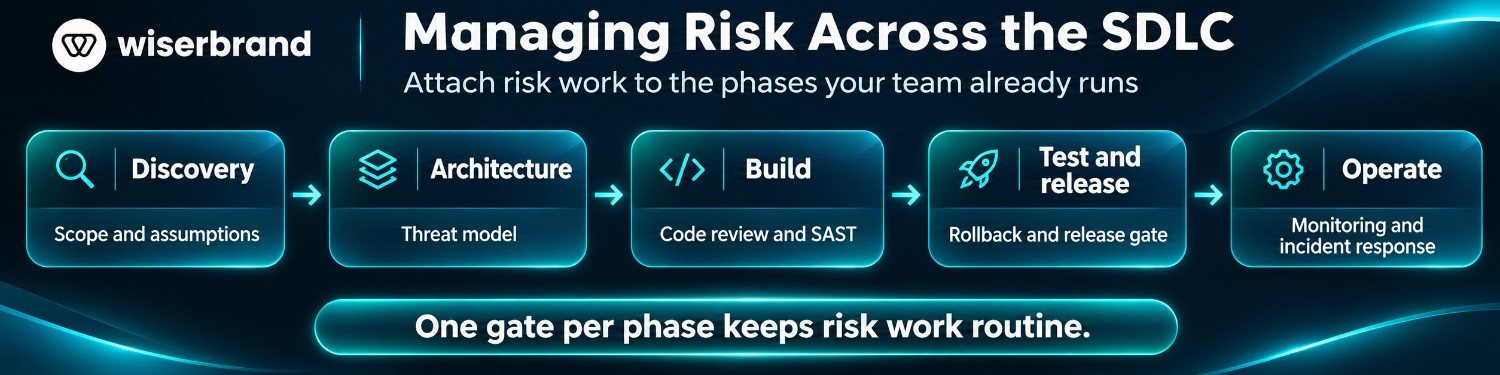
Attach risk work to the phases the team already runs, with one decision gate per phase, so risk review happens in sprint ceremonies and CI checks.
| Phase | Typical risks | Controls | Decision gate | Owner |
|---|---|---|---|---|
| Discovery and requirements | Unclear scope, wrong assumptions | Workshop, acceptance criteria, first rows | Register approved; every High has an owner | Product owner |
| Architecture and design | Scale, integrations, security by design | ADR, threat model, integration spike | No Critical without a plan | Architect |
| Build | Technical debt, vulnerable dependencies, unreviewed AI code | Code review, SAST and SCA, SBOM, risk line in the DoD | CI blocks critical findings | Tech lead |
| Test and verification | Escaped defects, performance | Risk-based testing, load tests | Defect escape rate within target | QA lead |
| Release and deploy | Failed release, no rollback | Feature flags, canary, rollback rehearsal | Go/no-go: no open Critical | Release manager |
| Operate and maintain | Incidents, drift, new CVEs, vendor changes | Monitoring, on-call, patch SLA, register review | Quarterly register review | SRE lead |
| Retire and migrate | Data loss, dependent systems | Migration plan, archiving, communication | Signed retirement plan | Product owner |
Security and compliance controls belong in Build and Test, where compliance by design turns policy into pipeline checks. NIST's Secure Software Development Framework (SP 800-218) v1.1 is the current final version; v1.2 was released as a draft in December 2025, and SP 800-218A adds practices for generative AI models (NIST SSDF).
AI-Assisted Development and Supply Chain Risks
AI coding tools and third-party components now carry a large share of software risk, so treat generated code and dependencies as untrusted input that passes the same gates as human code.
DORA's 2025 research, based on nearly 5,000 technology professionals, found that 90% use AI at work and that AI adoption still has a negative relationship with software delivery stability. In Stack Overflow's 2025 Developer Survey, 46% of developers said they distrust the accuracy of AI tools, and 66% named AI answers that are almost right, but not quite, as their top frustration (Stack Overflow).
IBM's 2026 report found that more than 20% of organizations reported a breach targeting AI models or applications, and that compromised APIs, applications, or plug-ins and cloud misconfigurations affecting AI workloads were the top causes of AI-related breaches, at 27% each. Verizon's 2026 DBIR found that 48% of breaches involved a third party, and software supply chain failures rank third (A03) in the OWASP Top 10:2025 (OWASP).
Controls:
- Require human review for AI-generated changes that touch authentication, payments, or data access.
- Run SAST and SCA in CI and fail the build on critical findings.
- Generate and store a software bill of materials for every build. In July 2026, CISA, NSA, FBI, and international partners published joint guidance on minimum SBOM elements that replaces the 2021 NTIA baseline (CISA).
- Apply the SSDF generative AI practices from SP 800-218A to AI features.
- For agents and tool-using systems, apply the controls in our guide to MCP server security.
If you sell software or connected products in the EU, the Cyber Resilience Act's vulnerability and incident reporting obligations have applied since 11 September 2026, and its main obligations apply from 11 December 2027 (European Commission).
Metrics That Show Risk Is Going Down
Track a small set of leading and lagging indicators: DORA's instability metrics, defect escape rate, and the total score of open risks over time. DORA groups change fail rate and deployment rework rate as instability metrics, direct signals of delivery risk.
| Metric | Formula or definition | Data source | Cadence | Worsening means |
|---|---|---|---|---|
| Change fail rate | Deployments needing intervention | CI/CD, incident tracker | Every sprint | Stability risk rising |
| Deployment rework rate | Unplanned deployments after an incident | CI/CD | Every sprint | Change quality falling |
| Failed deployment recovery time | Time to recover from a failed deployment | Incident tracker | Monthly | Weak rollback or monitoring |
| Defect escape rate | Production defects divided by all defects, times 100 | Bug tracker | Every release | Testing misses risky areas |
| Risk burn-down | Sum of P times I for open risks | Register | Every sprint | Risks pile up |
| Ownership coverage | High and Critical risks with an owner and recent review | Register | Monthly | Register theater |
| Critical vulnerability age | Median age against the patch SLA | Scanner | Weekly | Exposure growing |
Software Risk Management vs. Risk Management Software
Software risk management is the practice; risk management software is a category of tools, such as GRC, ERM, or application security posture platforms, that can host the register and evidence but cannot identify engineering risks for you.
A spreadsheet, a project tracker, or a platform work when owners and dates are real. Risk management is wider than any single project, while project management runs one effort and treats risk as one domain.
A 90-Day Plan to Put Risk Management in Place
Start with one register, one scale, and one gate, and expand only after the first quarterly review.
| Period | Actions | Owner | Gate | Artifact |
|---|---|---|---|---|
| Days 1 to 14 | Set scales; 60-minute workshop; 10 to 15 risks; owners | Sponsor, tech lead, delivery manager | G1: sponsor approves register | Register v1, scales |
| Days 15 to 45 | Risk tasks in backlog; SAST, SCA, and SBOM in CI; KRIs for High risks; review in the sprint review | Tech lead, DevOps | G2: CI blocks critical findings | Pipeline rules, dashboard |
| Days 46 to 90 | Quarterly review; risk burn-down and DORA metrics; retrospective; recalibrate | Engineering manager, sponsor | G3: continue, simplify, or strengthen | One-page report |
Teams coordinating many teams face a different problem, covered in managing large software projects.
When Lightweight Risk Management Is Enough
A two-week prototype needs a checklist, not a register; a regulated product that handles personal data needs the full process.
Common failure modes to avoid:
- Register theater: a register without owners or review dates.
- Everything scores 3×3: scales without anchors, so nothing is prioritized.
- Risks confused with issues: the register turns into a bug tracker.
- Controls outside the backlog: mitigations never get planned.
- Over-formalization: Monte Carlo simulation for a two-week prototype.
- Tool before process: buying a GRC platform before owners and scales exist.
Lightweight is enough for an internal tool with no personal data and a short life: a 10-question checklist and one review before release. Move to the full process when the product ships to customers or falls under a regulation.
FAQ
What is risk management in software engineering?
Risk management in software engineering is the ongoing practice of identifying, scoring, treating, and monitoring uncertainties that could change a software product's schedule, cost, quality, security, or business value. Teams keep a risk register with named owners and early-warning indicators, and review it at every phase of the life cycle, from requirements to production.
What are the main types of risks in software development?
The nine categories are technical, schedule, budget, security, operational, people, vendor and third-party, AI and model, and compliance. The biggest are usually technical, schedule, and security risks, because they connect directly to shipping on time and without a breach.
What are the benefits of risk management in software engineering?
A working process surfaces slippage in the sprint it starts, so fixes land while they are still cheap. It reduces incidents and rework, gives sponsors a factual basis for go/no-go calls, and keeps evidence ready for audits. It can reduce the likelihood or impact of failure, not prevent it.
What is the difference between a risk and an issue in a software project?
A risk has not happened yet and carries a probability, so it belongs in the register with an owner and a response plan. An issue has already occurred and needs action now, so it moves to the issue tracker. When a risk materializes, it becomes an issue.
How often should a software team review its risk register?
A common recommendation is every sprint for High and Critical risks, monthly for Medium, and quarterly for Low. Review sooner after every incident, major scope change, or vendor notice. Each row needs an owner and a next review date.
How does AI-generated code change software risk management?
It adds unreviewed code and new failure modes to the pipeline. Treat generated code as untrusted input: require human review for sensitive paths, run SAST and SCA in CI, keep a software bill of materials, and measure rework after AI-authored changes.
Which standards apply to software risk management?
ISO 31000:2018 provides general guidance and is not certifiable. ISO/IEC/IEEE 16085:2021 applies risk management to systems and software life cycle processes. NIST's SSDF (SP 800-218) covers secure development practices, and NIST CSF 2.0 describes cybersecurity outcomes without prescribing how to reach them. None is mandatory by default.
Final Thoughts
If a risk scores 15 or higher, has no owner, or has no early-warning indicator, it is not managed yet. Fix those three gaps before adding tools.
The next step is small: one 60-minute identification session, a register of 10 to 15 rows, and an owner for every High risk.
We develop custom software with QA and testing for functionality, performance, and security, plus support after launch. For companies where no one owns the technology decisions, our fractional CTO services include a focused intervention format for at-risk projects and rising costs. We provide custom software development and fractional CTO services, so read our mention of them as a vendor's perspective.


