SEO Title Tag Length and Best Practices

Summary
- Google's title link documentation sets no length limit for the title element and truncates title links to fit the device width.
- In September 2021, Google said it used title elements about 87% of the time, up from about 80%.
- In a Q1 2022 Zyppy study of 80,959 titles, Google rewrote 61.6%, and titles of 51 to 60 characters were rewritten least (39% to 42%).
- A separate Q1 2025 study found Google changed 76.04% of 24,886 titles, most often by removing the brand name.
- Aligning title and H1, trimming boilerplate, and testing against a control group lowers the risk of a bad change.
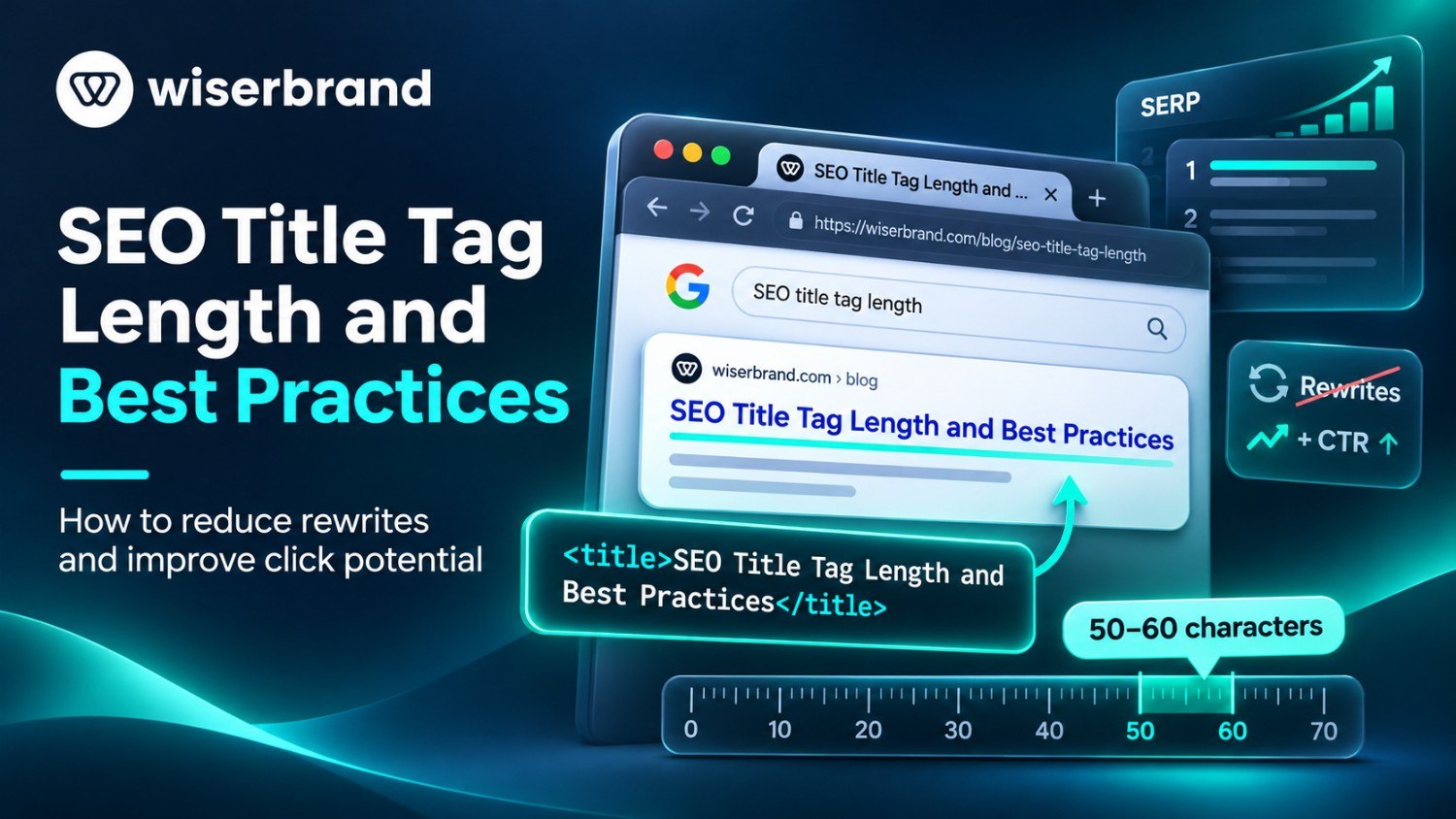
An SEO title tag is the HTML title element inside a page's head section, and it names the page for browsers, search engines, and link previews. Google uses it as the main but not the only source of the title link in search results, and that title link helps people decide which result to click. The HTML standard allows one title element per document.
Google often shows a title you did not write, so this article covers length, rewrite causes, formulas by page type, and how to test a change.
What an SEO Title Tag Does in Search, Browsers, and Shares
An SEO title tag names a page in three places: the search result, the browser tab, and link previews when og:title is missing. Google builds the displayed title link from several sources, and the HTML title is the main one rather than the only one. Its documentation lists nine sources, including the title element, the page's main heading, og:title, anchor text from other pages, and WebSite structured data.
Google added og:title to that list in August 2024. Bing's Webmaster Guidelines say missing, duplicate, or overly short title tags may reduce indexing reliability, ranking, and eligibility for grounding results and citations in Copilot.
The title does not carry a page on its own; it sets the click text a searcher reads.
How Long Should an SEO Title Tag Be?
Google has no character limit for an SEO title tag; it truncates title links as needed, typically to fit the device width. The practical rule is to keep the core meaning inside the first 50 to 60 characters and check the rendered width, because a long tail may never appear.
Treat 50 to 60 characters, and the roughly 580 to 600 pixel range often quoted with it, as an industry observation, not a Google rule. Google publishes neither number.
Pixels vs Characters
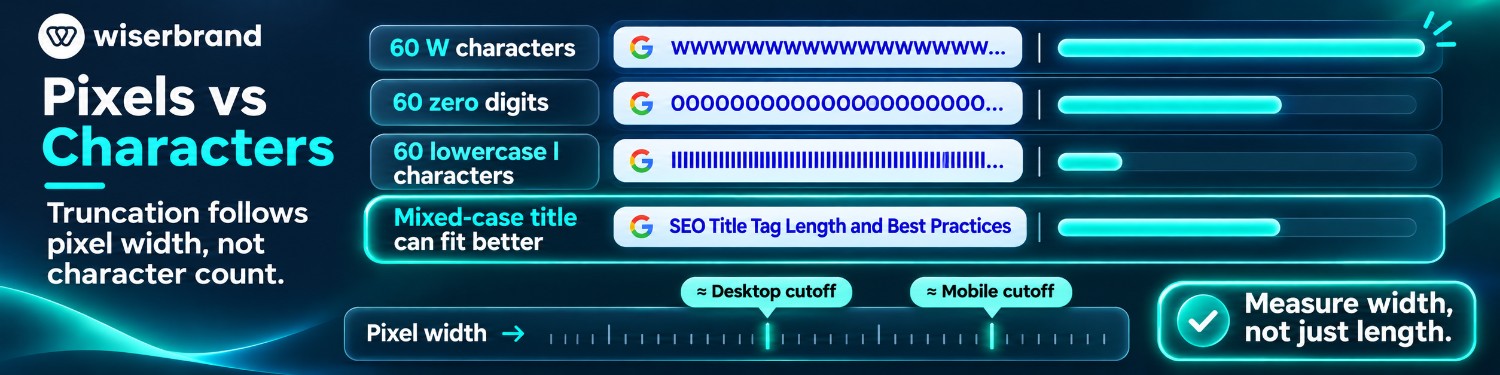
Truncation follows pixel width, not a character count. Screaming Frog observes a desktop cut-off around 580 pixels and a mobile cut-off around 485 pixels, where the font is smaller.
| Text sample | Characters | Estimated width |
|---|---|---|
| Sixty capital W characters | 60 | about 1,133 px |
| Sixty zero digits | 60 | about 667 px |
| Sixty lowercase l characters | 60 | about 267 px |
| SEO Title Tag Length, Best Practices, and Google Rewrite Risks | 62 | about 574 px |
| The same headline in capitals, shorter variant | 58 | about 696 px |
Estimated with Arial 20 px; this is our own illustration, not a third-party source.
Wide letters, capitals, and digits take more room, so a 62-character mixed-case headline can fit where a shorter all-caps line does not.
What the Rewrite Data Says About Length
Studies link mid-length titles with fewer rewrites, but they measure different things. In the Zyppy study of 80,959 desktop titles from the first quarter of 2022, Google rewrote 61.6% overall, 99.9% of those longer than 70 characters, and 96.6% of those of 1 to 5 characters. Titles of 51 to 60 characters were rewritten least, at 39% to 42%.
In John McAlpin's Q1 2025 study, unchanged titles averaged 44.47 characters and changed titles 62.58. Definitions also differ: Ahrefs, which counted punctuation tweaks and added brand names as matches, reported a 33.4% rewrite rate for 2021.
Why Google Rewrites SEO Title Tags
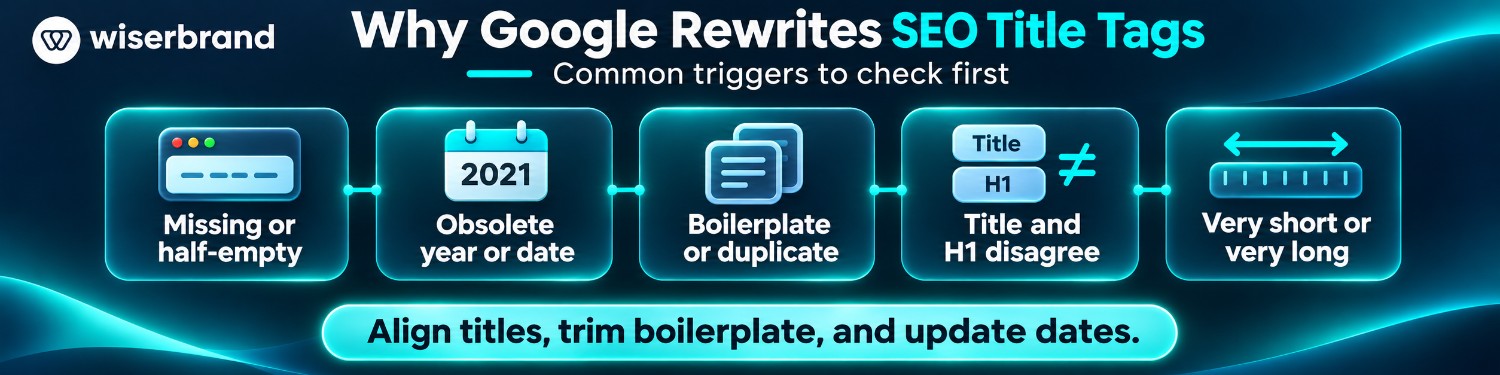
Google replaces a title tag when it finds a problem, such as missing, outdated, inaccurate, or boilerplate text, or when another element describes the page better. In August 2021, Google said it would generally no longer change titles based on the query, and a month later it said it used title elements about 87% of the time, up from about 80%.
The change rate is not small. In John McAlpin's Q1 2025 study, which compared displayed titles in the top 20 results with same-day crawls, 76.04% of 24,886 titles changed, and the brand name was removed in 63.0% of them. Its samples and methods differ from Zyppy's, so do not read the two as a trend.
Google also keeps testing. In March 2026, it told The Verge it was running a small, narrow experiment that replaced some titles in Search, using generative AI in the test, and that it was not yet approved for a fuller launch. As of November 2026, no wider rollout has been announced, and the December 2025 title link documentation does not mention generative titles.
| Trigger | How to check | Fix | Evidence |
|---|---|---|---|
| Missing or half-empty title | Crawl for short titles | Write a full title | Title link docs |
| Obsolete year or date | Compare with the H1 date | Update both | Title link docs |
| Inaccurate title for dynamic content | Compare with the main content | Build it from the content | Title link docs |
| Boilerplate or duplicate titles | Crawl for duplicates | Add the distinguishing attribute | Title link docs |
| No dominant H1 | Check for one heading | Use one prominent H1 | Title link docs |
| Language or script mismatch | Compare with the page language | Match language and script | Title link docs |
| Long brand block | Check the title ending | Use a short brand or site name markup | Title link docs |
| Very short or very long title | Check length and pixel width | Keep the core within 50 to 60 characters | Zyppy |
| Square brackets or pipes | Pattern search in titles | Use parentheses or a dash | Zyppy |
| Title and H1 disagree | Diff the two | Align key terms and numbers | Zyppy, Bing |
| Fast-changing prices | Pattern search for prices | Remove volatile data | Title link docs |
| robots.txt blocks crawling | Run a robots.txt test | Allow crawling, or use noindex | Title link docs |
SEO Title Tag Best Practices
The best SEO title tag describes one page accurately, leads with the term searchers use, and stays short enough to survive truncation. Eight rules cover most decisions.
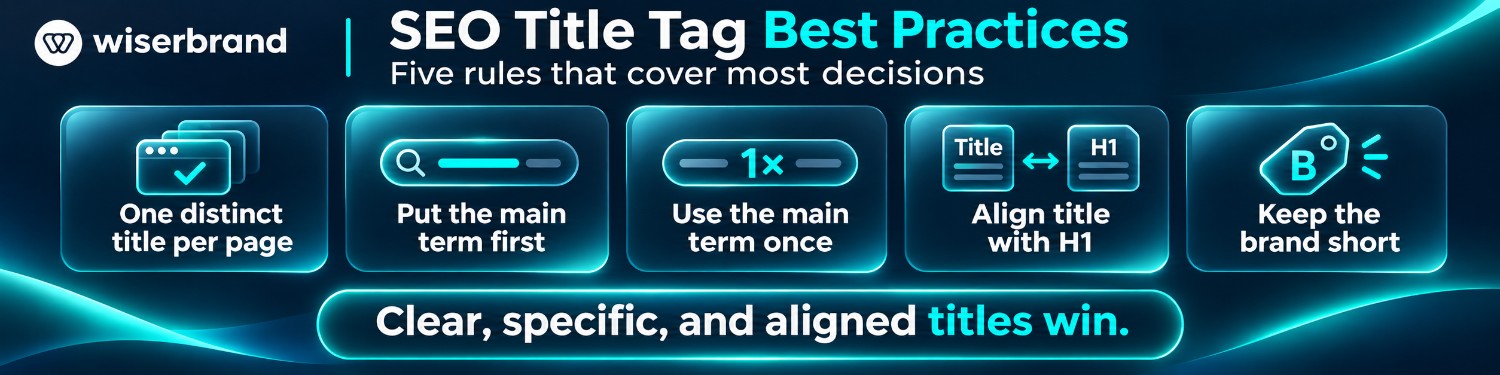
- Write one distinct title per page, with no boilerplate across a template. Google's SEO Starter Guide describes a good title as unique to the page, clear and concise, and accurate.
- Put the main term first, because truncation cuts the end.
- Use the primary term once, and stop there. Google's spam policies define keyword stuffing as filling a page with keywords or numbers to manipulate rankings. For a page with several terms, choose how many keywords one page should target first.
- Align the title with the H1. Bing asks owners to align titles, heading, and content intent. The two should agree on the key term and any numbers.
- Keep the brand short, or rely on the site name, which Google shows with results and you can set with WebSite structured data.
- Choose separators with the data in mind. Google's example allows a hyphen, colon, or pipe, but in the Zyppy sample pipes were removed or replaced in 41.0% of titles against 19.7% for dashes, and square brackets in 77.6% against 61.9% for parentheses. Default to a dash and parentheses.
- Keep numbers and dates in step with the H1. In the same sample, a number in both survived 97.3% of the time.
- Match the language and script of the page.
Title Formulas by Page Type
The best page title for SEO depends on the page's job: an article names the question, a product names the item, and a local page names the service and place. The examples are hypothetical.
| Page type | Formula | Example (hypothetical) | Rewrite risk to avoid |
|---|---|---|---|
| Blog or guide | Primary topic plus a specific angle or outcome | SEO Title Tag Length and Best Practices | A year in the title but not in the H1; clickbait |
| Service page | Service plus audience or differentiator, then brand | Technical SEO Audit for SaaS Companies - Brand | A generic Services or Home title |
| Product page | Brand and model plus key attribute, then store | Model X Leather Sofa, 3-Seat, Cognac - Store | A price or stock level that goes stale |
| Category page | Category plus scope qualifier, then store | Leather Sofas and Sectionals - Store | The same title on paginated pages |
| Local page | Service in city and state, then brand | Emergency Plumber in Austin, TX - Brand | Long city lists, which read as keyword stuffing |
| Comparison | Option A versus Option B plus a decision angle | HubSpot versus Salesforce for Mid-Market Sales | Brackets, or too many entities |
Check every formula against width and H1 alignment. For catalogs, category page optimization follows the same logic but has to handle filters and pagination.
SEO Title Tag vs H1, Title Link, Meta Description, and og:title
The title tag is code you write, the title link is what Google displays, and the H1 is the visible headline on the page. The elements do different jobs.
| Element | Who controls it | Where it appears | Main job | Typical mistake |
|---|---|---|---|---|
| Title element | Site owner | Browser tab; main source for search title links | Name the page accurately | Boilerplate, stuffing, stale dates |
| H1 | Site owner | On the page | Visible headline for readers | Disagrees with the title |
| Google title link | Google, from nine sources | Search results | Help people choose a result | Assuming it equals your title |
| Meta description | Site owner, though Google may show other text | Snippet candidate | Summarize the page | Treating it as a ranking lever |
| og:title | Site owner | Social and messaging previews; a Google title link source since August 2024 | Title for shares | Left empty or mismatched |
The Open Graph og:title property sets the title shown when a page is shared and is also a source Google can use for title links.
How to Test SEO Title Tag Changes in Search Console
Test title changes on a group of pages against a similar control group, compare equal date windows after Google shows the new title, and keep the change only if CTR rises without a position drop. CTR is clicks divided by impressions.
| Step | Owner | Action | Decision gate |
|---|---|---|---|
| 1 | SEO lead | Export Pages (Web) for 3 months: clicks, impressions, CTR, position | Only pages with enough impressions to read CTR; we suggest at least 1,000 per 28 days |
| 2 | SEO lead | Crawl titles; compare with displayed links for top queries | Truncated or rewritten pages become candidates |
| 3 | Content editor | Diagnose with the checklist, write the new title, align the H1 | Peer review: accurate, distinct, main term first |
| 4 | SEO lead | Split candidates into a test group and a similar control group | The groups are comparable |
| 5 | Developer or CMS owner | Deploy and request a recrawl in URL Inspection | The new title appears in the source and in live results |
| 6 | SEO lead | Wait until Google shows the change; compare equal 28-day windows for both groups | Keep if CTR rises and average position stays within plus or minus 1; revert if clicks fall against the control group; extend if inconclusive |
| 7 | SEO lead | Log confounders: core or spam updates, seasonality, new features, AI Overviews | Do not credit the title if a confounder overlaps |
The threshold in step 1 and the gate in step 6 are our suggestions, not study findings. A recrawl request does not speed crawling, which can take a few days to a few weeks. AI features traffic appears under the Web search type, and monitor search rankings after a change for longer-term tracking.
Do not change a title when Google already shows it and CTR is stable, when impressions are too low to measure, when the problem is content or intent mismatch, or during a core update or seasonal peak.
FAQ
What is an SEO title tag?
An SEO title tag is the HTML title element in a page's head section. It names the page for browsers, search engines, and link previews, and the HTML standard allows one title element per document. Google uses it as the main source of the displayed title link.
How many characters should an SEO title be?
Google sets no character limit and truncates title links to fit the device width, so 50 to 60 characters is an industry observation, not a rule. Screaming Frog observes desktop truncation around 580 pixels. Zyppy's analysis of about 250,000 URLs found traffic peaked around 55 to 60 characters, which the author calls correlation, not cause.
Is a meta title the same as a page title?
In most content management systems, a meta title and an SEO title both mean the HTML title element, though it is not a meta tag. A page title sometimes means the visible H1. Google reads the title element first, then can rebuild the title link.
Should the title tag and H1 be the same?
They do not need to be identical, but they should agree on the key term and any numbers. Bing asks owners to align titles, heading, and content intent. In the Zyppy sample, a number in both the title and the H1 survived 97.3% of the time.
Should I include my brand name in every title tag?
Keep the brand short if you include it, and place it at the end. Google shows a site name with results on mobile and desktop, and you can set a preferred name with WebSite structured data. Brand removal led the changes in the Q1 2025 study.
How long does it take Google to show an updated title?
Crawling can take a few days to a few weeks. Requesting a recrawl more than once does not speed it up, so use URL Inspection once for key URLs and wait. Watch the Performance report until Google shows the new title.
Do AI Overviews or AI Mode need a special title format?
No. Google says there are no additional requirements or special optimizations to appear in AI Overviews or AI Mode. Its 2026 guide to generative AI features says standard SEO practices still apply, and no special AI files or markup are needed. Our guide to how pages get cited in Google AI Overviews covers the rest.
Final Thoughts
Use one decision rule. If a page earns impressions but Google truncates the main term or shows a different title, fix the title before rewriting the content; if Google already shows your title and CTR is stable, leave it. Audit titles at the template level so one correction covers every page the template generates.
In a project for a furniture store, we tested updates to meta tags, SEO text, and page elements on selected sets of pages and compared them against control groups. That is an example of grouped testing, not evidence that a title change caused any single outcome. To map templates first, our SEO services team can start there, and the furniture store SEO case shows the method in context.