Fractional CTO Cost and Rates in 2026


Summary
- Go Fractional's live benchmark put the average fractional CTO rate at $202 an hour on November 4, 2026, with the middle half of observed rates between $150 and $250.
- In the Fractional Jobs 2026 survey, fractional executives at VP level and above reported a $229 hourly mean in engineering.
- The BLS median wage for computer and information systems managers, a group that includes CTO titles, was $175,140 in May 2025.
- Benefits were 32.5% of employer compensation costs for private-industry management, business, and financial occupations in June 2026.
- Korn Ferry reports executive search fees of generally one-third of a placed candidate's first-year cash compensation.
Fractional CTO cost is what a company pays for part of a senior technology leader's time: an hourly or monthly rate multiplied by agreed hours, plus terms such as minimum commitment, fixed-scope fees, expenses, and any equity. It is a budget line you can model, not a salary you match against a posting. Most published rates come from marketplaces and vendors, so the numbers disagree. If you are still deciding what the role covers, start with what a fractional CTO does, then return to the money. Disclosure: we sell fractional CTO engagements and software development, so the benchmarks here come from third parties and the worked example uses no WiserBrand pricing.
How Much Does a Fractional CTO Cost in 2026
As of November 4, 2026, Go Fractional's live benchmark put a typical fractional CTO engagement at $9,000 to $15,000 a month, based on about 15 hours a week at $150 to $250 an hour, with an average rate of $202.
Three published marketplace benchmarks sit behind most of the fractional CTO cost figures you will see: Go Fractional counts 18 job posts and 1,263 candidate profiles over a rolling 90 days, the Fractional Jobs 2026 report surveys self-reported rates, and Upwork uses historical contracts worldwide.
| Source | Who publishes | Data basis | Period | Hourly figure | Notes |
|---|---|---|---|---|---|
| Go Fractional live benchmark | Marketplace | 18 job posts and 1,263 candidate profiles | Rolling 90 days to November 4, 2026 | Average $202; median $200; middle half $150 to $250 | Employer offers averaged $136 an hour; talent asks averaged $204 |
| Fractional Jobs 2026 survey | Job board | 546 self-reported responses from VP-level and above executives | Job postings January 2024 to May 2026 | Engineering mean $229; $223 across all executives | Self-reported, and the function is engineering rather than CTO specifically |
| Upwork cost page | Marketplace | Historical contracts worldwide | Not stated | $117 to $208 | Sample size and period are not disclosed |
Employer offers and talent asks explain much of the spread: on the same data, employers offered $136 an hour on average while candidates asked $204. Self-reported figures run higher than posted rates, and global ranges run lower.
No independent survey publishes fractional CTO rates with a disclosed method, so the figures below come from marketplaces and a job-board survey, labeled by who collected them and when.
Fractional CTO Hourly Rate
A fractional CTO hourly rate in 2026 sits well above the hourly equivalent of an employee's salary, because the contractor's rate has to cover unbilled time, self-employment taxes, their own benefits, and gaps between clients. The BLS Occupational Outlook Handbook reports a median hourly wage of $84.20 in May 2025 for computer and information systems managers, a category that includes CTO titles, so the $202 marketplace average is roughly 2.4 times that equivalent.
Fractional CTO Day Rate
A day rate is usually the hourly rate multiplied by the hours in an agreed working day, so $202 an hour over eight hours comes to $1,616 as an illustration. Day rates fit bounded work such as a workshop, an audit, due diligence, or a board session. Define in the contract how many hours count as a day.
Fractional CTO Pricing Models Compared

Most fractional CTO work is billed as a monthly retainer for a set number of days or hours, while hourly, day-rate, and fixed-scope pricing suit bounded tasks, and equity or success fees are add-ons with their own risks. Fractional CTO pricing in 2026 runs through six models, and each moves risk in a different direction.
| Model | How it is billed | Best fit | Main risk | Contract must-have | Budget formula |
|---|---|---|---|---|---|
| Hourly | Actual hours with time reports | Narrow tasks: architecture review, vendor check, ad hoc decisions | Open-ended volume; pays for hours, not outcomes | Monthly hour cap, reporting format, overage rate | rate x hours |
| Day rate | Per day (workshop, audit) | Discovery, due diligence, board session | Higher effective rate than a retainer; little time for follow-through | Hours that count as a day; deliverable after each day | day rate x days |
| Monthly retainer (days per week) | Fixed fee for 0.5, 1, 2, or 3 days a week | Ongoing leadership: roadmap, team, vendors, security | Paying for availability without outcomes; scope creep | 90-day outcomes, days in scope, rollover or overage, notice period | day rate x days per week x 4. Illustration at $1,616 a day: 1 day about $6,464; 2 days about $12,928; 3 days about $19,392 per four-week month |
| Project or fixed scope | Fixed price per defined result | Tech audit, rescue, due diligence, migration plan | Weak scope leads to change orders; no implementation afterward | Deliverables, acceptance criteria, change-order process | fixed fee + change orders |
| Equity plus cash | Lower cash plus advisor equity with vesting | Pre-seed or seed with limited cash and a long horizon | Dilution; disputes if equity has no vesting; FAST does not cover work for hire | Separate grant documents, vesting and cliff, IP assignment in the consulting agreement | monthly cash + percentage, compared with the FAST grid |
| Success fee | Bonus tied to an event (launch, cost reduction) | Rare; only for measurable outcomes the CTO controls | Distorted incentives; fees tied to raising capital can raise regulatory issues, so review with counsel | Clear metric, baseline, who measures, cap | base + percentage of the measured result |
Most fractional CTO cost lands in a monthly retainer, so the contract has to name outcomes, not only days. The formula figures use the $202 average as illustration.
What Drives Fractional CTO Cost Up or Down
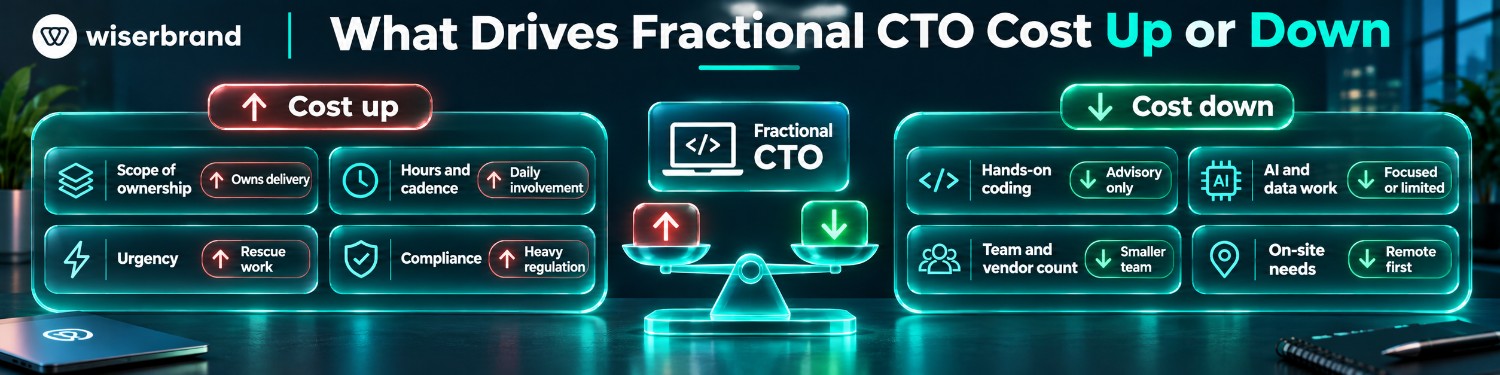
Hours and scope of ownership move the price more than anything else, followed by urgency, compliance-heavy domains, hands-on coding, AI and data work, and time-zone or on-site needs. In rescue work, a stalled project or growing technical debt pushes toward accountable delivery, billed differently from advisory time.
| Driver | Pushes cost up when | Pushes cost down when | What to ask in the proposal |
|---|---|---|---|
| Scope of ownership | The CTO owns delivery, hiring, and the team | The role is advisory and you keep decisions | Who owns delivery? |
| Hours and cadence | Daily involvement or on-call is needed | Work fits a weekly block | How many hours? |
| Stage and urgency | A fundraise, rescue, or due diligence is running | Roadmap work runs on a normal timeline | What is the deadline? |
| Domain and compliance | The product touches fintech, healthcare, or certifications | The regulatory load is light | Which standards apply? |
| Hands-on coding | The CTO ships code or reviews pull requests | The role stays at architecture and vendor level | Is coding in scope? |
| AI and data work | Model deployment, data pipelines, or governance are involved | No AI or data platform is required | Are specialists billed separately? |
| Team and vendor count | Several teams or agencies need coordination | One team and one vendor | How many people are in scope? |
| Geography and on-site days | Business-hours overlap or travel is required | Work runs asynchronously and remotely | How many on-site days? |
| Contract length and notice | A long term with short notice and no exit | A short term with milestones and notice | What is the exit? |
Fractional CTO Equity vs Salary
Most fractional CTOs are paid in cash through a retainer or hourly fees rather than a salary, and any equity is usually advisor-sized, vests over time, and sits under a separate grant document. If you searched for a fractional CTO salary, the role normally invoices as a contractor, so there is no payroll salary to benchmark. The Founder Institute FAST v3 template offers a starting grid by stage and involvement.
| Involvement | Pre-seed | Seed | Series A |
|---|---|---|---|
| Standard: monthly meetings | 0.50% | 0.25% | 0.10% |
| Expert: adds contacts and projects | 1.00% | 0.75% | 0.50% |
The template sets a three-month cliff and two-year vesting, and states that it is not designed for work-for-hire relationships, so an equity grant belongs in a separate document from a consulting agreement that assigns IP. Review the terms with counsel.
Carta data puts the first hire well above an advisor grant. Carta's H1 2026 report shows the median first hire received 1.75% of company equity, the 75th percentile 4.26%, and grants for VP level and above have shrunk. Carta does not break out CTOs, so treat these as context. If the real question is ownership and daily leadership, that is a technical co-founder discussion.
Fractional CTO Cost vs Full-Time CTO Salary
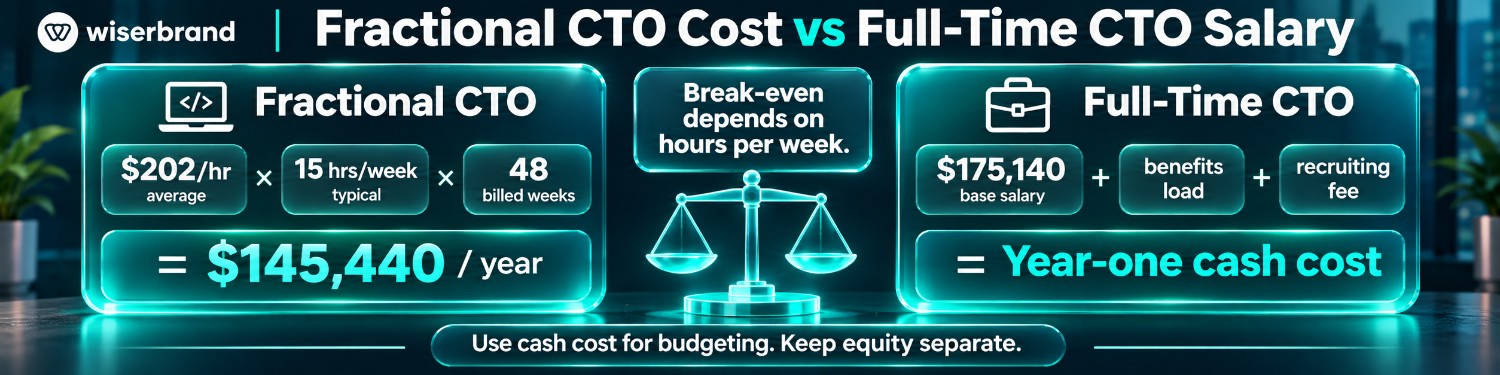
A full-time CTO costs far more than the base salary once you add benefits, a search fee, and an equity grant, so a fractional CTO is cheaper only up to a break-even number of hours per week.
Use these formulas:
- Fractional annual cost = hourly rate x hours per week x billed weeks + onboarding or discovery fee + expenses.
- Full-time year-one cost = base salary x (1 + benefits load) + bonus + recruiting fee. Equity stays separate as a percentage, and vacancy or ramp time stays separate in months.
- Break-even hours per week = full-time year-one cash cost / (hourly rate x billed weeks).
The default benefits load is 48.1%, from BLS ECEC Table 4, where benefits for private-industry management, business, and financial occupations were $28.78 of $59.85 in hourly compensation in June 2026. A broader private-industry measure puts benefits at 42.9% of wages. Both are group averages, not CTO-specific figures. The recruiting fee follows Korn Ferry's FY2026 annual report, which says executive search fees are generally one-third of the placed candidate's estimated first-year cash compensation.
Hypothetical example, not a quote.
| Input or result | Value | Source or assumption |
|---|---|---|
| Fractional rate | $202 an hour | Go Fractional average as of November 4, 2026 |
| Hours per week | 15 | Go Fractional typical scope |
| Billed weeks per year | 48 (12 four-week months) | Assumption |
| Fractional annual cost | $145,440 | 202 x 15 x 48 |
| Full-time base salary | $175,140 | BLS median, May 2025, used as a proxy |
| Benefits at 48.1% | About $84,219 | BLS ECEC load |
| Loaded salary | About $259,359 | 175,140 x 1.4809 |
| Recruiting fee, one-third of base, no bonus | $58,380 | Korn Ferry; first-year cash assumed equal to base |
| Full-time year-one cash | About $317,739 | Sum of the rows above |
| Fractional as a share of full-time | About 45.8% | 145,440 / 317,739 |
| Break-even | About 32.8 hours a week | 317,739 / (202 x 48) |
| Equity | Not in dollars: Carta median first hire 1.75%; FAST advisor 0.10% to 1.00% | Separate row |
The fractional CTO cost figure is sensitive to every input. At the 75th percentile rate of $250 an hour for 20 hours a week, the fractional cost rises to $240,000, about 75.5% of the full-time figure, and the break-even falls to roughly 26.5 hours. At $150 an hour, the break-even rises to about 44.1 hours. At the BLS 90th percentile wage of $297,510, year-one cash reaches about $539,743 and the break-even climbs to roughly 55.7 hours. With the broader 42.9% benefits load, year-one cash comes to about $308,603 and the break-even falls to about 31.8 hours.
The comparison leaves out ramp time, bonuses, management overhead, and the cost of an unfilled role. A full-time CTO also brings 40 or more hours a week and daily leadership, which becomes the better value above roughly 30 hours a week for more than two quarters.
Proposal Red Flags and Contract Checklist
The costliest mistakes in a fractional CTO deal usually sit in the terms rather than the rate: an undefined scope, no written IP assignment, equity without vesting, and lock-in with no exit.
Red flags:
- A price quoted before any discovery and without a written scope.
- Paying for availability with no 90-day outcomes or reporting.
- Hourly billing with no monthly cap or itemized hours.
- Equity without vesting or a cliff, or above the FAST grid for your stage without a stated reason.
- The consultant keeps IP in code or documentation, or offers only a license.
- A 12-month lock-in with no termination for convenience and no transition help.
- Undisclosed interest in recommended vendors, such as referral fees or the consultant's own agency.
- No disclosure of how many clients the CTO serves in parallel or availability during critical moments.
Contract checklist:
- Scope, 90-day outcomes, deliverables, and acceptance criteria.
- Hours band, overage rate, and reporting cadence.
- Pricing model, invoicing, and expenses policy.
- Written IP assignment of work product plus a license to the consultant's pre-existing IP, with counsel review.
- Confidentiality, data access, security duties, and return of credentials at offboarding.
- Independent contractor terms that match how the work is actually done.
- Term, notice period, termination for convenience, and handover.
- Conflict-of-interest disclosure and a reasonable non-solicit.
- Equity, if any: separate grant documents, vesting, cliff, and what happens when the engagement ends.
- Liability cap and insurance: ask what the consultant carries.
Under U.S. copyright law, work commissioned from a contractor generally counts as work made for hire only in listed categories and with a signed written agreement, so ask counsel about a written IP assignment. The IRS looks at behavioral control, financial control, and the type of relationship when deciding if a worker is a contractor or an employee, so the contract should match the work.
How to Budget a Fractional CTO Engagement
Start with the outcomes you need in 90 days, convert them into hours, calculate your break-even point, and only then compare proposals.
| Step | Action | Owner | Input | Decision gate |
|---|---|---|---|---|
| 1 | Write 3 to 5 outcomes for the next 90 days | CEO or founder | Business goals, technical debt, risks | If someone needs to manage the team daily, consider interim or full-time |
| 2 | Estimate hours and pick a model | CEO and finance | Outcomes, pricing model table | Hours below break-even, go fractional; at or above, go full-time or interim |
| 3 | Calculate the total cost of both options | Finance or CFO | The cost formula above, your quotes | Document the difference and the non-financial factors |
| 4 | Request 2 to 3 proposals on the same one-page scope | CEO or operations | Scope document | Proposals are comparable, with the same outcomes and hours |
| 5 | Run a legal review | Counsel | Contract checklist | IP, classification, and equity documents agreed |
| 6 | Run a 30 to 90 day first phase with a review | CEO or board | Outcomes, reports | Continue, re-scope, or move to full-time |
After the first phase, re-scope the retainer below your break-even hours, or follow the process in how to hire a CTO for a full-time hire.
FAQ
What Is Included in Fractional CTO Cost?
Fractional CTO cost covers the agreed rate multiplied by the hours or days in scope, plus any onboarding or fixed-scope fees, expenses, and equity. It does not include the benefits, payroll taxes, or search fees an employer pays for a full-time CTO.
What Is the Average Fractional CTO Hourly Rate?
Published marketplace data put the average at about $202 an hour as of November 4, 2026, with the middle half between $150 and $250, while Upwork lists $117 to $208 for global historical contracts. Treat both as vendor-reported marketplace benchmarks.
How Is a Fractional CTO Day Rate Calculated?
Multiply the hourly rate by the hours that count as one working day in the contract. At the $202 marketplace average, an eight-hour day comes to $1,616 as an illustration. Confirm in writing what counts as a day for you.
Do Fractional CTOs Earn a Salary or Equity?
Fractional CTOs usually invoice as contractors rather than draw a salary, and equity, when offered, tends to follow advisor-style grids such as FAST, which suggests 0.10% to 1.00% depending on stage and involvement. FAST is not designed for work-for-hire consulting.
Is a Fractional CTO Cheaper Than a Full-Time CTO?
In our hypothetical example, a fractional CTO stays cheaper in cash up to roughly 33 hours a week at $202 an hour. Beyond that point, a full-time hire costs less per hour and adds daily team leadership. Change the inputs and the break-even moves.
How Many Hours a Week Does a Fractional CTO Work?
Go Fractional reports a typical CTO scope of about 15 hours a week, and the Fractional Jobs 2026 report found that the typical fractional posting asks for about 10 hours a week. The scope you set, not the job title, drives that number.
Final Thoughts
Use the break-even point as your decision rule. If your 90-day outcomes need fewer hours than your break-even point and no one has to manage the engineering team day to day, price a fractional retainer. If the role needs more than about 30 hours a week for longer than two quarters, budget for a full-time hire.
If you want to see how we structure the work, our fractional CTO services run on a simple rhythm. Most engagements run 10-20 hours a week, and fractional and interim engagements are month-to-month. Every fractional and interim engagement starts with a technology assessment and a 90-day plan. We scope and quote every engagement individually.
A sustainable electronics startup case used a fractional CTO model; its page reports that the optimized infrastructure led to substantial savings, an infrastructure result rather than a measure of CTO cost.