AI Agent Adoption: How Businesses Are Moving From Pilots to Agentic AI

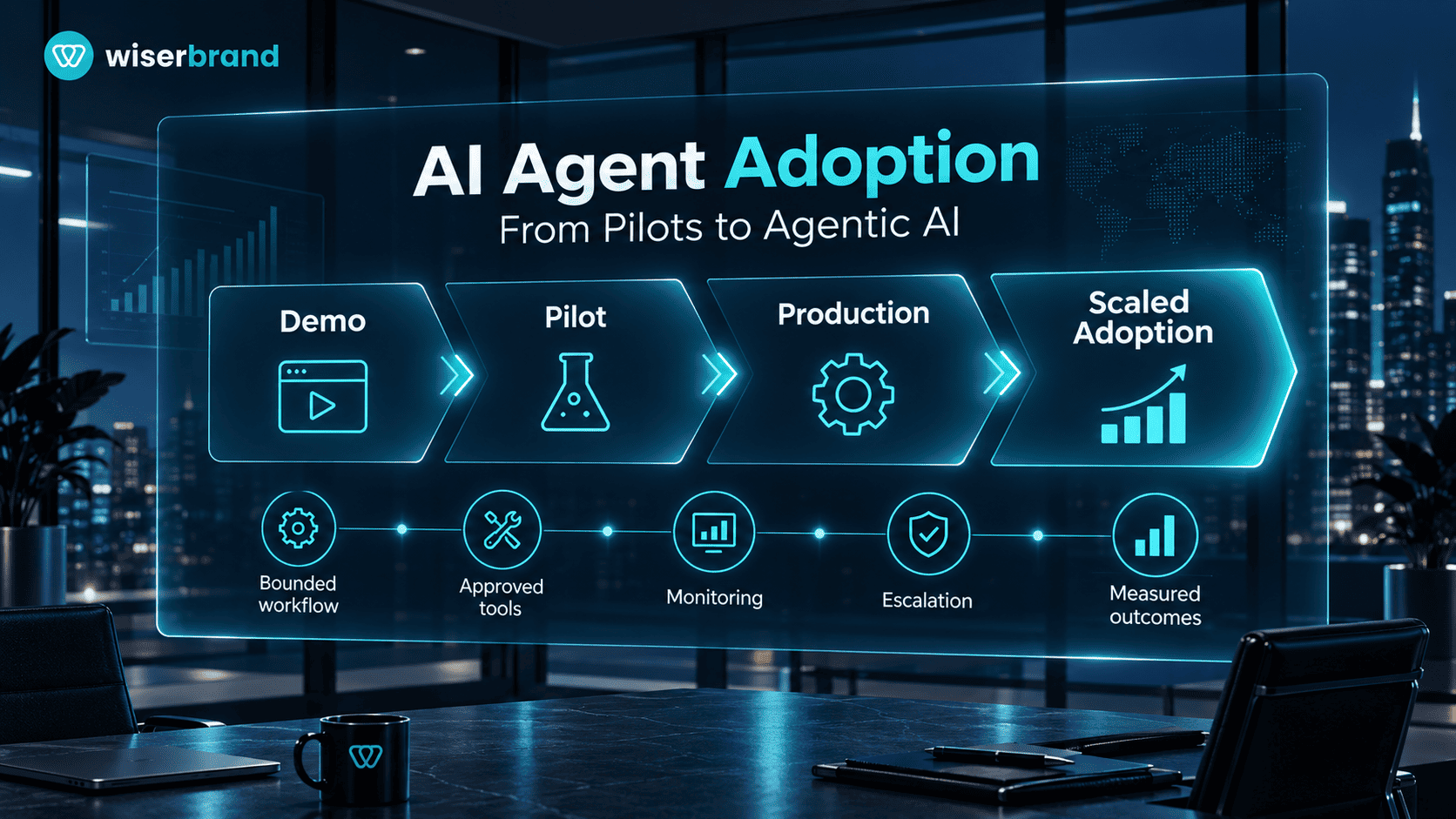
AI agent adoption begins when a business moves beyond isolated agent demos and puts agents into defined workflows with data access, tools, permissions, owners, and measurable outcomes. The key transition is not from one model to a more capable model. It is from experimentation to an operating system in which an agent has a bounded role, connected systems execute approved actions, exceptions have a route, and the business can decide if the workflow deserves more authority.
That distinction is especially important for agentic AI. An AI assistant may summarize or draft for a person. An AI agent can interpret context, select actions, and call tools toward a defined objective. More authority creates more operational value only when the organization also adds stronger validation, access control, observability, and recovery paths. A pilot should therefore answer two questions at once: does the agent perform the task well enough, and can the company operate the workflow safely and economically after the pilot team steps away?
What AI Agent Adoption Means in Practice
AI agent adoption is the controlled use of agents in repeatable business work. A deployed agent normally needs instructions, context, tools or APIs, state, permissions, stopping rules, monitoring, and an escalation path. The model may choose among permitted steps, but software systems still perform the actual record updates, messages, searches, or transactions.
The adoption boundary should be explicit. A research agent that reads approved sources and prepares an account brief has a different risk profile from an agent that can change prices or issue refunds. Both may use the same model family, but the second workflow needs stronger approval and rollback controls because the action has a larger business consequence. Setting that boundary is the first task in an AI adoption program that involves agents: decide what the agent may read, what it may propose, and what only a person or a deterministic rule may execute.
How Much Agent Adoption Is Real
Enterprise interest is broad, but survey results should be read within their sample. PwC’s AI Agent Survey, fielded among 308 U.S. business executives in late April 2025, reported that 79% said AI agents were already being adopted in their companies, and that 66% of those adopting agents saw increased productivity. Trust varied sharply by task type. Respondents reported the highest trust for data analysis (38%), and much lower trust for financial transactions (20%) and autonomous employee interactions (22%). That gap supports staging authority by task rather than setting one autonomy level for every workflow.
The same survey does not show that most U.S. businesses run production-grade agent systems. PwC noted that broad adoption often reflects agentic features embedded in enterprise applications, and that fewer than half of adopters reported rethinking operating models (45%) or redesigning processes around agents (42%). For planning purposes, that difference matters. Access to an agent feature is a usage signal. Workflow redesign, operating ownership, and production controls are stronger signs of adoption depth.
Why Pilots and Production Adoption Are Different
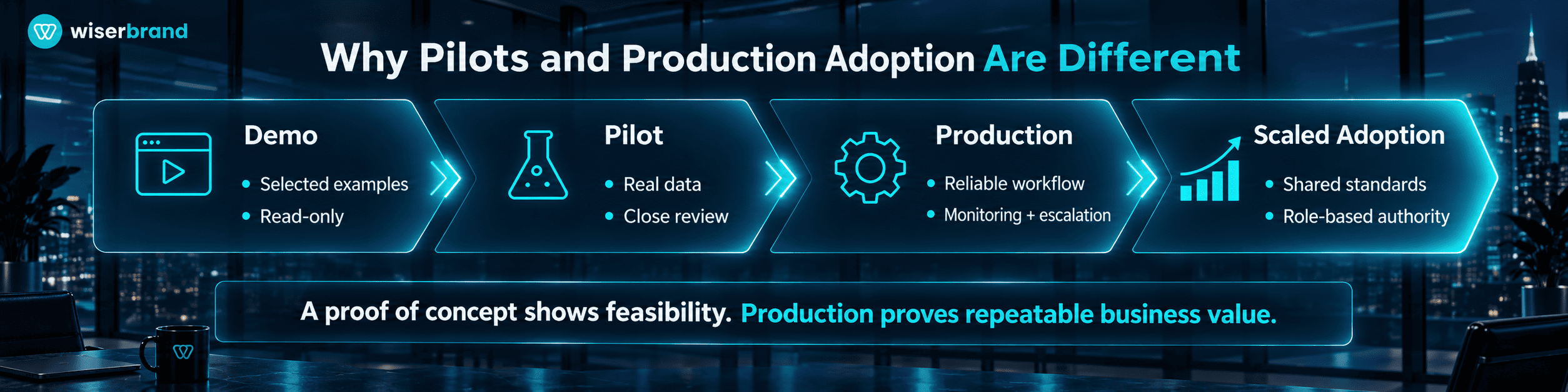
A pilot narrows the environment so the team can learn quickly. It may use a small user group, limited records, manual setup, extra human review, and a restricted action set. Production removes some of that scaffolding. The workflow must survive stale data, duplicate events, permission failures, unavailable tools, unexpected inputs, model changes, and normal staffing conditions.
| Stage | Primary Question | Agent Authority | Evidence Needed |
|---|---|---|---|
| Demo | Can the model perform the core reasoning task on selected examples? | Usually read-only or no system access. | Representative examples and basic output quality. |
| Pilot | Can the workflow perform useful work with real data under close observation? | Limited tools, narrow users, explicit approvals. | Completion quality, human edits, exceptions, latency, and cost. |
| Production | Can the business operate the workflow repeatedly without the pilot team supervising every step? | Approved read and write scope with monitoring and escalation. | Reliability, tool success, policy compliance, incidents, business metrics, and support ownership. |
| Scaled Adoption | Can proven agent workflows share standards without creating uncontrolled access or operating overhead? | Role-based authority by workflow and risk tier. | Portfolio value, reuse, operating cost, auditability, and change-control performance. |
This maturity path also explains why a proof of concept should not be judged by the same metrics as a production deployment. A PoC can answer technical feasibility. A production decision needs evidence about complete workflow behavior.
A Practical Adoption Path for AI Agents
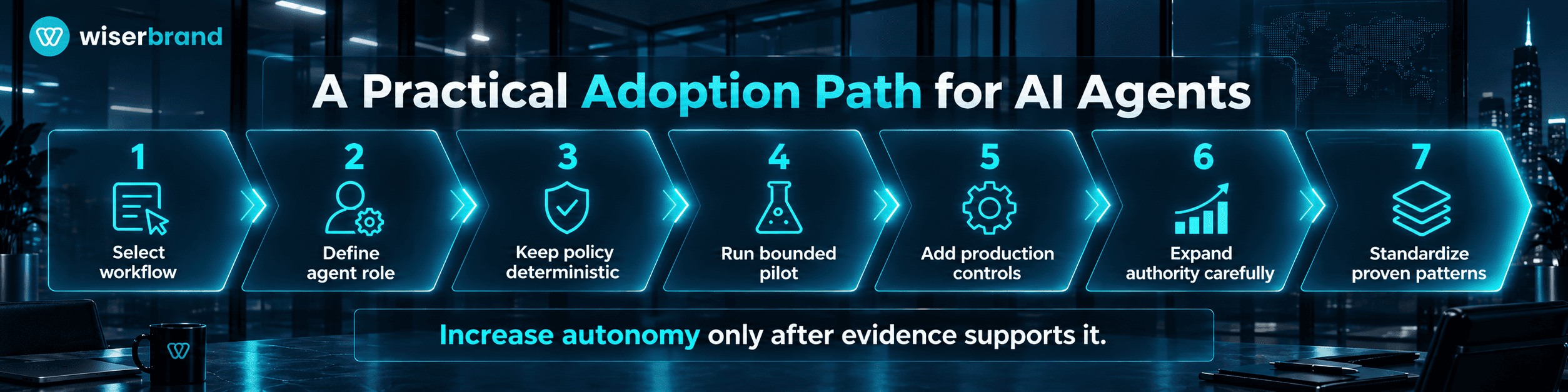
Anthropic’s guidance on building effective agents recommends finding the simplest solution that fits the task and increasing complexity only when needed, noting that agentic systems trade latency and cost for task performance. That principle is useful for adoption planning: a company should prove that model-controlled tool use is necessary before it accepts the added latency, cost, state, and failure paths of a more agentic design.
- Select one workflow with a measurable problem. Document the trigger, source systems, manual work, exception rate, current cycle time, and business owner.
- Define the agent role. Specify what requires interpretation, which tools are allowed, what data the agent may retrieve, and what completion means.
- Keep fixed policy deterministic. Required fields, consent rules, pricing thresholds, approval limits, identity checks, and irreversible gates should not depend on free-form model judgment.
- Run a bounded pilot. Use representative cases, restricted permissions, logging, and clear human review while the team studies failure patterns.
- Add production controls. Introduce retries, timeouts, deduplication, tool-result validation, escalation, incident ownership, and the ability to pause or roll back the workflow.
- Expand authority only after evidence supports it. A successful drafting agent does not automatically qualify for autonomous execution. Test each new action scope as a new risk boundary.
- Standardize proven patterns. Reuse identity, logging, evaluation, permission, and deployment controls across new agents while keeping business rules specific to each workflow.
An AI readiness assessment is useful before the pilot when the organization needs to map source systems, data quality, access constraints, skills, and candidate workflows across several departments.
Where Agentic AI Fits Better Than Standard Automation
Agents add value when the workflow contains ambiguity that fixed rules cannot express economically. Examples include interpreting unstructured requests, selecting among several research paths, comparing conflicting documents, planning a sequence of tool calls, or preparing a recommendation from changing context.
Standard automation remains a better fit for stable calculations, required approvals, exact routing rules, schema validation, record locks, scheduled transfers, and other deterministic steps. An agent should not own a decision simply because a model can produce an answer.
| Workflow Pattern | Best Starting Point | Reason |
|---|---|---|
| Predictable sequence with fixed conditions | Deterministic workflow | The same rules should produce the same path. |
| Unstructured input that needs classification or extraction | AI step inside a deterministic workflow | The model handles variable content while the workflow controls execution. |
| Task needs dynamic tool selection or multi-step planning | Bounded AI agent | The model benefits from controlled responsibility for choosing the next step. |
| High-impact action with uncertain reasoning | Agent recommendation plus approval | A reviewer keeps final authority over the material action. |
Integration Is Where Agent Adoption Becomes Operational
An agent that cannot access the right systems is still an assistant. Operational agents need controlled connections to the CRM, ERP, help desk, database, document store, email service, or other tools that contain the workflow state. The integration layer should validate parameters, check permissions, record results, and return explicit errors when a tool call fails.
For cross-system workflows, AI integration services can connect agents to existing applications while keeping source-of-truth ownership and read or write permissions explicit.
Careful Adoption Requires Bounded Authority
Careful adoption of agentic AI services depends on named controls rather than a general commitment to oversight. Stating that a human is in the loop settles nothing on its own. The design needs to specify when a person enters, what evidence the reviewer sees, what can be edited or rejected, how long the workflow waits, and what happens after rejection or timeout.
Least-privilege access is equally important. A lead-research agent may need read access to CRM and public company data but no permission to delete contacts. A support agent may draft a refund recommendation while a deterministic rule checks the amount and routes requests above a threshold for approval.
NIST’s Generative AI Profile for the AI Risk Management Framework describes generative-AI-specific risks and actions that organizations can use alongside the broader AI RMF. For agent workflows, the practical implication is to treat model behavior, connected tools, data access, and downstream actions as one risk surface rather than evaluating the generated text alone.
What Changes When an Agent Gets More Tools
Each new tool changes the failure space. Read-only retrieval mainly creates risks around data exposure and poor grounding. A CRM write tool adds incorrect-record and permission risk. Email or messaging tools add customer-facing risk. Financial tools add approval, reconciliation, and recovery requirements.
Untrusted content belongs in the same risk surface. Once an agent reads inbound email, web pages, uploaded files, or supplier portals, the retrieved text can carry instructions aimed at the model. Treat retrieved content as data rather than instruction, validate tool parameters against a schema before execution, and keep high-impact tools behind approval so an injected instruction cannot reach a payment, a deletion, or a customer commitment on its own.
Tool expansion should therefore be treated like a deployment change. Test representative calls, invalid parameters, partial failures, permission denial, duplicated events, and recovery. Record tool names and versions so an incident review can reconstruct what the agent was allowed to do at the time.
How Workforce Adoption Affects the Technical Design
People do not simply consume agent output. They correct it, reject it, route exceptions, change source records, and sometimes work around the system. Those behaviors should be part of the design rather than treated as a training problem after launch.
A useful rollout gives users a clear reason to trust or challenge an output. Show the source data that shaped the recommendation, record edits and overrides, and distinguish agent failures from source-data failures. User feedback is valuable only when the team can trace it to a specific workflow state and decide what should change.
Metrics for AI Agent Adoption
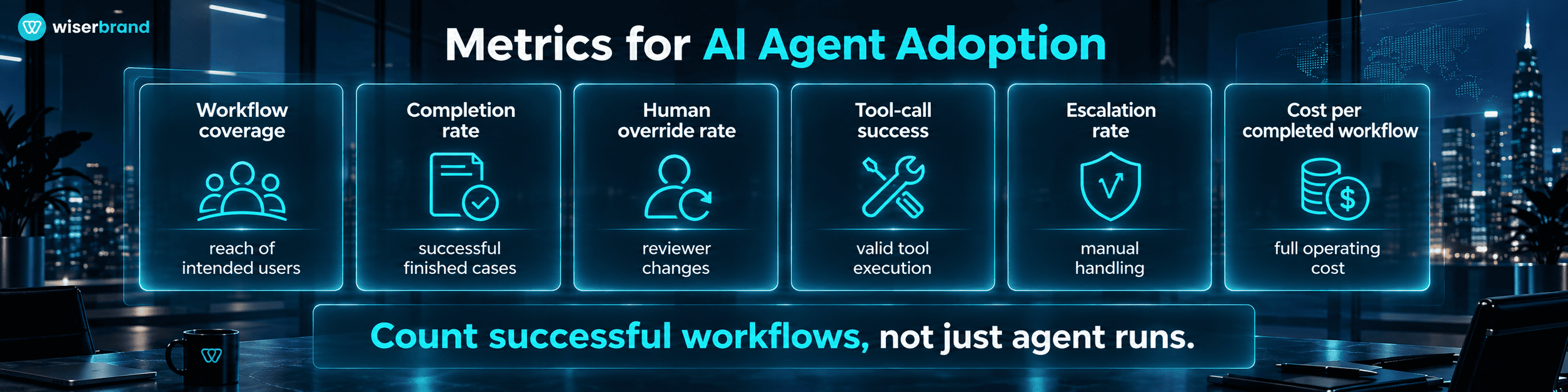
A strong scorecard combines adoption, quality, workflow, cost, and risk metrics. Counting agent runs alone rewards activity even if the workflow creates rework.
| Metric | What It Measures | Why It Matters |
|---|---|---|
| Active users or workflow coverage | Breadth of usage | Shows if the agent is reaching the intended operating group. |
| Workflow completion rate | Share of started cases that reach the intended outcome | Separates successful work from abandoned or failed agent runs. |
| Human override rate | Share of recommendations or actions changed by reviewers | Reveals quality gaps, policy ambiguity, or cases that still need judgment. |
| Tool-call success rate | Share of tool requests that execute with valid parameters and expected results | Finds integration problems that model-quality scores miss. |
| Escalation rate | Share of cases moved to manual handling | Shows workload transfer and identifies categories the agent cannot handle reliably. |
| Cost per completed workflow | Model, tool, infrastructure, and review cost per successful case | Tests if a technically working system is economical to operate. |
| Incident or policy violation rate | Cases that cross an approved risk boundary | Measures control performance as agent authority grows. |
Metrics should be segmented by workflow type, user group, model version, and risk tier when those differences are material. An overall average can hide a category that fails often but represents only a small share of volume.
Common Reasons Agent Pilots Fail to Scale
The Pilot Depends on Manual Cleanup
A pilot may look accurate because the project team quietly fixes missing fields, selects good examples, or resolves integration failures by hand. Production testing should record those interventions as part of the workflow cost.
The Agent Has No Clear Source of Truth
When CRM, ERP, spreadsheet, and email records disagree, the agent needs a rule for which system owns each field. Asking the model to infer truth from conflicting records creates hidden policy.
The Business Owner Is Missing
Technical teams can operate the service, but a business owner must decide which outcomes are acceptable, which exceptions matter, and if the workflow still deserves funding after launch.
The Team Measures Text Quality Instead of Workflow Quality
A well-written response can still be the wrong business action. Evaluation should include tool selection, execution result, policy compliance, final workflow state, and human correction.
When Not to Expand an Agent Pilot
Do not expand an agent because the demo is impressive. Keep the scope narrow or redesign it when integration failures dominate, the model cannot get reliable context, review cost removes the expected benefit, users frequently override the output for valid reasons, or the next action requires authority the organization cannot monitor or reverse.
A stop decision can be valuable. It prevents a weak use case from becoming operating debt and can reveal that the real need is better data, a deterministic workflow, or a smaller assistant rather than an agent.
Frequently Asked Questions
What Is the Difference Between AI Agent Adoption and AI Adoption?
AI adoption covers many forms of artificial intelligence, including prediction, assistants, search, generation, and automation. AI agent adoption specifically concerns systems in which a model has controlled responsibility for selecting or sequencing actions and can interact with tools toward a defined objective.
Does Every Agent Pilot Need Write Access?
No. Many pilots should start read-only or draft-first. Write access is justified only when the action is necessary to prove the workflow and the team has validation, permission, logging, and recovery controls for incorrect changes.
What Does Careful Adoption of Agentic AI Services Require?
It requires a bounded workflow, least-privilege tool access, deterministic policy checks, explicit human approval for high-impact actions, defenses against untrusted input, failure handling, observability, evaluation, and a rollback or remediation path. The control set should match the consequence of an incorrect action.
How Should Companies Compare Agent Platforms?
Compare platforms against the workflow: tool connectivity, permission model, state handling, evaluation support, observability, deployment options, cost, latency, and operational ownership. A broader feature list is not automatically a better fit.
When Is an Agent Ready for Wider Rollout?
Expand after the workflow meets predefined quality, completion, cost, risk, and operating criteria across representative cases. The team should also have named owners for incidents, model or prompt changes, integrations, and business policy.
Final Thoughts
AI agent adoption should progress by authority, not by hype. Start with a bounded workflow, prove that the agent can interpret the task, prove that connected tools behave reliably, and keep high-impact execution behind explicit controls. Broader rollout is justified only after the organization can operate the workflow without depending on the pilot team for constant rescue.
For companies moving from a pilot into connected production work, AI agent development services can cover workflow design, tool integration, permission boundaries, evaluation, and controlled deployment. Generative AI consulting is a better starting point when the main decision is still which agent use cases should be built at all.