Summary
Business Challenge
- A confirmed load did not mean confirmed data
Each time a dispatcher agreed terms with a broker, the rate confirmation arrived as a document – not as data. Someone still had to open it, read it, and key every field into the system by hand. Across a full day of loads, that added up to hours of work that produced nothing new – just moved information from one format to another.
- Manual entry meant errors and billing delays
Miskeyed rates, delayed invoicing, and occasional disputes with brokers over agreed terms were a recurring cost. Each error required time to identify and resolve, adding friction to relationships that depend on speed and trust.
- Finance and operations were always running behind
Load margins were invisible until data was entered. That made real-time decision-making impossible and meant financial reporting was always a step behind actual operations.
What We Did
We focused on automating the rate confirmation workflow end to end – replacing manual dispatcher entry with an AI agent that handles extraction, validation, and system integration without human involvement in routine cases.
1
Workflow and document audit
Mapped the full rate confirmation process – how documents arrived from brokers, what data needed to be captured per load, and where delays and errors were concentrated in the existing manual workflow.
2
Automated rate confirmation processing
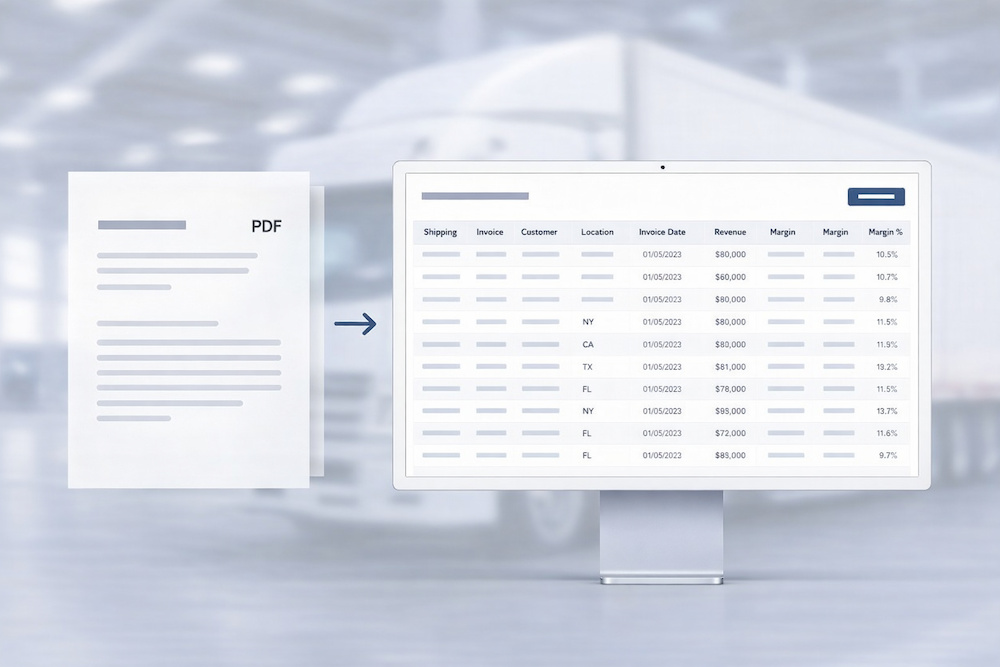
Built an AI agent that reads incoming rate confirmations autonomously, parsing carrier, rate, load details, and terms from unstructured broker documents and routing structured data directly into the client’s system. No dispatcher input required. The agent handles the full extraction-to-entry cycle, including non-standard document formats.
3
Decision-layer validation
The agent checks for rate mismatches, missing fields, and anomalies against expected parameters before data reaches downstream systems. Clean records pass through automatically; exceptions are flagged for human review.
4
System integration
Connected the agent’s output to the client’s existing operations platform, making confirmed loads, rates, and margins available in real time to both finance and operations without any manual handoff.