What Is AI Adoption? Meaning, Planning, and Implementation Guide

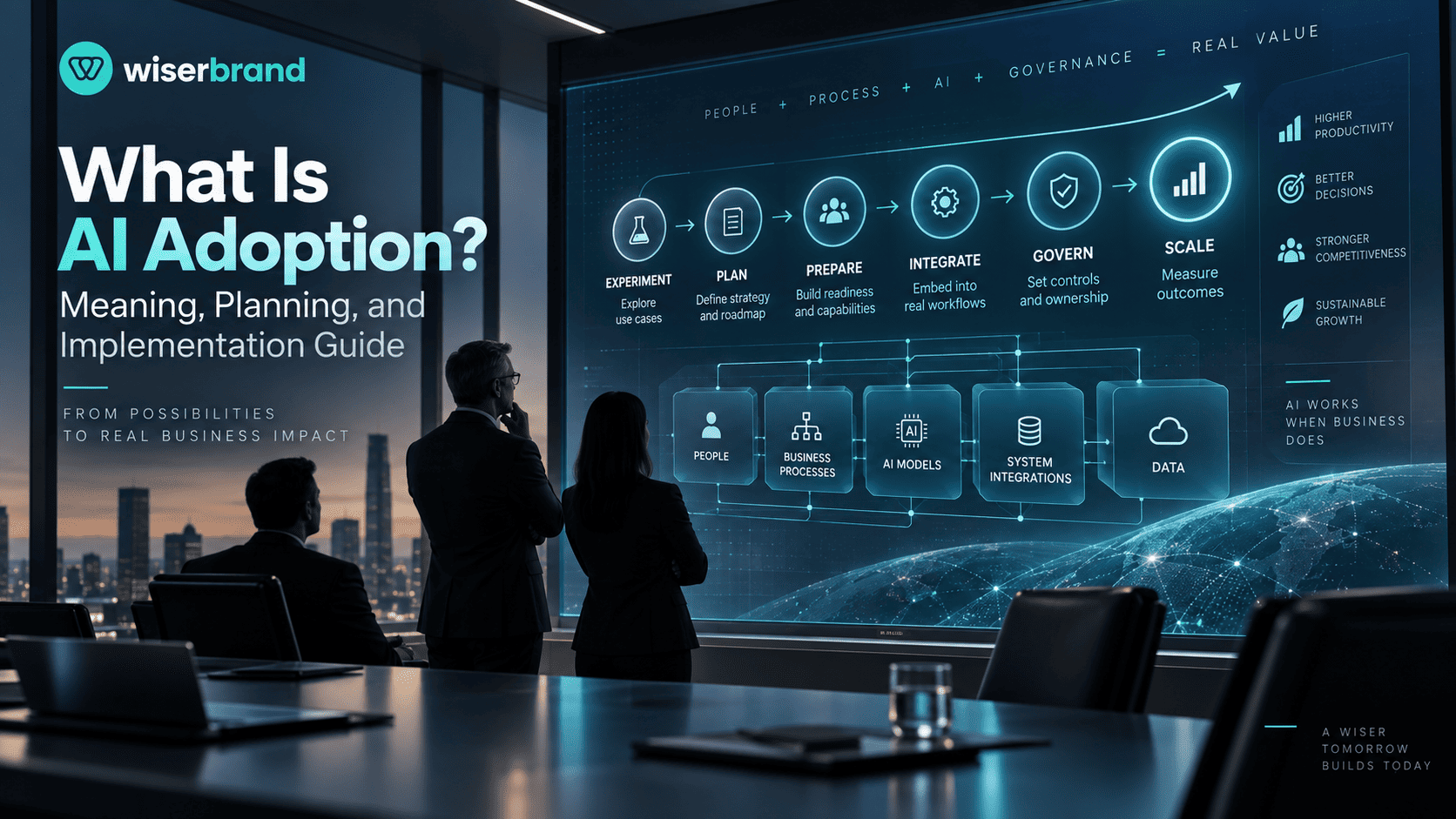
What is AI adoption in practical business terms? AI adoption is the process of putting artificial intelligence into real workflows, products, and decisions so people can use it consistently and the organization can measure the result. Adoption starts before deployment and continues after launch. It includes selecting suitable use cases, preparing data and systems, defining ownership, setting controls, training users, measuring outcomes, and deciding which pilots deserve a wider rollout.
That definition matters because buying an AI tool is not the same as adopting AI. A team may have access to a chatbot while its core processes remain unchanged. A company may also run several pilots without creating a repeatable operating model. For business leaders looking for AI adoption meaning, the useful question is not how many AI products the company owns. The useful question is which workflows have changed, who owns them, what controls are in place, and what evidence shows that the change is worth keeping.
What AI Adoption Means Inside a Business
AI adoption combines a technology decision with an operating decision. The technology side covers models, data, applications, integrations, and infrastructure. The operating side covers process ownership, user behavior, approvals, risk, support, and measurement. A deployment becomes meaningful adoption when both sides work together.
Adoption rates look very different depending on how a survey defines AI use. A Federal Reserve analysis of U.S. AI adoption compared three surveys and found estimates ranging from about 18% of firms in Census business survey data to a Survey of Business Uncertainty estimate that 78% of the labor force works at firms that have adopted AI. Those surveys target different respondents and count different units, so the numbers answer different questions. Internal programs face the same measurement problem. Counting licenses, prompts, or employee logins does not tell leadership how deeply AI is embedded in business operations.
A practical definition therefore has three parts: a business workflow changes, AI performs a defined role inside that workflow, and the organization can evaluate the result. The AI role may be narrow, such as summarizing a call, classifying a request, extracting document data, or drafting a response. Adoption does not require an autonomous agent, and many valuable use cases should keep execution under deterministic rules or human approval. That three-part test is also how structured AI adoption services scope an engagement: name the workflow, define the AI role inside it, and agree how the result will be evaluated before selecting a model or platform.
How Adoption Differs From Experimentation and Basic Automation
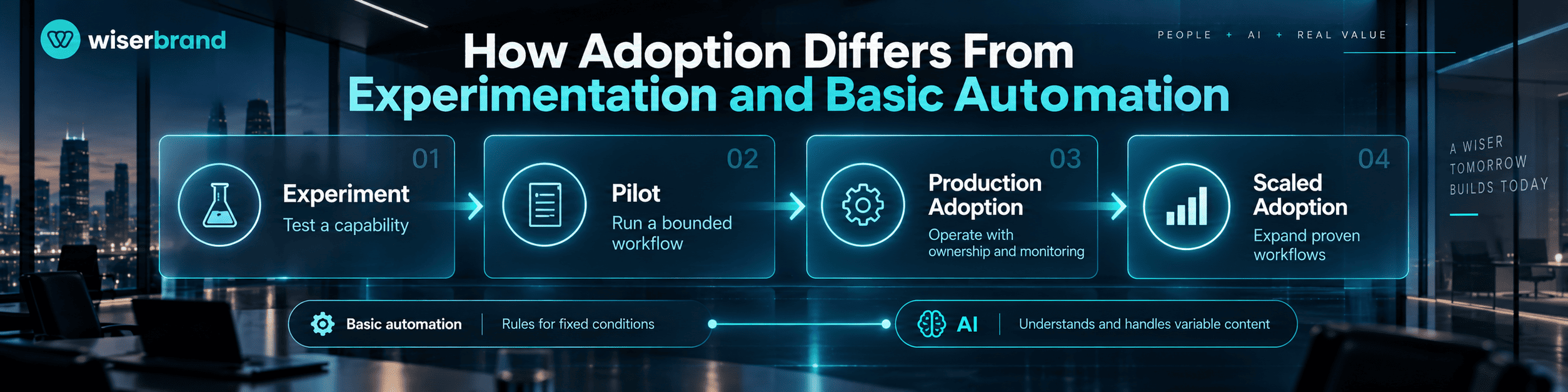
Experimentation asks if an AI capability can help. Adoption asks if the organization can run the capability reliably in normal work. The difference appears in ownership, data access, controls, integration, user behavior, and measurement.
| Stage | What Happens | What Is Still Missing |
|---|---|---|
| Experiment | A team tests prompts, a model, or a vendor feature on sample tasks. | Stable workflow ownership, controls, and production measurement may not exist yet. |
| Pilot | A bounded workflow runs with representative data and defined users. | The organization still needs evidence on reliability, cost, adoption, and exception handling. |
| Production Adoption | The workflow runs under defined permissions, monitoring, support, and business ownership. | The next question is if the workflow should expand to more users, actions, or business units. |
| Scaled Adoption | Several proven workflows use shared governance, integration, evaluation, and operating practices. | Scale still requires portfolio review so weak use cases do not remain active by default. |
Basic automation also differs from AI adoption. A deterministic workflow follows explicit rules. For example, a CRM can assign every lead from a specific region to a defined owner. AI becomes useful when the step requires interpretation, such as summarizing an unstructured inquiry or classifying intent from text. The strongest design often combines both: AI handles variable content, while rules enforce fields, thresholds, permissions, and approvals.
What an AI Adoption Plan Must Decide
An AI adoption plan turns a broad intention into a sequence of decisions. The plan should connect each proposed use case to a business problem, a responsible owner, required data, system changes, risk controls, a pilot boundary, and measurable success criteria.
The plan should also show what will not be automated. Fixed policy decisions, irreversible actions, and high-impact customer, financial, legal, HR, or access changes need stronger controls than low-risk drafting or summarization. The level of governance should follow the consequence of an error, not the novelty of the model.
Companies that need a structured starting point can use an AI readiness assessment to map data, systems, security constraints, team capability, and candidate workflows before committing to a build.
A Seven-Step Sequence for Building the Plan
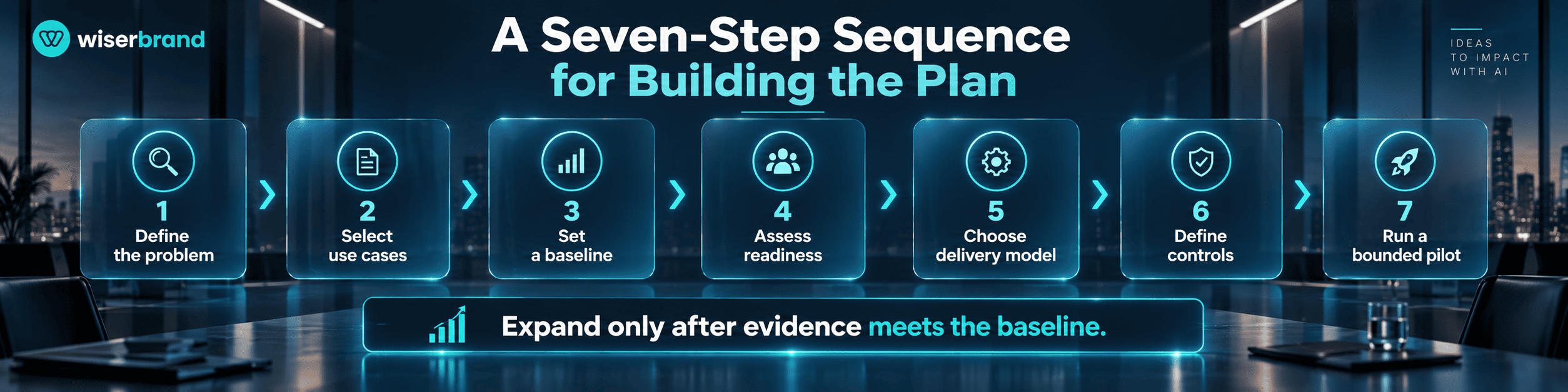
A useful plan is specific enough to guide investment but flexible enough to change when pilot evidence contradicts the original assumption. The following sequence keeps the work tied to operating needs.
- Define the business problem. Describe the current workflow, volume, delays, rework, failure points, and the decision that leadership wants to improve.
- Select candidate use cases. Favor work with repeatable inputs, clear ownership, accessible data, and a measurable outcome. Exclude ideas that depend on unavailable data or undefined authority.
- Set a baseline. Record the current cycle time, manual handling, error or rework rate, cost drivers, conversion point, backlog, or other metric that the proposed workflow can realistically affect.
- Assess data and system readiness. Identify sources of truth, required fields, integrations, access permissions, stale data risks, and gaps that would block a pilot.
- Choose the delivery model. Decide if the use case fits a native feature, a standard workflow, a vendor product, a custom model call, or an agent connected to business tools.
- Define controls before the pilot. Set approval points, tool permissions, fallback behavior, logging, escalation, and the conditions that stop the workflow.
- Run a bounded pilot and compare results with the baseline. Expand only after the workflow meets agreed quality, reliability, cost, and business criteria.
An AI strategy consulting engagement can help when leadership has many candidate use cases but no shared way to rank value, feasibility, data readiness, and risk.
How to Choose the First AI Use Case
The first use case should be important enough to prove value but bounded enough to diagnose failure. A workflow with clear inputs and a clear owner is usually easier to evaluate than a cross-company initiative with many systems and undefined decision rights.
| Criterion | Good Pilot Signal | Warning Signal |
|---|---|---|
| Business Pain | The current process consumes visible time, creates backlog, or delays an important decision. | The use case exists mainly because a new AI feature is available. |
| Data | Required records are accessible, sufficiently current, and tied to a known source of truth. | Inputs are scattered, conflicting, or inaccessible. |
| Action Boundary | The system can draft, classify, retrieve, or take a limited action with clear approval rules. | The desired outcome requires broad authority across sensitive systems. |
| Measurement | The team has a baseline and can define a success metric before launch. | Success is described only as greater innovation or more AI usage. |
| Ownership | A business owner and technical owner are named. | Responsibility is spread across a committee with no operating owner. |
Good early candidates often include internal search, document extraction, ticket classification, sales research, meeting preparation, content review, or exception triage. These workflows still need controls, but their output can often be reviewed before a material business action occurs.
What Readiness Looks Like Before Implementation
Readiness does not mean every dataset is perfect or every system has been modernized. It means the selected use case has enough structure to run a controlled test. Leadership should know which data the workflow needs, who may access it, which system owns the record, what the model is allowed to do, and how the result will be checked.
Capacity to run that test is not evenly distributed. A U.S. Census Bureau Business Trends and Outlook Survey analysis found that AI use among U.S. businesses stayed between 17% and 20% from December 2025 through early May 2026, and that 37% of firms with at least 250 employees reported using AI compared with less than 20% of firms with four or fewer employees. A workflow that is practical for a large company with dedicated data and security teams may be too costly to operate in the same form at a smaller organization.
Readiness should be evaluated at the workflow level. A company can be ready to deploy an AI assistant for internal document retrieval while being unready for an agent that changes customer records. Those projects need different data quality, permission, reliability, and review controls.
How AI Adoption Moves From Pilot to Production
Moving from pilot to production changes the standard of evidence. A pilot can tolerate manual setup, a narrow group of users, and close observation. Production requires repeatable access, monitoring, documented ownership, stable integration behavior, and a plan for failures.
The implementation team should test more than ideal examples. Missing fields, duplicate events, stale records, permission errors, unavailable APIs, malformed model output, and ambiguous requests reveal how the workflow behaves when normal operations become messy. Retry rules and escalation paths should be defined before wider release.
When the chosen use case needs CRM, ERP, help desk, database, or document-system connections, AI integration services can connect the model or agent to existing systems with explicit read and write boundaries.
Governance Belongs Inside the Adoption Process
Governance should shape the use case before deployment, not appear as a final approval step. The NIST AI Risk Management Framework is a voluntary framework intended to help organizations manage AI risks across design, development, deployment, and use. Its lifecycle framing fits adoption planning because risk changes as a system gains more data access, users, and authority.
For a low-risk summarization assistant, useful controls may include source restrictions, output review, and logging. For an agent that can update CRM or financial records, the control set should also cover role-based access, tool allowlists, schema validation, approval thresholds, and rollback or remediation paths. Set that control set while the use case is being designed, then revisit it each time the workflow gains new data, new users, or a new action.
Metrics for Measuring AI Adoption
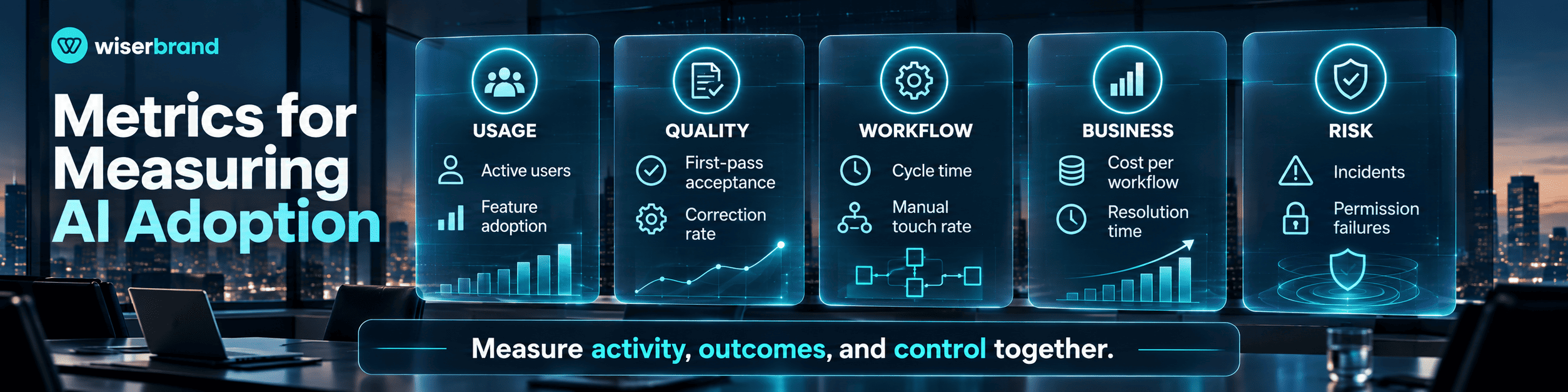
Adoption is not proven by the number of prompts sent or accounts provisioned. Usage metrics show activity. Business and workflow metrics show if the new operating method is useful.
| Metric Layer | Examples | What It Answers |
|---|---|---|
| Usage | Active users, frequency, feature adoption | Are people using the workflow? |
| Quality | First-pass acceptance, correction rate, grounded response rate | Is the output useful enough to act on? |
| Workflow | Cycle time, completion rate, escalation rate, manual touch rate | Does the process move with less friction or rework? |
| Business | Conversion, resolution time, backlog, cost per completed workflow | Does the operating result improve enough to justify ongoing cost? |
| Risk | Policy violations, permission failures, incidents, rollback events | Is the workflow staying inside its approved boundaries? |
A balanced scorecard matters because one metric can hide another problem. Lower response time is not useful if correction rates rise. Higher automated completion is not useful if teams spend more time fixing incorrect records. The baseline and acceptable trade-offs should be agreed before the pilot starts.
Common Mistakes That Stall Adoption
Starting With a Tool Instead of a Workflow
Tool-first programs create scattered experiments because the organization tries to find work for a capability it already bought. Start with a business problem and compare several ways to solve it, including non-AI automation.
Scaling Before the Pilot Has a Baseline
Without a baseline, leadership cannot tell if a faster-looking process created real value or simply moved work into review and exception handling. Measure the current process first.
Treating User Training as the Whole Change Plan
Training explains how to use a tool. Adoption also changes ownership, review habits, escalation, performance expectations, and sometimes job design. Managers need to define how the workflow fits normal work after the training session ends.
Giving AI More Authority Than the Use Case Requires
A drafting or recommendation workflow does not need broad write access. Start with the smallest action scope that can prove the use case, then expand permissions only when testing and operating evidence support the change.
When to Pause or Stop an Initiative
Pausing is a valid outcome. Stop or redesign the pilot when source data cannot support the task, the expected benefit is smaller than the integration and review cost, users reject the workflow for valid operational reasons, or the workflow requires authority that the organization is not prepared to govern.
A failed pilot can still improve the AI adoption plan if the team records why the use case failed. The finding may point to a data program, process redesign, smaller automation scope, or a different technology choice. Treating every pilot as something that must scale encourages weak use cases to survive.
Frequently Asked Questions
What Is AI Adoption in One Sentence?
AI adoption is the controlled integration of AI into real business workflows so people can use it repeatedly and the organization can measure quality, operating impact, cost, and risk.
What Is the Difference Between AI Adoption and AI Implementation?
Implementation is the technical work required to configure, build, integrate, test, and deploy a specific solution. Adoption is broader. It also covers workflow ownership, user behavior, governance, support, measurement, and decisions about expansion or retirement.
How Long Should an AI Adoption Plan Cover?
Use a planning horizon that supports several decision points rather than one fixed transformation date. A practical plan can sequence readiness work, one or more pilots, production validation, and scale decisions while leaving room to stop weak use cases.
Does AI Adoption Require AI Agents?
No. Many adoption programs begin with assistants, search, classification, extraction, prediction, or deterministic workflows that call AI for one step. Agents are useful when the model needs controlled responsibility for choosing actions or paths across a workflow.
How Should a Company Measure Adoption Success?
Measure both usage and workflow outcomes. Useful measures include active use, first-pass acceptance, manual handling, completion rate, cycle time, business impact, incidents, and cost per completed workflow. The exact set should match the process being changed.
Final Thoughts
The practical answer to what is AI adoption is simple: it is a change in how work gets done, supported by technology and governed like an operating process. Start with one workflow, document the baseline, define the AI role and action boundary, test the failure cases, and scale only after the evidence supports a wider rollout.
For organizations still choosing the first use cases, generative AI consulting can help turn an initial opportunity list into a pilot scope with defined data, architecture, controls, and success criteria.