AI Adoption Framework: A Practical Guide for Enterprise AI Implementation

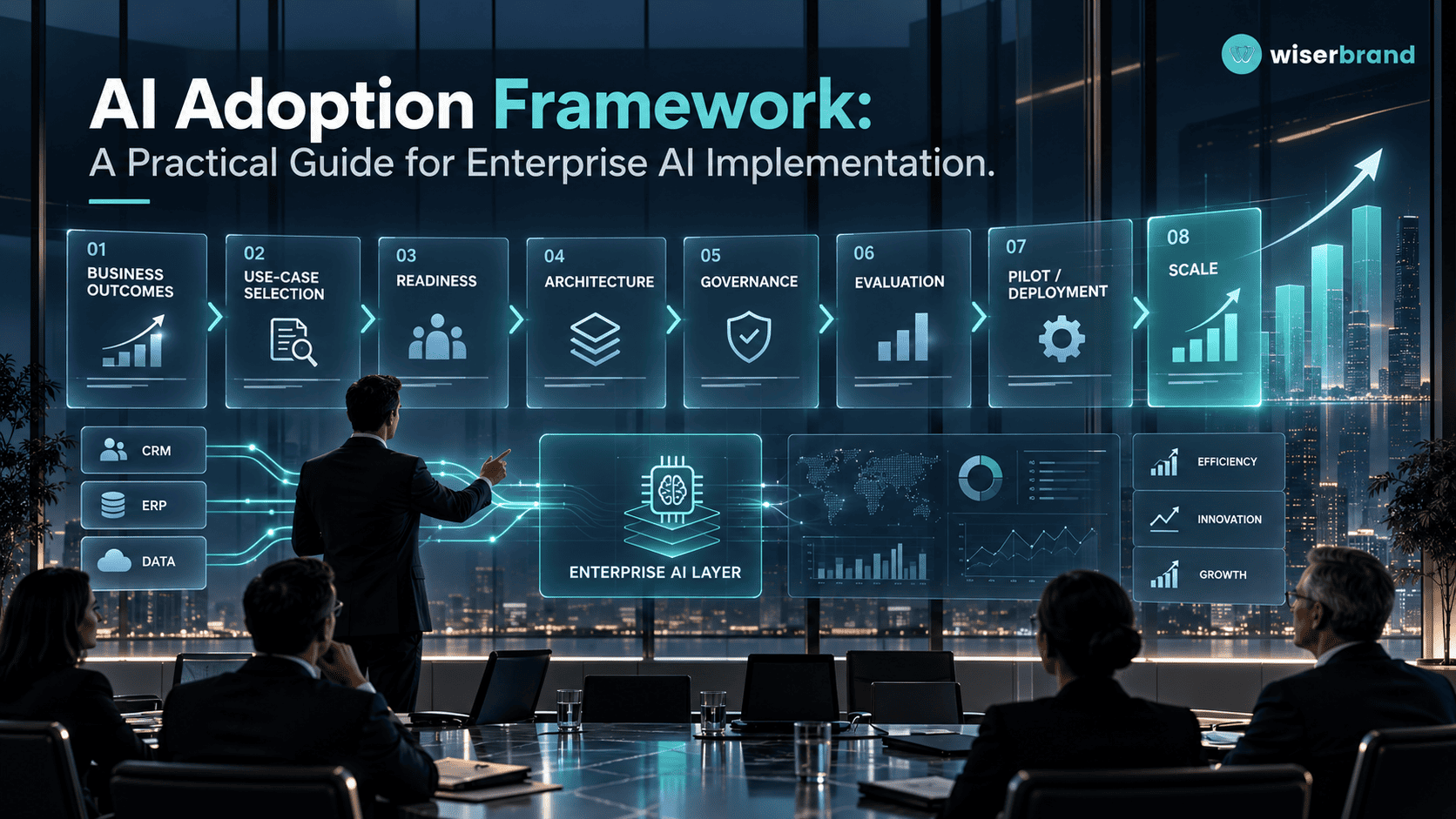
An AI adoption framework is a structured way to move from business objectives to controlled production use of AI. It connects use-case selection, process ownership, data and integration readiness, architecture, risk controls, evaluation, and operating metrics. For an enterprise, the framework should also define decision gates so a pilot advances only when the workflow meets agreed quality, risk, and business criteria.
The framework is not a model-selection checklist. It starts with the work the organization wants to change, identifies the systems and data that support that work, assigns authority between AI and deterministic rules, and sets ownership for deployment and ongoing operations. This guide provides a practical enterprise AI adoption framework that teams can apply to generative AI, predictive models, copilots, and bounded AI agents.
What an AI Adoption Framework Should Cover
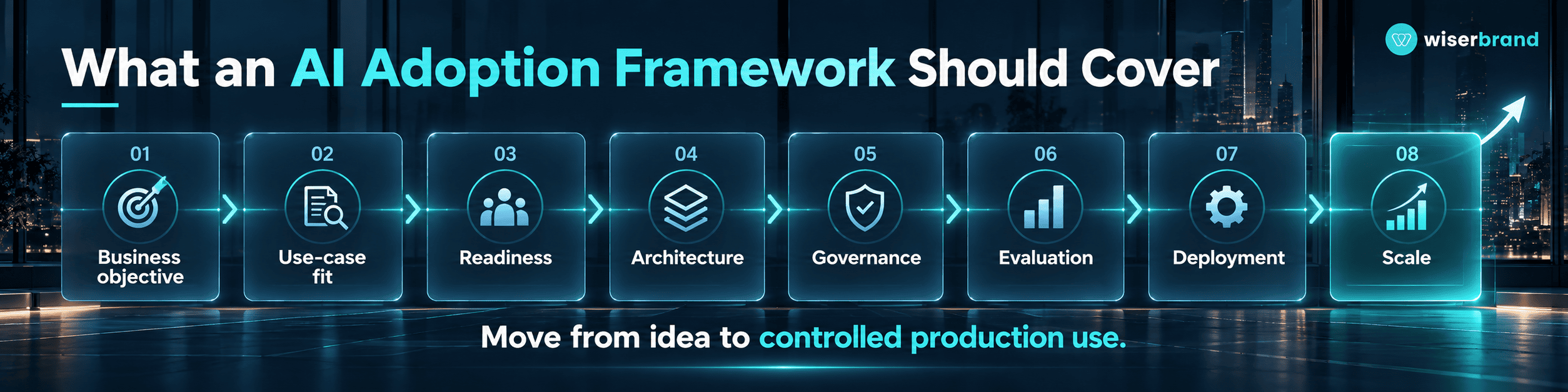
A useful framework covers both the implementation lifecycle and the operating model after launch. Microsoft’s Cloud Adoption Framework organizes its guidance into strategy, plan, ready, and adopt methodologies followed by govern, secure, and manage, and it now carries separate scenarios for AI adoption and for AI agents. An enterprise AI program can use the same lifecycle logic without being tied to one cloud or model provider.
| Framework Area | Decision to Make | Evidence Needed Before Moving On |
|---|---|---|
| Business objective | Which workflow or decision should change? | Baseline, owner, volume, cost or service metric |
| Use-case fit | Does the task need AI or ordinary automation? | Task variability, interpretation need, error tolerance |
| Readiness | Can the organization support the workflow? | Data access, integration path, skills, ownership, risk tier |
| Architecture | Which model, platform, tools, and rules will perform each step? | System map, source of truth, permission model, failure path |
| Governance | What may the AI read, recommend, and change? | Policy, approvals, logs, escalation, review criteria |
| Evaluation | What counts as an acceptable result? | Test set, quality threshold, tool success, business baseline |
| Deployment | How will production exposure be limited at first? | Pilot cohort, rollback plan, monitoring, incident owner |
| Scale | What evidence justifies broader use? | Workflow results, risk results, operating cost, owner sign-off |
The important design choice is the gate between stages. If the data source is unreliable, the team should not compensate by changing prompts. If the workflow has no owner, production deployment should wait. If a pilot improves speed but raises rework or policy violations, scaling should wait until the trade-off is resolved. Organizations running several initiatives at once can use an AI adoption program to keep the portfolio, governance model, and gate decisions in one place instead of repeating them per project.
Start With Business Outcomes and a Baseline
The first step in an AI adoption framework is to define the business problem in operational terms. Avoid goals such as “use AI in customer service” or “add AI to finance.” Instead, define the workflow, the current constraint, and the outcome that should change.
For example, a service team might target ticket triage because manual sorting delays assignment. A finance team might target invoice exception preparation because analysts spend time gathering the same supporting records for each review. A sales team might target account research because representatives repeatedly assemble CRM history, company data, and recent activity before meetings.
Record the baseline before introducing AI. Relevant measures may include cycle time, processing time, manual handling rate, error or rework rate, backlog, conversion, resolution, or cost per completed workflow. The baseline gives the pilot a comparison point and prevents a polished demonstration from becoming a substitute for evidence.
Organizations that need to rank opportunities across functions can use AI strategy consulting to connect business priorities with workflow economics, feasibility, data readiness, risk, and investment criteria.
Select Use Cases by Fit, Not Novelty
AI is useful when a task contains variable inputs or interpretation that fixed rules handle poorly. Examples include classifying unstructured requests, extracting information from different document formats, summarizing large records, drafting context-specific content, or recommending a next step from several signals.
Deterministic automation remains the better fit for fixed calculations, mandatory validation, stable routing rules, access checks, approval thresholds, and irreversible action gates. A production workflow can combine both. The model handles interpretation, while application logic controls the parts that must behave predictably.
| Candidate Signal | Good Fit | Warning Sign |
|---|---|---|
| Task structure | Variable inputs with a repeatable objective | The task is already a simple rule or lookup |
| Data | Required context is accessible and owned | Critical data is missing, stale, or disputed |
| Outcome | Correctness can be evaluated | No one can define an acceptable result |
| Risk | Authority can be bounded and exceptions can escalate | An error would cause an irreversible high-impact action |
| Volume | The workflow occurs often enough to measure | The task is rare and cheap to handle manually |
| Ownership | A business and technical owner are assigned | No team owns post-launch quality or incidents |
What an Enterprise AI Adoption Readiness Framework Should Measure
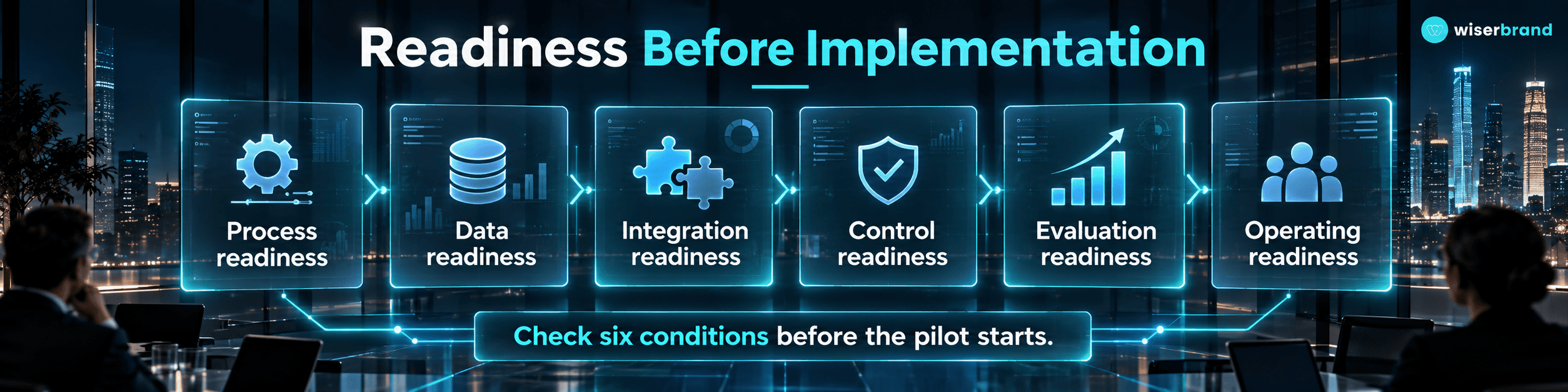
Readiness assessment sits between use-case selection and architecture. An enterprise AI adoption readiness framework should measure the conditions that determine if a use case can move into implementation: process clarity, data quality, integration access, security constraints, model and engineering capability, governance ownership, evaluation capability, and change-management capacity.
Readiness is use-case specific. A company may be ready for an internal knowledge assistant but not for an AI workflow that can update pricing or release payments. The first use case may need read access and answer evaluation. The second needs stricter identity, authorization, transaction controls, auditability, and human approval.
- Process readiness: trigger, inputs, decision points, exceptions, and completion condition are documented.
- Data readiness: required sources are accessible, current enough for the task, and assigned to an owner.
- Integration readiness: APIs, events, identity, and system permissions support the required read and write paths.
- Control readiness: policy rules, approval boundaries, and escalation paths are defined before the model receives authority.
- Evaluation readiness: test cases, acceptance criteria, and baseline metrics exist before pilot results are reviewed.
- Operating readiness: business, technical, data, and incident owners are named for production.
A formal AI readiness assessment is useful when several dependencies are uncertain or when leaders need a comparable way to rank multiple AI initiatives before funding implementation.
Map Data, Systems, and the Source of Truth
The next stage of the AI adoption framework is a system map. Identify where each required data element originates, which application owns the authoritative value, which systems may be modified, and what happens when information conflicts.
A customer workflow might use CRM records, support history, contracts, product data, and knowledge articles. An invoice workflow might use ERP records, purchase orders, approval rules, vendor data, and the source document. The model should receive only the context needed for its task, not unrestricted access to every connected system.
Integration design also needs failure behavior. Define timeouts, retries, duplicate-event handling, schema validation, and a manual path for unavailable systems. WiserBrand’s AI integration services are relevant when the target workflow spans CRM, ERP, ecommerce, document repositories, internal databases, or other applications that need controlled data exchange.
Choose the Smallest Architecture That Fits the Workflow
Architecture should follow workflow requirements. A native AI feature may be enough when the task stays inside one platform. A model call inside a deterministic workflow may be enough for classification or drafting. Retrieval-augmented generation may be appropriate when the model needs approved knowledge at run time. An agent becomes useful when the model must select among allowed tools or decide which bounded step to take next.
Do not add agent coordination solely because the technology is available. More components create more state, permission boundaries, retries, latency, evaluation work, and failure paths. The implementation should use the least complicated architecture that meets the workflow and control requirements.
| Architecture Pattern | Use When | Main Control Need |
|---|---|---|
| Native platform AI | The task and data remain inside one business platform | Platform permissions and output review |
| Model step in workflow | One bounded step requires classification, extraction, or drafting | Schema validation and deterministic next-step rules |
| RAG assistant | Answers depend on approved, changing knowledge | Source permissions, retrieval quality, citation evaluation |
| Single agent with tools | The model must choose among a small set of actions | Tool allowlist, parameter validation, stopping rules |
| Multi-agent system | Separating roles or permissions materially improves the workflow by more than the coordination cost it adds | State, handoffs, conflict handling, per-agent permissions |
Build Governance Into the Framework Before the Pilot
Governance is part of implementation design, not a review added after the workflow works. The NIST AI Risk Management Framework is a voluntary resource for organizations that design, develop, deploy, or use AI systems. NIST released AI RMF 1.0 in January 2023 and has said the framework is being revised, so teams should check the current version before writing policy around it. Its risk-management approach suits an enterprise framework because controls can be matched to the context and authority of each workflow.
For implementation, define who owns the use case, what data the system may access, which actions it may request, what deterministic checks run before execution, which cases require human approval, what is logged, and who responds to incidents. Higher-impact actions need stronger gates than low-risk internal drafting or summarization.
Human Approval Should Be an Explicit Workflow Step
A human-in-the-loop control should identify the exact gate. The reviewer needs the proposed action, supporting context, and the ability to approve, edit, or reject it. The workflow also needs a timeout or escalation path if nobody responds. Saying that a “human is involved” without these mechanics does not define a control.
How a Generative AI Adoption Framework Differs
A generative AI adoption framework needs extra controls because generated text, code, images, and other outputs are probabilistic and may be influenced by untrusted context. NIST’s Generative AI Profile for the AI RMF extends the AI RMF with guidance focused on risks specific to generative AI systems.
In practice, a generative AI adoption framework should add evaluation for factual grounding and output quality, source and retrieval checks where RAG is used, input and prompt-injection defenses for untrusted content, sensitive-data controls, human review for material customer-facing or business commitments, and version tracking for prompts, models, tools, and policies.
The same framework should separate content generation from execution. A model may draft a refund response, contract summary, or account recommendation, but a connected application or a human performs the business action. This distinction keeps authority visible and makes testing more meaningful.
For GenAI programs that need architecture, evaluation, workflow integration, and governance planning together, generative AI consulting can support the move from a selected use case to a controlled implementation plan.
Run the Pilot as a Test of the Whole Workflow
A pilot should test the completed operating process, not only model outputs. Create representative cases before deployment, including normal examples, edge cases, missing data, conflicting data, malformed inputs, permission failures, tool outages, and cases that should escalate.
- Freeze the scope. The business owner defines the users, workflow category, systems, data, and actions included in the test.
- Set acceptance thresholds. The team records the minimum quality, workflow completion, control, and business results required to proceed.
- Test offline first. The team evaluates model outputs, tool selection, parameter validity, policy behavior, and expected escalation on a controlled test set.
- Deploy to a limited production cohort. The workflow runs on live volume while risky write actions stay behind approval until observed performance justifies a different boundary.
- Review failures and corrections. The team captures tool failures, human edits, rejected recommendations, and cases that reached the wrong path.
- Compare with the baseline. The business owner reviews full workflow performance, not only model accuracy.
- Decide to scale, revise, or stop. The decision depends on the acceptance thresholds set in step 2, not on the impression the pilot left.
Decide how the team stops the workflow before it starts. A named owner should be able to pause the trigger, disable a specific tool, revert a prompt or model version, and reverse or remediate actions already taken. Where an action cannot be reversed, the approval gate becomes the primary control.
Define Roles Before Production
Enterprise AI crosses business, data, software, security, and risk responsibilities. The framework needs named owners so model quality, source data, integrations, policies, and incidents do not fall into an undefined shared responsibility.
| Role | Primary Responsibility | Key Production Question |
|---|---|---|
| Business owner | Workflow outcome and operating policy | Does the workflow solve the intended business problem? |
| Product or program owner | Scope, priorities, rollout, and change decisions | Which change is approved for the next release? |
| Technical owner | Architecture, integrations, deployment, reliability | Can the workflow recover from tool and system failures? |
| Data owner | Source quality, access, retention, definitions | Is the context current and authorized for this use? |
| Risk or security owner | Control requirements and incident criteria | Which actions or data need stronger restrictions? |
| Operations reviewer | Human approvals and exception handling | What happens when the AI recommendation is rejected? |
Use Decision Gates to Control Scale
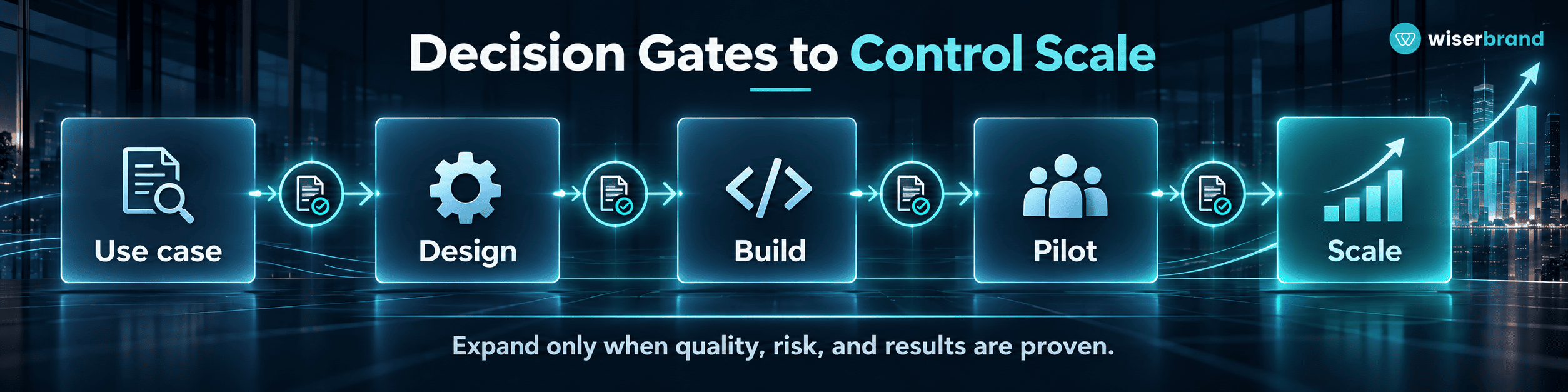
The AI adoption framework should define evidence required at each expansion point. A team may move from prototype to pilot after offline tests meet the acceptance threshold. It may move from pilot to a larger cohort after workflow quality, control performance, and business metrics remain acceptable under production conditions.
| Gate | Minimum Evidence | Stop or Revise Signal |
|---|---|---|
| Use case to design | Named business owner, recorded baseline, identified data path, measurable outcome | No owner, no baseline, or the task does not need AI |
| Design to build | Documented architecture, permission model, control set, and test plan | Critical data or integration dependency unresolved |
| Build to pilot | Offline evaluation passed against the acceptance thresholds, failure paths defined, rollback method and monitoring in place | Unsafe action path or quality below the agreed threshold |
| Pilot to scale | Workflow completion rate, output quality, control performance, operating cost, and the target business metric all measured under production conditions | Rework, incidents, or operating cost erase the intended value |
| Scale to broader authority | Results stable across the measurement period plus an approved change to the permission model | Authority expands faster than evaluation coverage |
Metrics for Enterprise AI Adoption
Track metrics at four levels. Model metrics show output quality. Workflow metrics show if the process reaches completion. Control metrics show how often people override, reject, or escalate AI behavior. Business metrics show if the workflow changes the operational result that justified the investment.
- Model: classification accuracy, extraction quality, grounded response rate, structured-output validity.
- Workflow: completion rate, cycle time, manual handling rate, tool success rate, exception rate.
- Control: human override rate, approval rate, policy violation rate, permission-denial events, incident count.
- Business: cost per completed workflow, backlog, SLA performance, conversion, resolution, throughput, or another use-case-specific outcome.
Do not optimize one measure in isolation. A higher automation completion rate is harmful if incorrect actions rise. Lower escalation may indicate better performance, or it may indicate that the system fails to route risky cases. Interpret the metric set together and segment results by use case, risk tier, model version, or workflow category when those differences matter.
Three Ways an AI Adoption Framework Fails in Practice
An AI adoption framework usually breaks down for one of three reasons, and each of them is a sequencing error rather than a technology problem.
Treating Adoption as a Technology Rollout
A model license does not define the workflow, the source of truth, the exception path, the owner, or the business metric. When a program distributes access and calls that adoption, usage rises while no process changes, so the organization has activity data and no evidence of operational value.
Skipping Data and Integration Readiness
Teams sometimes tune prompts around problems caused by stale records, missing identifiers, or inaccessible systems. Prompt changes cannot correct a wrong source value, so the fix holds only until the next case reaches the same bad record. Repair the source and the integration path before optimizing model behavior.
Scaling Before the Approval Model Is Clear
Broader rollout increases the number of records, users, and actions the workflow touches, so an unclear approval boundary that was tolerable in a pilot becomes an unbounded exposure at production volume. Define which actions remain draft-only, which require approval, and which may execute automatically before adding users, data, or tools.
FAQ
What Is an AI Adoption Framework?
An AI adoption framework is a structured process for selecting AI use cases, checking readiness, designing architecture and controls, testing a pilot, deploying to production, and deciding when to scale. A strong framework links each stage to evidence and an accountable owner.
How Is an Enterprise AI Adoption Framework Different From a Project Plan?
An enterprise AI adoption framework defines reusable decision criteria, governance, architecture principles, ownership, and scale gates across multiple initiatives. A project plan schedules the work for one implementation. The framework should guide project plans without forcing every use case into the same technical design.
What Should Be Checked Before an AI Pilot Starts?
Confirm the workflow scope, baseline, source-of-truth data, integration path, permissions, approval rules, exception handling, test cases, acceptance thresholds, monitoring, rollback method, and named owners. A missing dependency should be resolved before it becomes a production failure.
Does Every AI Use Case Need an Agent?
No. A native AI feature or a single model step inside a deterministic workflow is often sufficient. Use an agent when the model needs controlled responsibility for selecting tools or steps. Add multiple agents only when role separation, permission boundaries, parallel work, or independent evaluation justify the extra coordination.
How Do You Know When an AI Pilot Is Ready to Scale?
Scale after the pilot meets predefined thresholds for workflow completion, quality, risk controls, operating cost, and the target business metric. The production owner should also have monitoring, incident response, change control, and rollback procedures in place.
Final Thoughts
A practical AI adoption framework creates a sequence of decisions: choose a measurable workflow, verify readiness, map data and systems, select the smallest suitable architecture, define authority and controls, test the whole workflow, and scale only when production evidence meets the agreed gate. Apply the framework to one candidate workflow first and turn unresolved readiness gaps into a concrete implementation backlog.
When the selected workflow needs a purpose-built layer across several systems rather than another standalone tool, AI software development can cover the architecture, integrations, controls, and evaluation the framework calls for.