Image Recognition in Retail: Use Cases, Technology, and Rollout Plan

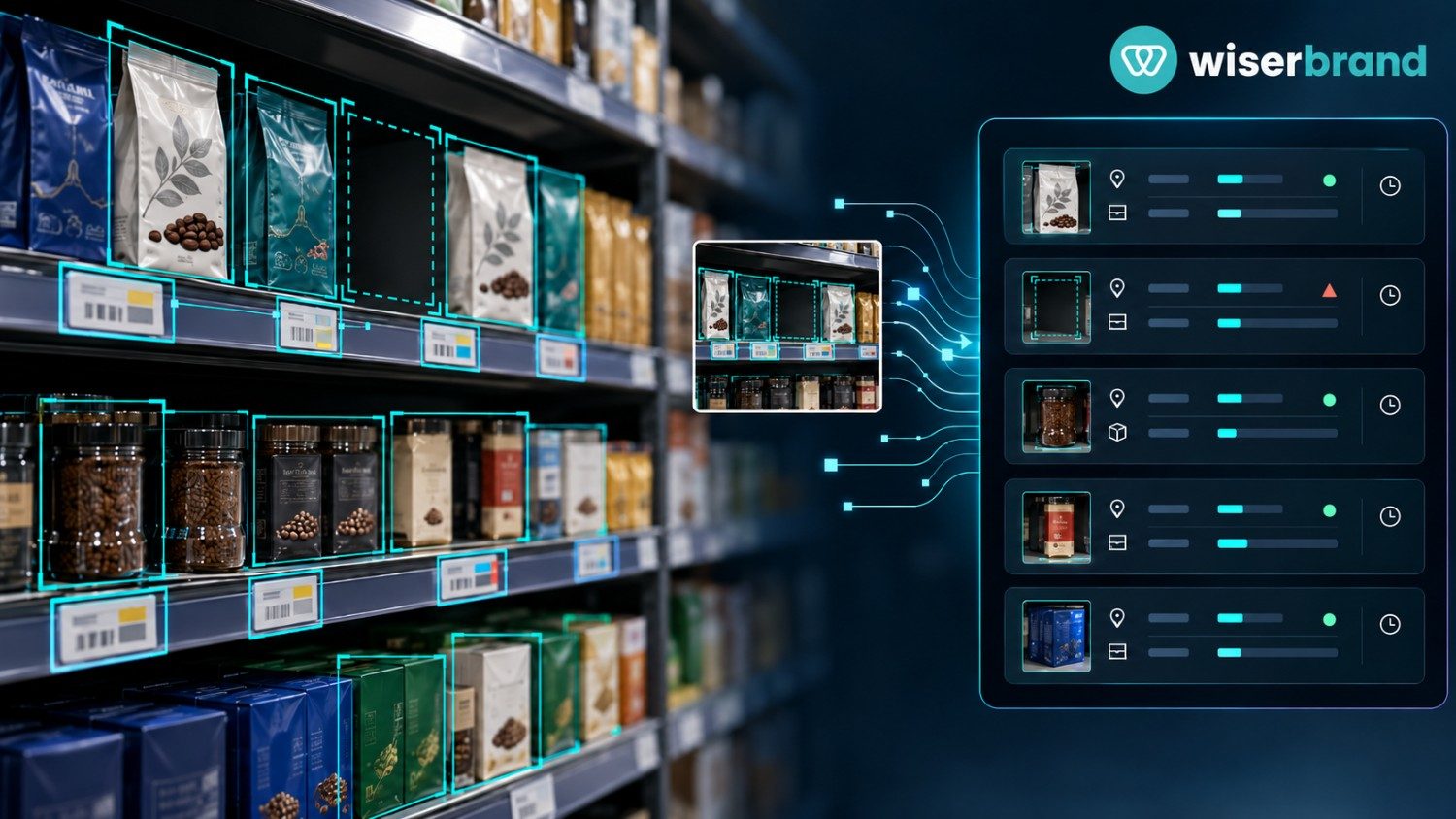
Image recognition in retail turns photos and video of shelves, displays, and checkout areas into structured records: which products are present, where they sit, and if prices and labels match the plan. Most chains learn about empty facings and misplaced products between audits, and a manual audit samples a small share of a store. The gap between the shelf and the system record becomes a lost sale, a bad price, or a task nobody owns. The useful unit is a task with store, fixture, product, and due time. This guide explains the technology behind a shelf photo, where the work fits in store and CPG operations, how to compare capture methods, and how to run a measurable pilot. It also covers the limits that decide if a pilot deserves a rollout: dense shelves, privacy, integration, and the cost of false alerts.
What Image Recognition Does in a Store
Retail image recognition technology assigns labels, locations, or text to pixels. In a store, it becomes five jobs. A classifier labels a whole image. An object detector draws a box around each product. Segmentation traces the visible edge of a facing or display. Optical character recognition reads a price tag. Visual search matches a shopper photo to a catalog item. Each task needs different labels, accuracy measures, and a workflow.
| Task | What It Reads | What It Returns | Retail Example |
|---|---|---|---|
| Classification | Whole image | Labels | Shelf type |
| Detection | Image and boxes | Products and locations | Facings, voids |
| Segmentation | Pixel edges | Masks | Share of shelf |
| OCR | Text regions | Price and promo text | Label checks |
| Visual search | Query and catalog | Ranked matches | Photo to SKU |
The output is a record, not a decision. A product model can count facings without identifying a shopper. Shelf records belong to inventory and merchandising. Person data belongs to a separate legal and security review.
How a Shelf Photo Becomes a Store Task
The pipeline behind image recognition in retail has seven stages. A model failure often starts in capture or master data.
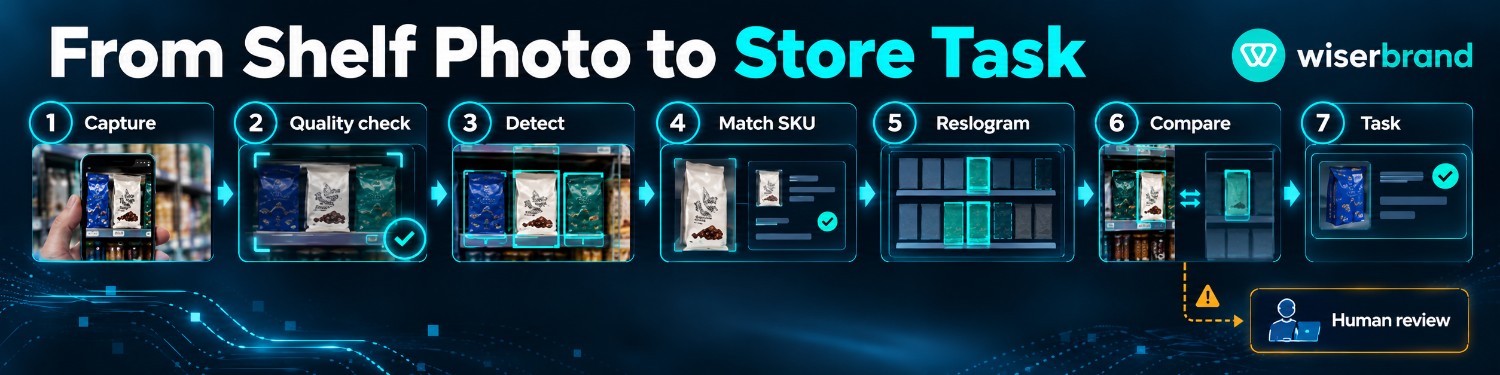
- Capture. An associate, fixed camera, or robot records store, fixture, timestamp, and pose.
- Quality check. Blur, glare, crop, and angle are scored before inference; a bad frame goes back.
- Detection. The model finds products, facings, gaps, labels, and display elements.
- SKU match. Detections meet the item file through barcode, label text, shape, and context. New items go to review.
- Realogram. The system maps what is on the fixture now, not what the plan says.
- Comparison. The realogram is checked against planogram, price file, and promotion calendar.
- Task. A difference becomes an event with store, fixture, SKU, condition, confidence, image reference, owner, and due time. Low-confidence cases wait for a person; the task goes to the workforce app and replenishment to ERP.
The model does not retrain from every photo. A new SKU needs labeled examples, a versioned dataset, and an evaluation run. A task is useful only if the receiving system records the outcome.
Where Retail Teams Use Image Data
The strongest commercial case is CPG retail execution, where image recognition in retail and CPG audits replace a sample of manual visits. For broader retail AI workflows, see generative AI use cases across retail operations.
| Use Case | Capture Method | Main KPI | Main Risk |
|---|---|---|---|
| Shelf monitoring | Mobile, fixed, or robot | On-shelf availability | False alerts, task fatigue |
| CPG field audit | Rep photo or guided capture | Share of shelf, compliance | Sampling, image quality |
| Checkout and loss prevention | Cameras, shelf sensors | Unscanned item rate | Privacy, false accusation |
| Catalog and visual search | Studio or user images | Conversion, returns | Catalog coverage |
| Virtual try-on | User photo or 3D model | Engagement | Fit, consent |
Shelf Monitoring and On-Shelf Availability
Shelf monitoring looks for empty facings, low stock, misplaced products, and price or promo labels that do not match the plan. A camera, robot, or associate can capture the fixture. The useful output is a task with the facing, label, and due time, not a red box.
On-shelf availability means the product is available where the shopper expects it. Shelf images show the physical state; the inventory record shows what the system believes. A 2026 ECR Retail Loss review, funded by vendors, reports that only about 35% of grocery records were correct (ECR Retail Loss research on inventory records). That is a reason to compare the photo with the record, not a benchmark for one chain.
Simbe says HomeBase cut controllable out-of-stocks by 58% (vendor-reported, baseline not stated). Ask for the count method, control stores, and period before treating that as a forecast.
Retail Execution and Store Audits for CPG Brands
CPG teams use image recognition for retail execution because one visit samples a small part of a large estate. A rep photographs a shelf, the system reads facings, share of shelf, planogram compliance, and price tags, and the visit is scored against a Perfect Store model.
Image recognition for retail execution changes the rep's job from counting to fixing. It flags a missing SKU, empty facing, or misplaced promo, but the rep decides what to resolve and records the outcome. Retail execution with image recognition works when capture is guided: the app asks for a straight-on shot, checks blur and glare, and rejects a bad frame.
Retail audit image recognition needs clear KPI definitions. Share of shelf is brand facings divided by total category facings. Planogram compliance is the share of positions that match the layout. Assortment compliance is the share of listed SKUs present. Price compliance is the share of checked labels that match the price file. Promo compliance is the share of planned materials in place.
| Audit KPI | What the Photo Shows | Action It Triggers |
|---|---|---|
| Share of shelf | Brand and total facings | Reorder or reset |
| Planogram compliance | Position of each SKU | Reset fixture |
| Price compliance | Label and price file | Replace label |
| Promo compliance | POSM presence and placement | Install or move material |
| Voids | Empty position with a listed SKU | Fill from back stock |
Vendors include Trax, FORM, BeMyEye, ParallelDots, Scandit, Pensa, and Zebra.
Checkout and Loss Prevention
Amazon's Just Walk Out combines cameras, shelf weight sensors, a 3D store model, and catalog images to link a pick to a virtual cart. Amazon announced in January 2026 that it would close its Go and Fresh stores and still markets the technology to third parties (company statement, January 27, 2026). That model needs a controlled entrance, a curated assortment, and a disputes process.
Most retailers do not need a checkout-free store. A simpler use is loss prevention: compare items on the belt or bag with the transaction and flag a possible unscanned item for human review. False positives are the main cost, and a flag is not proof of theft. Keep product recognition separate from face recognition and biometric categorization.
Catalog Imagery, Visual Search, and Virtual Try-On
In a catalog project, we built a neural image pipeline for a furniture retailer with more than 200,000 products. It classified silhouette versus interior shots, recognized 16+ image types, selected and cropped the lead image, and applied super-resolution below the marketplace minimum. The client reports up to 80% less manual image work (client-reported, no baseline published).
We also built a vision and NLP gift finder for a jewelry retailer for a 10,000-SKU catalog. The model was fine-tuned on 42,000 product images, had a p95 inference time of 1.1 seconds, and was retrained monthly for new SKUs. Both are catalog and online-retail projects, not in-store shelf monitoring. Visual search and virtual try-on use similar matching, but fit and consent need separate testing.
Mobile Photos, Fixed Cameras, and Robots Compared
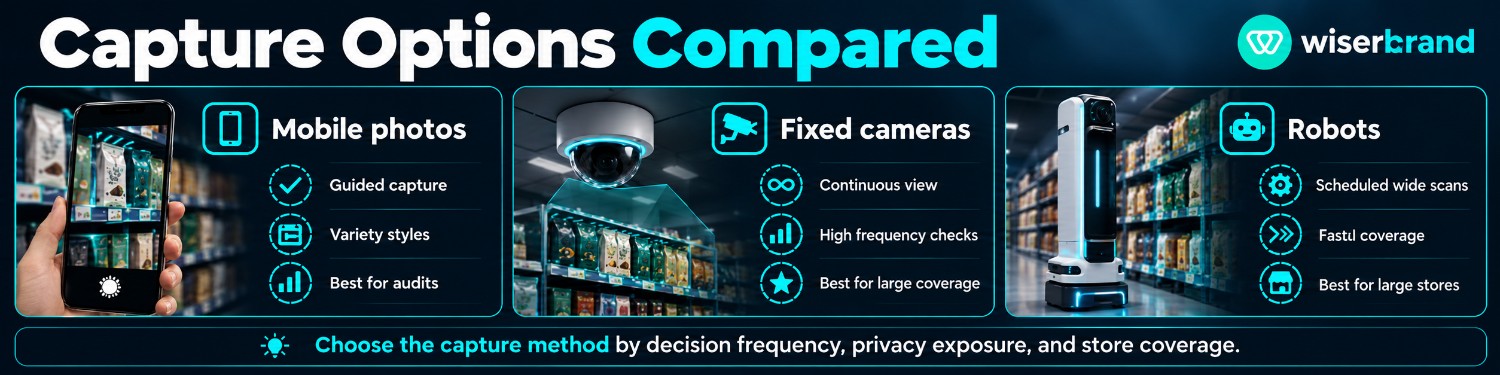
A capture plan for image recognition in retail starts with a decision, not a camera. A daily out-of-stock decision usually needs a fixed camera or robot. A weekly CPG audit can use a rep's phone. Accuracy from different vendors is not comparable because test sets and tasks differ.
| Capture Method | Coverage and Frequency | What Drives Accuracy | Privacy Exposure | Typical Fit |
|---|---|---|---|---|
| Mobile photos | Weekly or monthly visits | Guided capture, light, training | Faces in background | CPG audits, long tail |
| Fixed cameras | Continuous or scheduled | Pose, calibration, light | Shoppers and staff | High-value categories |
| Robots | Scheduled aisle scans | Navigation, height, clean shelves | Shoppers in aisle | Large stores, repeat scans |
| Handheld terminals | Task-driven scans | Barcode data, operator angle | Low if product-only | Price checks, receiving |
A phone is cheap and hard to standardize. A fixed camera gives consistent angles but adds install, power, and privacy cost. A robot covers more shelves per pass and still needs a person to fix them. Many pilots combine a fixed view for a high-value category with mobile capture elsewhere.
Real-Time Processing and Edge Hardware
Real time image recognition for retail means different latencies for different decisions. A checkout flag may need under a second. A shelf task can wait five minutes. A planogram report can wait until morning. Teams that call every workflow real-time buy unneeded edge hardware or accept cloud latency they cannot meet.
Edge processing for retail image recognition technology keeps the model on or near the camera. Sony's AITRIOS IMX500 puts a neural network on the sensor and can output metadata instead of video, which cuts bandwidth and keeps raw frames on the device. A Raspberry Pi AI Camera uses it for prototypes. NVIDIA's Jetson Orin Nano runs larger models at the edge. Cloud is easier to update and centralize but sends images over the network.
An unreliable store network favors a local model that syncs events later. A model that changes weekly favors cloud deployment. A hybrid design often works: detect at the edge, send a small event and crop, keep the full frame only for review. None of these options makes a shelf model accurate.
Why Retail Shelves Are Hard for Vision Models
Retail shelves are dense scenes. Products sit shoulder to shoulder, many are identical, and a detector must separate a gap from a shadow or label. The SKU-110K paper describes packed retail environments with many identical objects close together and shows that precise detection remains difficult for state-of-the-art models (SKU-110K dataset paper).
Similar packaging creates a second problem. Two shampoo bottles can share a silhouette, color, and cap, and a small label may be the only difference. Reflections hide text. A new package design invalidates training examples for that SKU. A private-label item may have no public images. A model trained on a competitor's catalog may recognize the category and miss the retailer's own item.
Few-shot and open-vocabulary detection reduce labeling. A model can find an object described by text or learn from a few examples, which helps with new SKUs and long-tail categories. These methods do not replace SKU-level matching among near-identical products. They narrow the search; the item file, barcode, and label text make the final match.
Precision is the share of alerts that are correct. Recall is the share of real problems found. Ask for both by category, fixture, lighting, and SKU novelty.
Scandit's July 2026 post says similar products without label data and poor angles create false alerts. Focal Systems' September 2026 post says first-day accuracy depends on the known assortment and that private label often needs retraining. Those conditions matter more than a single percentage.
| Failure Mode | Cause | Mitigation |
|---|---|---|
| Missed facing | Occlusion or low light | Add angle, retrain, review |
| False gap | Shadow or empty strip | Second view, raise threshold |
| Wrong SKU | Similar packaging | Require barcode or label |
| Stale model | New package or SKU | Monitor drift, retrain |
| Alert fatigue | Low precision at scale | Route by confidence, batch |
A false alert costs a few minutes. A missed gap costs a sale and trust. Set the threshold from that difference.
Build, Buy, or Combine: Choosing Retail Image Recognition Software
Buying retail image recognition software is usually faster than building, but the options differ in control and cost.
| Option | Examples | Best Fit | Main Limit |
|---|---|---|---|
| Retail execution SaaS | Trax, FORM, Scandit, Simbe, Pensa | CPG audits, shelf monitoring | Per-store fees, limited customization |
| Managed CV service | Rekognition Custom Labels, Azure Custom Vision | A defined task with your labels | Generic tooling, migration risk |
| Custom models | Internal team or partner | Private label, unusual fixtures, integration | Labeling and MLOps burden |
| Hybrid | SaaS capture plus custom task layer | Mixed estate, existing ERP and WFM | Two vendors to govern |
Microsoft plans to retire Azure Custom Vision, with full support until September 25, 2028, and points customers to Azure Machine Learning AutoML. Amazon Rekognition Custom Labels remains available. A managed service can shorten a prototype; confirm the roadmap, export rights, and migration cost.
Retail AI image recognition projects often fail on integration, not model selection. The item master, planogram, price file, promotion calendar, and task system each have an owner and update cycle. A model that reads a shelf but cannot write a task is a demo. Computer vision development should cover data review, model selection, evaluation, deployment, and handover.
Decision criteria: SKU count and variability, private-label share, ownership of images and labels, integrations, accuracy on your fixtures, privacy, and cost per store per month.
Privacy, Biometrics, and Regulation
Image recognition in retail does not require shopper identification. A model that counts facings does not need a face. A model that identifies a person, estimates age, or categorizes emotion creates biometric questions that a product-only workflow avoids.
The EU AI Act adds a regulatory layer. The European Commission's timeline applies prohibitions and AI literacy obligations from February 2, 2025. The AI Omnibus entered into force on July 27, 2026, and the Commission now lists high-risk Annex III rules for December 2, 2027 and Annex I product rules for August 2, 2028 (EU AI Act overview). Shelf product recognition usually sits outside high-risk categories, but shopper identification, emotion recognition, and biometric categorization can trigger stricter obligations. The Act does not replace privacy law.
| Control | What It Covers |
|---|---|
| Data protection impact assessment (DPIA) | Purpose, necessity, privacy risk |
| Signage | Notice at the entrance and cameras |
| Camera angle | Shelf-only view, no faces |
| On-device blur | Faces removed before transmission |
| Retention | Raw images deleted on schedule |
| Vendor terms | Access, audit log, deletion rights |
Collect the minimum image data, keep raw frames briefly, and send metadata or crops when possible. This is not legal advice. A privacy officer and local counsel should approve the design before capture starts.
A Pilot Plan From One Store to Chain Rollout
A pilot for image recognition in retail should test one decision, not the whole platform. Each step needs an owner and an output.
- Define the decision and KPI. Store operations. One metric, baseline, and target.
- Pick a category and store archetype. Category management. A fixture with volume and a stable planogram.
- Collect real images. Store team. A labeled set with poor light, angles, and new SKUs.
- Build a prototype. Data team or vendor. Detections, confidence, and error review.
- Run one store with a control. Pilot lead. Weekly precision, recall, and task completion.
- Set thresholds and review rules. Operations and compliance. Auto-create, confirm, and dismiss.
- Integrate the task and record. IT. Workforce event, ERP replenishment, and audit log.
- Decide go or no-go. Steering group. Rollout by archetype, retrain plan, and cost per store.
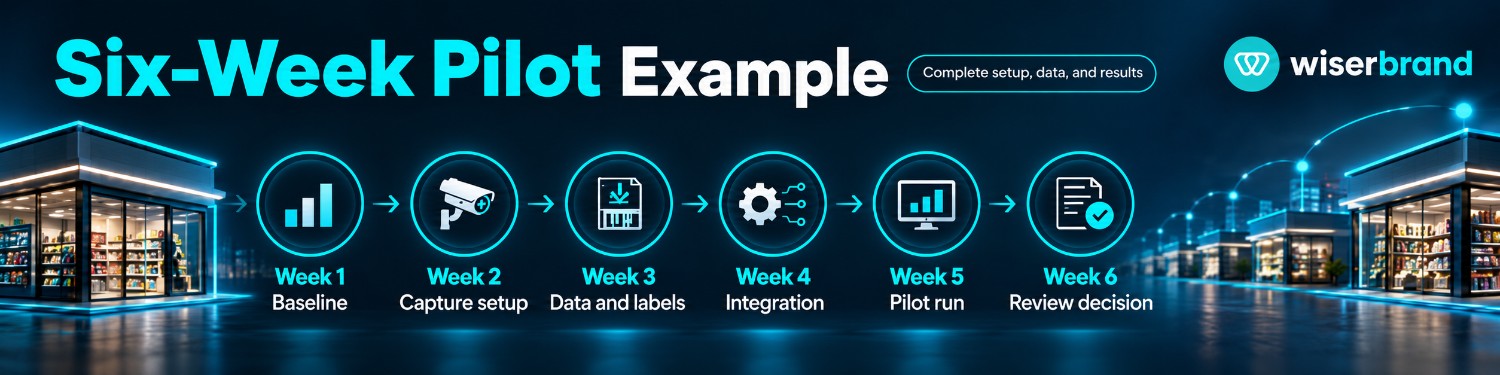
WiserBrand's six-week proof of concept fits steps one to four: one use case, real images, a tested model, and a go/no-go memo with a 90-day pilot plan. A chain rollout waits until precision, recall, reviewer capacity, and integration are stable in more than one store format.
Metrics That Prove the Business Case
Metrics should show a change in store work, not just model output.
| Metric | Definition | Owner | Action |
|---|---|---|---|
| On-shelf availability | Share of positions with a buyable item | Store operations | Fill gaps, adjust replenishment |
| Out-of-stock duration | Time a listed item is unavailable | Category management | Prioritize repeat gaps |
| Planogram compliance | Share of positions that match the layout | Merchandising | Reset or retrain |
| Price accuracy | Share of labels that match the price file | Pricing | Replace labels |
| Audit time | Labor hours per completed audit | Store operations | Shift labor to fixes |
| False alert rate | Share of alerts marked incorrect | Pilot lead | Raise threshold or retrain |
| Task completion | Share of tasks closed on time | Store manager | Fix ownership or workload |
| Cost per store | License, capture, labor, support divided by stores | Finance | Compare to value |
The business case for image recognition in retail needs a denominator and a counterfactual. Estimated annual value equals fixed gaps per store per week times sales per recovered item times stores, minus capture, review, software, and support. Sales lift is an estimate until a control store shows it. Recovered sales are not cash savings unless the cost line changes.
Measure the baseline first. Count the same fixture manually for two weeks and record the time. After the pilot, compare precision, recall, task completion, and out-of-stock duration with the control. Finding more gaps without closing tasks is not an improvement.
When Image Recognition Is Not the Right Fit
Image recognition for retail teams is not the right first project everywhere.
- Inventory records are accurate and the assortment is stable, so the photo adds little.
- No team owns shelf fixes, so alerts become a backlog.
- Privacy review cannot support product-only capture.
- The estate is small enough that manual audit is cheaper.
- RFID or POS data already answers the question.
- There are no labeled images or reviewers for a pilot.
The test asks if a photo changes a decision a team can act on this week.
FAQ
How Does Shelf-Level Recognition Differ From General Computer Vision?
General computer vision covers faces, medical images, and industrial inspection. Shelf-level recognition works on dense, repetitive scenes with near-identical products, frequent package changes, and a direct link to planogram, price, and inventory records. The hard part is matching the object to the right SKU and turning the difference into a task a team can close.
What Accuracy Should Retailers Expect in Real Stores?
There is no universal number. Vendors cite high accuracy without a shared method. Accuracy depends on task, lighting, angle, assortment, and novelty. Ask for precision and recall by category and condition, plus the false alert rate. Set the threshold from the cost of a wrong alert and a missed gap, not a vendor headline.
Which Use Case Should We Pilot First?
Start with one high-turnover category, a clear owner, and a clear decision. Shelf availability, price labels, and CPG audits are good candidates because the fix is visible. Defer checkout-free stores and shopper identification until the product-only process and task loop are stable.
Can Image Recognition in Retail Work Without Capturing Shoppers' Faces?
Yes, if the design separates the shelf from the shopper. Point the camera at the fixture, blur faces on the device, send metadata or crops, and set a short retention period. Product-only capture still needs privacy review and signage, but it avoids biometric questions.
How Do Image Recognition Results Connect to POS, ERP, and Task Systems?
Send a small event with store, fixture, SKU, condition, confidence, image reference, and timestamp. The task system creates a work item. ERP receives a replenishment or price correction request. POS supplies the sales and price record. A person confirms low-confidence events, and the audit log records approvals and dismissals.
When Is Custom Software Better Than Buying a Retail Image Recognition Platform?
Custom work fits a private-label-heavy assortment, unusual fixtures, strict data ownership, or deep integration with existing ERP and workforce systems. A platform is usually faster for a standard CPG audit or shelf-monitoring workflow. Many retailers combine purchased capture with a custom task layer.
Final Thoughts
The decision rule for image recognition in retail is simple. Start with one shelf decision that repeats weekly, has an owner, and can be fixed during a visit. Use the cheapest capture that gives a consistent image, measure precision and recall on your fixtures, and keep a person in the loop until false alerts are stable. Expand by store archetype.
A model can show an empty facing; it cannot fill the shelf. If replenishment, planogram, and task ownership are weak, image recognition adds a dashboard and a backlog. Fix the response first, then add the camera.
WiserBrand's retail AI adoption consulting helps retailers scope one image workflow, test it on real store or catalog photos, and plan integration with stock, price, and task systems. Our computer vision development and rapid proof of concept services cover data review, model selection, review rules, and handover. The next step is a one-store pilot with a baseline, a control, and a go/no-go date.