Generative AI for Retail: Use Cases Across Commerce and Store Operations

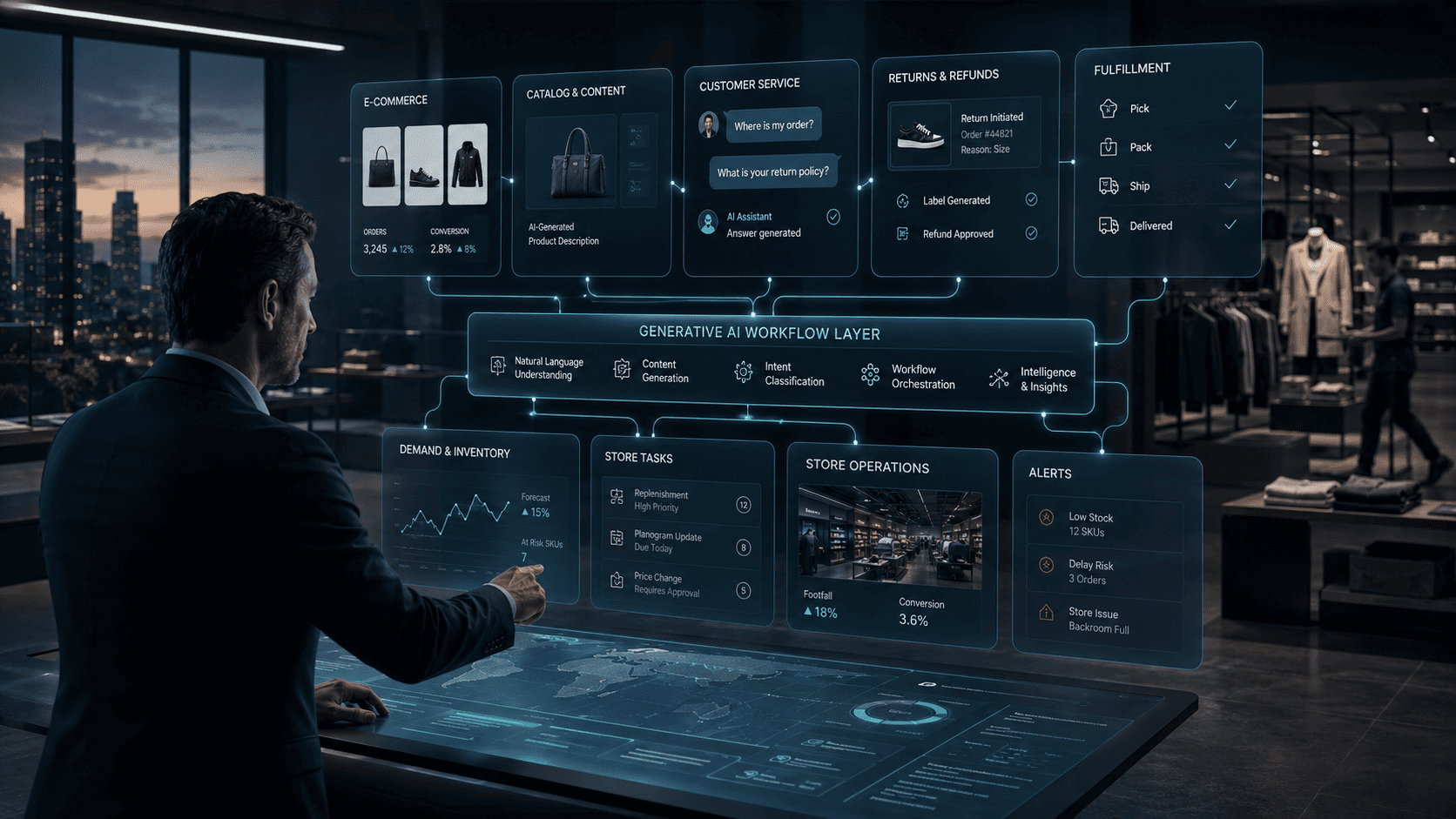
Generative AI for retail helps commerce, merchandising, customer service, and store teams work with product data, customer conversations, policies, operational records, and marketing content. It can create or transform text and images, retrieve approved knowledge, summarize exceptions, and prepare actions for employee review.
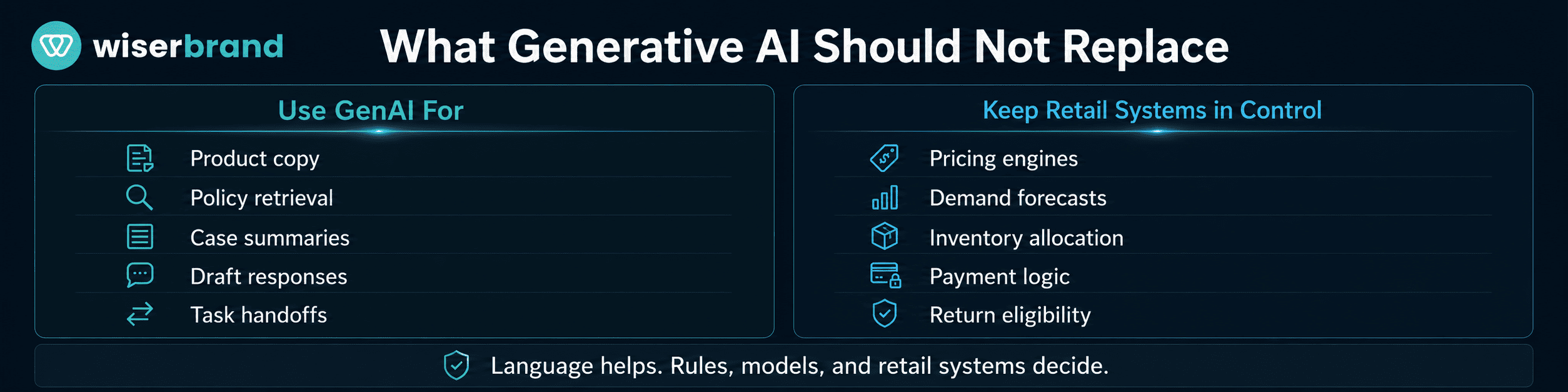
Its strongest role is not replacing pricing engines, recommendation models, demand forecasts, or store systems. Generative AI works best as a language and workflow layer around ecommerce platforms, point-of-sale systems, product information management, order management, CRM, inventory, workforce, and service tools.
A shopping assistant can explain product differences and check availability. A store associate assistant can retrieve a return policy and prepare the next step. A merchandising copilot can find missing product attributes and draft catalog content. In each case, trusted system data and deterministic business rules remain responsible for prices, eligibility, inventory, payments, and other high-impact actions.
This guide explains practical use cases across digital commerce and physical stores, the architecture behind them, the risks retailers need to control, and a staged path from pilot to production.
What Generative AI Means in Retail
Generative AI development for retail can support workflows that create or transform product content, summaries, classifications, structured records, and customer-facing drafts from approved business data. In retail, the model may work with product catalogs, customer questions, store policies, order histories, supplier documents, campaign briefs, employee instructions, and operational events.
Google Cloud groups retail AI applications across product discovery, product content, customer service, store productivity, merchandising, and operations. Its retail guidance also distinguishes generative experiences from the predictive and analytical systems used for recommendations, demand planning, and other numerical decisions.
That distinction prevents architecture mistakes:
| Technology | Strongest Fit | Retail Example |
|---|---|---|
| Generative AI | Language, content, knowledge retrieval, and guided workflows | Draft a product description from approved attributes |
| Recommendation model | Rank products for a shopper or context | Select items for a recommendation carousel |
| Predictive model | Estimate a future value or probability | Forecast demand or churn risk |
| Optimization engine | Select an action under formal constraints | Allocate inventory across stores |
| Computer vision | Interpret images or video | Detect shelf gaps or classify product images |
| Rules engine | Apply deterministic policy | Check return eligibility or promotion rules |
A retail solution may combine several of these technologies. A computer vision model can flag a possible shelf gap. An inventory service can verify available stock. Generative AI can summarize the issue and prepare a task for the store manager. The model should not pretend that a language response is a verified inventory event.
Where Generative AI Fits in the Retail Stack
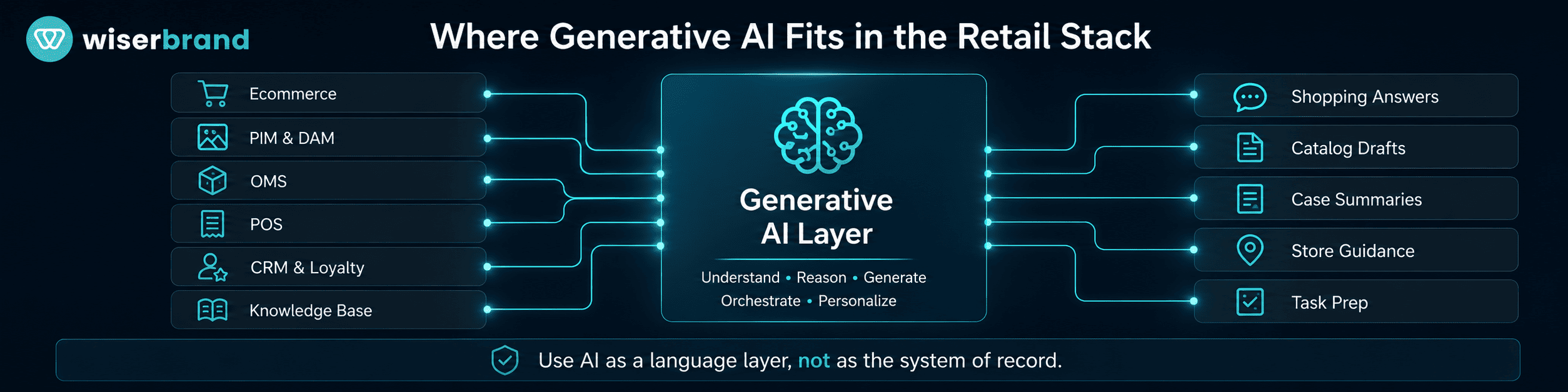
Generative AI for retail usually sits above existing commerce and operational systems. AI integration connects the model layer with ecommerce, PIM, OMS, POS, ERP, CRM, loyalty, workforce, and service platforms while keeping data access and actions controlled. It needs controlled access to business data and tools rather than a separate copy of retail logic.
| Retail System | Data the AI May Use | Example Output |
|---|---|---|
| Ecommerce platform | Catalog, customer session, cart, order status | Guided shopping answer or service response |
| PIM and DAM | Product attributes, descriptions, media, taxonomy | Enriched product record or localization draft |
| OMS | Order, fulfillment, pickup, cancellation, return status | Order explanation or exception summary |
| POS | Transactions, returns, store activity | Shift summary or customer-service context |
| ERP | Inventory, purchasing, suppliers, costs | Supplier exception brief or task draft |
| CRM and loyalty | Profiles, interactions, segments, consent | Service context or campaign draft |
| Workforce platform | Schedules, roles, tasks, training | Associate guidance or handover summary |
| Knowledge systems | Policies, SOPs, product guides | Grounded answer with source references |
| Contact center | Conversations, cases, resolution history | Case summary, reply draft, or routing recommendation |
A production approach to generative AI for retail should give the model only the minimum data required for the task. A product-content workflow does not need customer payment records. A store policy assistant does not need unrestricted access to employee files or pricing controls.
Commerce Use Cases
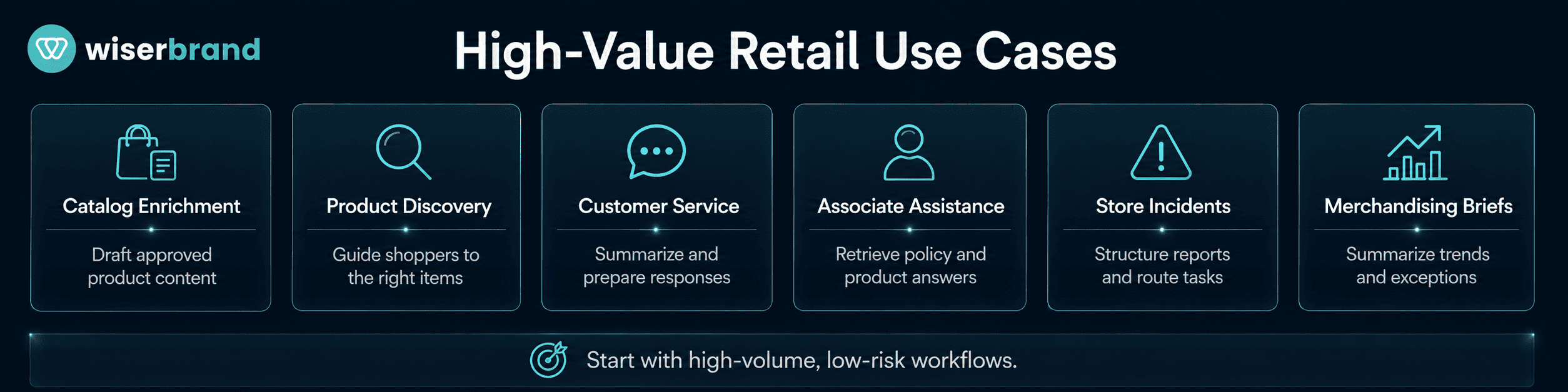
Product Catalog Enrichment
Product onboarding is a strong use case because retail teams often receive incomplete, inconsistent, or supplier-specific information. Generative AI can turn approved attributes into descriptions, bullet points, category suggestions, search terms, translations, and image metadata.
Google Cloud describes retail applications that create product descriptions, attributes, categories, labels, and marketing content from product information.
A practical workflow looks like this:
- A supplier or internal team submits a new SKU.
- Validation checks required identifiers, dimensions, materials, regulatory fields, and media.
- Generative AI prepares content from the approved attributes.
- Rules check length, prohibited claims, terminology, and channel requirements.
- A merchandiser reviews exceptions and high-value products.
- Approved content moves to the PIM and commerce channels.
The model should not invent specifications, compatibility, sustainability claims, warranties, or safety information. Missing facts should remain missing and enter an exception queue.
Conversational Product Discovery
A shopping assistant can help customers express needs in natural language, compare products, understand features, and narrow a large catalog. The assistant can ask useful follow-up questions and return products selected by a search or recommendation service.
Google Cloud documents customer-experience agents that combine generative responses with deterministic functions across product discovery and post-purchase service.
The assistant should separate three functions:
- conversation: interpret the shopper’s request;
- retrieval and ranking: find eligible products using current catalog and availability data;
- transaction logic: apply price, promotion, delivery, and payment rules through retail services.
This prevents the language model from inventing inventory, discounts, delivery dates, or product suitability.
Customer Service and Post-Purchase Support
Generative AI can classify contacts, retrieve order context, answer routine questions, draft responses, summarize cases, and prepare approved actions. Common journeys include order tracking, pickup status, return instructions, warranty guidance, missing-item intake, and delivery exceptions.
The system should show the difference between information and execution. Telling a customer that a return appears eligible is different from creating the return. Creating a label is different from issuing a refund. Each action needs authentication, validation, confirmation, and a recorded outcome.
Human escalation should remain easy for payment disputes, suspected fraud, legal complaints, vulnerable customers, repeated failures, or policy exceptions.
Marketing Content and Localization
Retail marketing teams can use generative AI to adapt approved campaign concepts across product categories, channels, segments, and languages. Useful tasks include first drafts of email content, paid ad variations, landing-page modules, social copy, creative briefs, and localization options.
The workflow should begin with controlled inputs:
- approved offer and dates;
- eligible products and markets;
- brand vocabulary;
- required disclosures;
- prohibited claims;
- channel length and format;
- customer consent and segmentation rules.
Generative AI can increase content capacity, but it cannot prove campaign incrementality or message quality. Teams still need experiments, brand review, legal review where applicable, and performance analysis.
Retailers also receive useful product and service feedback through reviews, chats, calls, surveys, and return reasons. Consumer data intelligence helps connect these signals with customer segments, purchase behavior, campaign response, and product performance. Generative AI can group recurring themes, summarize evidence, extract product attributes customers mention, and prepare issue briefs for merchandising, service, or product teams.
The output should preserve links to the underlying records. A summary such as “customers dislike the fit” is not enough. The team needs the affected products, volume, time period, customer segment, representative evidence, and uncertainty.
Store Operations Use Cases
Associate Knowledge Assistance
Store associates need fast access to policies, product information, inventory context, training, promotions, and service procedures. A grounded assistant can answer a question in plain language and cite the approved source.
Microsoft’s Store Operations Agent documentation describes a retail assistant that can connect store employees with retailer knowledge, inventory information, shipping status, and external connectors through a conversational interface. The capability remains identified as preview in current Microsoft documentation, so retailers should verify availability and terms before planning production use.
Useful questions include:
- Which return policy applies to this product?
- Is this item available in another location?
- Which promotion applies today?
- How should this pickup exception be handled?
- Which procedure covers this equipment issue?
- What information must be collected before escalation?
The assistant should show the policy version and effective date. It should not rewrite a mandatory procedure as optional or improvise a local exception.
Store leaders also assemble information from POS, task tools, inventory alerts, staffing, customer incidents, ecommerce pickup queues, and written notes. Generative AI can prepare a daily brief that highlights exceptions and open actions.
A useful brief may cover:
- sales and transaction variance;
- staffing gaps;
- delayed pickups or fulfillment backlog;
- inventory exceptions;
- unresolved customer cases;
- equipment or facility issues;
- promotional execution tasks;
- actions carried over from the prior shift.
The summary should distinguish source facts from generated interpretation. Managers need direct access to the underlying record before assigning work or changing priorities.
Inventory Exception Support
Demand forecasting and allocation are usually predictive and optimization problems. Generative AI can make those outputs easier to use by explaining why an alert appeared, collecting related records, and preparing a response.
For example:
- A forecasting or replenishment system flags a stockout risk.
- Inventory services confirm store, warehouse, and in-transit quantities.
- The assistant retrieves the promotion calendar and recent sales.
- Generative AI creates an exception summary.
- A planner or manager reviews transfer, reorder, substitution, or merchandising options.
- Approved actions move through the inventory or task system.
This pattern keeps the numerical decision in the appropriate model while using generative AI for context and coordination.
Store Task and Incident Management
Retail stores generate many operational requests: damaged fixtures, missing signage, pickup delays, refrigeration issues, merchandising tasks, customer incidents, and compliance checks. Generative AI can turn free-text reports into structured cases, identify missing fields, route them, and prepare a concise handoff.
High-risk incidents still need formal procedures. Safety, suspected theft, employee conduct, cash discrepancies, and legal complaints should follow controlled workflows with restricted data access and named owners.
The same assistant can help turn approved material into practice questions, role-specific explanations, checklists, and guided refreshers. An associate may ask how to process a specific service journey without searching several documents.
Generated training content needs subject-matter review. The system should not replace required certification, safety instruction, or formal policy acknowledgement. It should support access and reinforcement.
Merchandising, Planning, and Back-Office Use Cases
Retail teams can also use generative AI behind the customer and store experience.
| Function | Possible Use Case | Human or System Control |
|---|---|---|
| Merchandising | Summarize category performance and prepare a review brief | Merchant selects assortment and commercial action |
| Buying | Compare supplier documents and identify missing terms | Buyer approves supplier and commitment |
| Pricing | Explain price or markdown recommendations | Pricing rules and authorized managers control changes |
| Planning | Summarize demand scenarios and constraints | Forecasting and optimization systems produce numerical plans |
| Supply chain | Prepare a shortage or delay brief | ERP, OMS, and planners control orders and allocation |
| Finance | Explain margin variance and collect supporting records | Finance validates calculations and decisions |
| Ecommerce operations | Classify catalog, checkout, and fulfillment incidents | Product and operations owners approve fixes |
| Software delivery | Draft test cases, documentation, and code explanations | Engineers review, test, and deploy changes |
AWS describes retail generative AI applications across customer engagement, data operations, product content, and software delivery. AWS also documents an example architecture where generative AI supports test-case generation and code lineage in retail software work.
These use cases are valuable when the model reduces search, comparison, or drafting effort. They are weak candidates when the main problem is poor source data, missing system integration, or an unclear business process.
Benefits and the Mechanisms Behind Them
Generative AI for retail does not create value by generating more content. Value comes from changing a measurable workflow.
| Potential Benefit | Operational Mechanism | Example Metric |
|---|---|---|
| Faster product onboarding | Draft content and taxonomy suggestions reduce manual preparation | Time from supplier submission to approved SKU |
| Better associate access to knowledge | One grounded interface replaces searches across repositories | Time to approved answer |
| Lower service handling effort | The system retrieves context and prepares routine responses | Active handling time per resolved case |
| Faster exception review | Related records and policies arrive in one summary | Time from alert to assigned action |
| More campaign capacity | Approved content is adapted across formats and markets | Review time and approved assets per campaign |
| Better use of customer feedback | Reviews and conversations become structured themes | Time to identify and confirm a recurring issue |
| More consistent handoffs | Cases include intent, evidence, and completed steps | Repeat-information rate after transfer |
Each metric needs a baseline and a quality check. Faster product copy is not useful if corrections rise. Higher chatbot containment is not useful if customers return with the same issue. More generated promotions are not useful if margin or unsubscribe rates deteriorate.
Production Architecture
A production system for generative AI for retail needs more than a model and chat interface. Retail software development provides the commerce, inventory, customer, store, and integration layers that generative AI workflows depend on.
| Layer | Purpose |
|---|---|
| Experience | Shopping assistant, employee portal, service desktop, PIM, or workflow screen |
| Identity and consent | Customer, employee, store, region, role, and communication permissions |
| Orchestration | Intent, conversation state, prompts, tool selection, and escalation |
| Retrieval | Product, policy, service, and operational knowledge with source metadata |
| Retail integrations | Ecommerce, PIM, OMS, POS, ERP, CRM, loyalty, WMS, and workforce APIs |
| Rules and policy | Price, promotion, eligibility, refund, inventory, and approval logic |
| Model services | Generation, extraction, classification, embeddings, and reranking |
| Human work queues | Review, correction, approval, and exception handling |
| Evaluation and observability | Quality tests, traces, failures, latency, cost, and business outcomes |
| Security and governance | Access controls, data handling, versions, incidents, and rollback |
Hard business rules should not exist only in prompts. Price calculations, payment authorization, return eligibility, inventory reservations, employee permissions, and regulatory disclosures belong in deterministic services.
Every action should return a clear status. The system must know the difference between a drafted change, an approved change, a submitted action, and a completed transaction.
Data Readiness
Generative AI for retail often fails because the system receives inconsistent product, customer, inventory, or policy data.
Before implementing generative AI for retail, review:
- product identifiers and taxonomy;
- completeness and accuracy of attributes;
- store, warehouse, and channel hierarchies;
- customer identity and consent;
- current prices and promotion rules;
- inventory latency and reservation behavior;
- order and return statuses;
- policy ownership and effective dates;
- language and regional variants;
- API coverage and failure behavior;
- document access and retention;
- source traceability.
A model can write a polished answer from incomplete context. That makes source controls more important, not less.
Start with the smallest governed dataset that supports one workflow. A catalog assistant may need product attributes, content rules, taxonomy, and approved claims. It does not need a full customer data platform.
Risks and Controls
NIST’s Generative AI Profile is a companion to the AI Risk Management Framework and identifies actions for managing risks specific to generative systems across design, development, use, and evaluation.
For retail, the main risks are operational as well as technical:
| Risk | Retail Example | Control |
|---|---|---|
| Unsupported content | Invented product compatibility or delivery promise | Grounding, source references, prohibited-claim checks |
| Stale data | Old price, policy, or inventory appears current | Live service calls, timestamps, effective dates |
| Privacy exposure | Customer or employee data appears in prompts or logs | Data minimization, masking, role access, retention rules |
| Prompt injection | Product content or customer text changes model behavior | Input isolation, trusted-source controls, attack testing |
| Excessive authority | An assistant issues refunds or price changes outside policy | Least-privilege tools, limits, approval gates |
| Biased or unsuitable personalization | Offers exclude or disadvantage groups without valid basis | Segment testing, consent, policy review, monitoring |
| Brand and legal risk | Generated copy contains unsupported claims | Approved inputs, content rules, human review |
| Duplicate actions | A retry creates two returns, tasks, or messages | Idempotency, status checks, retry limits |
| Poor handoff | Customer or employee repeats the full case | Structured transfer with context and evidence |
| Model drift | Quality changes after model, prompt, or data updates | Regression testing, versioning, thresholds, rollback |
Retailers should also evaluate vendor data use, hosting, model changes, sub-processors, service availability, incident notification, and exit options.
A Practical Implementation Blueprint
- Select one decision or workflow.
Choose a frequent problem with a named owner and measurable baseline. Strong candidates include product onboarding, grounded policy search, order-service triage, or store handover summaries.
- Define the authority boundary.
List what the system may read, draft, recommend, update, and execute. Identify actions that need confirmation or approval.
- Map the current workflow.
Document triggers, users, systems, data, business rules, manual effort, waiting time, exceptions, and downstream actions.
- Prepare approved data.
Fix product attributes, policy versions, permissions, identifiers, and source ownership before adding model access.
- Build a read-only first release.
Start with retrieval, summarization, classification, and draft outputs. Keep high-impact writes disabled while the team learns failure patterns.
- Create an evaluation set.
Test normal cases, missing information, contradictory sources, outdated records, unusual language, prompt injection, unauthorized requests, and system outages.
- Pilot with one bounded group.
Use one product category, store region, support intent, or internal team. Compare the result with the baseline and collect correction reasons.
- Add controlled actions.
Introduce tasks, case updates, or other reversible operations first. Apply narrow permissions, transaction validation, logs, and rollback.
- Monitor the workflow.
Track source quality, acceptance, human override, unresolved cases, tool failures, latency, cost, customer or employee outcomes, and the primary business metric.
- Expand through approved releases.
Treat each new data source, market, language, tool, model, or autonomous action as a change that needs testing and ownership.
Build, Buy, or Customize?
| Approach | Strong Fit | Main Tradeoff |
|---|---|---|
| Ecommerce or CRM built-in AI | Standard content and service workflows inside one platform | Limited control across the retail stack |
| Retail AI product | Common product discovery, catalog, or store use case | Fit depends on systems and process |
| General cloud AI platform | Shared model, retrieval, security, and integration foundation | Retail workflows still need design and engineering |
| Custom application | Differentiated data, customer experience, or operating logic | Higher implementation and maintenance responsibility |
| Hybrid architecture | Vendor foundation with custom integrations, rules, and interface | Component ownership must remain clear |
Buy when the workflow is common and the product fits the system of record. Customize when a platform covers most of the need but lacks retail-specific data, controls, or user experience. Build when the workflow creates competitive value or requires integration and governance that packaged tools cannot provide.
Evaluate total operating cost: licenses, model usage, integration, data work, evaluation, employee review, monitoring, vendor updates, and support.
When Not to Use Generative AI
Generative AI is not the right primary solution when:
- a rules engine can produce the answer more reliably;
- the task requires exact numerical optimization;
- the source data has no trusted owner;
- inventory or pricing data cannot arrive within the decision window;
- a search interface already solves the knowledge problem;
- output cannot be reviewed before a high-impact action;
- the expected volume does not justify integration and maintenance;
- computer vision, forecasting, or conventional analytics is the real requirement;
- the retailer cannot monitor, restrict, and stop the system.
The correct first step may be PIM cleanup, API development, identity resolution, policy consolidation, or workflow redesign.
How to Measure Success
| Use Case | Primary Metrics |
|---|---|
| Catalog enrichment | Time to approved SKU, correction rate, attribute completeness |
| Shopping assistant | Product discovery completion, assisted conversion, bad-answer rate |
| Customer service | Task completion, repeat contact, escalation quality, handling time |
| Store knowledge assistant | Time to approved answer, source accuracy, unresolved question rate |
| Shift summaries | Preparation time, missed action rate, manager corrections |
| Inventory exception support | Time to decision, accepted recommendation, stockout or overstock impact |
| Marketing content | Review time, approval rate, campaign performance, correction rate |
| Feedback analysis | Time to confirmed issue, theme precision, action adoption |
Also track platform health:
- retrieval failures;
- unsupported output rate;
- unauthorized tool attempts;
- duplicate or failed actions;
- human override rate;
- latency;
- cost per completed workflow;
- incidents and rollback time;
- adoption by role and location.
A successful pilot saves time or improves a decision without moving hidden work or risk to another team.
FAQ
What Is Generative AI for Retail?
Generative AI for retail uses models that create or transform text, images, summaries, classifications, and structured records for commerce and store workflows. Common applications include product content, shopping assistance, service replies, associate knowledge, shift summaries, and operational exception briefs.
How Is Generative AI Different From Retail Analytics?
Retail analytics measures performance, finds patterns, and supports numerical decisions. Generative AI works mainly with language, content, knowledge, and workflow interaction. The two can work together: analytics detects an inventory issue, while generative AI explains the context and prepares an action for review.
Can Generative AI Recommend Products?
It can interpret the shopper’s request and explain product options. Product selection should still use current catalog data, eligibility rules, availability, and a search or recommendation service. The language model should not invent products, prices, specifications, or stock.
Can Retailers Use Generative AI in Physical Stores?
Yes. Store use cases include associate policy search, product and inventory questions, training support, shift handovers, task intake, and exception summaries. The assistant needs role-based access, approved sources, and clear escalation for customer, safety, cash, and employee incidents.
What Data Does a Retail AI System Need?
The required data depends on the use case. It may include product attributes, catalog taxonomy, policies, orders, inventory, customer consent, loyalty records, store hierarchy, workforce tasks, and service history. Start with the minimum governed sources required for one workflow.
What Is the Best First Retail Use Case?
A strong first use case is frequent, text-heavy, measurable, and low risk. Product content preparation, internal knowledge search, service-case summarization, and shift handover drafting are practical starting points because they can operate in read-only or draft mode.
What Are the Main Risks?
The main risks include fabricated product claims, stale prices or inventory, privacy exposure, prompt injection, biased personalization, excessive tool access, duplicate actions, weak human handoff, and model drift. Controls should combine trusted data, deterministic rules, limited permissions, evaluation, monitoring, and rollback.
Final Thoughts
Generative AI for retail is most valuable when it connects people with trusted product, customer, and operational context. It can reduce the effort required to create catalog content, guide shoppers, prepare service cases, assist store employees, and explain operational exceptions.
Start with one workflow and keep the system’s authority narrow. Use retail platforms and deterministic services for prices, inventory, eligibility, payments, and optimization. Use generative AI for language, knowledge retrieval, summaries, and prepared actions. Add autonomy only after the team can evaluate quality, monitor failures, and reverse changes.
We help retailers connect generative AI with ecommerce, PIM, OMS, POS, CRM, ERP, analytics, and store workflows. WiserBrand’s retail software development and generative AI services cover use-case discovery, architecture, integration, evaluation, and production support.