Custom AI Agent Development for eCommerce

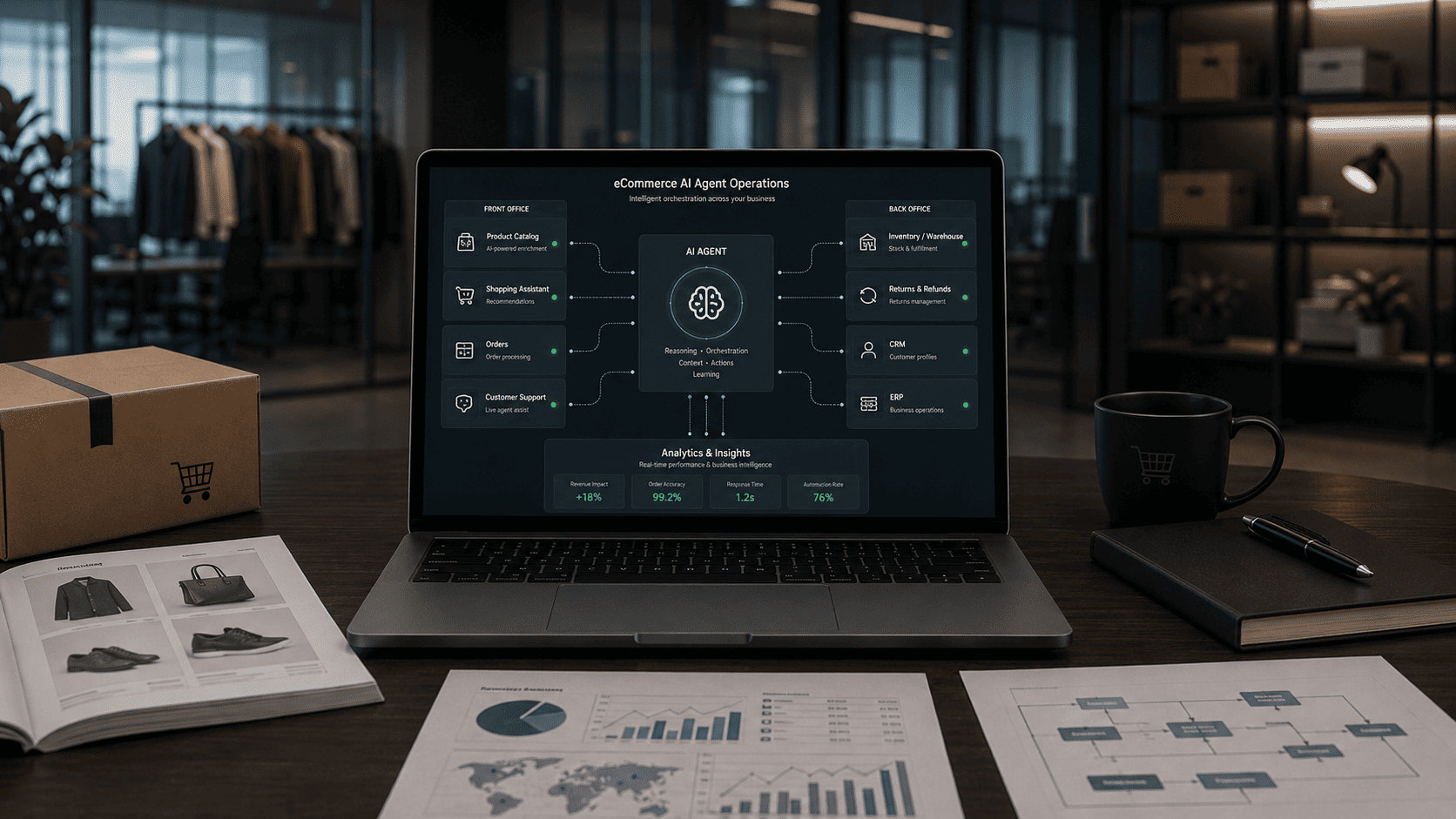
eCommerce agents are becoming a practical way for online retailers to improve shopping experiences, reduce operational work, and connect decisions across storefronts, ERPs, CRMs, inventory systems, support platforms, and marketing tools. They can guide shoppers, answer product questions, recommend alternatives, create return workflows, monitor stock issues, and help teams act on business signals faster.
Custom AI agent development matters because every ecommerce business has a different operating model. A fashion retailer, auto parts seller, B2B distributor, furniture brand, and subscription store may all use AI, but their catalogs, policies, fulfillment rules, customer questions, and risk levels are not the same.
BigCommerce frames ecommerce AI agents as autonomous technology changing digital retail, while Salesforce describes agentic commerce as AI acting on behalf of users or businesses, with AI agents for ecommerce able to make recommendations, manage inventory, and interact with customers. McKinsey also notes that agentic commerce is moving shopping toward AI agents that can anticipate needs, compare options, assemble baskets, and complete transactions with human intent as the guide.
That future is not only about shopper-facing assistants. The bigger opportunity for many retailers is custom eCommerce agents that connect front-office experience with back-office execution. An agent that recommends a product is useful. An agent that checks compatibility, reads inventory, applies policy, creates a support case, and routes an exception to a human can change how the business operates.
This guide explains where eCommerce agents create value, when custom development makes sense, how to design the architecture, and what to measure after launch.
What Are eCommerce Agents?
eCommerce agents are AI systems that can understand a goal, use data, call tools, follow rules, and complete multi-step tasks inside an ecommerce environment. They are more capable than a basic chatbot because they can take actions, not only answer questions.
A simple chatbot may respond to “Where is my order?” with a prepared answer. An ecommerce agent can identify the customer, check the order record, read shipment status, interpret the return policy, suggest the next step, create a support ticket, and escalate the case if the issue is unusual.
The difference comes from tool use and workflow logic. eCommerce agents can connect to systems such as:
- Storefront platforms
- Product information management systems
- ERPs
- CRMs
- OMS and WMS platforms
- Inventory databases
- Helpdesk tools
- Marketing platforms
- Review and loyalty systems
- Payment and fraud tools
- Analytics and BI dashboards
The agent does not need full control over every system. In many cases, it should have limited permissions and clear approval rules. The goal is to let the agent handle repeatable work while humans stay involved in high-risk decisions.
Why Custom AI Agent Development Matters
Off-the-shelf AI tools can be useful for common tasks. They may answer FAQs, summarize tickets, generate product descriptions, or help support agents respond faster. That can be a good start.
Custom AI agent development becomes more valuable when the workflow depends on business-specific rules. Ecommerce operations often have details that generic tools do not understand well: product fitment, bundle logic, regional shipping limits, warranty rules, return windows, customer segments, fraud signals, supplier constraints, and margin targets.
A custom agent can be designed around those rules. It can use your catalog structure, policies, internal tools, approval logic, and customer data in a controlled way. This is where custom AI development becomes more valuable than a generic tool built around common workflows.
The business case is strongest when the agent can reduce manual work or recover revenue at scale. Examples include helping shoppers find the right product, reducing support tickets, improving return handling, spotting stock risks, or keeping merchandising teams focused on high-impact changes.
McKinsey reported that generative AI copilots in ecommerce customer care can reduce handling time by 40 to 60 percent while improving satisfaction, and a sportswear company cut handling time by more than 40 percent while improving first-contact resolution. That does not mean every ecommerce agent will produce the same result, but it shows why customer operations are one of the strongest starting points.
High-Value Use Cases for eCommerce Agents
The best use cases are specific, measurable, and connected to business outcomes. A custom ecommerce agent should not exist because AI feels new. It should solve a real process problem.
Shopping Concierge
A shopping concierge helps customers find the right product faster. It can ask clarifying questions, compare products, explain differences, check fit, suggest alternatives, and guide the shopper toward a confident decision.
This is useful for catalogs with many variants, technical products, high-consideration purchases, or frequent compatibility questions.
Examples include:
- Matching skincare products to customer goals and restrictions.
- Helping a buyer choose furniture based on room size, material, and delivery constraints.
- Recommending auto parts based on make, model, year, trim, and fitment data.
- Guiding B2B buyers through product specs, availability, and order quantities.
- Suggesting alternatives when the preferred product is out of stock.
The key is grounding. The agent should use accurate product data, not guess. It should know when to say that a fit is uncertain and when to route the question to a human.
Customer Service and Returns
Support is often the fastest place to prove value. Many support questions are repetitive, but they still require context.
A custom support agent can check order status, summarize prior interactions, explain return rules, create return requests, classify issues, draft responses, and escalate unusual cases.
For returns, the agent can read the order, check eligibility, ask for the reason, request photos when needed, create the return record, and send the next-step instructions. If the case involves damage, fraud risk, high order value, or a policy exception, the agent can route it to a human.
This reduces workload without turning customer service into a black box.
Product Discovery and Search Support
Search often fails when customers do not know the exact product name. eCommerce agents can interpret intent more flexibly. They can understand needs, synonyms, constraints, and use cases.
For example, a customer may search for “quiet coffee grinder for apartment” or “dress for outdoor summer wedding.” A traditional search engine may match keywords. An agent can ask follow-up questions and connect the request to product attributes, reviews, availability, and price range.
This use case works best when product data is clean. The agent needs structured attributes, categories, descriptions, inventory status, and clear rules for ranking suggestions.
Merchandising and Catalog Operations
Merchandising teams handle many repetitive tasks. They review product descriptions, map attributes, find missing images, check category placement, analyze underperforming SKUs, and prepare promotion lists.
A merchandising agent can monitor catalog quality, flag incomplete products, suggest attribute cleanup, summarize performance changes, and identify products that need content updates.
For large catalogs, this can save significant time. It also helps teams catch issues before they affect conversions.
Inventory and Fulfillment
Inventory problems create customer frustration and operational cost. A custom agent can monitor stock movement, detect low-stock patterns, identify products at risk of overselling, and alert the right person before the issue reaches customers.
The agent can also help customer-facing teams by checking stock across warehouses, suggesting available alternatives, and explaining delivery limits.
Inventory agents need strict guardrails. They should not create purchase orders, change stock rules, or alter fulfillment logic without approval unless the workflow is low risk and well tested.
Pricing and Promotions
Pricing and promotion workflows are often data-heavy. Teams need to consider margin, inventory, demand, competitor pricing, campaign timing, and customer segments.
An agent can support pricing teams by surfacing products with margin pressure, identifying slow-moving inventory, generating promotion candidates, or checking if a discount conflicts with rules.
Human approval should stay central here. Pricing errors can harm margin, customer trust, and channel relationships.
Back-Office Operations
Many ecommerce agents produce the most value behind the scenes. They can reconcile orders, classify vendor emails, extract data from documents, prepare refund notes, update internal records, or summarize exceptions for managers.
Back-office agents are often easier to launch than shopper-facing agents because the risk is more controllable. They can work in draft mode, prepare actions for review, and leave a clear audit trail.
Custom eCommerce Agents vs. Off-the-Shelf AI Tools
The right choice depends on the process, data, risk, and expected value.
| Need | Off-the-Shelf AI Tool | Custom eCommerce Agent |
|---|---|---|
| Basic FAQ answers | Strong fit | Usually unnecessary |
| Product copy generation | Strong fit | Useful if rules are complex |
| Order status lookup | Good if integration exists | Better for custom policies and exceptions |
| Complex product recommendations | Limited | Strong fit |
| Returns and refunds | Limited without policy logic | Strong fit |
| Inventory workflows | Limited | Strong fit |
| B2B ordering | Often limited | Strong fit |
| Multi-system back-office work | Often limited | Strong fit |
| High-risk decisions | Needs human review | Better with custom guardrails |
A custom agent makes sense when the task needs business context, controlled system access, workflow logic, and measurable operational impact. A generic tool may be enough when the task is simple, low risk, and not deeply connected to your systems.
What a Custom eCommerce Agent Architecture Includes
A strong ecommerce agent is not only a model connected to a chat window. It is a controlled system with data, tools, policies, memory, permissions, and monitoring.
| Layer | Purpose |
|---|---|
| User interface | Chat, admin panel, support console, internal dashboard, or API endpoint. |
| Model layer | Understands intent, reasons through steps, and generates responses or actions. |
| Knowledge layer | Uses product data, policies, FAQs, manuals, reviews, and internal documentation. |
| Tool layer | Connects the agent through AI integration with ecommerce platforms, CRMs, ERPs, OMS and WMS systems, helpdesk tools, inventory databases, and analytics platforms. |
| Workflow logic | Defines what the agent can do, when it needs approval, and how it handles exceptions. |
| Memory and context | Keeps useful session or customer context where appropriate and permitted. |
| Guardrails | Limits unsafe actions, unsupported claims, policy violations, and risky outputs. |
| Observability | Tracks actions, failures, handoffs, accuracy, latency, and business impact. |
| Security | Controls access, permissions, data exposure, authentication, and audit logs. |
This structure matters because ecommerce agents operate close to revenue, customer data, and brand trust. A weak architecture can produce wrong recommendations, bad refund decisions, inventory errors, or privacy issues.
The agent should have the minimum access needed for the task. It should also explain its actions in a way the team can review.
Development Blueprint for Custom eCommerce Agents
A good build starts with the workflow, not the model. The model is only one part of the system.
- Choose one business problem. Start with a workflow that is painful, repetitive, and measurable. Good examples include product discovery, return intake, order support, catalog cleanup, or low-stock alerts.
- Map the current process. Document the trigger, data sources, systems, owners, approvals, customer touchpoints, and exceptions.
- Define agent scope. Decide what the agent can answer, what it can do, and what it must escalate.
- Prepare the data. Clean product attributes, policy documents, order data, support categories, and integration points.
- Connect tools carefully. Give the agent controlled access to the systems it needs. Avoid broad permissions.
- Add human approval gates. Use review steps for refunds, pricing changes, inventory updates, sensitive customer issues, and high-value orders.
- Test with real scenarios. Include normal cases, edge cases, incomplete data, angry customers, policy exceptions, fraud signals, and out-of-stock situations.
- Launch in a limited scope. Start with one category, one region, one support queue, or one internal workflow.
- Measure and improve. Track accuracy, deflection, conversion impact, handling time, exception rate, and customer satisfaction.
This approach keeps the project focused. It also helps the team learn what customers and employees actually need from the agent before expanding.
Safety, Governance, and Brand Control
eCommerce agents need more than good answers. They need boundaries.
The agent should not promise delivery dates it cannot verify. It should not approve a refund outside policy unless a human reviews it. It should not recommend products without checking availability or compatibility. It should not expose customer data to the wrong person.
Important controls include:
- Role-based permissions.
- Approved data sources.
- Human review for risky actions.
- Clear escalation paths.
- Policy-aware responses.
- Audit logs for actions and decisions.
- Testing before changes go live.
- Monitoring for wrong answers and failed tool calls.
- Red-team scenarios for abuse, prompt injection, and fraud.
- Regional privacy and compliance checks.
Agentic commerce also brings broader trust and risk questions. McKinsey notes that as agents gain more autonomy, companies need stronger trust, identity, payment, and governance systems, including clearer audit trails and controls around delegated actions.
For ecommerce brands, this is not optional. The more an agent can do, the more important containment becomes.
How to Measure eCommerce Agent Success
Success should be measured by business outcomes, not by how advanced the agent sounds.
| Metric | What It Shows |
|---|---|
| Conversion rate lift | Whether the agent helps shoppers buy with more confidence. |
| Average order value | Whether recommendations support larger or better-fit purchases. |
| Support deflection | How many routine issues the agent handles without human help. |
| First-contact resolution | Whether customers get useful answers in one interaction. |
| Handling time | How much admin work the agent removes from support or operations. |
| Return rate | Whether better guidance reduces wrong purchases. |
| Escalation rate | How often the agent needs human help. |
| Accuracy rate | How often responses and actions match policy and data. |
| Tool failure rate | How often integrations fail or return unusable data. |
| Revenue influenced | Sales or retained revenue connected to agent interactions. |
Pick metrics before launch. A product discovery agent should be measured differently from a returns agent. A merchandising agent should be measured by catalog quality, saved time, and issue detection. An inventory agent should be measured by stock risk, fulfillment issues, and response speed.
When Not to Build a Custom eCommerce Agent
A custom agent is not always the right first step. Some teams need cleaner data, better workflows, or simpler automation before they need an AI agent.
Avoid custom AI agent development when:
- Product data is incomplete or unreliable.
- Policies are unclear or change constantly.
- The team cannot define what the agent should do.
- The process has no owner.
- The use case has no measurable business value.
- The agent would need broad access without strong controls.
- A simple automation or off-the-shelf tool would solve the problem.
- The business is not ready to review and improve the agent after launch.
A custom agent should make a strong process faster. It should not be used to hide a broken process.
FAQ
What Are eCommerce Agents?
eCommerce agents are AI systems that can understand shopper or business goals, use ecommerce data, call tools, and complete multi-step tasks. They can support product discovery, customer service, returns, merchandising, inventory, pricing, and back-office operations.
How Are eCommerce Agents Different From Chatbots?
Chatbots usually answer questions. eCommerce agents can take actions. They may check order data, read policies, create tickets, recommend products, route exceptions, update records, or call internal tools based on defined rules.
What Is Agentic Commerce?
Agentic commerce is a shopping model where AI agents act on behalf of users or businesses. These agents can help compare products, make recommendations, assemble carts, and complete steps in the buying journey.
What eCommerce Agent Should We Build First?
Start with a workflow that is frequent, measurable, and painful. Strong first use cases include support triage, order status help, return intake, shopping concierge, catalog cleanup, and inventory alerts.
Do eCommerce Agents Need Access to Customer Data?
Some use cases need customer data, such as order support or returns. Others do not. Access should be limited to the data required for the workflow, with permissions, audit logs, and privacy controls.
Can eCommerce Agents Make Purchases for Customers?
They can, but that requires strong consent, payment, identity, fraud, and audit controls. Many brands should start with assisted shopping and human-approved actions before moving toward autonomous purchasing.
Do We Need Custom Development?
Custom development is useful when the agent must understand business-specific rules, integrate with multiple systems, handle exceptions, and operate safely around revenue or customer data. Simpler use cases may be covered by existing AI tools.
Final Thoughts
Custom AI agent development for eCommerce should start with business value, not novelty. The best eCommerce agents reduce friction in places where customers or teams already lose time: product discovery, support, returns, catalog work, inventory, pricing, and back-office operations.
The most useful agents are grounded in real data, connected to the right tools, limited by clear permissions, and measured against business outcomes. They do not replace judgment. They handle repeatable work and bring humans into the process when risk, context, or customer trust requires it.
If your ecommerce team wants AI agents that fit your actual catalog, systems, policies, and workflows, we can help design and build them. Our custom eCommerce development capabilities can support shopping assistants, support agents, return workflows, merchandising agents, inventory monitoring, system integrations, observability, and safety controls for production use.