How To Hire A CTO


Hiring a CTO is a business decision before it becomes a hiring task. The right person connects product goals, technical limits, hiring plans, security risks, and budget into one clear direction. The wrong hire can slow delivery, confuse the team, and create decisions that are expensive to reverse.
Many companies do not need a full-time chief technology officer right away. Some need a CTO for hire for a rebuild, a product launch, fundraising prep, vendor selection, or a period of rapid growth. Others need an outsourced CTO or project-specific CTO support while the business figures out its long-term leadership needs. The first step is not searching for candidates. It is defining what the CTO should own and what results the business expects.
What A CTO Actually Does
A Chief Technology Officer, or CTO, is the senior leader responsible for a company’s technology direction. The role covers the big decisions behind how technology supports growth, product development, operations, security, and long-term business goals.
A CTO is responsible for the technical direction of the business. That includes more than choosing tools or reviewing code. A strong CTO helps the company decide what to build, how to build it, what risks to avoid, and what kind of team can support growth.
The role usually sits across five areas:
1. Business Alignment
A CTO connects technology decisions to business goals. If the company wants faster growth, better margins, stronger retention, or a smoother customer experience, the CTO translates that into technical priorities. They help leadership understand what is realistic, what will take time, and where technical debt may block progress.
2. Technical Strategy
The CTO sets the long-term approach for the product and the platform behind it. That can include architecture, infrastructure, integrations, data strategy, security direction, and scalability planning. The goal is to avoid reactive decisions that solve one short-term problem while creating three new ones later.
3. Team Leadership
A CTO helps shape the engineering team. That may involve hiring, defining roles, mentoring technical leads, improving delivery processes, and setting standards for quality. In smaller companies, this can also mean stepping into hands-on problem solving when the team needs direction.
4. Product And Delivery Support
The CTO works closely with founders, product leaders, and operations teams to keep technical work tied to business value. They help break down product ideas, estimate complexity, set delivery priorities, and reduce confusion between technical and non-technical stakeholders.
5. Risk Management
A good CTO looks ahead. They spot problems before they become expensive. That includes security gaps, weak infrastructure, vendor risk, hiring gaps, poor documentation, fragile codebases, and delivery bottlenecks. This part of the role matters as much as product innovation, especially for growing companies.
For companies exploring consulting CTO responsibilities, the core job stays the same, but the engagement model changes. A consulting or outsourced CTO may lead architecture decisions, support hiring, review vendors, fix delivery issues, or guide a rebuild without joining full time. This is often a good fit when the business needs senior technical leadership but does not yet need a permanent executive.
When To Hire A CTO
Most companies do not need a CTO from day one. The need usually appears when technical decisions start affecting growth, delivery, cost, or risk. That is the point where ad hoc leadership stops being enough.
You should think about hiring a CTO when:
- Product complexity is growing and the team needs clearer technical direction.
- Delivery keeps slowing down because of weak planning, technical debt, or poor execution.
- Security, reliability, or compliance risks are becoming harder to ignore.
- You are planning a platform rebuild, migration, or major modernization project.
- You are hiring engineers but do not have strong technical leadership in place.
- Founders need a strategic technical partner to support business decisions.
Not every company needs a permanent hire. In some cases, an outsourced CTO or project-specific CTO support is the better fit. The right model depends on how long the need will last, how much ownership the person should take, and how central technology is to the business.
A simple rule is this: hire a CTO when the cost of weak technical leadership becomes higher than the cost of bringing in the right one.
What To Look For In A CTO
A strong CTO should bring more than technical knowledge. The role sits at the intersection of business, product, delivery, and leadership. If one of those areas is weak, the gap usually shows up fast.
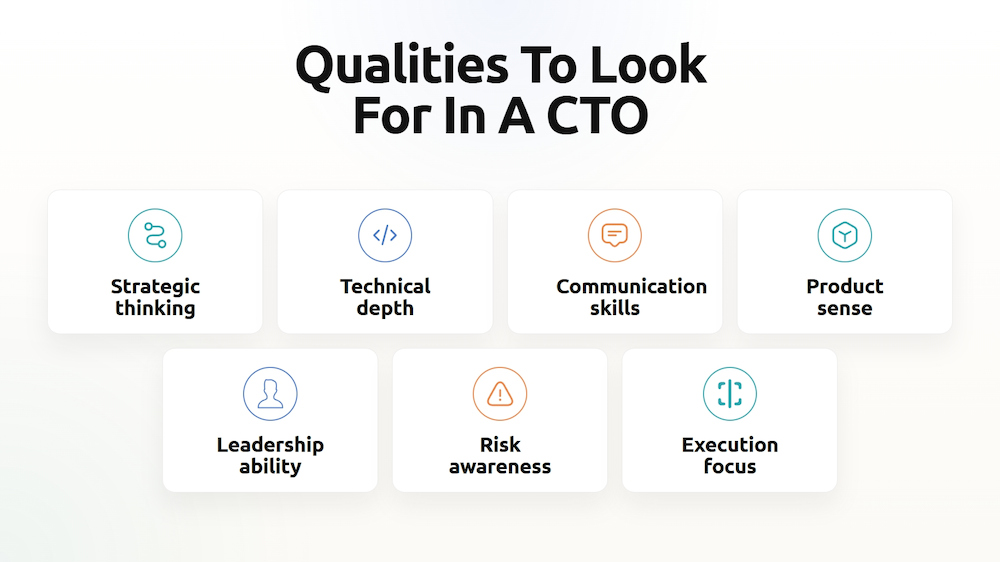
When you hire a CTO, look for these qualities:
- Strategic thinking. They should connect technical decisions to business goals.
- Technical depth. They need enough hands-on understanding to evaluate systems and guide the team with credibility.
- Communication skills. A CTO must explain tradeoffs clearly to founders, product teams, and engineers.
- Product sense. They should understand how technology choices affect the customer experience, speed to market, and product roadmap.
- Leadership ability. The role requires hiring judgment, team development, decision-making, and the ability to create clarity during pressure.
- Risk awareness. A good CTO sees problems early, including security gaps, fragile systems, and scaling limits.
- Execution focus. Strategy matters, but the person also needs to turn plans into action and help the team move forward.
It also helps to look for stage fit. A CTO who is excellent in a large enterprise may not be the right choice for a startup or a mid-market company. Some leaders are strong at building from zero. Others are better at scaling teams, modernizing systems, or fixing delivery problems. The best candidate is not the most impressive on paper. It is the one whose experience matches the business problem you need to solve.
This is also why companies should look closely at consulting CTO responsibilities before they hire. Some needs call for long-term executive leadership. Others call for an outsourced CTO who can guide architecture, support hiring, review vendors, or lead a transition period. The right answer depends on the scope of work, the company stage, and how much day-to-day involvement is needed.
How To Hire A CTO Step By Step
Hiring a CTO starts long before interviews. The process works better when the business is clear about the problem, the level of ownership, and the outcomes expected from the role. A vague search usually leads to a vague hire.
1. Define Why You Need A CTO
Start with the reason behind the hire. The role will look very different depending on what the business needs most. Some companies need leadership for product scaling. Others need help with a rebuild, security issues, team structure, investor readiness, or vendor decisions.
Write down the main goals for the first 6 to 12 months. That gives the search direction and helps separate true priorities from general expectations.
2. Choose The Right Engagement Model
Not every business needs a full-time executive. Some need a permanent CTO. Others need an outsourced CTO, a consulting leader, or project-specific CTO support for a defined period.
This choice affects cost, scope, and candidate profile. A full-time hire makes sense when technology is central to the business and the role will remain active across strategy, team building, and execution. A fractional or outsourced model makes more sense when the business needs senior guidance without full executive overhead.
3. Write The Scope And Expectations
A CTO role should not be described in broad terms alone. Define what the person will own. That may include architecture, hiring, delivery planning, security, vendor management, technical due diligence, or leadership across engineering and product.
It also helps to define what the CTO will not own. That prevents overlap with founders, product leaders, or engineering managers and makes the role easier to evaluate.
4. Decide On Must-Have Skills
Separate real requirements from nice-to-haves. Focus on the experience that matches the business stage and current challenges. A startup preparing to scale does not need the exact same person as a company rebuilding an old platform or tightening compliance.
Look at experience in areas such as:
- system architecture
- cybersecurity
- product development
- team building
- vendor selection
- budgeting and planning
The list should reflect the actual job, not an idealized executive profile.
5. Source Candidates From The Right Places
The best candidates do not always come through general job boards. Executive recruiters, trusted founder networks, investor introductions, niche CTO communities, and specialized consultants often produce stronger options.
If the company is trying to hire a CTO for a limited engagement, it may be better to search for experienced fractional leaders or consulting partners instead of traditional full-time candidates.
6. Interview For Strategy And Execution
A CTO interview should test how the person thinks, not just what they have done. Ask them to walk through past decisions, tradeoffs, failures, and priorities. Good answers should show business judgment, technical depth, and leadership maturity.
It helps to use real scenarios. Ask how they would approach a scaling issue, a platform rebuild, a weak engineering team, or a security risk. This reveals far more than generic questions about leadership style.
7. Validate Past Work And References
References matter more for this role than for many others. A CTO has wide influence, so you need a clear view of how they lead, how they make decisions, and what kind of environment they create.
Ask references about judgment, communication, delivery, hiring quality, and credibility with both technical and non-technical stakeholders. Past title alone is not enough.
8. Start With A Clear Onboarding Plan
A strong hire can still struggle in a weak setup. The first months should have defined goals, access to key stakeholders, visibility into the product and platform, and clear decision rights.
Give the CTO enough context to assess the business properly. That includes technical documentation, team structure, current risks, roadmap pressures, vendor relationships, and budget realities. Early clarity helps the person move from observation to action faster.
Questions To Ask Before You Hire A CTO
The goal of the interview is to understand how the candidate thinks, how they make decisions, and how well they fit your business. The best questions help you test judgment, communication, leadership, and stage fit.
Questions About Business And Strategy
- What business problems have you helped solve through technology?
- How do you decide what needs immediate attention and what can wait?
- How do you decide when to build internally, buy software, or use outside partners?
Questions About Technical Judgment
- What do you look at when assessing architecture, security, or technical debt?
- Tell us about a time you inherited a weak codebase, system, or process. What did you do first?
- What was a major technical decision you got wrong, and what did you learn from it?
- How do you evaluate tradeoffs between speed, quality, and long-term scalability?
Questions About Leadership And Team Building
- How do you approach hiring and structuring an engineering team?
- How do you manage technical leaders and help them grow?
- How do you handle conflict inside engineering or between engineering and product?
- What do you do when a team is missing deadlines or producing uneven work?
Questions About Fit For Your Company Stage
- Have you worked in a business at our stage before?
- Have you led growth, modernization, turnaround, or rebuild work similar to ours?
The best answers should give you more than credentials. They should show how the candidate thinks under real business pressure. A strong CTO should bring clarity to the conversation, not more abstraction. If the answers sound vague, overly broad, or disconnected from business outcomes, that is usually a warning sign.
How Much It Costs To Hire A CTO
CTO cost depends on the type of hire, the scope of responsibility, and the stage of the business. A full-time executive will cost far more than a part-time advisor or project-based consultant. Before discussing numbers, it helps to decide what kind of leadership the company actually needs.
Common CTO Pricing Models
Full-Time CTO
A full-time CTO is usually the most expensive option because the role carries ongoing responsibility across strategy, team leadership, architecture, hiring, risk, and delivery. In many markets, this means a six-figure base salary, and often significantly more for experienced leaders in competitive industries or high-cost regions. Equity, bonuses, and benefits may also be part of the package.
Fractional Or Outsourced CTO
An outsourced CTO or fractional CTO works well for companies that need senior leadership without a full executive commitment. Pricing is often structured as a monthly retainer, a fixed number of days per month, or a weekly advisory arrangement. This model usually costs less than a permanent hire, while still giving the business access to high-level technical judgment.
Project-Specific CTO Support
Some businesses do not need ongoing leadership. They need help with a platform rebuild, technical audit, vendor review, due diligence process, team restructuring, or launch planning. In these cases, project-specific CTO support may be priced by project fee, milestone, or day rate. This model can be cost-effective when the scope is clear and time-bound.
Consulting CTO Engagement
A consulting CTO may work somewhere between advisory and execution. The cost depends on how involved they are. Some stay focused on strategy and planning. Others take a more active role in architecture reviews, hiring, delivery oversight, and leadership meetings. The broader the scope, the higher the investment.
What Affects The Cost
Several factors influence what you will pay:
- Company stage and complexity
- Industry requirements
- Team size and leadership scope
- Product maturity and technical debt
- Geographic market
- Time commitment
A startup with a small product team may need a very different level of support than an enterprise managing a large engineering function, legacy systems, and multiple integrations.
Industries That Benefit The Most From Hiring A CTO
Some businesses feel the need for a CTO earlier than others. Usually, that happens when technology affects revenue, compliance, operations, customer experience, or delivery speed in a direct way. The more the business depends on stable systems, good data flow, and sound technical decisions, the more valuable strong technical leadership becomes.
Fintech
Fintech companies deal with security, integrations, compliance, data sensitivity, and product trust from day one. A CTO helps shape the platform, manage technical risk, and support decisions around infrastructure, payments, fraud prevention, and scaling. This is one of the clearest cases for fintech CTO consulting, especially when the company is growing fast or preparing for audits, partnerships, or investor review.
Logistics
Logistics businesses often rely on complex operational systems, third-party integrations, route data, warehouse tools, and real-time visibility. Technical issues can affect service quality and margins very quickly. A CTO helps connect product and engineering decisions to operational performance, which makes logistics CTO consulting especially useful during modernization, platform consolidation, or expansion.
Real Estate
Real estate companies increasingly depend on digital platforms, CRM integrations, lead flows, data reporting, internal automation, and customer-facing tools. That includes brokerages, proptech platforms, real estate marketplaces, and firms with large sales operations. Real estate CTO consulting can help when the business needs better system integration, stronger reporting, improved platform performance, or a clearer roadmap for digital growth.
Manufacturing
Manufacturing businesses often face a mix of legacy systems, process inefficiencies, supply chain complexity, and limited visibility across operations. Technical leadership becomes important when the company wants to modernize software, improve data flows, connect systems, or reduce dependency on outdated infrastructure. Manufacturing CTO consulting is often a strong fit for businesses moving through digital transformation with limited internal leadership.
Insurance
Insurance companies work inside a highly process-heavy environment with strict documentation, compliance demands, customer data, and older systems that are often hard to change. A CTO can help prioritize modernization, improve internal workflows, support automation, and guide vendor decisions. Insurance CTO consulting is especially useful when the business wants to improve operations without creating new technical risk.
Media
Media companies rely on content platforms, performance, distribution, data analytics, advertising systems, subscriptions, and fast product changes. Revenue models can shift quickly, and weak technical choices can affect both audience experience and monetization. Media CTO consulting helps when the business needs better platform stability, faster product execution, or stronger alignment between content, audience growth, and technology.
Benefits Of Hiring A CTO
The value of a CTO goes beyond technical oversight. A strong CTO helps the business make better decisions, avoid expensive mistakes, and move with more clarity. The benefits show up in strategy, execution, team performance, and risk management.
Clearer Technical Direction
Many companies struggle because technical decisions are made reactively. A CTO brings structure to that process. They help define priorities, choose the right path, and keep short-term fixes from creating bigger long-term problems.
Better Alignment Between Business And Technology
A CTO connects technical work to business goals. That matters when leadership is deciding what to build, what to delay, where to invest, and how technology supports growth. Without that connection, teams often stay busy without moving the business forward in the right way.
Stronger Product And Delivery Decisions
A CTO improves how product ideas turn into execution. They help assess complexity, set realistic expectations, and reduce the gap between what the business wants and what the team can deliver. This often leads to fewer delays, better prioritization, and more disciplined delivery.
FAQ
A CTO usually focuses more on technical direction, business alignment, long-term platform decisions, and executive-level planning. A VP of Engineering is often more focused on team management, delivery, processes, and day-to-day engineering execution. In smaller companies, one person may cover both areas for a period of time.
No. Some companies can operate well for a while with a strong senior engineer, engineering manager, or technical founder. The need for a CTO usually appears when technical decisions start affecting growth, delivery, hiring, security, or major business choices.
Yes, in many cases. An outsourced CTO is a strong option when the company needs senior guidance for a defined period, a specific initiative, or a growth stage that does not justify a full-time executive. This model is often used for audits, rebuilds, scaling plans, technical due diligence, hiring support, and vendor evaluation.
That depends on the hiring model and the level of clarity around the role. A full-time executive search can take weeks or months. A consulting or project-based CTO can often be brought in faster, especially when the scope is already defined.
Project-specific CTO support means bringing in senior technical leadership for a defined challenge rather than an open-ended executive role. That may include a platform rebuild, infrastructure review, security assessment, product launch, engineering team reset, or vendor selection process.
Yes. Developers can build, but they are not always responsible for setting direction, managing technical tradeoffs, shaping the team, or linking engineering work to business priorities. A CTO adds leadership, decision-making, and accountability at a higher level.