AI Consulting and Development Services: What They Include and How Implementation Works

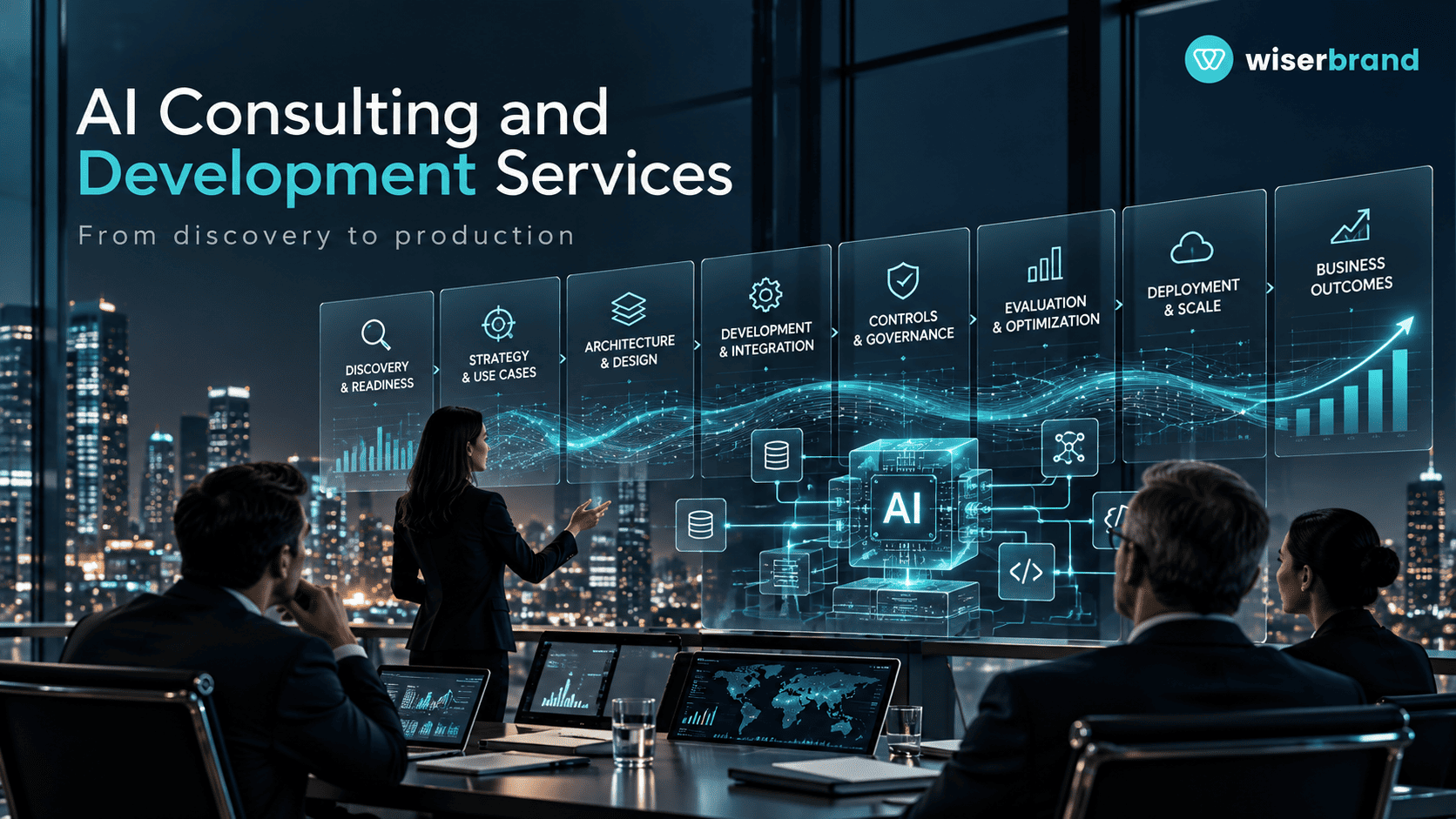
AI consulting and development services cover two jobs that buyers often merge into one purchase. Consulting decides which workflow to change, what the change is worth, and which controls the business needs before anything reaches production. Development builds the system that does the work: data access, retrieval, model calls, tool integrations, approval steps, monitoring, and the connections into the CRM, ERP, or help desk where the work already happens. Most programs need both. Problems start when a vendor sells strategy and hands over a deck, or writes code against a workflow nobody mapped. This guide sets out what a complete engagement includes, how implementation runs from discovery to production, which controls belong in scope, what drives the cost, and how to measure the result. It also describes the situations where an external partner adds little.
What These Services Actually Cover
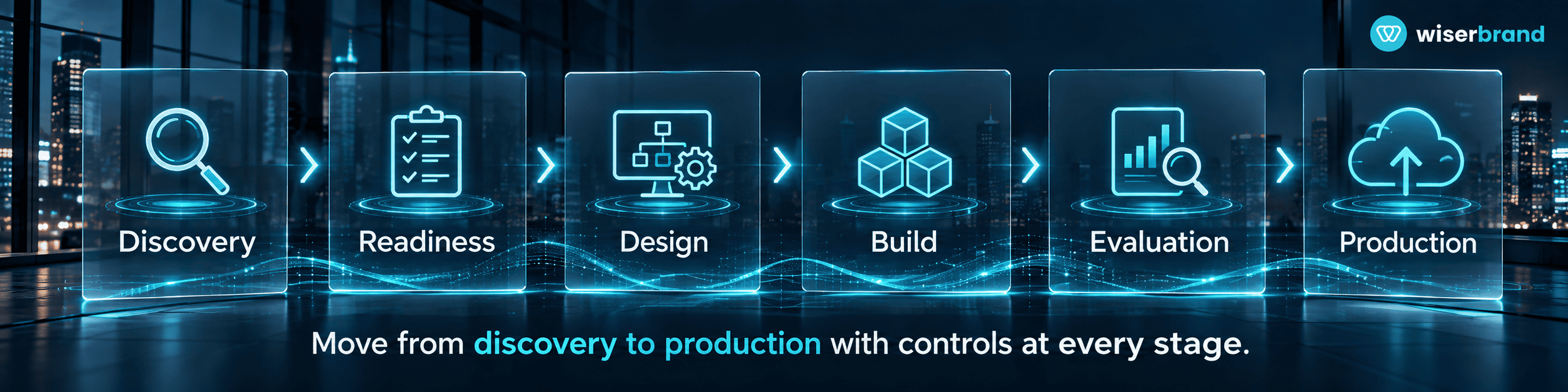
AI consulting and development services break into about ten components, and a serious engagement runs them as a sequence of decisions rather than a technology installation. Each component below answers a question the next one depends on.
- Workflow discovery: which process, which step, which decision, and what the current baseline looks like.
- Feasibility and value assessment: expected effect on cycle time, manual handling, error rate, or cost per completed case.
- Data and knowledge readiness: source systems, access rights, quality, freshness, and what has to be cleaned or restructured.
- Architecture design: model use, retrieval, deterministic logic, tool calls, state, and the boundary between them.
- Integration engineering: authenticated connections to source systems, event handling, and write-back rules.
- Control design: permissions, approval gates, escalation paths, and audit logging.
- Evaluation: test sets, expected tool selection, policy checks, and production monitoring.
- Deployment: staged rollout, rollback plan, and incident ownership.
- Enablement: reviewer training, runbooks, and documentation for the internal team.
- Managed operations: model and prompt versioning, drift review, cost tracking, and periodic re-evaluation.
Vendors package these differently. The useful procurement question is not the label on the package but which of these ten items appear in the statement of work, and who owns each one after go-live.
Consulting Work and Development Work Are Not the Same Purchase
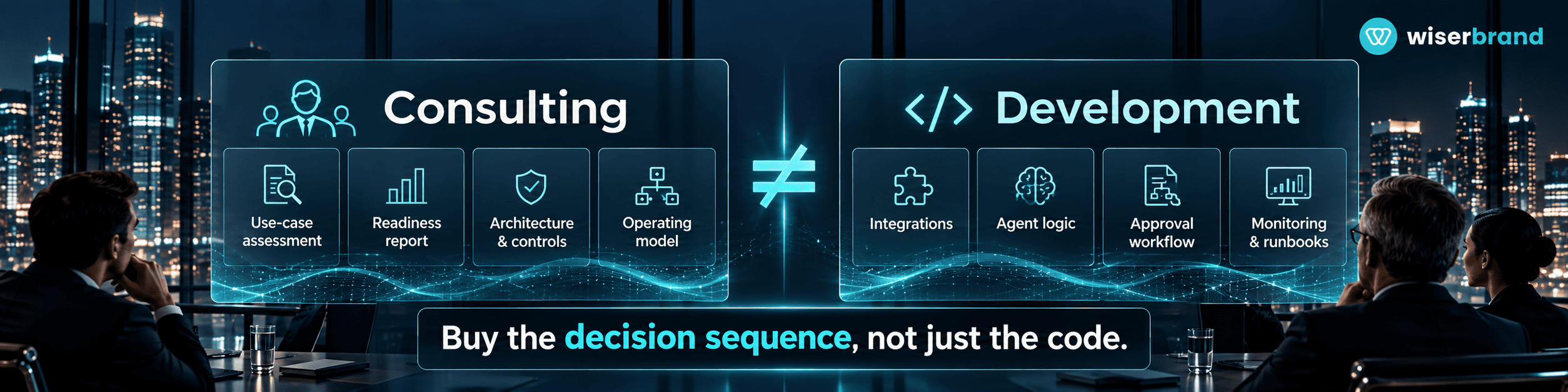
Buyers get into trouble when the contract covers one column of this table and the business expected both.
| Question | Consulting deliverable | Development deliverable |
|---|---|---|
| Which workflow should change first? | Use-case assessment with baseline data and a scored shortlist | Not applicable |
| Will the data support it? | Data and integration readiness report | Pipelines, retrieval index, access layer |
| What should the system decide? | Architecture and control design | Agent logic, tool schemas, validation rules |
| Who approves an action? | Risk tiering and approval policy | Approval UI, routing, audit log |
| Does it work? | Evaluation plan and acceptance criteria | Test framework, regression suite, dashboards |
| Who runs it next year? | Operating model and ownership map | Runbooks, monitoring, handover |
A consulting-only engagement is reasonable when an internal engineering team will build the system. A development-only engagement is reasonable when the workflow, controls, and success criteria are already documented. Buying one and expecting the other is the most common source of a stalled program.
Why So Many AI Programs Stop Short of Business Results
Access to AI is not the only constraint. In McKinsey's 2026 global survey of 1,719 respondents, 80 percent said AI had improved their individual productivity, while 37 percent said it had contributed to their organization's EBIT, a share that was essentially flat year over year. Larger companies also reported more agent scaling: 40 percent of respondents from organizations above $1 billion in revenue reported scaling agents in at least one function, compared with 22 percent at smaller companies.
Those figures separate individual tool use from organization-level results. A model that drafts a reply faster does not shorten a workflow that still waits on approvals, requires manual re-entry into an ERP, or routes cases incorrectly. Business impact depends on changing the workflow itself, then measuring fewer handoffs, less manual handling, shorter waiting time, and lower rework against a baseline.
Discovery: Choosing a Workflow Worth Automating
Discovery produces a shortlist, not an inventory of everything AI could theoretically touch. When the business has not yet selected a use case, an AI adoption assessment can rank candidate workflows by business value, data readiness, risk, and measurability before a build is scoped. A workflow deserves a place on that shortlist when it meets most of these conditions:
- Volume is high enough that a percentage improvement is worth engineering time.
- The task involves interpretation, classification, extraction, or drafting rather than pure calculation.
- The data needed to complete the task exists in systems the company can access.
- Most actions are reversible, or the risky ones can sit behind an approval gate.
- A baseline exists, or can be measured within a few weeks.
- One business owner can approve process changes without a committee.
Workflows that fail these tests are not always bad candidates, but they need a different sequence. When the data is scattered across spreadsheets and email, the first project is data consolidation. When no baseline exists, the first project is instrumentation. A partner who skips that answer and proposes an agent anyway is selling a build, not advice.
Data and Integration Readiness Comes Before Model Selection
Model choice is often easier to change than the data, integration, and permission design around it. Those surrounding systems usually determine if the workflow can read the right information, act within policy, recover from failures, and produce an outcome the business can measure.
Four questions matter more than benchmark scores. Which system is the source of truth for each field the workflow reads? Which systems allow writes, and through which API, with which rate limits? How stale can retrieved content be before an answer becomes wrong? And which records must stay outside the model context for privacy or contractual reasons?
Answering those questions often reveals concrete work: deduplicating customer records, restructuring a knowledge base written for humans rather than retrieval, adding a service account with scoped permissions, or building an event queue because the source system has no webhook. This is integration and data-readiness work rather than model tuning. Our data and AI consulting practice treats readiness as a separate phase with its own deliverable so data gaps, access constraints, and source-of-truth decisions are visible before model behavior is evaluated.
Choosing an Architecture: Assistant, Agent, or Deterministic Workflow
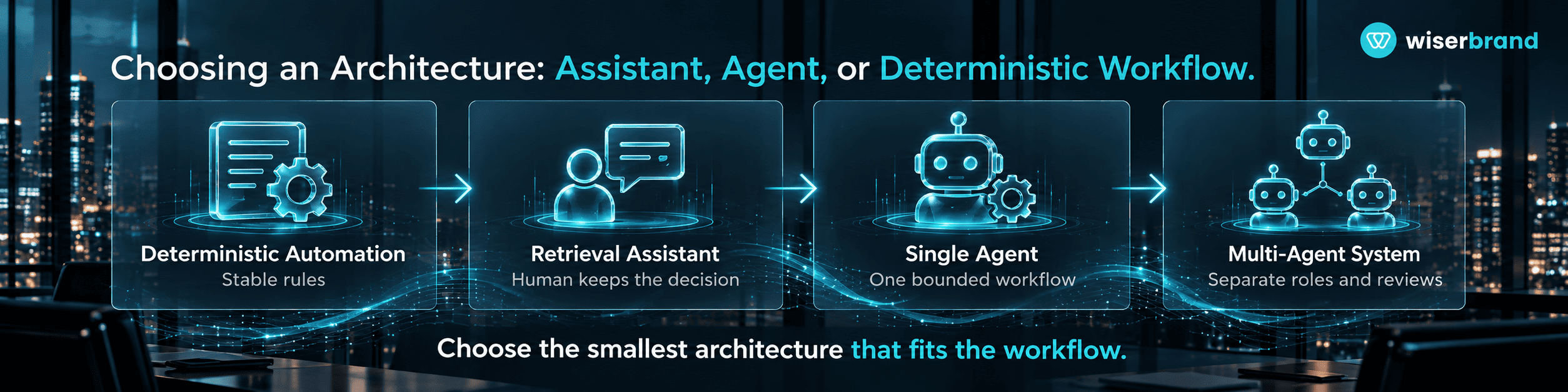
More autonomy is not a sign of a better system. It shifts risk, cost, and evaluation effort. The table below compares four common patterns for business workflows.
| Approach | Fits when | Main trade-off |
|---|---|---|
| Deterministic automation, no model | Rules are stable, inputs are structured, exceptions are rare | Breaks on unstructured input and new case types |
| Retrieval assistant or copilot | A person needs a draft, summary, or grounded answer and keeps the decision | Value depends on adoption; no workflow change without process redesign |
| Single agent with tools | One goal, a bounded action set, sequential steps, and clear stopping rules | Needs validation on every tool call and a defined escalation path |
| Multi-agent system | Roles need separate permissions, contexts, or independent review, or steps can run in parallel | Adds handoffs, state management, latency, coordination failures, and monitoring cost |
For a first project, a retrieval assistant or a single agent with a small allowlist of tools is often easier to test than a multi-agent design for the same sequential workflow. A single agent with strict parameter validation and a defined approval gate also leaves fewer handoffs to debug. Custom AI development work becomes justified when the workflow needs system-specific logic, write access, or controls that an off-the-shelf product does not expose.
Where the Engagement Changes by AI Type and Industry
Two variables materially change the shape of a project: the type of AI the task needs and the operating constraints of the industry or workflow.
Predictive ML and generative AI are different engagements
Buyers often shop for both under one heading, and the delivery work diverges early.
Predictive machine learning projects usually depend on labeled historical data and a measurable target. Delivery work may include feature pipelines, train-validation splits, holdout testing, and drift monitoring after release. Typical uses include demand forecasting, churn or propensity scoring, anomaly detection, and risk estimation.
Generative and agentic projects often do not require task-specific model training, but they do require grounding, retrieval quality, prompt and policy versioning, tool integration, and output evaluation. Production scope should be based on representative evaluation cases, permission boundaries, and failure handling rather than on how quickly a prototype can be assembled.
Plenty of workflows need both. A retention workflow might score accounts with a model and draft the outreach with a generative step, with each part evaluated on its own terms. When a provider markets AI and ML consulting and development as one capability, ask which of the two they have actually put into production, and how they evaluated it.
Industry decides the exception cases
Core architecture patterns can recur across sectors, but exception handling and control requirements vary with the workflow, the data involved, and the consequences of an incorrect action.
In retail, for example, an engagement may focus on order exceptions, return reason classification, catalog enrichment, or support workflows. The systems can include the ecommerce platform, order and warehouse management, the ERP, and the help desk, with explicit controls on refunds, pricing, and cancellations. Financial services and healthcare workflows may require more documentation, access control, and review because the data and decisions can carry higher regulatory or safety impact. Logistics projects often need explicit handling for late or inconsistent partner feeds.
The practical test during vendor selection: describe two of your messiest cases and ask the provider to walk through how the system would handle each. Sector familiarity shows up in that answer faster than in a logo slide.
How Implementation Works, Step by Step
The sequence below reflects how a production engagement usually runs. Steps overlap in practice, but skipping one tends to surface later as rework.
- Map the current workflow with the team that performs it, including exception paths and the informal steps nobody documented.
- Record a baseline: volume, cycle time, manual touches, error and rework rates, and current cost per completed case.
- Define the target scope precisely, including the completion condition and the actions the system may not take.
- Prepare data and access: source connections, retrieval content, service accounts, field-level restrictions, and logging.
- Build the first version against a test environment, with schema validation on every tool call and a human review step on every action that writes to a system of record.
- Evaluate offline on real historical cases, including malformed inputs, ambiguous requests, and cases the process handled badly in the past.
- Run a limited pilot on live volume with a narrow segment, full logging, and a documented rollback path.
- Widen scope by relaxing one control at a time, based on measured accuracy and reviewer override rates, not on schedule pressure.
- Hand over runbooks, dashboards, versioning practice, and a named owner for prompts, policies, and incident response.
Steps 7 and 8 show if the team has enough evidence and control to widen the rollout. Without a rollback path and a named owner for failures, the organization cannot contain a bad release or assign remediation clearly, which makes broader deployment harder to justify.
Permissions, Approval, and Exception Handling
Control design is part of the architecture, not a compliance formality added at the end. The practical question for each action the system can take: what happens when the model is wrong, and how quickly can someone reverse it?
| Action type | Reasonable default control |
|---|---|
| Read customer or order data | Scoped service account, field-level filtering, access logging |
| Draft a customer reply | Human review before sending during pilot; sampling review afterward |
| Update a CRM field or case status | Automated with schema validation, change log, and revert capability |
| Issue a refund or credit | Automated below a policy threshold, human approval above it |
| Change pricing, contracts, or access rights | Human approval in every case |
| Delete records or close accounts | Blocked; the system prepares the request only |
Exception handling deserves the same attention. The system needs a defined response for missing data, conflicting records, tool timeouts, permission denials, invalid model output, and duplicate events. In each case the decision is the same set of options: retry with backoff, pause and wait, route to a human queue with a clear description of what failed, or stop. Silent failure is the outcome to design out, because it produces incomplete work that looks complete.
Evaluation: Offline Tests and Production Monitoring
Evaluating text quality alone tells you very little about a workflow. A useful evaluation plan covers three levels: what the model produced, what the system did with it, and what happened to the case.
Offline testing runs on historical cases with known outcomes and checks classification accuracy, extraction correctness, grounding against approved sources, expected tool selection, and policy compliance. Adversarial and malformed inputs belong in that set from the start. Production monitoring then tracks workflow completion rate, tool success rate, escalation rate, reviewer override rate, latency, and cost per completed case, segmented by case type so that a failing category is visible instead of averaged away.
Reviewer overrides are a useful early signal. A rising override rate in one case category can point to a missing policy, incomplete context, or a model problem; reviewing the corrected cases helps separate those causes.
Governance and Compliance Belong in the Scope
Governance work should be proportional to risk. A drafting assistant for low-risk internal notes typically needs fewer controls than a system that scores applicants, prices insurance, or changes customer records. Higher-impact use cases need documented risk assessment, human oversight, logging, and a named accountable owner.
Two useful reference points for enterprise programs are the NIST AI Risk Management Framework, which NIST describes as voluntary and is currently revising, and the European Commission's AI Act guidance. NIST's framework organizes risk management around govern, map, measure, and manage functions. For companies operating in the European Union, the Commission's current guidance lists the AI Act's general application from 2 August 2026, with high-risk rules applying from 2 December 2027 for stand-alone systems and 2 August 2028 for AI embedded in regulated products after the Digital Omnibus entered into force on 27 July 2026.
A consulting partner can help map a use case to the applicable internal and external requirements, but legal or regulatory classification remains the organization's responsibility and may require qualified counsel.
What Drives the Cost of an Engagement
Pricing for AI consulting and development services varies by workflow, but several recurring cost drivers can be scoped before a build begins.
- Integration count and integration quality: a modern API with sandbox access generally requires less integration work than a legacy system reached through a database view or screen automation.
- Data preparation: cleaning, deduplication, restructuring content for retrieval, and permission modeling.
- Risk tier: approval workflows, audit logging, and documentation add engineering and review time.
- Evaluation depth: building a labeled test set from historical cases adds real work and should be scoped explicitly rather than treated as an optional polish step.
- Model and token spend in production, which scales with volume and context size rather than with the build.
- Human review capacity during the pilot, which is a real operating cost even though it sits in another department's budget.
- Ongoing operations: monitoring, re-evaluation after model or prompt changes, and incident handling.
- Portability: contracts that leave prompts, evaluation sets, and integration logic with the provider raise the cost of changing partners later, so settle ownership before the build rather than at renewal.
The same McKinsey survey found that about one in five respondents said operating costs, including token costs, had constrained their organization's AI use. Cost per completed workflow belongs in the business case from the beginning, not after the pilot.
Metrics That Show the Engagement Worked
Select metrics that match the workflow and pair each efficiency measure with a quality measure. Faster processing can hide quality loss if rework, overrides, or downstream errors are not tracked alongside cycle time.
| Layer | Example metrics | What they tell you |
|---|---|---|
| Model | Extraction precision, grounded response rate, policy adherence | The model behaves correctly on its own task |
| Step | Tool call success rate, valid parameter rate, routing accuracy | The system acts on the model output reliably |
| Workflow | Straight-through processing rate, manual touch rate, cycle time, exception rate | The process actually changed |
| Business | Cost per completed case, SLA compliance, rework rate, resolution time, capacity released | The change is worth what it costs |
Two cautions apply. Released capacity is not the same as saved cost unless the organization actually reallocates or reduces the hours. And a falling escalation rate is only good news when quality and reopen rates hold steady; under-escalation is a risk, not an efficiency gain.
Mistakes That Waste an AI Budget
- Starting from a tool that was already purchased and looking for a workflow to justify it.
- Buying a proof of concept with no baseline, which makes the result impossible to evaluate.
- Automating the approval step because it is the slowest one, when it is slow for a reason.
- Building a multi-agent structure for a sequential process, then paying for the coordination in latency and debugging time.
- Leaving prompts, policies, and model versions untracked, so nobody can explain why behavior changed last week, and treating the knowledge base as ready simply because it exists.
- Ending the engagement at go-live, with no owner for evaluation, cost, or incident response.
When You Do Not Need AI Consulting Services
AI consulting and development services are not always the right spend. Skip or delay the engagement in these cases:
- The workflow is fully rule-based and stable. Prefer deterministic automation or an existing platform feature because the task does not require model interpretation.
- A vendor you already use ships the capability natively and your requirements sit inside its configuration limits.
- The blocking problem is data ownership or process disagreement between departments. Neither is solved by a model.
- Your team has built and operated similar systems and mainly needs delivery capacity. Staff augmentation or a focused engineering engagement may fit better than broad advisory work.
- Nobody internally can own the result. Without a business owner, decisions about workflow changes, incidents, evaluation, and broader rollout have no clear owner after handover.
FAQ
How long does a first AI implementation take?
There is no reliable general timeline for a first AI implementation. A narrow workflow with clean API access and known evaluation criteria can move faster than a program that needs data consolidation, new permission models, or legacy integration work. Ask the provider to break the schedule into discovery, data preparation, build, evaluation, and pilot so the estimate can be checked against actual dependencies.
What is the difference between AI consulting and AI development?
Consulting produces decisions and evidence: which workflow to change, what the baseline is, which architecture fits, what controls the risk tier requires, and how success will be measured. Development produces the working system, including integrations, validation, approval flows, monitoring, and documentation. Many providers offer both, and the boundary should be explicit in the statement of work rather than assumed.
Should the first project use an agent or a simpler assistant?
Start with the smallest design that changes the workflow. If a person still makes the decision and the value comes from a faster, better-grounded draft, an assistant is sufficient. An agent is justified when the system needs to retrieve data, choose among a bounded set of actions, and complete steps in source systems, with validation and an approval gate on anything hard to reverse.
How do we measure return when the benefit is time saved?
Convert time into a business result only when the organization does something with it. Measure the workflow first: manual touches removed, cycle time, exception rate, and rework. Then state explicitly what happens to the released hours, either reassigned to other work or reflected in capacity plans. Presenting hours saved as cost saved without that step overstates the case and tends to fail review.
Who should own the system after go-live?
Assign three named roles: a business owner accountable for the process outcome, a technical owner for integrations and model or prompt changes, and a reviewer or approver group for actions that require human sign-off. Without these roles, changes, incidents, and rollout decisions have no clear decision owner.
Can we do this with an internal team instead?
Often yes. The deciding factors are experience with production AI systems, available engineering capacity, and access to the source systems involved. An internal team may already have the process knowledge and delivery capability. An external partner is more useful when the organization needs architecture review, evaluation design, integration capacity, or a faster first implementation, with operating ownership handed back internally afterward.
Final Thoughts
When you evaluate AI consulting and development services, buy the sequence rather than the label. A useful engagement names the workflow, records a baseline, confirms that the data supports the task, keeps risky actions behind approval, tests against representative historical cases, and leaves the team with monitoring, runbooks, and an owner. If those elements are missing, it is difficult to evaluate the work as a production implementation.
We apply the same operating logic to AI agent development and broader adoption engagements: define one workflow, set the control boundary, and agree on metrics before the build starts. If you are deciding where to begin, the practical next step is a workflow assessment that produces a baseline, a risk tier, and a scoped architecture recommendation you can act on with any partner.