AI Consulting for Small Businesses: Services, Costs, and Where to Start


AI consulting for small businesses helps an owner decide which task to improve, whether existing software can handle the work, and what an implementation must include. A useful engagement defines a workflow, checks the available data, estimates the value of a change, and sets review and approval rules. For example, drafting a customer reply requires different access and controls from issuing a refund. Start with one measurable task so the team can compare the new process with the current process before funding a larger build. For a single-user drafting task, testing an existing AI feature may be a reasonable first step before hiring a consultant.
What AI Consulting for Small Businesses Covers

AI consulting for a small business can cover opportunity selection, tool selection, workflow design, data access, controls, and staff handover. The practical deliverables include:
- AI opportunity review: a shortlist of business tasks ranked by measurable value, implementation effort, and the consequences of mistakes.
- AI tool selection: a comparison of capabilities already available in your software with a separate tool or custom build.
- AI workflow design: a description of the task from its trigger to a checked result, including the model's job and the employee's responsibility.
- AI data and access setup: connections to the CRM, inbox, spreadsheets, or booking system, with permissions limited to the chosen task.
- AI operating controls: validation, approval, logging, and recovery rules for customer messages, business records, payments, or documents.
- AI workflow handover: prompts, templates, ownership, and training so staff can operate and adjust the process after the engagement.
For a small business considering an AI build, an AI adoption assessment can define the candidate workflow, baseline, data constraints, and implementation options. Add evaluation, governance documentation, and integration work according to the actions involved: a draft for review needs different controls from a system allowed to change customer records or release payments. Ask the consultant to connect each proposed deliverable to a named task or risk.
AI Subscription Prices and Implementation Costs
The JPMorganChase Institute's April 2026 study of payments from 4.6 million small businesses describes entry-level generative AI subscriptions around $20 to $30 per month and median monthly AI spending near $28 in 2025. These figures describe paid AI services in the study, not consulting fees, integration budgets, or total operating costs.
For a small-business AI implementation, budget separately for software access and for connecting the workflow to business systems. A reply-drafting tool, for example, may need approved policies, access to the correct customer record, tests for exceptions, and an employee review step. A consulting proposal should price the relevant setup and controls explicitly. The subscription figures do not establish what share of your project budget integration will consume.
What Business AI Adoption Data Measures
The JPMorganChase Institute's April 2026 analysis measures cumulative adoption through payments for AI services: 5.2 percent in early 2023 and 17.7 percent by December 2025. December 2025 rates were 26.1 percent for employer firms and 15.3 percent for nonemployers. The measure counts firms that have ever paid for an identified AI service; free tools and AI embedded in other software are excluded. The researchers suggest organizational capacity may help explain the employer gap, but the comparison does not establish causation.
The U.S. Census Bureau's Business Trends and Outlook Survey instead asks businesses about AI use in the previous two weeks. For the period ending 3 May 2026, the national rate was 19.8 percent; 37 percent of firms with at least 250 employees used AI, compared with less than 20 percent of firms with four or fewer employees. These are survey-based usage figures, not the same cumulative paid-adoption measure used by JPMorganChase.
For a small business planning an AI pilot, adoption percentages are background information rather than a business case. A useful implementation decision still needs a named task, available data, an accountable owner, and staff time for testing and review.
AI Pilot Workflows for Small Businesses
For a small business, candidates for an initial AI pilot include repetitive, text-based tasks with digital inputs and an output that a person can check before it reaches a customer or changes a business record. The examples below separate the AI model's limited task from the employee's responsibility; they do not establish which workflow will deliver the fastest payback.
| Function | Workflow to test | What the AI model does | What a person still does |
|---|---|---|---|
| Customer service | Draft replies to common questions | Uses the message, relevant account or order details, and an approved policy to draft a reply | Checks and sends the reply; handles refunds and complaints |
| Sales | Summarize inquiries and prepare follow-ups | Summarizes a lead, proposes CRM updates, and drafts a follow-up | Confirms updates, sets prices, negotiates, and commits to delivery dates |
| Operations | Classify and route requests | Extracts fields and proposes a category and recipient | Checks exceptions and resolves disputes |
| Finance administration | Extract invoice and receipt data | Prepares vendor, amount, date, and line-item data for accounting review | Checks mismatches and approves payments |
| Marketing | Repurpose approved material | Drafts email, listing, or social-post variants | Approves factual claims, tone, and offers |
| Scheduling | Prepare appointment options | Reads permitted availability and proposes slots or confirmation drafts | Approves bookings that create a cost or commitment |
During an initial small-business AI pilot, keep pricing decisions, payments, refunds, contractual promises, hiring decisions, and legal or tax conclusions with designated human reviewers. These responsibilities belong in the table's right-hand column. The AI model's role is to prepare drafts, extract information, classify requests, or suggest options for review.
AI Consulting Cost Drivers for Small Businesses
An estimate for AI consulting for small businesses is more useful when the provider states the workflow, assumptions, and exclusions behind the price. A published fixed price may cover a defined assessment or configuration task; a cross-system build needs its own scope. Ask how the following factors affect the proposed fee:
- Systems involved. Configuring one tool with an accessible API requires different work from connecting three tools, including a legacy desktop application.
- Data condition. Duplicate customer records, conflicting prices, or outdated policies create cleanup and validation work before the AI workflow can use those records reliably.
- Action risk. Drafting for review needs different controls from writing directly to a system of record, where validation, logging, and a recovery path must be defined.
- Configuration or custom development. Check whether existing software can perform the task before paying for custom interfaces, workflow logic, or integrations.
- Operating costs. Estimate subscriptions, model usage, monitoring, and staff review at the expected monthly volume, alongside the implementation fee.
- Training and handover. Name who will own prompts, configuration, vendor accounts, and process changes after the consulting engagement.
For a first small-business AI project, ask the provider to price discovery separately from the build. Define the discovery deliverable as a measured baseline, a recommended workflow, a data and access review, and an implementation estimate with assumptions. The business can then use that work to approve a build, seek another provider, or stop before further spending.
Calculating the Business Case for an AI Workflow
For a small-business AI pilot, compare the current process with the complete new process, including employee preparation, review, corrections, and exception handling. Record six inputs using a representative period:
- V: expected task volume per month.
- B: measured baseline human minutes per task.
- A: pilot human minutes per task, including preparation, review, corrections, and a per-task share of monitoring time.
- R: loaded hourly staff cost, including employment costs.
- C: incremental monthly non-labor costs such as subscriptions, model usage, and infrastructure. Do not add review labor again: review is already included in A.
- I: one-time implementation cost, including discovery, configuration or build, initial testing, and training.
Monthly hours released = V x (B - A) / 60. Monthly capacity value = hours released x R. Capacity-valued net monthly benefit = capacity value - C. If that net benefit is positive, capacity-based payback in months = I / net monthly benefit. A zero or negative net benefit gives no positive payback under these assumptions.
Released salaried time is not automatically a cash saving. For cash payback, use G as verified net monthly cash savings from the process plus additional contribution from work sold, after the costs of delivering that extra work. Keep costs already included in C out of G so each cost is counted once. Cash net monthly benefit = G - C; if positive, cash payback in months = I / (G - C). Document how the cash benefit occurs, such as avoided paid overtime or additional work sold, and compare payback with the investment horizon the business accepts.
Illustrative AI Pilot Payback Calculation
Consider an illustrative small-business AI pilot, not a market benchmark: 600 tasks per month, eight human minutes per task before automation, and three minutes after automation, including preparation, review, and corrections. At a loaded labor cost of $24 per hour, the 600 x (8 - 3) / 60 = 50 hours released have a capacity value of 50 x $24 = $1,200 per month. With $100 in incremental monthly non-labor costs and a $2,400 implementation fee, capacity-valued net benefit is $1,100, giving capacity-based payback of $2,400 / $1,100, or about 2.2 months. Review labor is already in the three-minute figure and is not subtracted twice.
That 2.2-month figure is not a cash-payback promise. If the same pilot instead produces only $400 of verified monthly cash savings, then cash net benefit is $400 - $100 = $300 and cash payback is $2,400 / $300 = eight months. If no cash benefit materializes, the business has released capacity rather than recovered the fee in cash. Replace every illustrative input with measured pilot results before deciding.
Fractional AI Help for a Small Business
A fractional AI adviser provides recurring advice for a defined number of hours or deliverables each month. For a small business already operating an AI workflow, the arrangement can cover tool decisions, measurement, or adjustments to the next use case. Advice alone does not supply the capacity to build integrations, test a release, or run operating controls. Define the monthly deliverable, response expectations, and who performs implementation work before agreeing to a retainer.
AI Consulting Engagement Formats for a Small Budget
| Format | What you get | Good fit when |
|---|---|---|
| Half-day working session | A ranked shortlist of tasks and a recommended first move | You have ideas but no clear starting point |
| Paid assessment | Baseline measurement, data and access review, scoped recommendation | You need a decision you can defend to a partner or lender |
| Fixed-scope build | One workflow implemented, tested, and handed over with documentation | The workflow is defined and the systems are accessible |
| Fractional support | A few hours a month of ongoing advice and adjustment | Your team runs the system but needs a technical fallback |
| Managed operation | The partner runs monitoring, updates, and incident handling | The provider is contracted to own monitoring and incident response; the business still names an accountable decision-maker |
The five AI consulting formats above describe different deliverables rather than an exhaustive market classification. For a small business with a defined task, capped discovery or a fixed-scope build makes the spending limit and acceptance criteria explicit. Time-and-materials work can suit unresolved dependencies, but the contract should name the next decision point, spending cap, and conditions for stopping.
Scoring a Small Business AI Workflow
For a small-business AI pilot, rate each candidate task against the seven criteria below. The 1 and 5 columns describe the endpoints; use 2 to 4 for intermediate conditions and record the reason for each score. Add the seven scores with equal weight unless the business documents another weighting before comparing tasks. The scorecard is an internal prioritization aid, not a validated industry benchmark or a safety approval.
| Criterion | Score 1 | Score 5 |
|---|---|---|
| Frequency | A few times a month | Many times a day |
| Time per instance | Under two minutes | Half an hour or more |
| Input structure | Handwritten, verbal, inconsistent | Digital text or standard documents |
| Data availability | Lives in someone's head | Sits in a system you can connect to |
| Reversibility of mistakes | Money leaves or a contract is signed | Someone edits a draft before it goes out |
| Clarity of a good result | Depends on judgment nobody has written down | Obvious to any experienced team member |
| Owner | Nobody is accountable | One person owns the process and can change it |
Use the AI workflow scorecard to compare candidates, then inspect each weak criterion. Poor data availability calls for data or access preparation; unclear acceptance criteria call for process documentation. A high total must not override an unresolved risk such as unauthorized payments or contractual commitments. Resolve those limits with the process owner before the pilot.
A First 90 Day Plan for a Small Business AI Pilot
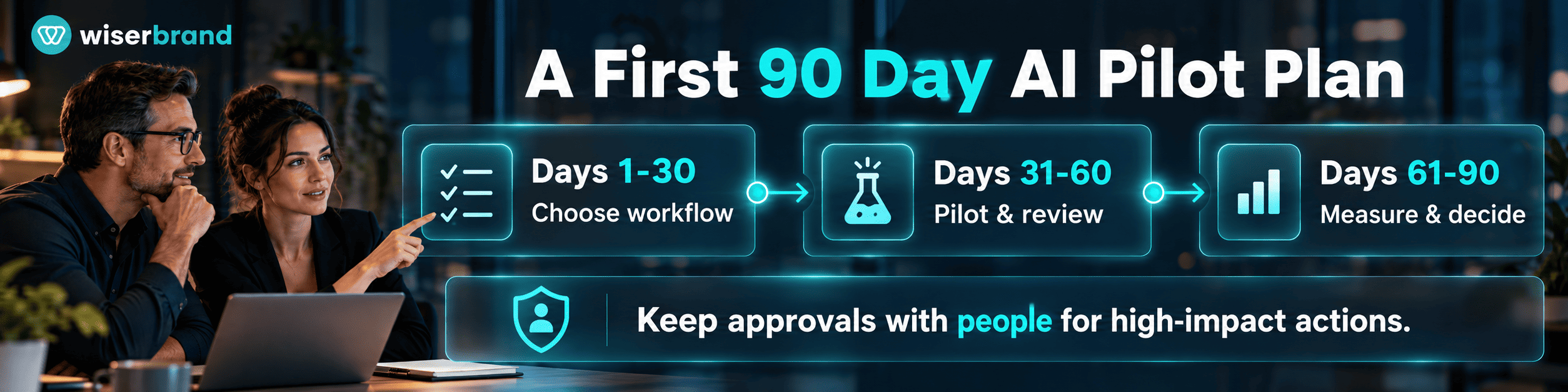
- Days 1 to 14: choose one AI workflow with accessible digital inputs, enough recurring volume to measure, a clear definition of a correct result, and an accountable owner. Measure task volume, human time, and errors in the current process for two weeks.
- Days 15 to 30: test AI features already available in your software, then configure the smallest useful version. Define permitted data and actions, human approvals, failure handling, and acceptance criteria before evaluating the pilot.
- Days 31 to 44: run the AI workflow alongside the manual process for two weeks. Capture input preparation, review, correction and monitoring time, incorrect outputs, and exceptions rather than recording model speed alone.
- Days 45 to 60: examine frequent and high-impact failures, correct missing policies or data, and retest representative routine and unusual cases. Record the number and severity of errors, including errors found in outputs that reviewers initially accepted.
- Days 61 to 90: if the agreed acceptance criteria are met, move to limited live use with human review and a documented way to stop or revert the workflow. Compare total human time, operating cost, and customer-visible errors with the baseline.
- Before reducing review, the small-business process owner should assess error severity, incident history, sample coverage, and checks of unedited outputs. A low draft-edit rate alone does not establish that an AI workflow is safe to run without review.
- Keep payments, pricing commitments, and other high-impact actions behind explicit human approval during the initial AI rollout. Document who owns the prompts, tool accounts, incident response, and decision to suspend the system.
- Treat this 90-day sequence as a planning example, not a delivery guarantee. If access, data, or acceptance criteria remain unresolved, extend the relevant phase or stop the pilot instead of advancing because a calendar date has arrived.
AI Data Access and Privacy Basics
For a small-business AI workflow, limit access to the records the task actually needs. An AI reply-drafting tool, for example, may need the relevant customer order and approved policy but not permission to issue a refund.
Give the AI tool its own account rather than sharing a staff login. Check vendor terms for retention and training use, and omit customer identifiers when the task does not require them. Record the inputs, outputs, actions, and human approvals needed to investigate a disputed result, while limiting the log's access and retention because the log may also contain customer data.
For AI systems within the EU AI Act's scope, the European Commission's guidance on Article 50 gives 2 August 2026 as the application date for transparency obligations. Providers of systems that interact directly with people must design them to inform users of AI interaction unless that interaction is obvious from context. Separate duties concern certain generated or manipulated content. A small business should identify whether its role is provider, deployer, or both and determine the duties and exceptions relevant to the particular system.
Human Approval for High Impact AI Actions
One failure mode in small-business AI work is a plausible but incorrect answer reaching a customer before anyone checks the content. A draft-and-review workflow creates an opportunity to catch that error before the reply creates a commitment.
During an initial small-business AI rollout, keep payments, pricing decisions, contractual promises, delivery commitments, and legal or tax conclusions behind explicit human approval. For lower-risk actions, change the review policy only after the owner checks representative cases, unedited outputs, and incident severity against documented acceptance criteria. Fewer edits are a useful observation, not proof that the underlying answers are correct.
Measuring a Small Business AI Pilot
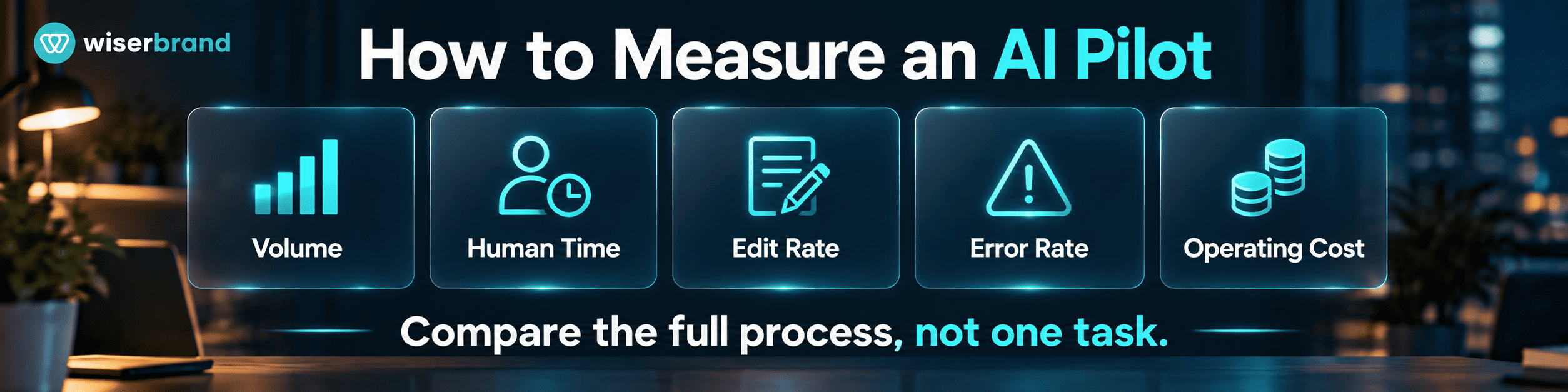
For a small-business AI pilot, a shared spreadsheet can hold a consistent weekly record of volume, total human time, quality, and cost. Use the same period and workflow boundaries for baseline and pilot comparisons. The following definitions make the measurements interpretable without a dedicated dashboard:
| Metric | How to capture it | How to interpret it |
|---|---|---|
| Volume handled | Count processed items and record the period | Shows usage and the denominator for per-item measures |
| Human time per item | Total preparation, review, correction, exception-handling, and allocated monitoring minutes / processed items | Compare the same task scope before and during the pilot |
| Draft edit rate | Reviewed drafts changed by a person / all reviewed drafts in the same week x 100 | Shows intervention frequency; does not detect every incorrect unedited answer |
| Customer-visible error rate | Outputs with an identified error sent to customers / all outputs sent to customers in the same week x 100 | Record counts and severity as well as the rate; zero observed errors does not prove no errors occurred |
| Rework | Count items needing a second pass and record the associated human minutes | Include those minutes in total human time rather than treating them as free |
| Operating cost | Record subscriptions, usage, and infrastructure separately from staff time | Compare costs at the measured volume; avoid subtracting review labor twice in a business case |
In a small-business AI pilot, hours released describe capacity, not necessarily cash savings. State how the business uses that capacity, such as handling more paid work or avoiding paid overtime, and measure the resulting financial change. For a business-case calculation, include review and correction time in the new process's human time; subtract incremental non-labor operating costs separately so review labor is not counted twice.
How to Vet an AI Consulting Provider
Before hiring an AI consulting provider for a small business, ask for concrete answers about scope, measurement, failures, and handover:
- Which workflow would you start with in my business, and why that one?
- What would you measure in the first month, and what does failure look like?
- Which parts can be done with software I already pay for?
- What happens when the model is wrong, and who finds out first?
- Who owns the prompts, accounts, and configuration when the engagement ends?
- Can you give me one example of a project you advised against?
Question an AI consulting proposal that names a technology stack before a workflow, promises a percentage saving without a measured baseline, or adds multiple agents to a sequential task without explaining the coordination benefit. For a reversible first commitment, request separately priced discovery with a baseline, data and access review, workflow recommendation, and scoped estimate as its deliverables.
When a Small Business Can Skip AI Consulting
- One person owns a repetitive drafting or summarizing task. Test an available AI tool with human review, then measure total human time and corrections. Seek outside help if the task needs integrations, controls, or skills the employee cannot supply.
- The required AI capability is already included in existing software. Test configuration and limitations before funding a custom substitute.
- The input records are incomplete, inconsistent, or inaccessible. Improve the source data or access first; storing reliable records in a spreadsheet or inbox does not, by itself, require replacing those systems.
- The business cannot name the task or define a correct result. A discovery discussion may help, but a build needs a workflow and acceptance criteria.
- The process owner is unavailable during a seasonal peak. Schedule the AI pilot when staff can supply examples, review failures, and validate changes.
FAQ
How to Budget for Small Business AI Consulting
Separate software access, one-time implementation, and ongoing operations in a small-business AI consulting budget. Price discovery around a workflow, baseline, and data/access review. A build estimate should state the systems involved, cleanup work, action permissions, tests, training, and handover. Ongoing cost includes usage, subscriptions, monitoring, and staff review. A software subscription price alone is not an implementation estimate; request a scoped proposal before setting a build budget.
Can a Small Business Run an AI Pilot Without a Consultant
A small business can start by testing a single-user AI drafting or summarizing task with human review and measured results. Outside help becomes relevant when work crosses systems, data requires preparation, actions create financial or contractual commitments, or staff cannot build and test the workflow. Choose consulting because those constraints need outside capacity, not because an adoption percentage suggests every business needs a consultant.
What Changes Between Small Business and Enterprise AI Consulting
AI consulting for small businesses can focus on one workflow, existing tools, proportionate controls, and handover to a small team. Enterprise engagements may involve more users, systems, procurement steps, and higher-impact actions, creating additional architecture, evaluation, and governance work. Company size alone does not set the control requirement: a small business handling sensitive data or payments still needs controls appropriate to those actions.
Which AI Use Case Can Pay Back Fastest
There is no universally fastest-payback AI use case for a small business. Draft-and-review tasks are candidates when the output is inspectable before sending and the required context is digital. Extraction into accounting or CRM systems is a candidate when recurring volume justifies integration and validation. Measure total human time before and during the pilot, subtract incremental operating costs, and identify a realizable financial benefit before calculating cash payback.
How to Protect Customer Data When Using AI Tools
AI customer-data safety depends on the vendor contract, access permissions, and information sent to the service. Check retention and training-use terms, restrict the AI account to necessary records, and avoid unnecessary identifiers. Protect the logs as well as the original records. For sensitive or regulated data, establish the applicable contractual and legal requirements before processing. A paid subscription alone does not establish that the planned use meets those requirements.
How Soon Can a Small Business See AI Pilot Results
A small-business AI workflow using existing tools has fewer access and integration dependencies than a new cross-system build, but neither has a universal delivery time. A proposal should tie milestones to data access, cleanup, configuration, testing, staff review, and acceptance criteria. Treat a 90-day pilot plan as a schedule to adapt to those dependencies, not a promise of results by day 90.
Choosing the Next AI Step for a Small Business
For AI consulting for small businesses, start with one repetitive workflow, measure total human time and errors, and retain human approval for customer or financial commitments. Expand only after the process owner has evidence from representative outputs and incidents. An increase in tool usage alone does not establish a business benefit.
WiserBrand offers an AI adoption assessment to examine workflow options, data readiness, risks, and implementation scope before a build decision. WiserBrand's custom AI development and AI agent development services cover applications and workflows that need custom logic or system connections. For example, a scoped project can define a CRM-connected drafting workflow with approval points and logs. Agree the workflow, deliverables, and acceptance criteria in the proposal before commissioning implementation.