Top 10 SaaS Development Companies for Startups and Enterprises in 2026

Choosing a SaaS development company comes down to one question: can this team build and run a multi-tenant product that keeps each customer's data isolated, meters usage, bills on subscription, and supports data export. This list of the top SaaS development companies in 2026 covers ten vendors that publish SaaS work, and it compares them on the same eleven fields, including a limitation and one question to ask before signing.
One distinction matters from the start. A SaaS vendor sells a finished product; a SaaS development company builds the product for you. This article covers the second group. WiserBrand publishes this ranking and appears at #3 under the same rules as every other entry. Facts come from each company's own site, press releases, or public partner records, checked on October 28, 2026. The order groups firms by scenario, not by quality.
10 SaaS Development Companies at a Glance
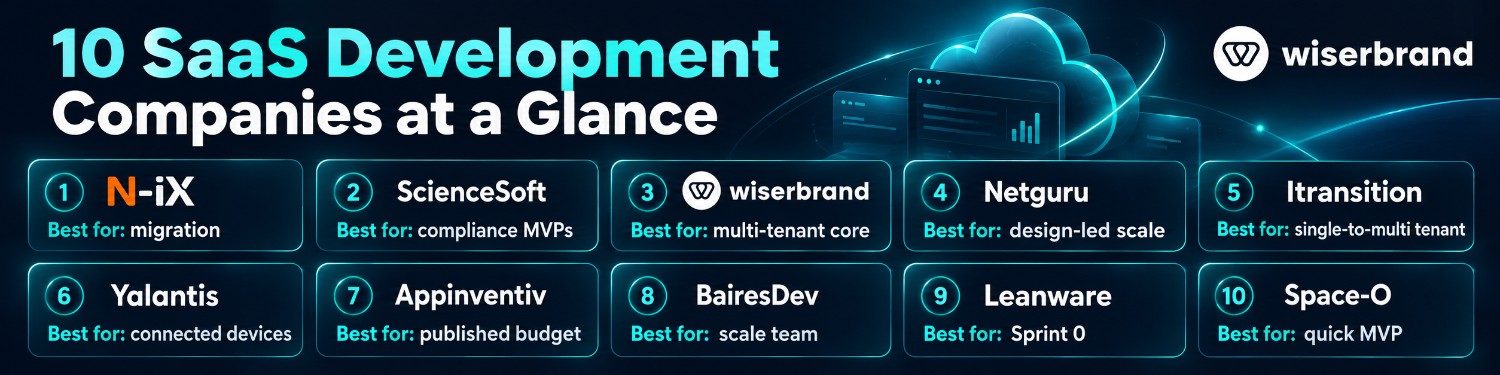
The table compares the ten best SaaS development companies in 2026 on the fields buyers check first. "Not published" means the vendor does not make the figure public. Prices are as each vendor publishes them and are not a written quote.
| Rank | Brand | Best for | Price or model | Key differentiator | Important limitation |
|---|---|---|---|---|---|
| 1 | N-iX | Migrating existing software to subscription SaaS at enterprise scale | Not published; FAQ "tens of thousands to several hundred thousand dollars" | AWS Premier tier with an AI Services competency; ISO 27001:2022 and SOC 2 Type 2 claimed | SaaS is one service line; no SaaS case with numbers |
| 2 | ScienceSoft | Compliance-heavy healthcare or fintech SaaS MVPs | Indicative only: $45,000+ design, $105,000+ managed MVP, $200,000+ full build | Named healthcare and fintech cases; the client keeps the code | Prices marked "not our official pricing"; certification body not named |
| 3 | WiserBrand | A multi-tenant SaaS core with integrations and SLA-backed support | Not published | Nine services in one contract; tenancy models and an API gateway published | No SaaS case with metrics; no ISO 27001 or SOC 2 |
| 4 | Netguru | Product-led MVP-to-scale work with design and strategy | Not published; blog estimates $25,000-150,000 (MVP) and $300,000-800,000+ (full) | B Corp; design and strategy sit inside delivery | Headcount is 400+, not 700+; best SaaS figures date to about 2017 |
| 5 | Itransition | Moving a single-tenant product to multi-tenant SaaS | Not published | The only quantified single-to-multi-tenant case with tiered billing | SaaS is a side line; the case client is anonymous |
| 6 | Yalantis | SaaS tied to connected devices or regulated healthcare | Not published; one IoT prototype at a fixed $80,000 | Isolation, subscription billing, and SSO described on one page | Facts from search snippets only; ISO scope not named |
| 7 | Appinventiv | A published budget range and client-owned code | $40,000-300,000; $25-50+ per hour | Multi-tenancy stated as a base requirement; client owns the code | Security wording contradicts itself across pages |
| 8 | BairesDev | Scaling an existing SaaS team through a large nearshore bench | Not published | Billing integrations (Stripe, Chargebee, Zuora, Recurly) and a large bench | Facts from snippets only; HQ and SOC 2 wording conflict |
| 9 | Leanware | A fixed-fee Sprint 0 and a small senior team | Sprint 0 $5,000-15,000; retainer $1,682 a month | Milestone-based pricing; never billed by the hour | Small team; no certificates; tenancy and billing not described |
| 10 | Space-O Technologies | A quick offshore SaaS MVP with broad add-on services | Not published (only budget form buckets) | Multi-tenancy next to AI and support add-ons | Headcount numbers conflict; no certification evidence |
Which SaaS Development Partner Fits Your Product Stage
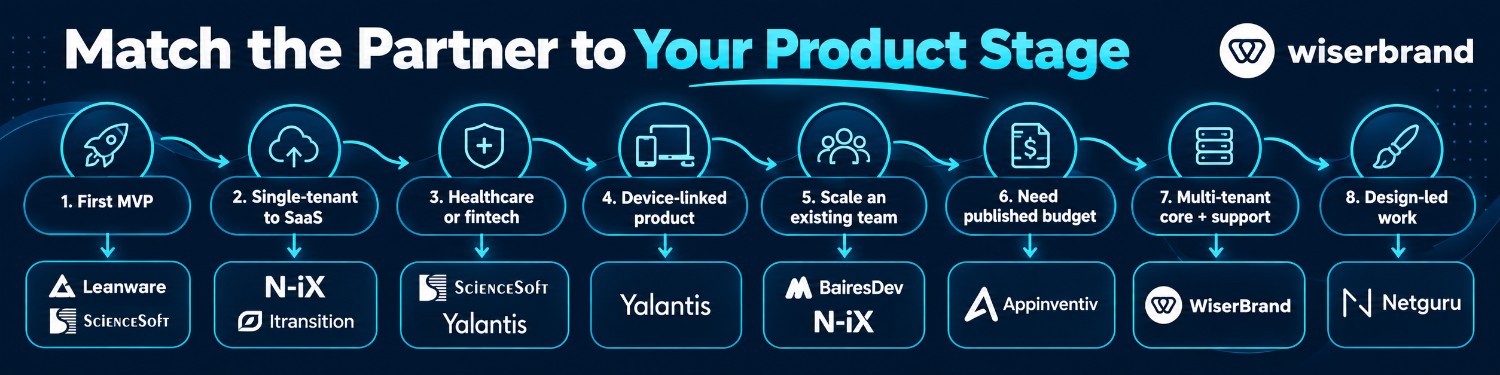
Start from your stage and your constraint, not the brand. The ten vendors here solve different problems, and most buyers filter on five facts: what has to be migrated, which compliance regime applies, how large your own team is, if a certificate must exist before signing, and how much price visibility procurement needs.
| Your stage or constraint | Look at | Why |
|---|---|---|
| A first MVP with a fixed first phase | Leanware; ScienceSoft | Leanware prices Sprint 0 at $5,000-15,000; ScienceSoft names a managed MVP scope |
| A single-tenant product moving to subscription | N-iX; Itransition | Both document a move to multi-tenant; Itransition publishes the numbers |
| Compliance-heavy healthcare or fintech work | ScienceSoft; Yalantis | Both publish healthcare programs; ask which certificate covers the team |
| A product tied to devices or clinical workflows | Yalantis | Multi-tenancy sits next to IoT and medical-device engineering |
| Scaling an existing SaaS team | BairesDev; N-iX | Both staff dedicated teams; BairesDev reports teams in 2-4 weeks |
| A published budget range and client-owned code | Appinventiv | The only entry with a published range and client-owned code |
| A multi-tenant core with post-launch support | WiserBrand | Nine services in one contract, with SLA-backed support |
| Design-led work from MVP to scale | Netguru | Design and strategy are part of delivery |
| A fast offshore MVP with add-on services | Space-O Technologies | A 3-4 month MVP claim plus AI, QA, and support |
The 10 SaaS Development Companies, Field by Field
Facts below come from each company's own website, press releases, or public partner records, checked on October 28, 2026. Certificates are as each company states them; we did not check certification registries. Where a company publishes nothing on a field, the entry says "not published" instead of dropping the field.
#1 N-iX - Best for Migrating Existing Software to Subscription SaaS at Enterprise Scale
N-iX fits a company that already has a product and wants subscription SaaS without rebuilding the business. Discovery on its SaaS page names multi-tenant architecture design as a deliverable, and the service list covers migration, integrations, and support. Two gaps matter: no SaaS case carries numbers, and SaaS is one line among many rather than a separate practice.
- Type: Enterprise engineering firm with SaaS as one service line.
- SaaS evidence: Migration to a subscription SaaS model, multi-tenant architecture design inside discovery, and AI or ML features within SaaS products. Billing appears only as a subscription plan, not an implementation.
- Delivery scope: SaaS consulting, design and prototyping, migration, development, integrations, support, and SaaS audit, across Discovery, UX design, Development, Release, and Support.
- Geography: Valletta, Malta headquarters; founded in Lviv in 2002. Offices in Ukraine, Poland, Bulgaria, Romania, Sweden, the UK, the US (Plantation, Florida), Colombia, and India. 2,400+ people in 10 countries (undated).
- Engagement and pricing: Not published. The FAQ gives "tens of thousands to several hundred thousand dollars." Models include staff augmentation, a managed team, a custom solution, and discovery. An AI program runs 1-2 weeks to assess and 4-6 weeks to pilot.
- Compliance and certifications: States ISO/IEC 27001:2022, ISO 9001, SOC 2 Type 2 (Security, Availability, Confidentiality, Privacy; report under NDA), PCI DSS v4, and GDPR. No certification body is named, and no HIPAA certificate is claimed. No trust center.
- Cloud partner status: AWS Premier Tier Services (DevOps, Migration and Modernization, AI Services, Digital Sovereignty) with an AI Services competency; Microsoft Solutions Partner; Google Cloud specializations only.
- Post-launch ownership: IP terms are described as discussed in the MSA and are not published. SLA values are not published.
- Proof: Fluke Corporation moved an on-premises product to a multi-tenant, cloud-native SaaS, with qualitative results only (less downtime, lower support costs). Code Worldwide (adZU OS) is named, with figures that differ across snippets. The SaaS page claims 160+ clients; the homepage claims 90+ enterprise clients. Company-reported.
- Limitation: SaaS is a service page, not a practice; no SaaS case with quantities; rates not published; the fit is enterprise and mid-market, not an early startup.
- What to check: Name two live multi-tenant SaaS products you built or modernized, with tenant counts, and put code ownership in the contract.
#2 ScienceSoft - Best for Compliance-Heavy Healthcare or Fintech SaaS MVPs
ScienceSoft is the one entry that publishes indicative SaaS prices, even while labeling them unofficial. It works healthcare and fintech cases with named clients and states that all software code belongs to the client. Read the certification wording closely: the security page claims ISO 9001 and 27001 certification without a body, scope, or expiry.
- Type: Broad software and IT vendor with a SaaS line, including a separate SaaS page, SaaS for healthcare, and SaaS consulting.
- SaaS evidence: Multi-tenancy architectures designed to scale; billing handled as a business model rather than an implementation; migration between clouds and from on-premises to SaaS; a full revamp offer for existing SaaS; AI and analytics among the features. The company states 14 years in SaaS.
- Delivery scope: Consulting (requirements, roadmap, TCO/ROI), UX/UI, architecture, development, QA, CI/CD, and L1-L3 support, with warranty support for 1-3 months.
- Geography: McKinney, Texas (5900 S. Lake Forest Drive, Suite 300). Delivery countries include the US, Mexico, Finland, Latvia, Poland, Saudi Arabia, and the UAE. 750+ people (undated). Founded in 1989.
- Engagement and pricing: Time and material, time and material with a cap, fixed price, subscription, and per-ticket. Indicative ranges labeled "not our official pricing": $45,000+ for SaaS design, $105,000+ for a managed MVP, and $200,000+ for a full build. The pricing page lists $200,000-600,000 for a specialized solution and $3,000-16,000+ a month for L3 support.
- Compliance and certifications: States ISO 9001 and 27001 certification as an IT vendor on its security page, with 114 implemented controls; body, scope, and expiry are not stated. ISO 27701 appears on the homepage; ISO 13485 wording differs between pages. HIPAA, PCI, SOC 2, and GDPR appear as standards it works in line with. No trust center.
- Cloud partner status: AWS Select Tier Services Partner (since 2017) and Amazon RDS Delivery Partner; Microsoft Partner since 2008; Claude Certified Services Partner.
- Post-launch ownership: "All software code is owned by your organization," per the SaaS page. Support runs L1-L3. No numeric SLA is published; 99.98% is described as a project availability figure.
- Proof: AKLOS Health reached a market-ready MVP in six months. Viber runs a billing portal for 1B+ users. UNM Health Sciences Center covers 387,000 older adults. MindCare Solutions is projected to cut manual coordination by 40%. Company-reported, with no stated method.
- Limitation: Rates and SLA values are not published; the SaaS prices are explicitly unofficial; SaaS is not the only focus; the certification body and scope are not named.
- What to check: From which location the team will work, if the ISO 27001 certificate covers it, and if 99.98% is a contractual SLA with penalties.
#3 WiserBrand - Best for a Multi-Tenant SaaS Core With Integrations and SLA-Backed Support
WiserBrand fits a product team that needs a multi-tenant core, integrations, and one contract for the chain from architecture to support. The SaaS application development service publishes tenancy models (schema, database, or cluster isolation) and an API gateway with rate limiting and OAuth2 or JWT auth, detail that procurement can check. The gap is honest and specific: no SaaS case with metrics, no ISO 27001 or SOC 2, and no trust center, so a strict security review will take longer.
- Type: Product development team, described on the site as product strategists, SaaS developers, and cloud architects.
- SaaS evidence: Nine services, including SaaS product consulting, custom SaaS application development with a multi-tenant core and admin portals, SaaS architecture design (microservices on Kubernetes, serverless, tenancy models), API development (contract-first OpenAPI or GraphQL), SaaS integration, cloud architecture and DevOps, legacy modernization with the strangler-fig pattern, and QA against the OWASP Top 10. Billing and subscriptions are not named in the service list.
- Delivery scope: Five stages: Discovery and Product Strategy; Architecture and Planning; Agile Development and DevOps in two-week sprints; Quality and Security Hardening; and Launch, Measure, Improve with blue/green rollout and zero-downtime claims.
- Geography: New York headquarters (1120 Avenue of Americas, 4th floor, New York, NY 10036) and an R&D center in Buenos Aires. Headcount distribution is not published. The About page reports 180+ professionals and 11 years; JSON-LD lists 2015.
- Engagement and pricing: Fixed-scope project, time and material, a dedicated product squad (product owner, SaaS developers, UI/UX designer, DevOps engineer), and continuous improvement and support on an SLA-backed arrangement. No SaaS prices. Timelines: "MVP in weeks" for SaaS, a feature-complete beta in 6-8 weeks for MERN, and kickoff within two to four weeks of the MSA for Angular; none is specific to SaaS.
- Compliance and certifications: No ISO 27001, SOC 2, or trust center. The SaaS page describes automated controls for GDPR, HIPAA, or PCI DSS that help pass audits, and penetration testing sits in stage four. A data-mining page references an "ISO-27001 framework" not confirmed elsewhere; do not repeat it.
- Cloud partner status: No AWS, Azure, or Google tier is published; badge alt text is not a tier.
- Post-launch ownership: The SaaS page does not mention IP. Other pages differ: code and artifacts belong to the client from creation on the Angular nearshore page, a work-for-hire agreement at each sprint review on the Node.js page, and upon payment on the JavaScript page. Support is SLA-backed with 24/7 language, without numeric values.
- Proof: No SaaS case with metrics. A trading platform is described as an enterprise-ready MVP whose core technology was adopted into the client's flagship platform. An e-trading modernization kept 100% of existing customers. A marketplace case reports about 10% of total revenue. A logistics rebuild reports 20% lower operational costs, 10% lower churn, and 18% higher sales without a measured or estimated label. Company-reported; local counters list 180+ professionals, 70+ completed projects, and 11 years.
- Limitation: No published SaaS prices, no SaaS case with metrics, no ISO 27001 or SOC 2, and no trust center; nearshore hubs are described inconsistently across pages.
- What to check: Which cases confirm a multi-tenant design and billing; who owns code from creation under the contract, since the pages disagree; and which SLAs apply in the support plan.
#4 Netguru - Best for Product-Led MVP-to-Scale Work With Design and Strategy
Netguru runs design, strategy, and build from one studio, which fits a founder who wants the product experience shaped alongside the engineering. The SaaS page defines the model as cloud applications delivered on subscription, and the company is a Certified B Corporation. Two caveats: the best SaaS case numbers date to about 2017, and no case documents a multi-tenant design.
- Type: Product studio and generalist with a SaaS practice.
- SaaS evidence: Six services (consulting, custom development, UI/UX, cloud migration, SaaS integrations, support). Multi-tenant and single-tenant architectures are described, and a July 2026 blog post explains multi-tenancy and recommends Stripe. Inn Style, a booking SaaS, reports 425,312 nights confirmed, a 400% user base increase, and £5m through Stripe; Prospero.AI is a mobile MVP in five weeks. Company-reported.
- Delivery scope: Strategy, design, development, testing, migration, API, deployment, and support, described as a hybrid maintenance model with 24/7 monitoring.
- Geography: Poznan, Poland (Male Garbary 9). Founded in 2008. 400+ people on the About and SaaS pages (undated). 2,500+ projects and an NPS of 73.
- Engagement and pricing: Dedicated teams, staff augmentation, and a delivery center. No price list. Its own blog publishes conflicting estimates: $25,000-150,000 for a SaaS MVP over 3-6 months, $300,000-800,000+ for a full multi-tenant product, and $20,000-45,000 a month for a team of 5-7 in Eastern Europe.
- Compliance and certifications: A blog post claims ISO 27001 certification and an ISMS since 2018, without a body or scope; the About page shows a TUV NORD logo without a standard. ISO 27701 is described as in progress. No SOC 2 for the company. Certified B Corporation since 2020.
- Cloud partner status: AWS Partner without a tier; "Microsoft Gold Partner," possibly outdated; Google Cloud Partner network without a tier.
- Post-launch ownership: SLA values and IP terms are not published.
- Proof: Inn Style, Prospero.AI (five-week MVP), and ProFinda (three years, seven people). Company-reported. The SaaS page mistakenly names other companies, which signals weak page maintenance.
- Limitation: Headcount is 400+, not 700+; the strongest SaaS figures are old; no multi-tenant design case; the ISO claim has no body or scope.
- What to check: A current ISO 27001 certificate (body, scope, expiry) and a reference SaaS product with 50+ tenants delivered in the last two years.
#5 Itransition - Best for Moving a Single-Tenant Product to Multi-Tenant SaaS
Itransition publishes the clearest quantified migration story of the ten: an unnamed life-science company moved from single- to multi-tenant and reports faster releases, faster user tasks, fewer support requests, and faster onboarding, on tiered pricing and recurring billing. For a buyer who wants the migration pattern proven with numbers, that case carries weight. The trade-off is focus, because SaaS is one line in a large systems integrator.
- Type: Large systems integrator with SaaS as one line among ERP, CRM, Dynamics 365, BI, and AI.
- SaaS evidence: Single, multi, and hybrid tenancy, chosen when it fits. The life-science case reports 35% faster releases, 30% faster user tasks, 25% fewer performance-related support requests, and 2x faster onboarding, on .NET 8 and Kubernetes with tiered pricing, installments, and recurring billing. A wellness platform uses Stripe and subscriptions with an MVP in three months. The SaaS page does not mention AI. Company-reported.
- Delivery scope: Consulting, analysis, UI/UX, development, QA, release, migration, integrations, and L1-L3 support.
- Geography: Headquarters not named on the readable pages. Companies House lists Itransition Group Limited (05915098, London). Offices in the US (Colorado, Georgia), London, and Berlin. "3,000+" people (undated). One page claims 10+ development centers; a 2018 release says three.
- Engagement and pricing: Full projects, dedicated teams, and staff augmentation. No prices.
- Compliance and certifications: ISO 9001:2015 and ISO/IEC 27001:2013 from PECB (IAS-accredited), dated November 19, 2018, scoped to software development, QA, deployment, and maintenance in three development centers. No current certificate and no transition to the 2022 edition were found. SOC 2, HIPAA, and PCI are not published. No trust center.
- Cloud partner status: AWS Advanced Tier Services since 2017 and AWS Well-Architected; Microsoft Solutions Partner (Data & AI, Digital & App Innovation) with an Azure AI Platform specialization (February 16, 2026); Databricks Consulting and SI partner (September 1, 2026).
- Post-launch ownership: SLAs are set per support engagement, with no values. IP terms are not published.
- Proof: The life-science migration and the wellness platform, both company-reported, with mostly anonymous clients.
- Limitation: SaaS is a side line of a large SI; the SaaS page has no AI and no prices; clients are mostly anonymous; certification currency is unconfirmed.
- What to check: Which SaaS case is genuinely multi-tenant in production, and a current ISO 27001:2022 certificate scoped to the team that will build your product.
#6 Yalantis - Best for SaaS Tied to Connected Devices or Regulated Healthcare
Yalantis publishes one of the strongest SaaS field sets: multi-tenant architecture and tenant data isolation, subscription and usage-based billing integration, and RBAC with SSO on AWS or Azure. For a product that connects to devices or touches clinical workflows, that combination is rare. The caution is data provenance: the site blocks automated requests, so every fact here comes from search snippets and needs a browser check before publication.
- Type: Engineering company moving toward IoT, hardware, and medical devices, with a SaaS line. The homepage reads "Compliant Software, Hardware and IoT Development."
- SaaS evidence: Multi-tenant architecture and tenant data isolation; subscription billing and usage-based pricing integration; RBAC and SSO on AWS or Azure; conversion of a legacy PACS to multi-tenant. Cases are anonymized and company-reported: a radiology platform reports 30% lower infrastructure cost per hospital and 5x faster processing; an AI health tracker covers 60+ hospitals; an IIoT product reports 99.9% availability. No named SaaS client.
- Delivery scope: Full cycle, including discovery, design, software, embedded, hardware, IoT, AI, cloud and DevOps, QA, and support. The SaaS page lists 20+ business analysts, six architects, and 400+ engineers.
- Geography: Warsaw headquarters and R&D lab; an admin hub in Larnaca, Cyprus; the legal entity is Yalantis OU in Tallinn; offices in Long Beach and Munich. Founded in 2008 in Dnipro. Engineer counts vary at 400+, 450+, and 500+ (undated). Not Limassol.
- Engagement and pricing: Time and material, fixed price, managed team, and managed product, with names that differ across pages. One IoT prototype is quoted at a fixed $80,000 over 10-12 weeks. No rates.
- Compliance and certifications: "We hold" ISO 9001, 27001, 13485, 27701, and IEC 62443, with the ISO 9001 scope differing between two pages; no numbers, bodies, or scope are given. SOC 2 and HITRUST are sold as client services. HIPAA work is built under a BAA.
- Cloud partner status: AWS Advanced Tier (one page still says Select).
- Post-launch ownership: An NDA page states the client owns "code and ideas," which is not a contract term. SLA values appear only in individual cases.
- Proof: Anonymous radiology, AI health, and IIoT cases only. Company-reported.
- Limitation: SaaS is one line among IoT and hardware; cases are anonymized; ISO bodies and scope are not named.
- What to check: A current ISO 27001 certificate (body, scope, expiry) and a reference multi-tenant SaaS client, not only IoT and radiology work.
#7 Appinventiv - Best When You Want a Published Budget Range and Client-Owned Code
Appinventiv is the only entry that publishes a SaaS budget range, and it states that designs, code, and proprietary materials remain with the client. Multi-tenancy is described as a base requirement rather than a later change, which is the right instinct. The weak spot is security wording that shifts between pages enough that a buyer should ask for the actual reports.
- Type: Offshore generalist in mobile and AI engineering, based in India, with a SaaS line.
- SaaS evidence: Tenant-aware architectures with defined boundaries and usage governance; billing and metering logic with traceable usage histories; Stripe as a partner; migration; and MVP work. Ility, a real-estate SaaS, launched in 45 days with +40% occupancy and a 2% landlord ROI (20% elsewhere). Domino's reports +23% conversion but is not SaaS. Company-reported.
- Delivery scope: Consulting, custom development, MVP, integration, product development, and cloud migration, across planning, design, engineering, QA, staged release, and support.
- Geography: The legal entity is Appinventiv Technologies Pvt. Ltd. in Noida, with offices in Noida, Punjab, New York, Emeryville, London, Dubai, Calgary, and Queensland. Headquarters is not stated. Founded in 2015. "1700+" people (labels vary; undated).
- Engagement and pricing: "The cost of developing a SaaS application can vary between $40,000 to $300,000," with 3-4 months for a simple build and 10-12 months for a complex one. A dedicated team runs on a monthly retainer with 30 days notice; fixed price and time and material are also offered. Hourly rates are listed at $25-50+.
- Compliance and certifications: Conflicting. The security page states ISO 27001:2022 and SOC 2 Type II without a body, number, scope, or audit period, with summaries under NDA. The compliances page says "ISO-Certified and CMMI Level 3" and lists SOC 2, HIPAA, and PCI DSS as standards it works to. The SaaS page and About describe practices "aligned with" ISO/IEC 27001 and SOC 2, which is not a certificate.
- Cloud partner status: AWS Advanced Tier Partner with "Triple Competency Recognition" (competencies not named); Azure and Google without a tier; Claude Preferred Services Partner.
- Post-launch ownership: "The ownership of all designs, code, and proprietary materials remains with the client," per the security page. No SLA values are published.
- Proof: Ility (45-day launch) and Domino's (+23% conversion). Company-reported.
- Limitation: A very broad generalist; the SaaS page is mostly a feature list; security claims contradict each other.
- What to check: The ISO 27001:2022 and SOC 2 Type II reports (body, scope, period), and confirmation that they cover the delivery center that will build the product.
#8 BairesDev - Best for Scaling an Existing SaaS Team Through a Large Nearshore Bench
BairesDev is built for one job: adding senior engineers to a team that already knows what it is building. Its billing coverage is the deepest here (Stripe, Chargebee, Zuora, PayPal, Recurly, with plan changes, proration, and dunning), and it reports placing teams in 2-4 weeks. Everything here comes from search snippets, so treat the numbers as vendor claims and confirm them directly.
- Type: Nearshore generalist with an enterprise tilt.
- SaaS evidence: Multi-tenancy as a capability; billing integrations across several providers with plan changes, proration, and dunning; monolith-to-SaaS migration with parallel running; and MVP as a separate service. NextRoll added 48 engineers in seven teams and grew Shopify merchants by 60%; Azlo doubled its client base in 18 months. No MVP-to-launch SaaS case was found. Company-reported.
- Delivery scope: Dedicated teams for builds and migration, staff augmentation, and MVP development.
- Geography: Conflicting: San Francisco (50 California Street, Suite 1500) on the contact page and Mountain View in 2026 press releases. A distributed team, about 90% based in Latin America. "4,000+ professionals in 40+ countries" (September 23, 2026); 3,000+ is older. Founded in 2009 in Buenos Aires.
- Engagement and pricing: No rates. Time and material, a monthly dedicated team, and fixed price. Teams are staffed in 2-4 weeks. The company claims 30-50% savings against US hiring.
- Compliance and certifications: ISO/IEC 27001:2022 through IRAM IQNET, scoped to sourcing technical talent and the tools used for staff augmentation and dedicated teams. SOC 2 wording conflicts: "certified" on one page, "in compliance with" on another, and "support" on the SaaS page, with no type named. HIPAA, PCI, and GDPR appear as experience.
- Cloud partner status: "AWS Partner" without a tier; Google Cloud Partner; "Microsoft Gold," an outdated label.
- Post-launch ownership: "All code, IP, and related assets we build for you belong to your company, as specified in the contract." No SLA values.
- Proof: NextRoll, Azlo, and SiriusXM (an 11-year AWS migration, not billing). Company-reported.
- Limitation: Rates are not published; the CIO 100 award is for an internal HR model, not client SaaS; the numbers conflict (3,000 or 4,000 people, 40 or 50 countries, headquarters, SOC 2 type).
- What to check: If a SOC 2 Type II report exists with an audit period, and which named team lead will work on your SaaS.
#9 Leanware - Best for a Fixed-Fee Sprint 0 and a Small Senior Team
Leanware is a boutique with a narrow promise: a priced Sprint 0, then delivery by accepted milestones, never by the hour. For a founder who wants a small senior team in US time zones and a fixed first phase, the model removes some contract risk. The limits are real: a small team, no certificates or cloud tier, and a SaaS page that does not describe multi-tenancy or billing.
- Type: Boutique nearshore software studio ("Not a consulting firm. Not staff aug. Not a body shop.").
- SaaS evidence: Multi-tenancy and subscription billing are not mentioned on the SaaS page. Modernization is described as slicing the system while the current product keeps running. ElephantCPA, an accounting SaaS, reports 80% lower cloud costs across 130+ user stories; BizWorth cut an appraisal from six working days to seconds, reaching 52 signups and 7 paid subscribers in the first month. Of 30 cases, only three are described as SaaS. Company-reported.
- Delivery scope: Sprint 0 (UI/UX, design system, user stories, milestone plan, repository scaffold with infrastructure as code), weekly sprints, QA, DevOps on AWS, GCP, or Azure, an optional retainer, code audit, and a fractional CTO.
- Geography: Bogota, Colombia. Founded in 2020. Miami is a US legal entity, not an office. Headcount is not published ("a small senior team"; nine people on About); its own blog gives 40, 45-50, and 10-49.
- Engagement and pricing: Sprint 0 at "$5,000 to $15,000 for two to four weeks"; build priced by accepted milestones, with "We do not publish a build rate card" and "never billed by the hour"; a retainer at "$1,682 a month for 42 hours." The blog also mentions $25-49 an hour, which conflicts with the page.
- Compliance and certifications: Not published (ISO 27001, SOC 2, HIPAA, GDPR). A Clutch 5.0 rating across 26 reviews and a Clutch 2026 award are reviews, not certificates.
- Cloud partner status: Not published.
- Post-launch ownership: The services page states the contract assigns full ownership of the codebase and design assets; a business page says ownership transfers on payment. For a retainer, the first response comes within one business hour on critical issues.
- Proof: ElephantCPA, BizWorth, Plannerd, and Notary.io. Only two carry numbers. Company-reported.
- Limitation: Small team; no certificates and no cloud partner tier; multi-tenancy and billing are not described; only a few SaaS cases carry metrics.
- What to check: Who leads the project if a key engineer leaves a team of two to four people, and which security attestations cover your production data.
#10 Space-O Technologies - Best for a Quick Offshore SaaS MVP With Broad Add-On Services
Space-O sells speed and breadth: a 3-4 month MVP claim, a multi-tenant and API story, and AI, QA, and 24/7 support around it. For a small budget that needs many services from one vendor, that breadth is the appeal. The risk is evidentiary: headcount numbers disagree across its own pages, no certificate is published, and Space-O runs its own listicle that places itself first, so do not treat its data as a source for other companies.
- Type: Outsourcing generalist with a SaaS and AI line.
- SaaS evidence: Multi-tenant architectures, secure APIs, and cloud infrastructure; subscription billing mentioned without detail; payment gateways; legacy-to-SaaS migration; ML for analytics. No LLM services appear on the SaaS page. Fyule, an eLearning product, "secured funding of $1.4 million through an Angel syndicate"; the rest carry no metrics. The site claims 500+ SaaS projects and 97% retention without support. Company-reported.
- Delivery scope: A six-stage process: discovery, UI/UX, architecture, QA and security, deploy, and support, with SSO, RBAC, penetration testing, and 24/7 monitoring.
- Geography: Ahmedabad, India (service division), with the product division in the same city and sales offices in Mesa, Arizona, and Brampton, Ontario. Founded in 2010. Headcount conflicts at 250+ (careers), 140+ in-house engineers (About and SaaS), and 180+ (homepage).
- Engagement and pricing: Dedicated team, fixed price, hourly, and on-site. No rates, only budget-form buckets ($10-20K, $20-50K, $50K+), which are not prices. Estimates in 24-48 hours.
- Compliance and certifications: Conflicting. The SaaS page states ISO 9001 and ISO 27001 certified development processes (ISO 27001:2013), while the homepage calls ISO 27001 an alignment. No certificate, body, or scope is published. SOC 2 appears as "covers SOC 2 certification" on the homepage and "works to" on the SaaS page. HIPAA is described as "ready." No trust center.
- Cloud partner status: "AWS Partner" with no published tier; "OpenAI Select Partner."
- Post-launch ownership: The SaaS page states all projects are secured by an NDA and is silent on IP. No SLA values.
- Proof: Fyule (funding). Most cases carry no metrics. Company-reported.
- Limitation: Conflicting numbers across its own pages; no certification evidence; no named SaaS case with product metrics; it publishes a competing listicle that ranks itself first.
- What to check: The ISO 9001 and 27001 certificate (body, scope, expiry), which of the 500+ SaaS projects was multi-tenant with subscription billing, and who owns the code and from when.
SaaS-Specific Questions That Separate a SaaS Developer From a Generic Vendor
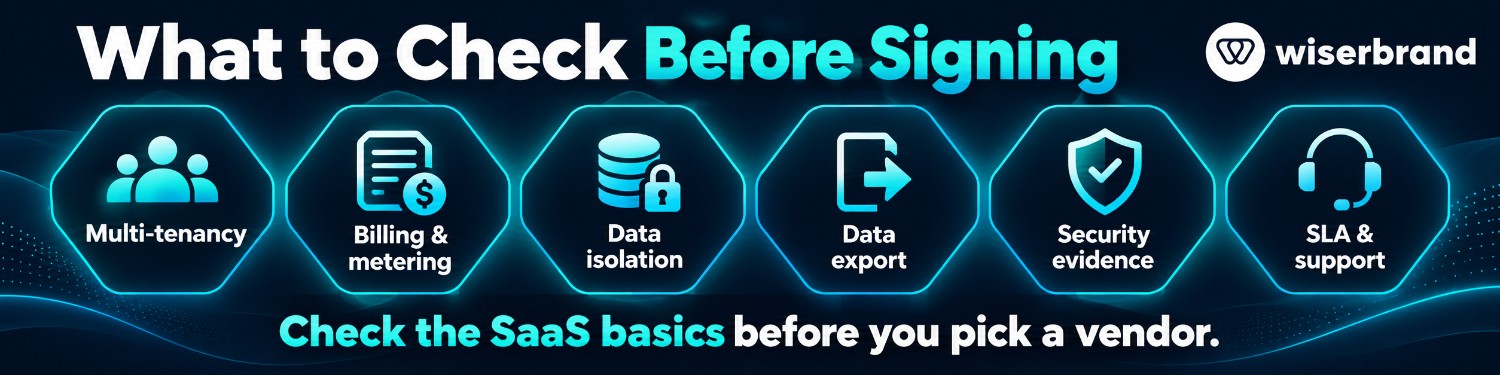
A generic software vendor can build a login screen and a database. A SaaS builder has to handle tenant boundaries, metering, and exit. A multitenant solution serves multiple customers, or tenants, and tenants are distinct from users. If a vendor cannot say where that boundary is enforced in code, the security review has not started. SaaS development companies differ most on what they publish, so ask for the same evidence from each. The table turns each SaaS-specific risk into a question, a red flag, and a check you can run in one call.
| Criterion | What to ask | Red flag |
|---|---|---|
| Tenant isolation | Which model: shared schema, database per tenant, or cluster per tenant, and where the boundary is enforced | "Multi-tenant" with no isolation model named |
| Billing and metering | How plan changes, proration, dunning, and usage metering are implemented, on top of which provider | Billing described as a business model, not an implementation |
| Security evidence | A SOC 2 Type 2 report with an audit period, and an ISO 27001 certificate with body, scope, and expiry | "Aligned with" or "certified" with no report to show |
| Verification standard | OWASP ASVS 5.0.0 requirements named in the contract, with test evidence per release | Security described only as penetration testing at the end |
| Data export and exit | Open interfaces and a structured, machine-readable export in the first release | No export plan, and egress priced per gigabyte on the way out |
| IP and code ownership | Who owns code, designs, and infrastructure definitions from creation, in a sample agreement | IP terms unpublished, or pages that disagree on the transfer point |
| SLA with numbers | Uptime, response time, and credits per severity, in writing | "SLA-backed" with no values |
| AI features | Where tenant data sits, which model provider is used, and the per-tenant limits | An AI demo with no answer on data residency |
OWASP publishes the ASVS requirements, in its own words, for use during procurement to specify application security verification in contracts, and version 5.0.0 was released on May 30, 2025. Naming a version and a scope level in the contract turns "we test security" into a requirement the vendor accepts.
Two rows carry the most weight. Tenant isolation is the decision that is expensive to reverse, because moving from a shared schema to a database per tenant later touches every query. And the security row only counts with a scope: a report that covers a parent entity says nothing about the delivery center that will touch your data.
What SaaS Development Costs: Prices Vendors Publish
No independent benchmark for SaaS development cost exists in the sources checked here, so the figures below are what each of these SaaS development companies publishes, nothing more. Treat a vendor range as starting context, not a quote, and compare offers on identical scope, team size, and timeline.
| Vendor | Published price | Scope it covers | Label |
|---|---|---|---|
| ScienceSoft | $45,000+ / $105,000+ / $200,000+ | Full SaaS design / managed MVP / full build | Site states "not our official pricing" |
| ScienceSoft | $200,000-600,000; L3 support $3,000-16,000+ a month | Specialized business solution | Vendor range |
| Appinventiv | $40,000-300,000; $25-50+ an hour | SaaS application development | Vendor range |
| Netguru | $25,000-150,000 (MVP); $300,000-800,000+ (full); $20,000-45,000 a month (team of 5-7) | Blog estimates, not a page price list | Vendor blog |
| Leanware | $5,000-15,000 (Sprint 0, 2-4 weeks); $1,682 a month (42-hour retainer) | First phase and support | Vendor page |
| N-iX | "tens of thousands to several hundred thousand dollars" | Whole engagement | Vendor FAQ |
| WiserBrand, Itransition, BairesDev, Yalantis | Not published |
The rule that follows is simple: ask for a fixed price on the first phase, if that is discovery, an architecture decision, or a Sprint 0. A vendor that prices the first phase up front is easier to evaluate than one that opens with a ranges-only proposal, and the same phase returns the tenancy and billing decisions in writing before the build budget is committed.
SaaS Developers vs a SaaS Development Agency vs In-House
The top SaaS development companies in this list rarely compete for the same work, so the model matters less than the missing role. Match the engagement to the skill you do not have, then own the outcome.
Hire individual SaaS developers when a technical founder or CTO already owns architecture, security, and DevOps, and a written backlog exists. This is the cheapest route per hour and the one with the most architecture risk, because nobody in the contract owns the tenancy and billing decisions. If that ownership is missing, building an MVP first can expose the gaps cheaply.
Use a SaaS development agency when you lack an architect, QA, and DevOps as one team. You pay for the full chain, and you still name an internal owner for the product after launch. Agencies differ most on what they publish: some show prices and compliance evidence, most do not.
Use staff augmentation when you have a product team and want senior capacity without handing over direction. Nearshore and offshore teams sit here. The decision rule: augmentation extends your roadmap, while an agency replaces a missing function, so choose the one that matches what is absent, not the one with the lower rate.
Before You Book: Bring Your Tenancy and Billing Model
The fastest way to disqualify a SaaS vendor is to send a feature list. Bring two decisions instead: your tenancy model and your billing model. Ask each candidate to state where tenant isolation is enforced, how plan changes and proration are handled, and how a customer would export their data on the way out. A vendor that can scope those decisions at a fixed price is ready for a second call.
If your product needs a multi-tenant core with integrations and support after launch, that is the work we do: we publish the tenancy models, scope the architecture, and carry the build through support on an SLA-backed arrangement. See how our SaaS application development service frames the first phase, and read the architecture considerations behind multi-tenancy before you send the brief.
SaaS Development Companies FAQ
How Much Does It Cost to Hire a SaaS Development Company, and Who Publishes Prices?
Published ranges vary widely. ScienceSoft lists $45,000+ for design, $105,000+ for a managed MVP, and $200,000+ for a full build, marked "not our official pricing." Appinventiv lists $40,000-300,000. Netguru's blog gives $25,000-150,000 for an MVP and $300,000-800,000+ for a full product. Leanware prices Sprint 0 at $5,000-15,000. N-iX gives only a broad FAQ range. WiserBrand, Itransition, BairesDev, and Yalantis publish no SaaS prices. No independent benchmark exists, so compare quotes from SaaS development companies on identical scope and ask for a fixed price on the first phase.
How Long Does a SaaS MVP Take?
Vendor timelines cluster between five weeks and four months for a first release. Netguru claims an MVP in five weeks. ScienceSoft names 1-4 months, and Space-O and Appinventiv both state 3-4 months for a simple build. Leanware runs a 2-4 week Sprint 0 before milestone delivery. Add four to eight weeks for a security review and contracting, which no vendor timeline includes. The rule: fix the milestone that proves the thesis, and treat the timeline as a target, not a commitment.
Is a SaaS Vendor the Same as a SaaS Development Company?
No. A SaaS vendor sells a finished product on subscription; a SaaS development company builds the product for you. The two meet when you buy software rather than commission it, which is a different purchase with a different checklist. If your question is about managing the vendors whose products your company uses, that is software-as-a-service security posture management, covered in this guide, not a development decision.
Should I Hire SaaS Developers Directly or Use an Agency?
Match the model to the missing role. Hire individual developers when a technical owner already controls architecture, security, and DevOps and a written backlog exists. Use an agency when the architect, QA, and DevOps are absent from your team, and keep an internal product owner. Use staff augmentation when you have a team and need senior capacity without giving up direction. The rule: augmentation extends a roadmap you already run, while an agency replaces a function you do not have.
What Happens to My Customers' Data If They Switch Away From My SaaS?
Build the exit into the first release. The European Commission's Data Act, in application since September 12, 2025, sets a switching framework for data-processing providers; its FAQ (v1.4, January 2026) ends switching charges, including egress, on January 12, 2027, caps notice at two months, and sets switching within 30 days. For a product builder, that means open interfaces and a structured, machine-readable export from day one, not a later feature.
Which Security Evidence Should a SaaS Development Company Show?
Ask for three items. First, a SOC 2 Type 2 report with a named audit period. Second, an ISO 27001 certificate with the certification body, scope, and expiry, not the word "aligned." Third, OWASP ASVS 5.0.0 requirements named in the contract with per-release test evidence. Among the ten, N-iX publishes SOC 2 Type 2, ISO 27001:2022, and PCI DSS v4; ScienceSoft and Appinventiv state ISO 27001 without a body or scope; WiserBrand publishes no certificate. The rule: a claim without a body, scope, and period is a claim, not evidence.