SLM vs LLM: Which AI Model Is Right for Your Business?

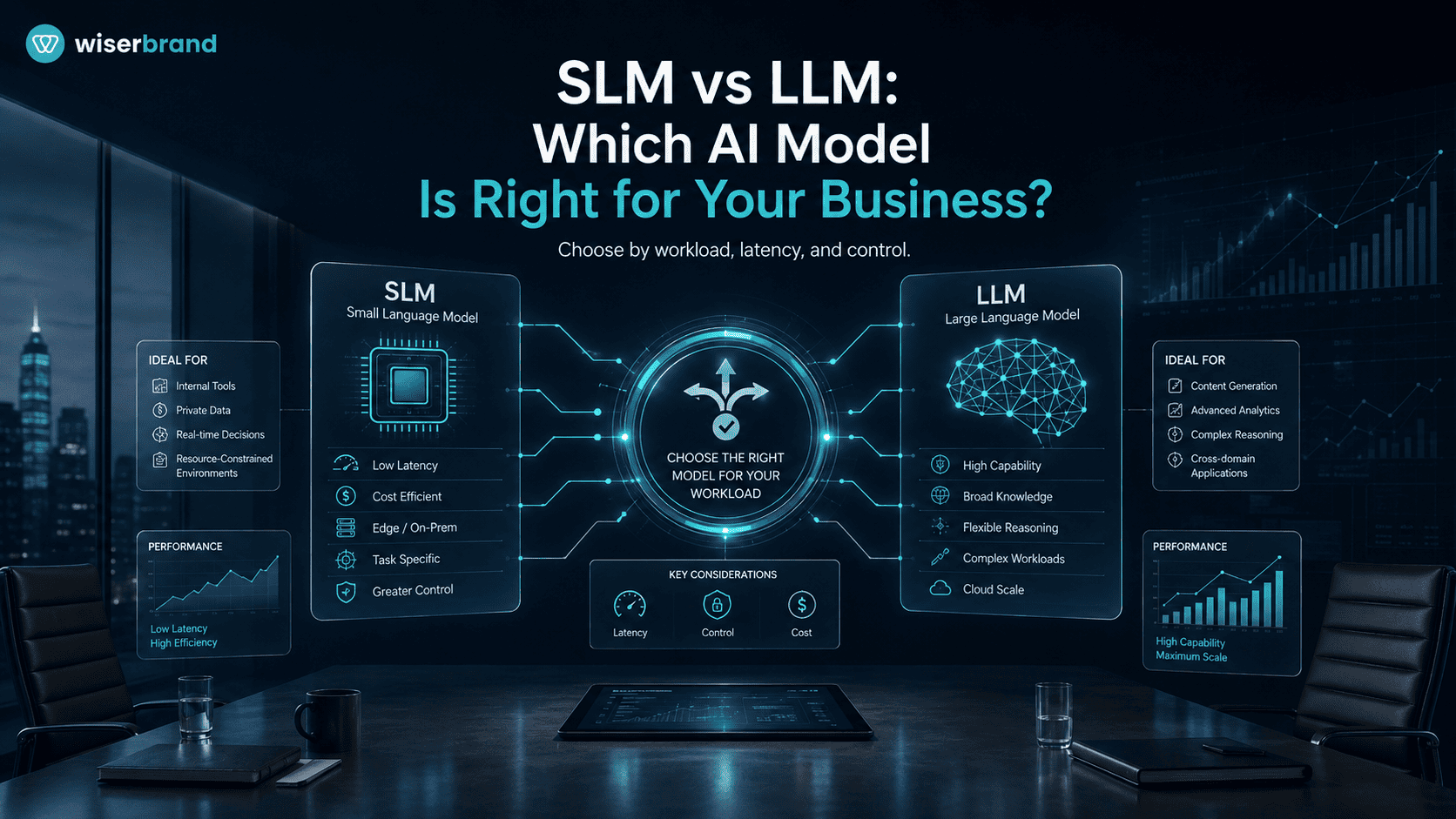
The SLM vs LLM decision should start with the workload, not model prestige. A small language model can be the better business choice when the task is narrow, traffic is high, latency matters, or inference must stay on a device or private infrastructure. A large language model is usually stronger when users bring varied questions, the task requires broad knowledge, or the workflow depends on complex synthesis and reasoning.
Model size is only one factor. Data quality, model architecture, quantization, retrieval, tool design, and evaluation can change the result. A smaller model that is tested on one repeatable task may outperform a much larger general model in cost, speed, and operational consistency. A larger model may reduce development effort when the process is ambiguous or spans many domains.
This guide explains the practical differences, where each model type fits, how hybrid routing works, and how to select a model using production evidence rather than benchmark reputation.
What Do SLM and LLM Mean?
A small language model, or SLM, is a language model designed with a relatively compact parameter count and computational footprint. It can process and generate language like a larger model, but it usually targets efficient inference, local deployment, or a narrower set of tasks. IBM describes SLMs as smaller in scale and scope than LLMs, with lower memory and compute requirements that can suit edge devices, mobile applications, and offline inference.
A large language model, or LLM, is trained at greater scale and is usually designed for broader language understanding and generation. LLMs commonly support open-ended conversation, drafting, coding, summarization, research assistance, and multi-step reasoning across many topics.
There is no universally enforced parameter threshold that separates an SLM from an LLM. Vendors use the labels differently, and architecture can matter as much as the raw parameter count. Google currently offers Gemma variants from models intended for mobile devices through models intended for large servers or clusters, which shows why deployment fit is more useful than a fixed naming boundary.
LLM development should start with the workload and deployment requirements rather than model size alone. The same evaluation process can compare compact models, larger general-purpose models, and hybrid routing options against one business task.
For a business decision, use these working definitions:
| Model Type | Practical Definition |
|---|---|
| SLM | A compact model selected for bounded tasks, efficient inference, local execution, or predictable high-volume workloads |
| LLM | A larger general-purpose model selected for broad capabilities, complex inputs, or flexible reasoning across varied tasks |
| Hybrid | An architecture that routes each request to the smallest model that can complete it acceptably |
SLM vs LLM at a Glance
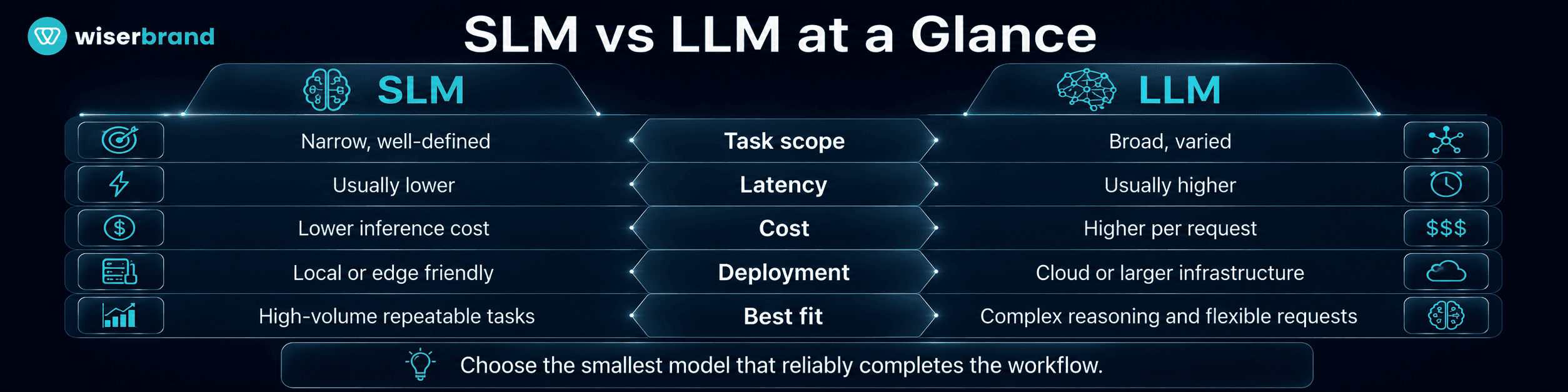
| Decision Area | SLM | LLM |
|---|---|---|
| Task scope | Narrow or well-defined | Broad, ambiguous, or cross-domain |
| Typical strength | Efficiency and specialization | General capability and flexibility |
| Infrastructure | Can fit on smaller servers, edge devices, or local hardware | Often uses larger cloud or server infrastructure |
| Latency | Often lower for comparable deployment conditions | Often higher because more computation is required |
| Throughput | Often higher per unit of compute | Lower per unit of compute in many setups |
| Inference cost | Usually lower for the same request volume | Usually higher, especially for long prompts and outputs |
| Data control | Easier to deploy locally or inside a private environment | Managed APIs are common, though private options also exist |
| Customization | Fine-tuning can be practical for narrow tasks | Prompting, RAG, adapters, and managed tuning are common |
| Open-ended work | More limited outside its tested domain | Usually stronger across varied requests |
| Operations | More model-hosting responsibility if self-managed | Managed providers can reduce infrastructure work |
| Main risk | Poor performance outside its intended task | Paying for capability the workflow does not need |
These are operating tendencies, not guarantees. A poorly selected SLM may be slower or less accurate after retries. A well-optimized LLM service may meet a strict latency target. Test the exact model, runtime, prompt, retrieval pipeline, and hardware that will reach production.
Key SLM vs LLM Differences
Capability and Task Breadth
LLMs are usually better when the request can vary widely. A general enterprise assistant may need to answer questions about finance, sales, HR, operations, policies, and technical systems in one interface. A larger model can reduce the amount of task-specific routing and prompt design needed for such breadth.
SLMs work best when the domain and output are bounded. Common examples include intent classification, field extraction, ticket routing, short summaries, command interpretation, and responses grounded in a narrow product or policy set.
Microsoft’s Phi-4 technical report describes a 14-billion-parameter model developed with a strong focus on training-data quality and reasoning performance relative to its size. Google recommends starting with the lowest-parameter Gemma variant that can meet the application’s needs rather than selecting a larger model by default.
The business implication is simple: model capability should be evaluated against the actual task distribution. Broad benchmark scores do not reveal how often the model completes your workflow correctly.
Latency and Throughput
Smaller models usually require less computation per generated token. This can support faster responses, more concurrent requests, and lower infrastructure requirements when the models are compared under similar conditions.
The advantage matters for:
- on-device assistants;
- interactive product features;
- high-volume classification;
- call-center support;
- manufacturing or field applications with weak connectivity;
- workflows that invoke the model several times per case.
Microsoft describes Phi Silica as an SLM optimized for local execution on a Windows device’s neural processing unit. Google also lists small Gemma variants for mobile devices, laptops, desktops, and small servers.
Do not evaluate latency from one prompt. Measure median and tail latency under expected concurrency, prompt length, output length, retrieval load, and tool use. A fast model that needs several retries may create a slower completed workflow.
Cost and Infrastructure
An SLM can reduce inference cost because it needs less memory and compute. The company may also run it on existing local hardware, a single server, or lower-cost cloud instances.
The full cost still includes:
- model hosting or API usage;
- engineering and integration;
- data preparation;
- evaluation;
- monitoring;
- security;
- employee review;
- failed requests and retries;
- hardware idle capacity;
- model updates.
LLMs accessed through managed APIs can be cheaper for pilots and variable demand because the provider handles infrastructure and the business pays for usage. A self-hosted SLM can become attractive when the workload is stable, high volume, and well suited to one compact model.
Compare cost per correctly completed task, not cost per token. A cheaper model can become more expensive if users correct its output, escalate more cases, or rerun the same request.
Deployment and Data Control
SLMs are easier to deploy on local hardware because their memory and compute requirements are lower. This can help when the application must run offline, on a device, in a store, at an industrial site, or inside a controlled network.
Google states that Gemma models can run on customer hardware, mobile devices, or hosted services. Microsoft offers on-device and on-premises options for members of its Phi family.
A smaller model does not make the application private by itself. Prompts, retrieved documents, embeddings, logs, telemetry, and tools may still move data outside the intended boundary. Data control depends on the full architecture.
LLMs can also run in private cloud or self-hosted environments when suitable model weights and infrastructure are available. The SLM vs LLM choice should not be used as a substitute for a complete security and data-residency review.
Customization and Domain Fit
Businesses usually customize language-model applications through one or more of these methods:
| Method | What It Changes | Best Fit |
|---|---|---|
| Prompt and instruction design | How the model responds to a request | Behavior, format, tone, and workflow guidance |
| Retrieval-augmented generation | Which current business information enters the prompt | Policies, product data, customer records, and knowledge |
| Fine-tuning or adapters | Model behavior learned from examples | Repeated task patterns and domain-specific output |
| Structured tools and rules | Which external actions and exact checks are available | Business transactions, permissions, and calculations |
| Model routing | Which model receives each request | Balancing capability, cost, privacy, and latency |
Fine-tuning a smaller model can be practical when the organization has reliable examples and a clear definition of success. RAG is often the better first choice when the main problem is access to current private information.
A larger model may need less fine-tuning to handle diverse tasks, but it still needs retrieval, access controls, tool validation, and workflow-specific evaluation.
Maintenance and Model Operations
Self-hosting an SLM transfers operational responsibility to the business. MLOps provides the practices needed for model versioning, deployment, monitoring, evaluation, regression testing, capacity management, and rollback. The team needs to manage model versions, inference software, hardware, scaling, security updates, capacity, monitoring, and rollback.
A managed LLM provider can reduce this burden, but the business still owns application behavior, data access, prompts, retrieval, tools, evaluations, and vendor-change review.
The model can also become obsolete while the application remains useful. Design the model interface so that a new SLM or LLM can replace the existing one without rebuilding every business integration.
Where SLMs Fit Best
SLMs are strongest when the task boundary is clear and the output can be checked automatically or reviewed quickly.
| Use Case | Why an SLM Fits | Required Control |
|---|---|---|
| Ticket or email classification | Short inputs, fixed labels, high request volume | Reject unsupported labels and route low-confidence cases |
| Field extraction | Structured output can be validated against a schema | Leave uncertain values blank and retain the source |
| On-device assistance | Compact models can run without a continuous cloud call | Test hardware, updates, local storage, and device security |
| Narrow knowledge assistant | The domain and sources are controlled | Use retrieval, citations, permissions, and a fallback |
| Simple tool selection | The approved tool set and arguments are limited | Validate every tool call outside the model |
| High-volume short summaries | Repeated task can make inference efficiency material | Measure omissions, corrections, and total workflow time |
High-volume classification and extraction are especially practical because teams can measure precision, recall, field accuracy, or routing accuracy. The workflow can reject malformed output and send ambiguous cases to a larger model or human queue.
On-device and offline assistance creates additional operational requirements. A local model needs secure distribution, device compatibility, storage, version control, and update procedures. Test the weakest supported device rather than a developer workstation.
For internal knowledge use, retrieval should supply current policies, product information, or technical documentation. Fine-tuning should not be used as a substitute for a maintained knowledge source. The system needs source-level permissions and a clear response when the question falls outside the supported domain.
Where LLMs Fit Best
LLMs are stronger candidates when the task distribution is broad, the input is ambiguous, or the output requires synthesis across several sources and formats.
| Use Case | Why an LLM Fits | Required Control |
|---|---|---|
| Company-wide assistant | Users ask varied questions across departments | Apply role-based retrieval and domain escalation |
| Complex document analysis | The task requires comparison across long or inconsistent material | Link conclusions to evidence and retain qualified review |
| Open-ended drafting | Quality depends on nuance, structure, and broad context | Verify facts, claims, and customer-facing content |
| Complex coding assistance | Requests span design, debugging, explanation, and refactoring | Test code and keep deployment authority outside the model |
| Cross-functional research | The model must synthesize varied concepts and sources | Separate sourced facts from generated recommendations |
| Multimodal workflow | Text, images, or audio may be interpreted together | Evaluate each input type and the combined workflow |
A broad enterprise assistant also needs access segmentation. An executive, salesperson, engineer, and HR employee should not receive the same source permissions because they use one interface.
Some current open-weight model families blur the boundary between small and large models. Google’s Gemma family includes multimodal and function-calling capabilities across several model sizes and deployment targets. The relevant question is not which category owns a feature. Test if the specific model performs the required task within the business limits.
Hybrid SLM and LLM Architectures
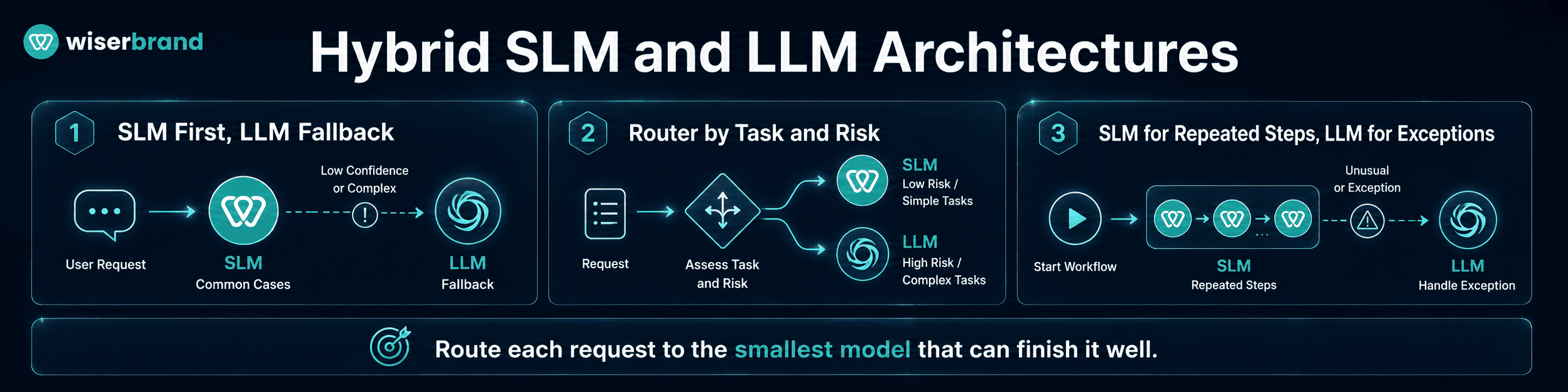
Many businesses do not need to make one global SLM vs LLM choice. In generative AI development, different models can be routed by task, risk, data sensitivity, latency, or cost so each workload uses the smallest model that meets its acceptance criteria.
SLM First, LLM Fallback
An SLM handles common, well-defined requests. The system sends difficult or low-confidence cases to an LLM.
This pattern can reduce cost while preserving broader capability. The fallback rule may use:
- SLM confidence;
- unsupported intent;
- input complexity;
- document length;
- failed validation;
- repeated user clarification;
- high-risk classification.
Confidence alone can be misleading. Validate it against real errors and combine it with deterministic conditions.
Router by Task and Risk
A lightweight model or rules service classifies the request and selects a model route.
Examples:
- local SLM for sensitive extraction;
- task-specific SLM for classification;
- managed LLM for complex synthesis;
- specialized coding model for software work;
- human queue for high-impact decisions.
The router should record why it selected the route. Sensitive content must not be sent to an unapproved model before classification.
SLM for Repeated Steps, LLM for Exceptions
A workflow may use an LLM to interpret a complex case once, then use SLMs for repeated subtasks such as extraction, labeling, short summarization, and validation support.
This pattern can be useful in document pipelines, customer service, research, and agentic workflows. It requires consistent schemas so that models can exchange structured data without losing context.
Distillation and Teacher-Student Development
A larger model can help create or label examples used to train a smaller model. Human review is still needed because generated labels can copy errors or bias from the teacher.
The business value comes from moving a proven, repeated task to a cheaper model after the task and evaluation set are stable. Distillation is a model-development project, not a shortcut around data quality.
SLM vs LLM Business Decision Framework
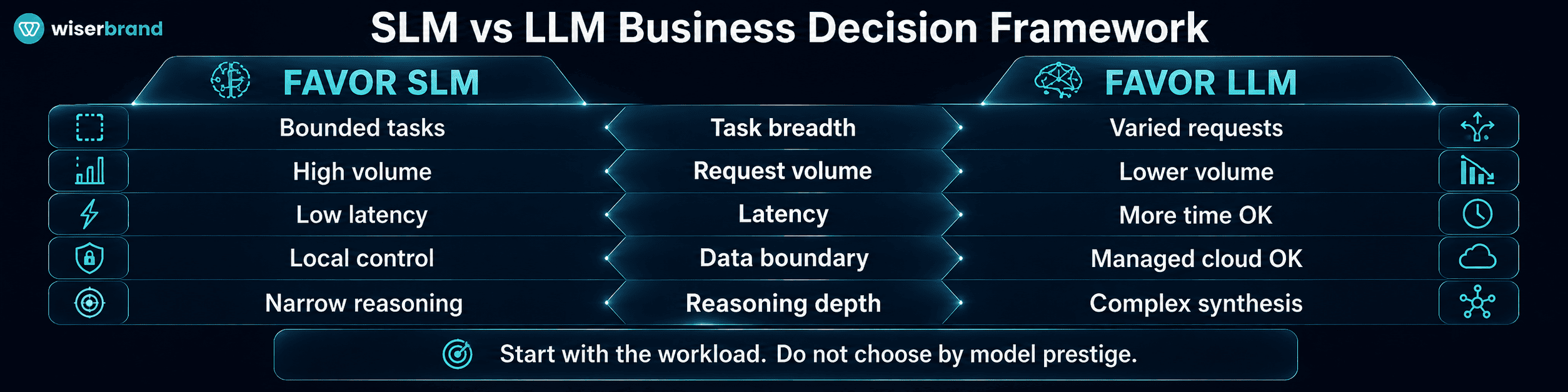
Score the use case before selecting a model. AI strategy consulting can help compare candidate architectures by task complexity, data requirements, latency, infrastructure, operating cost, risk, and expected business value.
| Criterion | Favor an SLM When | Favor an LLM When |
|---|---|---|
| Task breadth | Inputs and outputs are bounded | Requests vary across topics and formats |
| Correctness definition | Success can be labeled or validated clearly | Quality depends on nuanced human judgment |
| Request volume | High and predictable | Low, variable, or still experimental |
| Latency | Local or interactive response is critical | More response time is acceptable |
| Connectivity | Offline or edge operation is required | Reliable managed-cloud access is available |
| Data boundary | Local inference solves a documented requirement | Enterprise service controls meet the requirement |
| Model operations | The business can host and support the model | A provider-managed service is preferred |
| Context and reasoning | Short context and narrow reasoning | Long context and complex synthesis |
| Change rate | Task behavior is stable enough to tune and test | User needs change frequently |
| Time to launch | Model hosting work is acceptable | Fast API-based delivery matters |
Do not average these criteria blindly. A hard requirement such as offline execution, an air gap, or a fixed data boundary can decide the architecture even when an LLM performs better.
How to Evaluate SLM vs LLM
A benchmark score is not a complete result. An evaluation is only interpretable when the team states what it set out to measure and which assumptions the test makes, because the same model can pass a public benchmark and still fail the task distribution the business actually sends it.
For SLM vs LLM selection, build a representative test set from the actual workflow:
- Collect normal, difficult, incomplete, and adversarial examples.
- Define the expected output or review criteria.
- Test the full application, including retrieval and tools.
- Record quality, latency, cost, and failure behavior.
- Measure human review and correction time.
- Test under expected concurrency.
- Repeat tests after model, prompt, retrieval, or tool changes.
Use several metrics:
| Metric Area | Example Measures |
|---|---|
| Task quality | Accuracy, groundedness, extraction precision, accepted output |
| Reliability | Invalid output, refusal, timeout, retry, and fallback rates |
| Performance | Median latency, tail latency, throughput, and concurrency |
| Economics | Cost per correct completion and infrastructure utilization |
| Human effort | Review time, correction rate, escalation rate |
| Risk | Sensitive-data exposure, unauthorized tool attempts, harmful outputs |
| Operations | Availability, rollback time, version coverage, incident rate |
A model should pass the acceptance threshold for the specific use case. It does not need to win every benchmark.
Production Controls for Both Model Types
Both SLMs and LLMs are probabilistic systems. A smaller model does not become deterministic because it has fewer parameters.
Production controls should include:
- versioned models, prompts, and retrieval configurations;
- source-level access permissions;
- structured output validation;
- narrow tool permissions;
- time, token, and cost limits;
- human approval for high-impact actions;
- fallback and escalation;
- evaluation after changes;
- monitoring for quality, latency, and cost;
- incident and rollback procedures.
Microsoft’s guidance for its on-device Phi Silica model notes that small input changes can produce meaningful output changes, which is one reason language-model behavior should not be treated like conventional deterministic code.
The level of control should follow the workflow’s impact and reversibility, not the model label.
Implementation Blueprint
- Define one workflow and outcome.
State who uses the model, which input starts the work, which output is required, what happens next, and how success is measured.
- Create an evaluation set before choosing the model.
Use real examples and include edge cases. Avoid selecting a model from a generic leaderboard and building tests afterward.
- Test a strong managed LLM baseline.
A capable LLM can show the quality ceiling and help validate the workflow quickly. It also reveals if model quality is actually the bottleneck.
- Test smaller candidates.
Compare task-specific SLMs, quantized variants, and local deployment options. Use the exact infrastructure intended for production.
- Add retrieval and deterministic tools.
Give the model current information through controlled retrieval. Put calculations, permissions, eligibility, and irreversible actions in conventional services.
- Compare the completed workflow.
Include latency, retries, review time, infrastructure, failures, and fallback. Do not compare raw responses alone.
- Choose the routing architecture.
Select one model, an SLM-first fallback pattern, or task-based routing. Document why each route exists.
- Launch with narrow authority.
Begin with read-only, classification, extraction, or draft outputs. Add system-changing actions after validation and monitoring are stable.
- Monitor production drift.
Track changes in input distribution, output quality, user corrections, cost, latency, and fallback volume.
- Reevaluate the model periodically.
Model capabilities and prices change. Keep business integrations separate from the model endpoint so the company can replace or reroute models without rebuilding the workflow.
Common Selection Mistakes
- Choosing the largest model because it leads broad benchmarks.
- Choosing an SLM only because it is cheaper per request.
- Using parameter count as the only capability measure.
- Fine-tuning before testing retrieval and prompt design.
- Assuming a local model automatically solves privacy and compliance.
- Ignoring hosting, monitoring, and support cost.
- Testing clean examples but not ambiguous or adversarial inputs.
- Comparing response quality without human correction time.
- Using one model for every business function.
- Allowing fallback to send sensitive data to an unapproved endpoint.
- Treating model selection as permanent.
- Granting the model broad tool access to compensate for weak workflow design.
FAQ
How Should a Business Compare SLM vs LLM?
A business should compare SLM vs LLM using task quality, latency, total cost, data boundaries, deployment needs, and employee review. An SLM is a compact model selected for efficiency or a bounded task. An LLM is usually selected for broader capability and varied inputs.
Is an SLM Less Accurate Than an LLM?
Not in every task. A smaller model can perform well on a narrow workflow, especially after task-specific tuning or when the output is grounded and validated. An LLM is usually more capable across varied and unfamiliar requests. Both need evaluation on the intended workload.
Are SLMs Cheaper to Run?
They usually need less compute and memory, which can reduce inference cost. Total cost also includes hosting, engineering, monitoring, evaluation, employee review, and idle capacity. Compare cost per correctly completed workflow.
Can an SLM Run On-Premises?
Yes. Many compact open-weight models can run on local servers, laptops, edge devices, or on-premises infrastructure. Hardware requirements depend on model size, precision, context length, concurrency, and latency targets.
Does an LLM Have Better Reasoning?
Larger models often provide stronger broad reasoning and instruction following, but model architecture, training data, post-training, tools, and task design affect performance. A business should test the exact models rather than assume size determines every result.
Should a Business Use Both SLMs and LLMs?
Often, yes. An SLM can handle common high-volume tasks, while an LLM handles complex or low-confidence cases. A router can also select models by task, risk, data classification, or latency requirement.
What Is the Best First Step?
Choose one workflow and create a representative evaluation set. Test a strong LLM baseline and at least one smaller model on the complete workflow, including retrieval, validation, human review, latency, and cost.
Final Thoughts
The SLM vs LLM decision is a workload decision. Choose an SLM when a compact model can complete a narrow task reliably and the business benefits from lower latency, local execution, or lower inference cost. Choose an LLM when the task requires broad knowledge, complex synthesis, or flexible handling of unfamiliar requests.
A hybrid design is often the most practical. Route common requests to a smaller model, reserve larger models for difficult cases, and keep hard business rules outside both.
We help companies evaluate model candidates, design RAG and routing architectures, deploy managed or self-hosted models, connect business systems, and build the monitoring needed for production. WiserBrand’s LLM development services cover model selection, fine-tuning, retrieval, infrastructure, evaluation, and ongoing optimization.