Private LLMs: When Businesses Need More Control Over Data and AI

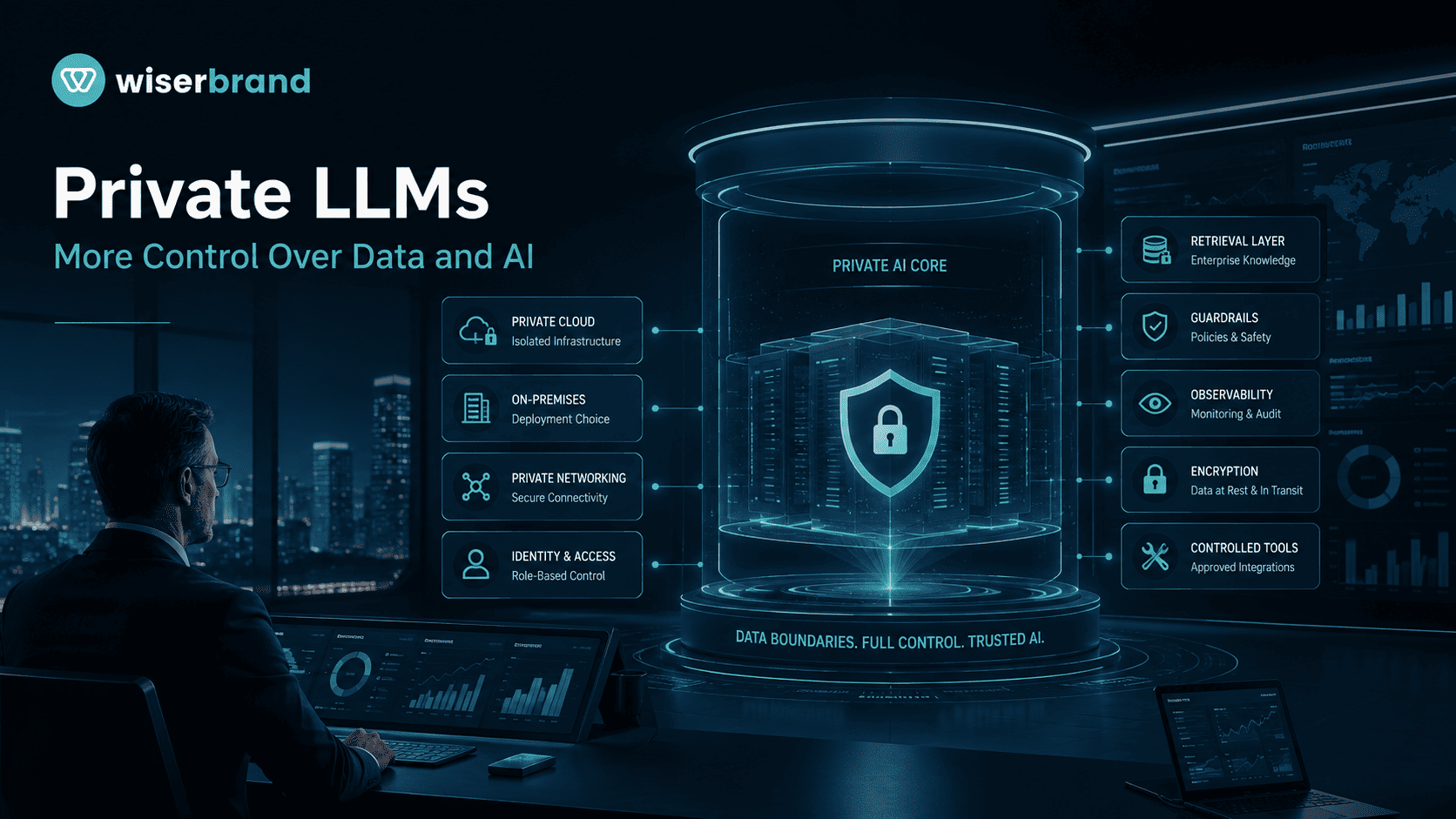
A private LLM is a large language model deployed with controls that limit where business data is processed, who can access the system, how the model is updated, and which external services it can contact. The model may run in a private cloud environment, a customer-controlled virtual network, an on-premises data center, or an air-gapped system.
The important word is control. A private LLM does not have to be trained from scratch, and self-hosting is not the only way to protect business data. Managed enterprise AI platforms can provide contractual data-use restrictions, regional processing, private networking, dedicated resources, and customer-managed storage. Self-hosted open-weight models provide more infrastructure and model control, but they also transfer security, performance, maintenance, and capacity responsibilities to the business.
This guide explains what a private LLM actually is, which business requirements justify one, how deployment options differ, what private infrastructure does not solve, and how to choose an architecture that matches the workload.
What Is a Private LLM?
A private LLM is an LLM deployment designed so that the organization controls the data boundary, access model, network path, model lifecycle, and operational policies used by the application. LLM development helps businesses design, integrate, evaluate, and operate language-model solutions around these requirements. The term usually describes the deployment and governance environment more than the origin of the model.
A company can deploy an open-weight model on its own hardware and still operate it poorly. Logs may expose confidential prompts. Retrieval may ignore document permissions. An agent may have excessive access to internal systems. Model files may come from an unverified source. The deployment is self-hosted, but the application is not necessarily secure.
The opposite is also possible. A managed model API may process data inside an enterprise cloud boundary with contractual restrictions, private endpoints, regional controls, encryption, and tenant-specific storage. Microsoft states that prompts, completions, embeddings, and training data for models sold through Microsoft Foundry are not made available to model providers or other customers and are not used to train foundation models without customer permission. AWS states that Bedrock model providers do not have access to customer prompts and completions, while Google Cloud states that it does not use Vertex AI customer data to train or fine-tune models without permission.
This creates a deployment spectrum rather than a simple public-versus-private split.
| Deployment Model | Model Location | Business Control | Typical Tradeoff |
|---|---|---|---|
| Consumer AI application | Provider-managed shared service | Low control over application behavior and enterprise integration | Fast access, unsuitable for unapproved confidential data |
| Enterprise managed API | Provider-managed cloud service with business terms and controls | Data-use, identity, audit, and regional controls vary by service | Strong models with low infrastructure burden |
| Private cloud endpoint | Managed models connected through private networking and customer resources | Greater network, storage, identity, and egress control | More setup and cloud dependency |
| Self-hosted cloud model | Open-weight or licensed model in the company’s cloud account | Control over runtime, model version, network, and telemetry | Requires inference engineering and capacity management |
| On-premises deployment | Model runs in a company data center or controlled edge environment | High infrastructure and data-location control | Hardware, support, and operational burden |
| Air-gapped deployment | Model and data run without internet connectivity | Strong isolation from external networks | Limited external tools, updates, and operational flexibility |
The correct choice depends on the workload, not on which option sounds most secure.
Private LLMs Are an Architecture Decision
Businesses often begin by asking which model should be private. The better question is which parts of the AI system need stronger control.
Production generative AI solutions require more than a model endpoint. They combine application interfaces, identity management, retrieval, tools, evaluation, monitoring, and operational controls.
- user interfaces;
- identity and role management;
- prompts and system instructions;
- retrieval indexes;
- source documents;
- embeddings;
- conversation state;
- model inference;
- tool and API calls;
- output filters;
- logs and traces;
- evaluation data;
- employee review queues.
Running the model inside a private network protects only part of this chain. If source documents are copied to an unapproved vector database, the private model does not fix the exposure. If unrestricted application logs store full prompts, the model location does not solve retention risk. If an agent can export a customer list through a tool, network isolation around inference is insufficient.
A private LLM program should therefore define the complete data and execution boundary. It should answer where data enters, where it is stored, which systems process it, which people can access it, what leaves the environment, and how every component is monitored.
When Businesses Need a Private LLM
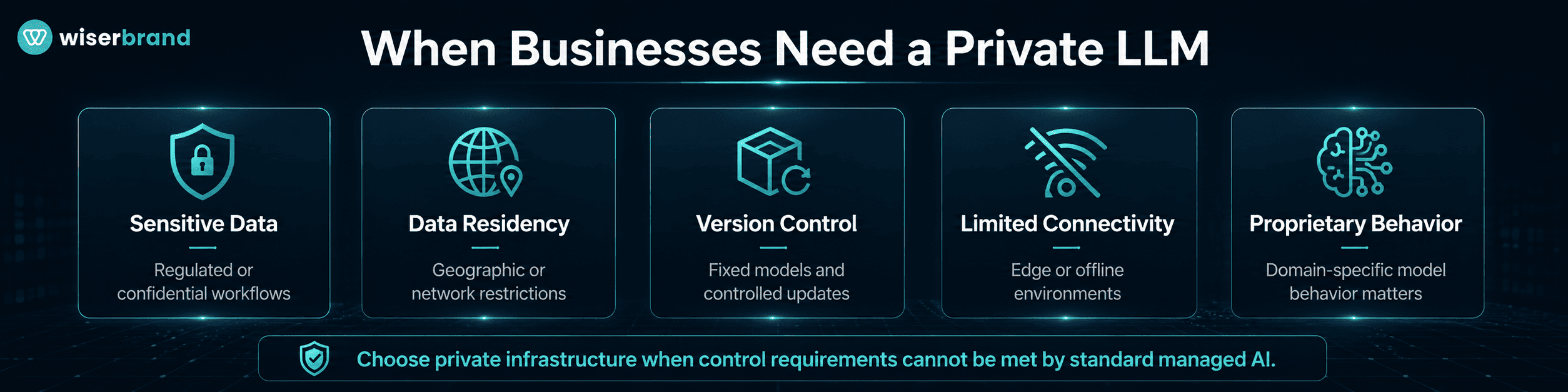
A private deployment becomes reasonable when a business requirement cannot be met reliably through a standard managed service configuration. The decision should be based on specific constraints rather than a general preference to keep AI “in-house.”
Sensitive or Regulated Data Is Central to the Workflow
A company may need stronger controls when prompts and retrieved context contain health records, financial information, legal material, security data, proprietary designs, customer communications, employee records, or unreleased business plans.
The presence of sensitive data does not automatically require self-hosting. An enterprise managed service may provide adequate contractual, technical, and regional controls. The business should compare the service terms and architecture with its data classification, regulatory duties, client contracts, and internal policies.
A private LLM becomes more compelling when the organization cannot permit the relevant data to enter a third-party inference environment, even under enterprise terms, or when the workflow requires direct access to highly restricted internal systems.
Data Residency and Network Isolation Are Hard Requirements
Some organizations need to keep processing within a specific geography, cloud tenant, virtual network, data center, or disconnected environment. This may result from law, customer contracts, defense or public-sector requirements, operational resilience, or internal security policy.
Major cloud platforms support parts of this model. AWS documents the use of VPC endpoints and AWS PrivateLink so Bedrock-related traffic can connect privately rather than traverse the public internet. Microsoft Foundry supports private endpoints and network isolation, although support and traffic paths vary across features and tools. Google Vertex AI provides security controls such as data-residency options, customer-managed encryption keys, VPC Service Controls, and private connectivity for supported services.
Cloud privacy controls still need detailed review. A feature may use a public endpoint, global processing mode, platform-managed storage, or a tool that does not support private networking. The architecture should be validated component by component.
Air-gapped deployment is a narrower requirement. NVIDIA documents an air-gap model in which model assets are prepared in a connected environment, transferred through an approved channel, and run without outbound internet access or API credentials.
The Business Needs Model and Version Control
Managed providers can update model availability, safety systems, quotas, pricing, context limits, or supported regions. Those changes are useful for many companies because the provider handles improvement and maintenance. They can be problematic when a validated workflow depends on a fixed model version and controlled release schedule.
Self-hosting can give the organization authority over model lifecycle management. Strong MLOps practices help manage model versions, evaluation pipelines, deployments, monitoring, regression testing, and rollback processes.
- model version;
- inference engine;
- quantization;
- prompt templates;
- fine-tuned adapters;
- update timing;
- regression testing;
- rollback;
- decommissioning.
That control is valuable in regulated, high-impact, or deeply integrated workflows. It also creates an obligation to maintain the full stack. The company must track model licenses, vulnerabilities, dependencies, hardware compatibility, evaluation results, and end-of-support risks.
The Environment Has Limited or Unreliable Connectivity
Factories, ships, remote field locations, secure facilities, and edge environments may not have dependable access to an external model API. A smaller local model can support document search, troubleshooting, classification, or drafting even when the external network is unavailable.
The tradeoff is model capability and operational complexity. Smaller models may have lower hardware requirements and latency, but their quality must be tested against the actual workflow. A local model should not be selected only because it can run on available equipment.
Proprietary Model Behavior Is Strategically Important
Some businesses need more control over model behavior because the AI capability is part of the product or operating advantage. The company may need domain-specific terminology, a custom output format, specialized code generation, low-level inference optimization, or a release process that competitors cannot easily replicate.
This does not always mean training a foundation model.
Most organizations should first evaluate:
- better instructions;
- retrieval-augmented generation;
- deterministic tools;
- structured output constraints;
- model routing;
- fine-tuning or adapters;
- a smaller specialized model.
RAG supplies relevant information at inference time. It is not model training. Fine-tuning changes model behavior from examples but does not automatically give the model current access to private documents. These methods solve different problems.
Stable High-Volume Workloads May Justify Dedicated Capacity
Managed APIs are attractive for pilots and variable demand because infrastructure costs follow usage and the provider manages capacity. Self-hosted or dedicated deployments can become financially interesting when demand is high, predictable, and concentrated on models that can run efficiently on owned or reserved infrastructure.
The cost comparison must include more than token prices. A private LLM requires hardware or reserved compute, inference software, platform engineering, monitoring, security, backups, updates, on-call support, capacity planning, and idle headroom.
Use cost per correctly completed workflow as the main economic measure. A lower inference cost is not a saving if slower models create more employee review, failed tasks, or customer rework.
When a Private LLM Is Not Necessary
A private deployment is usually unnecessary when the business is still validating the use case, the data is public or low sensitivity, traffic is uncertain, and a managed enterprise service satisfies the required controls.
Do not self-host only because:
- the organization wants to say it owns AI;
- an open-weight model is available;
- public token prices appear high in a spreadsheet;
- the security team prefers on-premises infrastructure by default;
- the model will access an internal knowledge base;
- another company announced a private model.
A managed service may be the safer option if the company lacks staff to patch inference servers, monitor GPUs, evaluate model changes, respond to security incidents, and support the application outside business hours.
The strongest model for the workflow may also be available only through a managed service. Choosing a weaker private model can increase business risk if users rely on inaccurate summaries, classifications, or recommendations.
Private, Managed, or Hybrid: A Decision Matrix
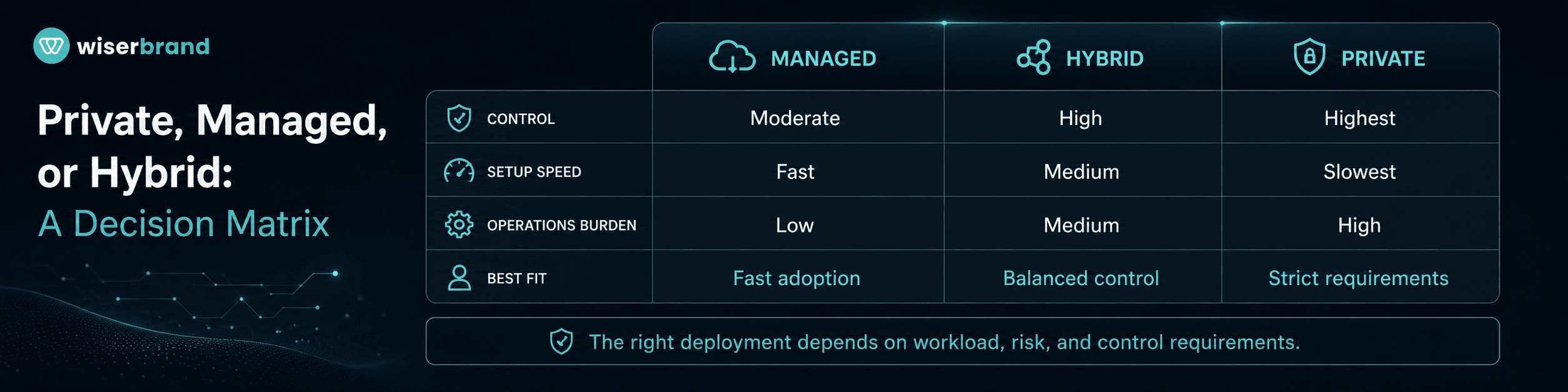
| Requirement | Managed Enterprise API | Self-Hosted Private LLM | Hybrid Architecture |
|---|---|---|---|
| Fast pilot | Strong fit | Slower setup | Strong fit with managed default |
| Low infrastructure burden | Strong fit | Weak fit | Moderate |
| Fixed model version | Depends on provider | Strong fit | Private route for validated workflows |
| Strict network isolation | Available on supported services | Strong fit | Route sensitive work privately |
| Air-gapped operation | Usually unavailable | Strong fit | Possible only for local branch |
| Highest frontier-model capability | Often strongest | Depends on available weights and hardware | Managed route for approved tasks |
| Full runtime control | Limited | Strong fit | Selective control |
| Highly variable demand | Strong fit | Requires spare capacity | Managed overflow possible |
| Predictable high volume | Can use reserved capacity | May become efficient | Route by cost and sensitivity |
| Small AI operations team | Strong fit | Weak fit | Managed-first approach |
| Proprietary inference stack | Limited | Strong fit | Private for differentiated capability |
A hybrid architecture is often the practical answer. It can route requests by data classification, use case, model quality, latency, or cost. Public information and low-risk drafting may use a managed model. Restricted documents and internal operations may use a private endpoint or self-hosted model. High-impact outputs may require human approval regardless of model location.
Hybrid routing adds its own complexity. The business needs clear classification, fallback behavior, consistent evaluations, and controls that prevent sensitive context from reaching the wrong route.
What a Private LLM Does Not Guarantee
Private deployment improves control. It does not guarantee security, compliance, accuracy, or business value.
| Misconception | Reality |
|---|---|
| Private means no data can leak | Applications, logs, retrieval, tools, users, and administrators can still expose data |
| Self-hosted means compliant | Compliance depends on controls, evidence, process, and legal scope |
| Open-weight means transparent | Model weights do not explain all training data, behavior, or risks |
| Fine-tuning makes answers factual | Fine-tuning can change behavior but does not verify current business facts |
| On-premises means cheaper | Hardware, staffing, capacity, and maintenance may exceed managed-service cost |
| No external API means no vendor risk | Hardware, model, software, and support vendors remain in the supply chain |
| Private means the company owns the model | Model licenses may restrict use, modification, redistribution, or outputs |
NIST’s Generative AI Profile treats risk management as a lifecycle activity covering design, development, deployment, use, and evaluation. The location of the model is one control choice inside that broader system.
Reference Architecture for a Private LLM
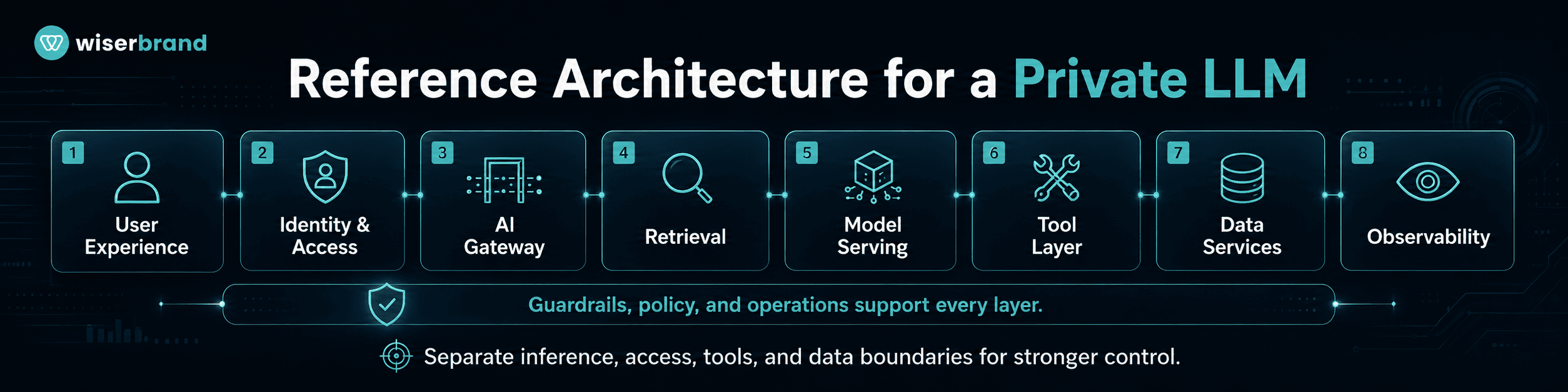
A production architecture should separate model inference from application permissions and business rules. AI integration connects private models with enterprise systems through controlled APIs, retrieval pipelines, business tools, and approved workflows.
| Layer | Responsibility |
|---|---|
| User experience | Internal assistant, application feature, API, or workflow interface |
| Identity and access | User, role, department, client, and record permissions |
| AI gateway | Authentication, routing, quotas, policy, and model selection |
| Retrieval | Approved documents, metadata, access filtering, and citations |
| Model serving | Inference engine, model weights, batching, and runtime |
| Tool layer | Narrow business operations exposed through validated APIs |
| Data services | Systems of record, document stores, vector indexes, and state |
| Guardrails | Input inspection, output checks, prohibited actions, and approval thresholds |
| Observability | Logs, traces, evaluations, latency, cost, and incidents |
| Operations | Deployment, updates, backups, scaling, recovery, and support |
A self-hosted model can run through containers, Kubernetes, dedicated inference servers, or specialized deployment software. NVIDIA documents self-hosted NIM deployments on customer compute through Docker, Kubernetes, multi-node, and air-gapped options. Open-source inference engines such as vLLM and SGLang are also commonly used, while Hugging Face currently identifies its older Text Generation Inference toolkit as being in maintenance mode and recommends newer inference engines for future deployments.
The model endpoint should not receive broad database credentials. Tools should expose narrow capabilities such as find_customer_order, create_draft_case, or request_refund_approval. Permissions, calculations, transaction limits, and irreversible gates belong in deterministic services.
Security Controls That Matter
Data Classification and Routing
Classify prompts, files, retrieved records, and intended actions before choosing the model route. The classification should determine which models, regions, storage locations, and tools are allowed.
Do not depend only on employees to recognize sensitive data. Add input checks, source-level labels, role permissions, and blocking rules for high-risk content.
Private Networking and Egress Control
Private endpoints can restrict access to approved networks, but the full system needs review. Model servers, retrieval indexes, object storage, telemetry, identity providers, package registries, monitoring, and external tools may create separate network paths.
Define permitted outbound destinations. A private model application that can browse the unrestricted internet or call arbitrary URLs may still expose data through tool use or prompt injection.
Encryption and Key Management
Encrypt data in transit and at rest. Decide if default cloud-managed keys are sufficient or if customer-managed keys are required. Protect model weights, adapters, prompts, indexes, logs, and backups according to their sensitivity.
Key ownership alone does not provide access control. The business also needs identity management, rotation, separation of duties, and incident procedures.
Retrieval Permissions
RAG systems should filter documents before retrieval according to the current user and workflow. Post-generation filtering is too late if the model has already received restricted content.
Store source metadata such as owner, classification, jurisdiction, effective date, customer, department, and access group. Recheck authorization for each request rather than copying a shared set of documents into one unrestricted index.
Logging and Retention
Logs support debugging and audit, but they can become a new sensitive-data store. Define which prompts, outputs, retrieved passages, tool parameters, and user identifiers are recorded.
Use masking or structured event logs where full content is unnecessary. Set retention by purpose. Limit employee access to traces and evaluation datasets. Include backups and exported observability data in the policy.
Model and Supply-Chain Governance
Record model source, license, checksum, version, quantization, inference engine, dependencies, container image, evaluation results, and deployment history.
Scan containers and libraries. Review model licenses before using weights in products or customer services. Treat model and runtime updates as controlled releases with regression testing and rollback.
Application and Agent Controls
A private LLM can still follow a malicious instruction contained in an email, webpage, or document. Restrict tools, isolate untrusted content, validate structured outputs, and require approval for high-impact actions.
Do not confuse private inference with safe agency. An internal model with unrestricted write access can create more risk than a managed model limited to drafting.
Choosing the Model
Model selection should start with workflow evaluation, not leaderboard position.
Test candidate models on representative tasks:
- factual questions grounded in company data;
- document extraction;
- classification;
- summarization;
- code or structured output;
- multilingual content;
- refusal and escalation;
- long-context behavior;
- tool selection;
- adversarial inputs.
Measure quality after the full workflow, including retrieval and employee review. A smaller model may be sufficient for classification or drafting. A stronger managed model may be needed for complex reasoning. Routing several models by task can produce better cost and control than forcing one model to handle everything.
Model size also affects hardware, latency, concurrency, and operating cost. Quantization can reduce memory requirements but may change quality. Test the exact model build and runtime configuration that will reach production.
Cost Model
Compare total cost over the expected workload.
| Cost Area | Managed Service | Self-Hosted Deployment |
|---|---|---|
| Model usage | Per-token or reserved throughput | Compute and capacity allocation |
| Infrastructure setup | Low to moderate | Hardware, cloud compute, networking, storage |
| Operations | Provider handles core model service | Internal or managed platform team |
| Scaling | Provider-managed within quotas | Capacity planning and orchestration |
| Idle demand | Usually limited usage cost | Reserved hardware may remain underused |
| Updates | Provider-managed | Organization validates and deploys updates |
| Security maintenance | Shared responsibility | Larger internal responsibility |
| Failure support | Provider service and contract | Internal on-call plus vendors |
The private option becomes financially stronger when utilization is predictable, the selected model runs efficiently, and the company already has the required infrastructure and skills. Managed services remain attractive when demand changes quickly or the organization needs access to several advanced models.
Build the comparison around:
- cost per correctly completed task;
- peak and average concurrency;
- latency target;
- employee review and correction time;
- failed workflow cost;
- infrastructure utilization;
- support and incident cost;
- model update frequency.
Implementation Blueprint
- Define the workload and risk.
Document the users, inputs, source systems, output, action authority, data classes, jurisdictions, expected volume, latency, and cost of a wrong result.
- Test a managed enterprise baseline.
Determine if a managed service with appropriate data-use terms, regional deployment, identity controls, private networking, and storage configuration already meets the requirement. Self-hosting should solve a documented gap.
- Create a deployment decision record.
State why the use case needs a managed API, private endpoint, self-hosted cloud model, on-premises model, air gap, or hybrid route. Include rejected options and tradeoffs.
- Build the minimum data boundary.
Connect only the documents and systems required for the first workflow. Apply source ownership, access filtering, retention, and audit rules before adding model access.
- Evaluate candidate models.
Use a representative test set and business acceptance criteria. Measure the exact runtime configuration, not a hosted demo of a different model build.
- Start in read-only or draft mode.
Limit the first release to search, summaries, extraction, classifications, or draft recommendations. Keep system-changing actions behind employee review.
- Add production operations.
Implement model and prompt versioning, deployment automation, health checks, capacity monitoring, security scanning, backups, incident response, and rollback.
- Test failures and attacks.
Include missing data, stale documents, conflicting sources, unauthorized users, prompt injection, model timeouts, retrieval outages, GPU failures, traffic spikes, and attempts to export data.
- Pilot with a bounded user group.
Measure completion, quality, review effort, latency, utilization, and support incidents. Capture why users reject or correct outputs.
- Expand through governed releases.
Treat new departments, data sources, models, tools, and permissions as changes to the risk boundary. Reevaluate the architecture as managed-service terms and model capabilities change.
How to Measure Success
| Area | Example Metrics |
|---|---|
| Workflow outcome | Completion rate, time saved, backlog reduced, accepted output |
| Quality | Grounded answer rate, extraction accuracy, correction rate |
| Human effort | Review time, override rate, escalations |
| Security | Unauthorized access attempts, blocked data exposures, incidents |
| Reliability | Availability, timeout rate, failed retrieval, recovery time |
| Performance | First-token latency, total latency, concurrency, throughput |
| Cost | Cost per completed workflow, GPU utilization, idle capacity |
| Governance | Models with current review, overdue updates, trace completeness |
Do not use “data stayed private” as the only success criterion. The system also has to solve the workflow accurately, reliably, and at an acceptable operating cost.
Common Mistakes
- Treating every enterprise API as a public consumer chatbot.
- Treating every self-hosted model as private and secure.
- Starting with hardware procurement before validating the use case.
- Training or fine-tuning before testing retrieval and workflow design.
- Copying restricted documents into an index without user-level permissions.
- Logging full prompts and outputs without a retention policy.
- Giving the model unrestricted access to internal tools.
- Ignoring model licenses and software supply-chain risk.
- Comparing token price with GPU cost while excluding engineering and idle capacity.
- Selecting a smaller model without measuring the added review work.
- Building an air-gapped system that cannot receive controlled updates.
- Assuming private infrastructure removes the need for human review.
FAQ
What Is a Private LLM?
A private LLM is a language-model deployment with business-controlled data, access, network, model, and operational boundaries. It may run through a managed private cloud configuration, in the company’s cloud account, on-premises, or in an air-gapped environment.
Does a Private LLM Have to Be Self-Hosted?
No. Some companies use the term only for self-hosted models, but enterprise managed platforms can also provide private networking, tenant isolation, regional processing, data-use restrictions, and customer-controlled storage. The business should describe the actual architecture rather than rely on the label.
Is a Private LLM More Secure Than a Public LLM?
It can provide more control, but security depends on implementation. Identity, retrieval permissions, logs, tools, network egress, model supply chain, updates, and employee access can still create risk. A well-configured managed service may be safer than a poorly maintained self-hosted model.
When Should a Business Self-Host an LLM?
Self-hosting is most justified when the organization needs a fixed model and runtime, strict network or location control, air-gapped operation, specialized inference behavior, or predictable high utilization. The business also needs the skills and budget to operate the platform.
Is RAG the Same as Training a Private LLM?
No. Retrieval-augmented generation retrieves relevant business content when a request is processed. Fine-tuning changes model behavior through training examples. RAG is usually the first option for current private knowledge because source documents can be updated without retraining the model.
Are Private LLMs Cheaper?
Not automatically. Self-hosting adds compute, idle capacity, platform engineering, security, monitoring, updates, and support. It may become economical for predictable workloads on efficiently served models. Managed APIs are often cheaper for pilots and variable demand.
What Is the Best First Step?
Classify one use case by data sensitivity, regulatory scope, model quality, volume, latency, and action risk. Then test if an enterprise managed service meets those requirements before accepting the added responsibility of self-hosting.
Final Thoughts
A private LLM is useful when the business needs control that a standard managed configuration cannot provide. That may include strict data location, private networking, fixed model versions, air-gapped operation, proprietary inference, or stable high-volume workloads.
Private deployment should not become the goal by itself. The goal is a reliable AI workflow with an appropriate data boundary, narrow permissions, measurable quality, controlled updates, and sustainable operating cost.
Start by testing the requirement against managed enterprise controls. Move to self-hosting only for a documented gap. Use a hybrid model when different workloads need different levels of capability and control.
We help companies evaluate LLM deployment options, design private data and network boundaries, integrate business systems, deploy open-weight or managed models, and build the evaluation and operations layer required for production. WiserBrand’s LLM development services and generative AI practice cover model selection, RAG, fine-tuning, infrastructure, security controls, and ongoing support.