Generative AI in Manufacturing: Practical Use Cases Across Operations


Generative AI in manufacturing helps engineers, operators, maintenance teams, planners, and service staff work with complex industrial information faster. It can search technical records, summarize plant events, draft work instructions, explain quality deviations, generate automation code, and prepare operational decisions for human review.
Its best role is not direct control of production equipment. Generative AI is strongest as a knowledge and workflow layer around manufacturing systems. It turns documents, logs, messages, specifications, and system records into usable answers or prepared actions. Deterministic software, validated models, and authorized employees should continue to control safety-critical settings, product acceptance, machine commands, and irreversible transactions.
This guide explains where generative AI can create practical value across manufacturing operations, which use cases need other types of AI, how to connect the technology to existing systems, and what controls are required for production use.
What Generative AI Means in Manufacturing
Generative AI development for manufacturing can support workflows that create or transform text, code, structured records, technical summaries, and operational explanations from approved industrial data. In a manufacturing environment, the model may work with maintenance manuals, standard operating procedures, bills of materials, engineering files, quality records, shift notes, supplier documents, and operational data.
In practice, generative AI in manufacturing is only one part of industrial AI. The 2026 roadmap on AI and machine learning for smart manufacturing, a multi-institution paper published in July 2026 with contributions from NIST researchers, covers generative AI, large language models, digital twins, autonomous systems, sensing, supply chain optimization, reliability, safety, and other approaches. It also highlights persistent challenges around industrial data, heterogeneous sensing and control systems, and trustworthy operation in high-stakes environments.
A useful distinction is:
| Technology | Strongest Fit | Manufacturing Example |
|---|---|---|
| Generative AI | Language, knowledge, content, code, and multi-step assistance | Summarizing a machine history and drafting a troubleshooting plan |
| Predictive machine learning | Forecasting a defined outcome from historical and sensor data | Predicting failure probability or demand |
| Computer vision | Interpreting images and video | Detecting surface defects or missing components |
| Optimization | Selecting a plan under formal constraints | Production scheduling or material allocation |
| Robotics and control systems | Executing physical actions | Moving parts, adjusting equipment, or controlling a process |
| Digital twins | Simulating physical products or operations | Testing a process change before plant deployment |
Many useful solutions combine these approaches. A predictive model may detect an abnormal asset condition. Generative AI can then retrieve the relevant maintenance history, explain the signal, and prepare a work order. The predictive model produces the risk estimate. The generative layer helps people act on it.
Where Generative AI Fits in the Manufacturing Stack
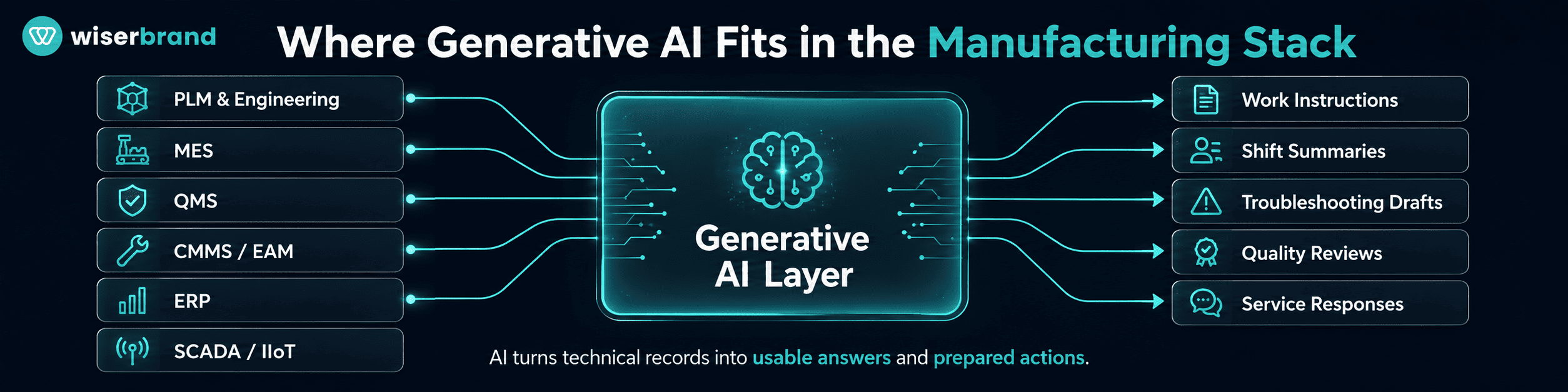
Generative AI usually sits above existing operational and business systems rather than replacing them. AI integration connects the model layer with MES, ERP, PLM, QMS, CMMS, historian, document, and service systems while keeping access and action boundaries explicit.
| System | Data the AI May Use | Example Output |
|---|---|---|
| PLM and engineering repositories | Specifications, drawings, revisions, test results | Design comparison or change summary |
| MES | Orders, production events, routings, downtime, genealogy | Shift summary or exception explanation |
| QMS | Nonconformances, inspections, CAPA, audit records | Investigation draft or recurring issue summary |
| CMMS or EAM | Work orders, asset history, manuals, parts | Troubleshooting guidance or work-order draft |
| ERP | Materials, purchasing, inventory, orders, costs | Supplier exception summary or planning brief |
| SCADA, historian, and IIoT platforms | Time-series signals, alarms, equipment states | Context for an anomaly or plant-event report |
| Document systems | SOPs, manuals, safety procedures, training content | Grounded answer with source references |
| CRM and service systems | Installed base, cases, warranties, customer messages | Service response draft or case summary |
The model should receive only the information needed for the workflow. Access to a maintenance manual does not imply access to production credentials. Access to operational history does not imply authority to change equipment settings.
NIST has also documented industrial work on technical language processing and large language models for engineering design, maintenance, information retrieval, knowledge extraction, standards, and manufacturing applications. That work reflects a central manufacturing opportunity: turning dense technical language into information that engineers and operators can retrieve and use more efficiently.
Practical Use Cases Across Operations
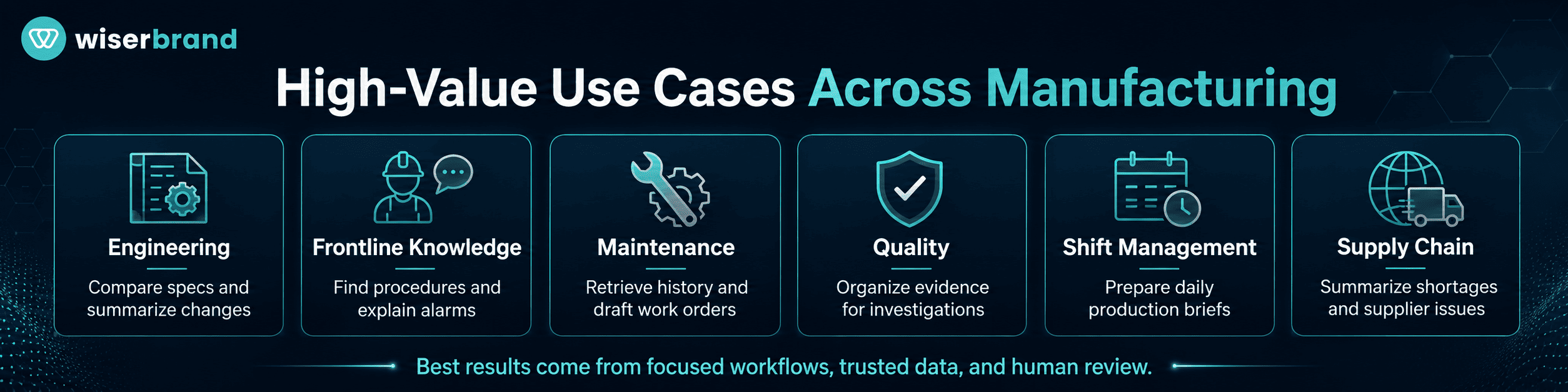
The best generative AI in manufacturing use cases start with a specific workflow problem. They have named users, trusted data, a measurable baseline, and a clear boundary between model assistance and human authority.
Product Engineering and Design Support
Engineering teams work across requirements, prior designs, test results, field feedback, material constraints, supplier data, and standards. A generative assistant can retrieve related projects, compare specifications, summarize design changes, generate initial requirement drafts, or help document design-review decisions.
It can also support generative design workflows by translating engineering goals into structured constraints or summarizing simulation results. The model should not certify that a design meets safety, regulatory, or performance requirements. Engineers still need validated simulation, formal verification, physical testing, and change control.
Microsoft describes generative AI applications in product engineering that analyze product data, customer feedback, and engineering information to support research and development. Siemens positions its Industrial Copilot across design, planning, engineering, operations, and services, including automation engineering support. These are vendor capabilities and examples, not evidence that every manufacturer will achieve the same result.
Frontline Knowledge and Work Instructions
Operators often need information that exists across SOPs, manuals, training files, quality alerts, maintenance notes, and local process documents. A grounded manufacturing assistant can answer questions in plain language, show the source, and adapt approved instructions to the user's role, equipment, product, or shift context.
Useful tasks include:
- finding the correct procedure for a machine and product version;
- explaining a technical term or alarm;
- translating approved instructions for multilingual teams;
- creating a checklist from a controlled procedure;
- summarizing a shift handover;
- identifying which document version applies.
The assistant must preserve the approved procedure. It should not improvise a workaround or rewrite a safety step as optional. Source ownership, effective dates, revision status, and access rights are part of the solution.
Microsoft's manufacturing materials describe copilot scenarios that give frontline employees access to manufacturing information through natural-language interfaces. Siemens has also presented shop-floor Industrial Copilot scenarios for industrial workers.
Maintenance and Troubleshooting
Maintenance is a strong fit because technicians combine structured asset data with unstructured knowledge. The relevant evidence may include alarms, sensor trends, prior work orders, manuals, spare-part records, technician notes, and known failure modes.
Generative AI can:
- summarize asset history before a repair;
- retrieve similar incidents;
- extract symptoms, actions, and results from old work orders;
- draft a troubleshooting sequence;
- prepare a work order with probable tools and parts;
- summarize the completed repair for future search;
- convert technician notes into structured fields.
The model should not independently declare that equipment is safe to operate. Diagnostic thresholds, lockout procedures, maintenance approval, and return-to-service decisions need formal controls.
NIST research on maintenance work orders shows how natural-language processing can surface influential equipment, actions, and environmental factors from maintenance documents for deeper analysis. NIST also emphasizes the need to combine human problem-solving with sensing and decision-support tools rather than treating technology and human expertise as separate systems.
Quality Investigation and Documentation
Quality teams spend time reading inspection notes, nonconformance reports, customer complaints, process records, supplier documents, and corrective-action histories. Generative AI can organize this evidence and prepare an investigation for review.
Potential workflows include:
- grouping nonconformances by symptom, product, process, or supplier;
- summarizing evidence for a deviation review;
- drafting a five-whys or fishbone starting point;
- finding similar CAPA records;
- checking if required investigation fields are missing;
- creating a customer-facing summary from an approved internal decision;
- generating audit preparation checklists from controlled requirements.
The model can suggest possible causes. It should not state root cause without supporting evidence. Product disposition, regulatory reporting, CAPA approval, and release decisions remain human-owned.
This use case also shows why generative AI and conventional analytics should work together. Statistical process control, inspection measurements, and computer vision detect patterns. The generative layer helps assemble the narrative, supporting evidence, and next review step.
Production Meetings and Shift Management
Plant teams often prepare daily reports by collecting data from MES, downtime logs, quality records, staffing systems, and written shift notes. A generative assistant can create a first-pass production brief and highlight exceptions that need discussion.
A useful daily summary may include:
- plan versus actual output;
- downtime by cause and asset;
- scrap or rework changes;
- open quality holds;
- material shortages;
- labor or skill gaps;
- safety events that are approved for the audience;
- actions carried over from the prior shift.
The summary should link to the underlying records. It should distinguish recorded facts from generated interpretation. A plant leader should be able to inspect the event, correct the explanation, and assign the action.
Microsoft has described factory operations agents that use manufacturing data solutions and a semantic model to let users query factory information through natural language. This pattern depends on contextualized plant data rather than an LLM reading disconnected exports.
Production Planning and Scheduling Assistance
Production planning is usually an optimization problem, not a language-generation problem. It involves capacity, routing, labor, materials, changeovers, due dates, maintenance windows, and business priorities.
Generative AI can still support the workflow. It can collect planning constraints from messages and documents, explain why a schedule is infeasible, compare planning scenarios, summarize the impact of a shortage, or turn a planner's decision into tasks and communications.
The actual schedule should come from validated planning logic, an APS system, mathematical optimization, or approved rules. The generative assistant acts as an interface and explanation layer.
Siemens announced planning-agent capabilities in 2025 that combine generative interfaces with production planning and resource-allocation workflows. Treat this as a vendor example of the architecture, not a general performance benchmark.
Supply Chain and Procurement Operations
Manufacturers receive large volumes of supplier emails, quotations, certificates, packing documents, contracts, change notices, and exception messages. Generative AI can extract information, compare documents, and prepare a response or escalation.
Practical workflows include:
- summarizing supplier delays and affected production orders;
- extracting terms from quotes for buyer review;
- comparing requested and confirmed dates;
- checking documents for required fields;
- drafting a supplier follow-up;
- compiling evidence for a sourcing review;
- summarizing inventory and production exposure from a shortage.
The model should not select a supplier or change a purchase commitment based only on generated reasoning. Price, quality, capacity, contractual risk, geopolitical exposure, and approved sourcing policy require structured evaluation and accountable decisions.
Automation Engineering and Industrial Software
Generative AI can assist controls and software engineers with code explanation, draft generation, documentation, test-case preparation, and debugging. Siemens describes its Industrial Copilot as able to generate, optimize, and debug automation code. The company also states that its industrial assistant uses automation and process information from Siemens systems alongside Azure OpenAI services.
A safe workflow treats generated code as untrusted until reviewed and tested. Use version control, simulation, static checks, test benches, staged deployment, and authorized engineering approval. The model should not deploy logic directly to production controllers from a chat response.
Code assistance can save search and drafting time. It does not remove the engineering responsibility for deterministic behavior, interlocks, fail-safe states, timing, cybersecurity, and compliance.
Aftermarket Service and Installed-Base Support
Manufacturers with installed products need to support service teams, distributors, and customers across many product versions and configurations. Generative AI can search service manuals, summarize the installed asset history, draft a customer response, identify required parts, or guide a service employee through an approved diagnostic process.
The assistant becomes more useful when it can connect product configuration, warranty, service case, parts availability, and technical documentation. It should not promise coverage, a repair date, or safe continued operation unless approved systems and policies support that answer.
What Generative AI Should Not Replace
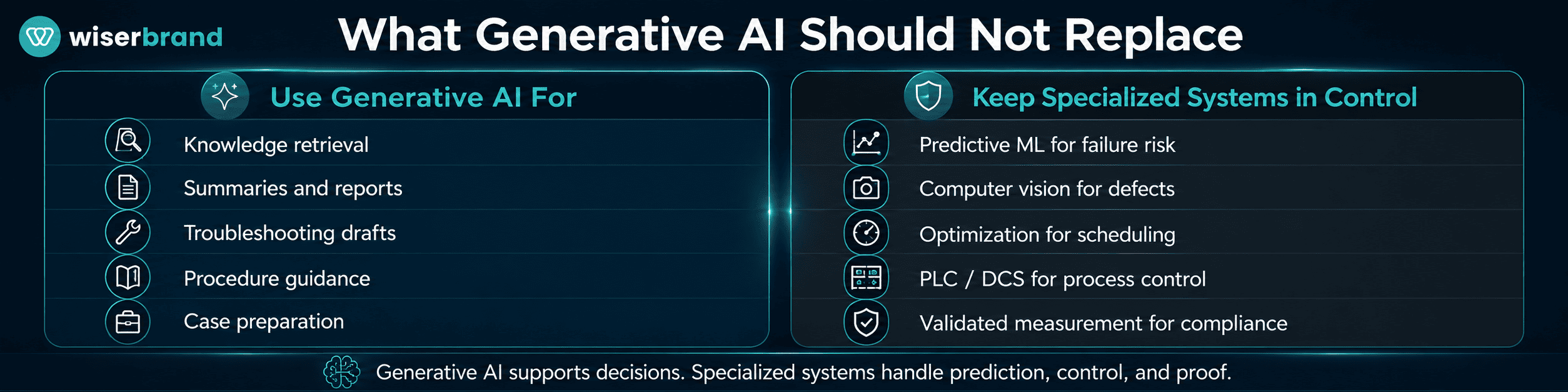
Some manufacturing problems are better solved with other technology.
| Problem | Better Primary Approach | Role for Generative AI |
|---|---|---|
| Predicting bearing failure | Time-series ML and condition monitoring | Explain the alert and prepare maintenance context |
| Detecting a surface defect | Computer vision | Summarize inspection evidence and create a case |
| Optimizing a production schedule | Mathematical optimization or APS | Explain constraints and scenario tradeoffs |
| Controlling a process variable | PLC, DCS, or validated control logic | Provide documentation or operator assistance |
| Proving dimensional compliance | Calibrated measurement and statistical methods | Prepare reports and retrieve procedures |
| Preventing unauthorized OT access | Network, identity, endpoint, and OT security controls | Assist analysts with incident context |
This distinction prevents a common implementation mistake: asking a language model to become a predictor, controller, or optimizer when the task needs a specialized method.
Benefits and Their Operating Mechanisms
Benefits should be tied to a changed workflow rather than a generic claim about AI.
| Potential Benefit | How the Workflow Changes | Example Metric |
|---|---|---|
| Faster knowledge retrieval | Workers search one grounded interface instead of several repositories | Time to approved answer |
| Lower documentation effort | The system drafts reports and structured records from source data | Minutes per work order or report |
| Shorter troubleshooting preparation | Asset history and similar cases are assembled before technician review | Time to diagnosis or work-order readiness |
| More consistent handovers | Shift events and open actions follow a shared template | Missed-action rate |
| Faster engineering review | Changes, requirements, and test evidence are summarized | Review cycle time |
| Better use of unstructured data | Notes, documents, and messages become searchable and classifiable | Records processed and correction rate |
| Wider access to operational data | Natural-language questions reach governed plant data | Active users and accepted answers |
Do not count generated outputs as value by themselves. A plant does not benefit because the assistant produced 10,000 summaries. It benefits when those summaries reduce preparation time, improve response, or help avoid a specific error without creating new risk.
Architecture for Production Use
A production system for generative AI in manufacturing usually depends on the same integration, data, workflow, and operational foundations used in manufacturing software development. The architecture typically needs several layers:
| Layer | Purpose |
|---|---|
| User experience | Chat, mobile, desktop, engineering tool, or embedded workflow |
| Identity and permissions | User, plant, role, asset, product, and document access |
| Orchestration | Prompt logic, routing, state, tool calls, and escalation |
| Knowledge retrieval | Approved manuals, SOPs, engineering records, and policies |
| Data integration | MES, ERP, PLM, QMS, CMMS, historian, and service APIs |
| Deterministic services | Calculations, eligibility, thresholds, transactions, and control rules |
| Model layer | Selected foundation or specialized models |
| Evaluation and observability | Quality tests, traces, latency, cost, failures, and overrides |
| Security and governance | Data controls, model approval, change management, and incident response |
The architecture should keep operational technology boundaries explicit. A knowledge assistant may read selected historian data through a controlled service. That does not mean the model should connect directly to the plant network or receive controller credentials.
For sites with limited connectivity or strict data constraints, some retrieval, inference, or filtering may run at the edge or within a private environment. The deployment model should follow latency, availability, intellectual property, cybersecurity, data residency, and vendor-management requirements.
Data Readiness and Integration
Generative AI does not fix fragmented manufacturing data by itself. It can make fragmentation harder to see by producing a polished answer from incomplete context.
Before development, check:
- document ownership and revision status;
- asset, product, part, and location identifiers;
- MES, ERP, PLM, QMS, and CMMS integration paths;
- historian and event-data quality;
- access rules by site and role;
- available APIs or stable exports;
- source latency and outage behavior;
- traceability from generated output to source record;
- treatment of engineering intellectual property;
- retention and vendor data-use terms.
That smart manufacturing roadmap identifies industrial big data, heterogeneous systems, integration, reliability, explainability, and safety as central adoption challenges. NIST research on distributed manufacturing also notes that production, quality, maintenance, and inventory systems often manage their data and decisions separately, limiting cross-functional context.
Start with the smallest data set that supports the chosen workflow. A maintenance assistant may need approved manuals, asset hierarchy, work orders, and selected alarms. It does not need the entire enterprise data lake for its first release.
Risks and Controls
The risks of generative AI in manufacturing are material because an incorrect output can affect product quality, worker safety, equipment, delivery, or intellectual property.
| Risk | Example | Control |
|---|---|---|
| Unsupported answer | The assistant invents a maintenance step | Retrieval grounding, citations, confidence rule, escalation |
| Outdated instruction | The model uses an obsolete SOP | Revision-aware source control and effective dates |
| Excessive authority | An agent changes a production record or machine state | Least-privilege tools, approval, transaction limits |
| Prompt injection | A document contains instructions aimed at the model | Content isolation, source controls, adversarial testing |
| Sensitive data leakage | Design IP appears in an external service or log | Data classification, private deployment options, masking, retention rules |
| Tool failure | A work order is created twice after a retry | Idempotency, status checks, retry limits, audit logs |
| Weak traceability | No one can determine why an answer was given | Source references, version logs, tool traces |
| Poor human adoption | Operators ignore the assistant after wrong answers | Limited pilot, feedback, correction workflow, visible boundaries |
| Model or process drift | Performance declines after documents or processes change | Continuous evaluation, thresholds, revalidation, rollback |
NIST's Generative AI Profile provides a cross-sector companion to the AI Risk Management Framework for managing risks specific to generative systems. The broader AI RMF is intended to incorporate trustworthiness into the design, development, use, and evaluation of AI systems.
A manufacturing implementation should also use existing OT cybersecurity, functional safety, quality, and change-control practices. The AI system is an additional component, not a reason to bypass established controls.
A Practical Implementation Plan
A generative AI in manufacturing rollout should move through controlled releases rather than one broad deployment.
- Select one operational problem.
Choose a workflow with frequent manual effort, accessible data, a named owner, and a measurable result. Good starting points include document search, shift summaries, maintenance history preparation, or quality-case drafting.
- Record the baseline.
Measure current time, error, backlog, repeat work, and user effort. Without a baseline, the team may like the assistant but remain unable to show operational value.
- Map the full workflow.
Document the trigger, users, source systems, decisions, approvals, exceptions, output, and downstream action. Identify where the model may assist and where deterministic logic or human authority must remain.
- Prepare approved data.
Clean document versions, map identifiers, define access, and create traceable source connections. Do not begin by indexing every available file.
- Build a read-only first release.
Start with retrieval, summaries, classifications, and drafts. Keep system updates disabled until quality and failure behavior are understood.
- Create evaluation cases.
Test normal questions, missing data, conflicting documents, outdated procedures, unsupported requests, multilingual input, prompt injection, and system outages. Include cases where the correct result is refusal or escalation.
- Pilot with the real users.
Run the workflow with one plant, team, asset class, product family, or document set. Capture corrections and reasons for non-use.
- Add controlled actions.
After the read-only workflow is stable, add bounded actions such as creating a draft work order or assigning a review task. Use narrow permissions, confirmation, audit logs, and rollback.
- Monitor the operational result.
Track accuracy, source quality, task completion, human override, latency, cost, tool failures, and the target business KPI.
- Expand through reusable patterns.
Reuse identity, retrieval, evaluation, observability, and security components. Do not copy a workflow into another plant without checking local systems, procedures, language, and ownership.
Choosing the Right First Use Case
Score candidate workflows before committing to a platform or model.
| Factor | Strong Signal | Weak Signal |
|---|---|---|
| Frequency | Daily or weekly work at meaningful volume | Rare special case |
| Manual effort | People search, summarize, or re-enter data repeatedly | Little recurring effort |
| Data readiness | Approved sources and identifiers exist | Conflicting or inaccessible data |
| Workflow clarity | Trigger, owner, and output are known | Process varies by person |
| Risk | Human review can contain mistakes | Wrong output can cause immediate physical harm |
| Measurement | Time, quality, backlog, or cost can be compared | No baseline or owner |
| Integration | Stable read APIs or exports exist | Direct legacy access with no control layer |
| Adoption | The output appears in an existing tool | Workers must open another isolated portal |
A high-value but high-risk use case may still be worth pursuing. It should not be the first workflow unless the organization already has strong AI, data, OT, security, and validation capabilities.
How to Measure Success
Use workflow and business metrics together.
| Use Case | Primary Metrics |
|---|---|
| Knowledge assistant | Time to answer, source accuracy, unresolved question rate |
| Maintenance support | Preparation time, correction rate, repeat failure analysis time |
| Quality investigation | Case preparation time, missing evidence, reviewer rework |
| Shift summary | Preparation time, missed action rate, manager corrections |
| Engineering assistant | Review cycle time, accepted drafts, defect escape rate |
| Supplier-document processing | Processing time, extraction accuracy, exception rate |
| Automation code assistant | Engineering time, test failures, production defects |
| Service assistant | Case handling time, source accuracy, escalation quality |
Also track model and system health:
- grounded answer rate;
- human override rate;
- failed retrievals;
- unauthorized tool attempts;
- duplicate or failed actions;
- latency;
- cost per completed task;
- user adoption;
- incidents and time to rollback.
A faster workflow is not better if quality, safety, or trust falls. Review the full set of outcomes.
Build, Buy, or Customize?
| Approach | Best Fit | Main Tradeoff |
|---|---|---|
| Built-in vendor copilot | Common workflows inside an existing platform | Limited flexibility and vendor dependence |
| General enterprise AI platform | Shared model, retrieval, security, and tooling foundation | Internal integration and governance work remains |
| Specialized industrial product | Domain-specific engineering or plant use case | Fit may vary across equipment and sites |
| Custom application | Differentiated workflow, data, interface, or control needs | Higher development and operating responsibility |
| Hybrid architecture | Vendor foundation with custom data, rules, and user experience | Requires clear boundaries between components |
A manufacturer should choose based on workflow fit, integration, data control, deployment model, model choice, evaluation, observability, vendor change policy, licensing, and exit options. A short product demo is not enough to validate plant readiness.
When Not to Use Generative AI
Do not force the technology into a workflow when:
- a search index or rules engine can solve the problem more reliably;
- the data has no owner or current version;
- the output cannot be checked before it affects safety or quality;
- the task requires deterministic precision;
- the plant cannot monitor or disable the system;
- users have no practical correction or escalation path;
- a predictive, vision, simulation, or optimization model is the real requirement;
- the expected value does not justify integration and maintenance.
The correct first step may be digitizing records, improving the asset hierarchy, connecting MES and CMMS data, or fixing the underlying process.
FAQ
How Is Generative AI Used in Manufacturing?
Generative AI in manufacturing is used to retrieve technical knowledge, summarize plant data, draft reports and work instructions, assist engineering, organize maintenance history, support quality investigations, process supplier documents, and prepare service responses. It usually works around operational systems rather than directly controlling equipment.
Is Generative AI the Same as Predictive Maintenance?
No. Predictive maintenance normally uses sensor and historical data to estimate equipment condition or failure risk. Generative AI can explain the prediction, retrieve similar cases, summarize asset history, or prepare a work order. The prediction should come from a validated condition-monitoring or machine-learning method.
Can Generative AI Control Manufacturing Equipment?
A language model should not directly control safety-critical equipment. PLCs, DCS platforms, robotics controllers, interlocks, and validated control services should execute physical actions. Generative AI can assist operators or engineers, but commands need deterministic validation, permissions, and approval suited to the risk.
What Manufacturing Data Does a Generative AI System Need?
The data depends on the use case. Common sources include manuals, SOPs, work orders, quality records, engineering documents, MES events, ERP records, asset hierarchies, and selected historian data. Start with approved sources required for one workflow rather than connecting every enterprise system.
What Is the Best First Manufacturing Use Case?
A strong first use case is frequent, text-heavy, measurable, and low risk. Examples include searching controlled technical documents, creating shift summaries, preparing maintenance history, or drafting quality-case records. These workflows can begin in read-only mode and keep employees responsible for final action.
What Are the Main Risks?
The main risks include unsupported answers, obsolete procedures, exposure of engineering intellectual property, prompt injection, excessive tool access, failed integrations, weak traceability, poor user adoption, and model drift. Controls should include approved sources, least-privilege access, evaluation, audit logs, human review, and rollback.
How Long Does Implementation Take?
The timeline depends on data readiness, integrations, risk, plant access, evaluation requirements, deployment environment, and change control. A narrow knowledge pilot can move faster than an agent connected to MES, QMS, CMMS, and production workflows. Scope should be based on release evidence rather than a generic estimate.
Final Thoughts
Generative AI in manufacturing creates the most value when it helps people work with industrial knowledge and operational context. It can reduce the effort required to search documents, prepare cases, explain plant events, draft engineering content, and coordinate work across systems.
The safest pattern is augmentation first. Keep validated control logic, measurements, optimization, product disposition, safety decisions, and irreversible actions outside the language model. Start with one workflow, use approved data, show sources, test real failure cases, and measure the operational result before expanding autonomy.
We build manufacturing software and generative AI solutions around these production constraints. WiserBrand's manufacturing software development practice covers MES integration, IoT connectivity, predictive maintenance, dashboards, and custom plant applications, while our generative AI services cover use-case selection, data integration, model workflows, evaluation, and monitored deployment.