AI in Manufacturing: Use Cases, Generative AI, and Implementation

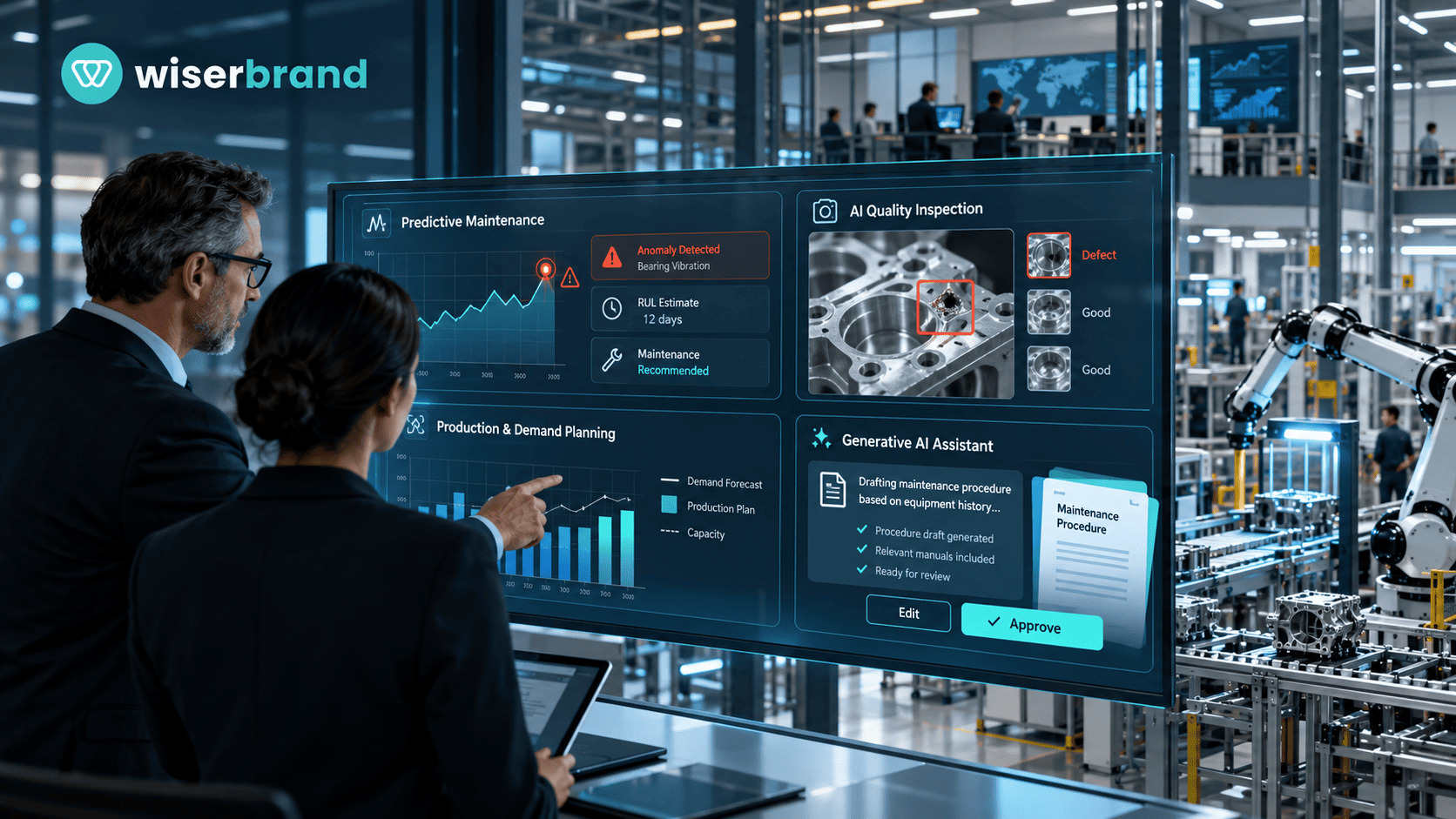
AI in manufacturing is the use of models on production and business data to detect defects, forecast equipment or demand risk, and prepare decisions for the people who own them. Predictive systems return a score, a class, or a forecast. Generative AI returns an explanation, a summary, or a draft: a maintenance answer, a request for quotation (RFQ) packet, a quality narrative, or control code. The difference matters because a forecast can be checked against an outcome, while a draft has to be checked against a source.
The operating problem is rarely a shortage of data. It is the delay between an event and a decision: an unplanned stop, a nonconformance, an RFQ that waits for engineering. This guide covers both families of use cases, the data and integration work behind them, the controls that keep a model out of consequential decisions, and how to choose a first pilot.
What AI in Manufacturing Does
A manufacturing AI system reads four kinds of input: images and video from inspection points, time series from machines and sensors, transactional records from enterprise resource planning (ERP) and manufacturing execution systems (MES), and documents such as drawings, specifications, manuals, and quality records. It returns a signal that something is outside normal behavior, a forecast or score, an explanation with source references, or a draft that a person edits and approves.
Factory-floor work includes anomaly detection on a drive, defect classification at an inspection station, energy per good unit, and constraint checks before a schedule is released. Engineering and back-office work includes retrieving the current revision of a work instruction, drafting programmable logic controller (PLC) code for review, assembling an RFQ packet, and writing a nonconformance summary.
A sensor, a PLC, an ERP, or a dashboard does not become AI because it produces data. The model has to change a decision; if no one acts differently, the task is a reporting exercise.
Predictive AI, Generative AI, and Automation
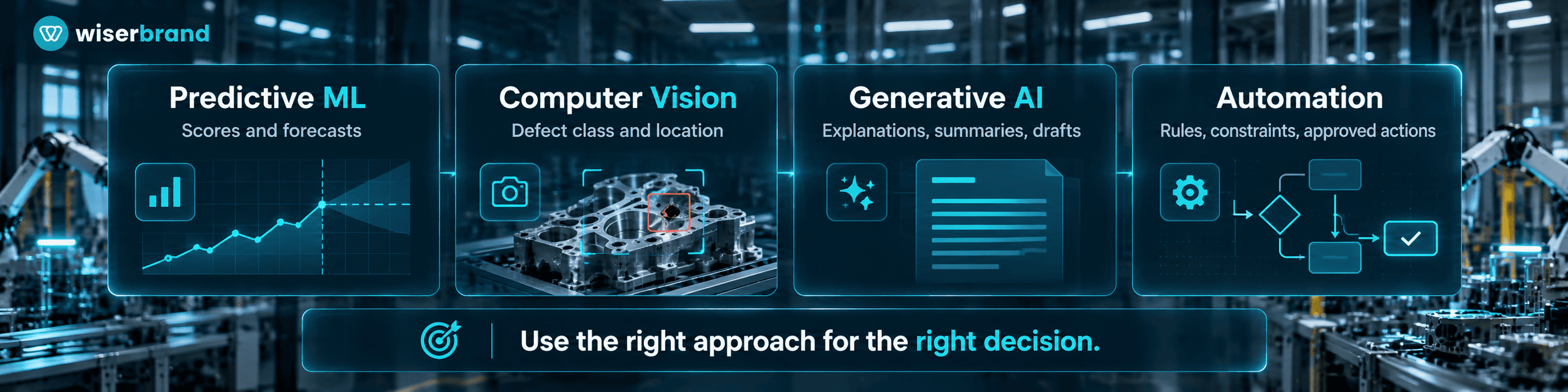
| Approach | Input | Output | Manufacturing example | Main limitation |
|---|---|---|---|---|
| Predictive machine learning | Time series, asset history, maintenance logs | Risk score or remaining useful life | Anomaly score for a critical drive over a defined horizon | Needs failure labels and stable operating conditions |
| Computer vision | Images, camera settings, part and lot IDs | Defect class, location, score | Surface or weld defect classification at an inspection station | Sensitive to lighting, new products, rare defects |
| Generative AI | Documents, records, retrieved context, prompt | Explanation, summary, extracted fields, draft text or code | Maintenance answer with source links, RFQ packet, nonconformance draft | Can produce plausible text without a supporting source |
| Deterministic automation and optimization | Rules, constraints, orders, capacity | Approved schedule, triggered action, validated calculation | Constraint-based scheduling solver, required-field rule | Cannot resolve ambiguous input it was not designed for |
Artificial intelligence in manufacturing is the wider category, and generative AI is one subset. A scheduling optimizer may be a mathematical solver with no machine learning, and a language model does not resolve capacity constraints by itself. Retrieval-augmented generation (RAG) pulls approved records into the prompt; it does not retrain the model. A copilot suggests a step to a person, while an agent selects steps and calls tools inside limits you define.
AI Use Cases on the Factory Floor
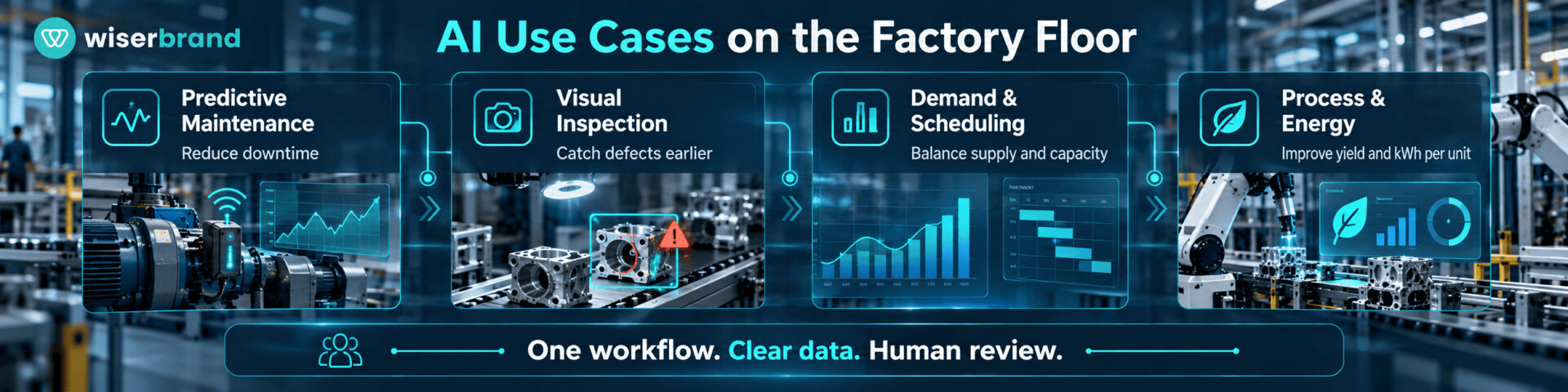
Each workflow shares one skeleton: a trigger, authoritative data, a model output, a review step, an exception path, and a measure. AI in manufacturing projects often stall at the review step, not the model.
Predictive Maintenance and Condition Monitoring
The trigger is a temperature, vibration, or pressure deviation outside the normal band for that asset and operating mode. Inputs include the time series, asset ID, current mode, and maintenance history from a historian or supervisory control and data acquisition (SCADA) system and a computerized maintenance management system (CMMS). A model scores anomaly or failure risk over a defined horizon. The workflow checks signal persistence, asset criticality, and open work orders, then prepares a message or draft work order. A maintenance engineer decides which work is needed. If the data is stale, the case follows a manual route. Track false alerts per asset-week, confirmed incidents, useful lead time, and unplanned downtime hours. Sparse failure labels often make anomaly detection a better fit than predicting a specific failure date.
Visual Inspection and Quality Control
A part enters an inspection station, and the camera captures images tied to a part or stock-keeping unit (SKU), lot ID, and camera settings. A model built through computer vision development returns a defect class, location, and score. The validated station workflow rejects the part or sends it to review, and a quality engineer sets thresholds and disposition rules. Poor focus, a lighting change, or an unseen SKU moves the result to an agreed fallback instead of a silent guess. Accuracy on a test set does not prove the economics of the line, and new products and optic changes require revalidation. Measure defect recall, false reject rate, escapes, and throughput at confirmed quality.
Demand Forecasting and Production Scheduling
A planning cycle or a large order change starts the run. Planning draws on ERP orders and history, inventory, lead times, routings, and capacity calendars. A forecasting model estimates demand, and a solver calculates feasible schedule options. The planner approves a version after checking material, resources, and due dates. Stale inventory, a missing routing, or an impossible due date becomes an explicit exception rather than a silent assumption. Measure forecast WAPE and bias, schedule adherence, stockouts, and on-time delivery. Generative AI can explain a plan or draft a customer message, but it does not replace the feasibility check that a solver performs.
Process and Energy Optimization
A yield, cycle time, or energy-per-unit deviation triggers the analysis. The analysis uses process history, batch context, permitted recipe limits, and quality measurements. A model or optimizer proposes candidate settings. A process engineer checks them in simulation, a designed experiment, or a controlled trial, and an approved controller executes the permitted change. A value outside the limits, or missing batch context, blocks the change. Not every process needs a model; a stable loop with a conventional controller may already hold the variable. Safety interlocks remain separate from any optimization layer. The measures are first-pass yield, scrap, cycle time, and kWh per good unit.
Generative AI Use Cases in Manufacturing
Generative AI in manufacturing works on documents, records, and code, and its output is a draft until a person with authority approves it. Four workflows are worth examining first.
Maintenance Knowledge and Operator Assistance
An operator enters an asset ID and an error code. Retrieval selects available and current original equipment manufacturer (OEM) manuals, approved standard operating procedures, and maintenance logs. The assistant forms an explanation with citations and marks the parts it cannot support. Rules check the release state of each source and the permission of the user. A configuration with no matching instruction goes to escalation rather than to an invented procedure, and an authorized employee makes the decision about physical intervention. Measure source correctness, the share of answers drawn from the current revision, search time, and correction rate. RAG reduces manual searching, but it does not guarantee that an answer is true. Teams that need a custom retrieval layer usually start with LLM development rather than a general chatbot.
Engineering and PLC Code Assistance
An engineer submits an approved functional specification. The model works from project context, approved libraries, standards, and version-compatible documentation. It prepares code or a test draft. Deterministic checks verify format, compilation, and configured rules, and the engineer reviews the logic, runs simulation or test, and approves release. An unsupported function or a mismatched library version stops preparation before deployment. Measure accepted drafts, review and debug time, rework, and validation failures. The volume of generated lines is not a productivity measure, because review effort and rework carry the real cost.
RFQ Review and Quality Documentation
Two document workflows share one pattern, and the RFQ path is one application of AI in manufacturing that carries commercial risk. Intake creates a case ID and stores the attachments, sender, and arrival time. Extraction produces candidate fields with units, a page reference, and explicit missing values; rules check required fields and incompatible values. Text inside a customer attachment cannot change system permissions or tool access. Permitted retrieval finds relevant part and job records with match reasons, revisions, and timestamps; a similar name is not the same part. The workflow assembles a review packet and a clarification draft, and the estimator sees the sources and the gaps. A person approves the commercial and engineering decision; nothing is sent automatically. After approval, a permitted ERP write checks record version and idempotency, logs the approval, and routes failures to a person without duplicates.
For a nonconformance, the trigger is an open case in the quality management system (QMS). The case file holds inspection evidence, lot genealogy, approved rules, and source records. The workflow prepares a factual timeline and a draft report with links. A quality engineer confirms the conclusions, root cause stays a hypothesis until verified, and corrective action is not closed automatically. A missing measurement, conflicting part identity, or a different requirement revision goes to manual review. Measure preparation and review time, factual corrections, and evidence completeness.
Design Exploration and Synthetic Training Data
A design brief with load cases, material, and manufacturing constraints starts exploration. A design system proposes candidates, and an engineer checks geometry, material and process fit, tolerance, simulation, and physical tests. A candidate that breaks a constraint is rejected. Name the method precisely: topology optimization, a learned model, and language-model assistance are not the same technique. Measure iteration time, accepted candidates, and rework. A generated shape is not a released part.
Synthetic data follows the same rule. When a rare defect class has too few examples, an approved generator or simulation creates candidate samples. A domain reviewer checks physical plausibility, provenance is recorded, and training and test sets stay separate. The holdout must contain real, independent production data. Measure per-class recall and false positives on the real holdout, because a lower training loss says nothing about defect escapes.
What Manufacturing AI Looks Like in Practice
BMW describes AIQX, its AI quality platform, as constant monitoring of production lines through analysis of sensor and image data. BMW cites no detection rate for it here, so treat the platform as a pattern rather than a benchmark. BMW's AIQX quality platform shows a sensor and image pipeline wired into a defined production process.
Siemens announced on November 12, 2024 that thyssenkrupp Automation Engineering integrated its engineering copilot into a battery machine used for battery quality inspection. The copilot helps engineers create TIA Portal projects, develop structured control language code for PLCs faster, and generate a machine visualization; thyssenkrupp planned to use it at scale from 2025. Siemens' engineering copilot deployment is an engineering assistance case, and a rollout announcement is not evidence of the state at every site.
Our own Odoo-based manufacturing case involves a New York manufacturer of standard and custom AC filters that runs manufacturing, ecommerce, and field service on one Odoo instance. WiserBrand built an AI agent layer around Odoo that detects exceptions, gathers context, and prepares a recommended action for employee approval, including custom quote preparation and production conflicts. The case gives no baseline or measurement window for its results, so it illustrates the workflow rather than offering a controlled comparison.
Data and Integration Requirements
Two data flows cover most projects. In the first, sensors and cameras feed an edge or cloud model that writes to a validated operational workflow. In the second, approved documents and ERP records feed permission-aware retrieval, the model drafts, deterministic checks run, and a reviewer decides. The two flows meet at the same identifiers: part, asset, job, lot, revision, and timestamp.
AI in manufacturing projects often fail at the integration layer, not at the model layer. Records have different authorities. A job number belongs to ERP, a routing to manufacturing engineering, an inspection result to quality, a work order to maintenance, and a drawing revision to document control. An AI manufacturing workflow that treats them as one source will produce confident answers from the wrong record.
Every interface needs part and asset IDs, units of measure, timestamps, revision or release state, and the requesting user's permission. Where each model runs follows latency, connectivity, drawing sensitivity, and support capacity. A line-speed inspection step has to finish inside the station cycle, and a language-model response is not hard real-time control. A retrieval answer should show the document and its revision, not ask the reader to trust the text. Existing systems rarely need replacement; they need AI integration with existing systems that respects record ownership and access.
How to Choose and Pilot the First Use Case
The scorecard is an editorial tool, not a validated index. Score each item from 1 to 5 with the workflow owner, IT, operations, and the reviewer. A low consequence or ownership score blocks it.
| Criterion | What to check before starting |
|---|---|
| Value | Task frequency, baseline time or errors, cost of delay, the action after the output |
| Data readiness | Representative records, labels or approved documents, IDs, revisions, permissions |
| Integration effort | Native ERP function, API and event quality, licenses, support |
| Consequence | Physical, quality, commercial, or information harm from a wrong action |
| Reviewer capacity | Who can check the output and how long the check takes |
| Ownership | Business, technical, and incident owner, plus the support budget |
Seven steps turn the score into a pilot for almost any decision about AI for manufacturing.
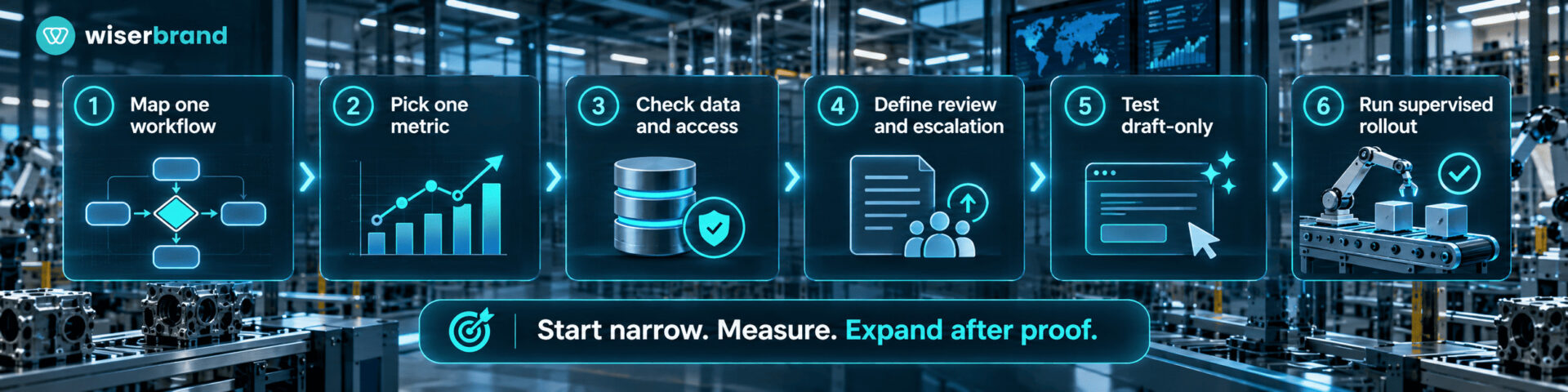
- Define one bottleneck, its start and end, a baseline, and a business owner.
- Test simpler options first: a form, master-data repair, ERP configuration, a deterministic rule, an existing module, or a direct integration.
- Check data, rights, source records, freshness, and exception cases.
- Choose the assistance model, permitted actions, reviewer, escalation, and acceptance criteria before development.
- Build a read-only or draft-only prototype and test output, sources, access, and API behavior. A first application of AI in manufacturing should stay there when consequences are high.
- Run shadow mode or a supervised rollout, and measure the whole workflow, review effort included.
- Expand only after quality, usefulness, support ownership, and rollback are confirmed.
Build versus buy follows the same logic. A ready component wins when its tasks, modules, permissions, deployment, and cost fit the requirement. A custom layer earns its place when the workflow crosses systems or depends on specific revisions. An available API does not prove support for the integration you need, so check edition, license, rate limits, sandbox, and release policy. A focused AI proof of concept tests those assumptions.
Risks and Controls Before Scaling
| Risk | Manufacturing consequence | Control and owner |
|---|---|---|
| Outdated revision | Work prepared to a different requirement | Retrieval limited to approved release; source owner and engineering |
| Weak or missing source | Incorrect procedure or fact in a packet | Source links, conformance check, abstain and escalate; reviewer |
| Prompt injection in an attachment | Attempt to change instructions or trigger an extra action | Untrusted input, allowlisted tools, policy validation; technical owner |
| Drawing or customer data exposure | IP disclosure or contract breach | Data minimization, access boundaries, vendor retention review; security owner |
| Drift after a SKU or camera change | Missed defects or extra rejections | Segmented quality monitoring and revalidation; quality and model owner |
| Duplicate or conflicting write | Duplicate request or overwritten newer data | Idempotency, version check, API confirmation; integration owner |
NIST's Generative AI Profile lists confabulation, privacy, information security, and value chain integration among the risks that need management. It is voluntary, not a manufacturing certification, and it supports the controls above.
Risk rises when a manufacturing AI workflow can write to a controlled system. A timeout or an unavailable API should leave a pending status, a bounded retry, and a manual queue, not an incomplete packet. A missing reviewer defaults to pending, escalation, and an audit trail. Rollback means disabling a write tool or restoring the previous workflow version, keeping the log, and handing unfinished cases to a person. A physical action cannot be rolled back like a text record, so prevention and the approval boundary come before launch.
How to Measure Manufacturing AI Value
| Metric | Definition and unit | Baseline source | Owner |
|---|---|---|---|
| Defect recall | TP / (TP + FN), per defect class | Inspection records for the same product mix | Quality engineer |
| False reject rate | FP / (FP + TN), per station and shift | Station logs before the pilot | Quality engineer |
| Unplanned downtime | Hours, plus actionable alert lead time and false alerts per asset-week | CMMS history, previous 12 months | Maintenance planner |
| Forecast error | WAPE = Σ abs(actual − forecast) / Σ abs(actual) × 100%, with bias | ERP demand history, matching horizons | Demand planner |
| Retrieval quality | Citation support rate, current-revision rate, appropriate abstention | Human-scored approved reference set | Knowledge owner |
| Cost per accepted task | Model, API, licenses, infrastructure, reviewer, exceptions, maintenance | Finance and vendor invoices | Business owner |
TP, FP, FN, and TN stand for true positive, false positive, false negative, and true negative. Each metric needs a unit, definition, baseline, source, owner, period, and segmentation rule. Targets come from pilot data.
AI in manufacturing value depends on the denominator as much as the numerator. Cost includes integration, data preparation, review, support, licenses, and inference; a faster output does not offset critical errors or a larger review burden. Compare similar jobs, products, and loads. ROI over one agreed period is (quantified benefit − total cost) / total cost × 100%, with both components written down; payback is the point when accumulated net benefit covers implementation cost. Do not count the same effect twice, and do not call released capacity cash savings until a cost line changes. Overall Equipment Effectiveness is availability × performance × quality, not standalone proof that AI worked.
FAQ
What Is AI in Manufacturing Used For?
It covers detection, prediction, and preparation. Predictive models score equipment risk or forecast demand. Computer vision classifies defects at inspection stations. Generative AI retrieves approved instructions, drafts RFQ packets and quality summaries, and assists engineering. A person reviews the output before anything changes.
How Is Generative AI Different From Predictive AI?
Predictive AI returns a prediction: a probability, a class, a forecast, or a risk score that can be compared with the outcome. Generative AI returns content: an explanation, a summary, extracted fields, or a draft. The first is judged by recall and calibration; the second by source support, revision currency, and reviewer acceptance.
Which Generative AI Use Case Should a Manufacturer Pilot First?
Pick a task with authoritative sources, low consequence if the draft is wrong, a reviewer with spare capacity, and a measurable baseline. Maintenance knowledge retrieval and RFQ preparation usually fit. Avoid anything that releases production work, approves a price, or writes to a controlled system. The proof is faster acceptance with fewer corrections.
Can AI Work With Legacy Manufacturing Systems?
Often, within limits. AI in the manufacturing industry depends on what a system exposes: an API, a database view, an export, a file drop, or only a screen. Event quality matters as much as connectivity, because a late or duplicate status can mislead the model. Test the edition, license, and sandbox before promising an interface.
What Does It Cost to Implement Manufacturing AI?
Cost follows scope, not a price list. The main components are discovery, data preparation, integration, licenses, review, testing, training, and support. A read-only workflow on one system costs less than a multi-site deployment with write access. Ask for a pilot scope, assumptions, and a price after discovery.
Can Generative AI Control Production Equipment?
Not in a validated control system. A generative model can prepare a recommendation, a draft work order, or code for review; a person or a deterministic controller decides what executes. Safety functions, interlocks, and machine control stay in the systems built for them. Any physical change needs an approval boundary and a named owner before launch.
Plan a Manufacturing AI Pilot
AI in manufacturing pilots usually fail because one of four pieces is missing: a single task, a permitted data source, a measurable baseline, or a named person who decides what happens after the output. If any is missing, the pilot produces a demo rather than an operating result.
We help manufacturing teams assess workflow and data readiness, define review boundaries, and plan a measurable pilot. Explore our manufacturing AI adoption services to discuss one operating bottleneck and the systems involved.