What Is AI TRiSM? A Practical Framework for Managing AI Risk


AI TRiSM, short for AI trust, risk, and security management, is a framework and set of technical capabilities for keeping AI systems trustworthy, secure, compliant, and observable throughout their lifecycle. It connects governance policies with operational controls such as AI inventories, access restrictions, evaluation, runtime monitoring, data protection, incident response, and human approval.
The framework matters because a policy document cannot stop a model from exposing sensitive data, following a malicious instruction, drifting after deployment, or taking an unauthorized action. AI risk has to be managed where the system is designed, tested, deployed, and used.
This guide explains what AI TRiSM covers, how it relates to other AI risk frameworks, which controls belong at each lifecycle stage, and how to implement it without creating a governance program that is heavier than the AI use case.
What AI TRiSM Means
The term comes from Gartner and expands to AI trust, risk, and security management. Gartner currently describes it as both a framework and a set of technical capabilities that support continuous monitoring, validation, and policy enforcement across the AI lifecycle.
The framework is broader than model security. It covers the conditions required for an AI system to remain useful and acceptable in production:
- Trust: Is the system reliable enough for its intended use, and can people understand its role and limits?
- Risk: What harm, loss, or operational failure could occur, and how will the organization reduce or accept that exposure?
- Security: Can attackers, unauthorized users, or unsafe integrations manipulate the system, its data, or its actions?
- Management: Who owns the system, which policies apply, how are changes approved, and what happens when performance or risk changes?
For implementation, treat it as an operating layer rather than a certification, a single product, or a replacement for legal review. AI strategy consulting can help connect governance requirements with use-case prioritization, ownership, risk classification, and deployment boundaries. The layer turns governance requirements into controls that can be tested, monitored, and enforced.
Why Policy-Only AI Governance Falls Short
AI governance defines expectations. Operational risk management connects those expectations to the systems that have to follow them.
A policy may state that customer data cannot leave an approved environment. An operational control must restrict model access, filter inputs, inspect outputs, log tool calls, and block a request that violates the rule. A policy may require human review for employment decisions. The workflow must prevent the model from submitting a final decision without an authorized approver.
This difference becomes more important after deployment. Production AI receives unfamiliar inputs, interacts with changing data, depends on external services, and may gain access to business tools. Risks can appear even when the model passed its original tests.
| Risk | What It Can Look Like in Production | Required Control |
|---|---|---|
| Unreliable output | Unsupported answer presented as fact | Grounding checks, evaluation, confidence rules, human review |
| Bias or unfair impact | Different error rates across relevant groups | Segmented testing, impact review, escalation |
| Sensitive data exposure | Customer or internal data appears in prompts or outputs | Data classification, masking, access control, output inspection |
| Prompt injection | External content changes the model’s instructions | Input isolation, instruction hierarchy, tool restrictions, attack testing |
| Excessive agency | An agent can perform actions beyond its business role | Least-privilege tools, transaction limits, approval gates |
| Model or data drift | Quality falls as data, behavior, or context changes | Monitoring, thresholds, retraining or rollback process |
| Weak accountability | No owner can explain or stop the system | Inventory, named owners, logs, incident procedures |
The purpose is not to eliminate every risk. That is not realistic. The purpose is to make risk visible, assign ownership, apply proportionate controls, and preserve the ability to stop or change the system.
Core Trust, Risk, and Security Control Domains
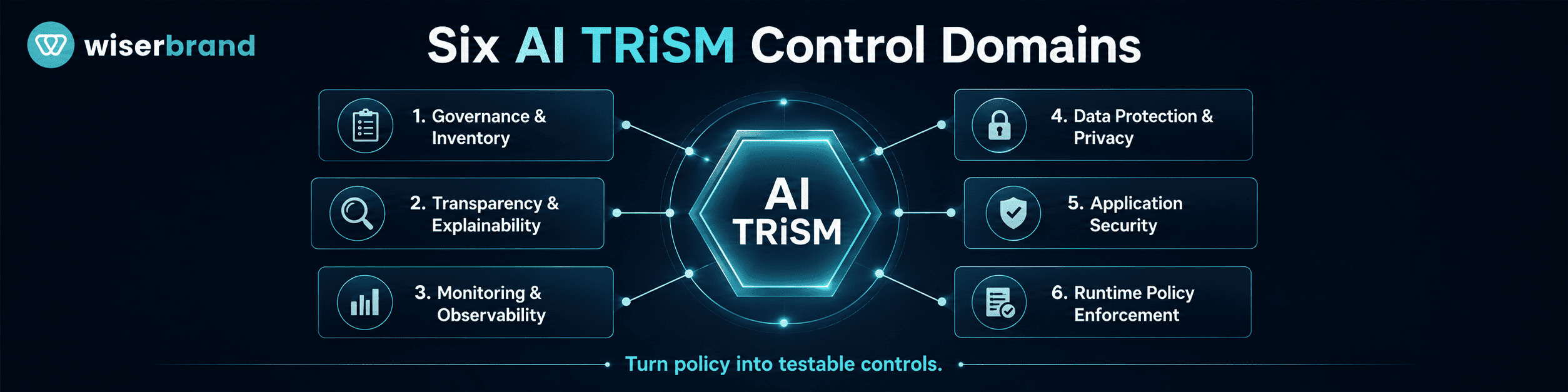
The framework is often summarized through several capabilities rather than one rigid checklist. A practical implementation can organize them into six connected control domains.
AI Governance and Inventory
The organization needs a current record of the AI systems it builds, buys, embeds, or allows employees to use. The inventory should include models, applications, agents, data sources, vendors, tool permissions, business owners, technical owners, affected users, risk level, and deployment status.
Inventory is the starting point because unmanaged AI often enters through SaaS features, browser tools, APIs, employee experiments, and vendor updates. A central AI team may not have approved or even seen every use case.
Governance should define:
- who can approve an AI use case;
- which risk classification applies;
- which evidence is required before release;
- who owns monitoring and incidents;
- how vendor and model changes are reviewed;
- when the system must be paused or retired.
A register that is updated once a year is not enough for a fast-changing AI environment. Ownership and change management need to follow the actual release cycle.
Transparency and Explainability
Transparency means giving users, operators, and reviewers enough information to understand what the system does, which data it uses, and where its limits are. Explainability focuses on the factors or evidence behind a specific output or decision.
The required depth depends on the use case. A product description assistant may need source attribution and editing history. A credit, insurance, employment, or medical workflow may need a more rigorous explanation of inputs, decision logic, validation, and human responsibility.
Useful controls include:
- visible disclosure that AI is involved;
- source citations for retrieval-based answers;
- model cards or system documentation;
- decision records;
- explanation methods suited to the model type;
- user-facing limits and escalation paths;
- traceable versions of prompts, policies, and models.
An explanation should help a person review the output. A generic statement such as “the model analyzed multiple factors” does not provide meaningful oversight.
Model and Application Monitoring
Monitoring checks if the AI system still performs within an accepted range after launch. Strong MLOps practices add model and workflow versioning, production monitoring, evaluation, deployment controls, rollback, and incident visibility. The model is only one component. Teams also need to monitor retrieval, prompts, tools, APIs, policies, user behavior, and downstream business results.
Relevant signals may include:
- task completion;
- accuracy or groundedness;
- unsupported claim rate;
- refusal and escalation rate;
- human override rate;
- latency and availability;
- token and infrastructure cost;
- drift in inputs or outputs;
- tool-call failures;
- policy violations;
- performance by relevant segment.
Each metric needs a threshold and owner. A dashboard that shows quality declining without a response rule is observation, not risk management.
Data Protection and Privacy
AI systems can process sensitive information through prompts, training data, retrieval indexes, logs, feedback, and generated outputs. Data controls need to cover the full path, not only the original database.
The control set may include:
- data classification;
- approved-use rules;
- minimization;
- masking or tokenization;
- encryption;
- retention limits;
- regional processing restrictions;
- role-based access;
- vendor data-use review;
- deletion and correction procedures;
- leakage testing.
A model should not receive a full customer profile when the workflow only needs an order number and delivery status. Limiting data at the source reduces exposure more reliably than asking the model not to reveal it.
AI Application Security and Adversarial Resistance
AI applications introduce security problems that traditional application controls do not fully cover. Prompt injection, sensitive information disclosure, improper output handling, data poisoning, model theft, and excessive agency are examples addressed by current OWASP guidance for LLM and generative AI applications.
The control program should connect application security with AI-specific testing. Useful controls include:
- threat modeling;
- input and output validation;
- prompt injection testing;
- retrieval source controls;
- dependency and model provenance;
- sandboxed tool execution;
- least-privilege credentials;
- rate and transaction limits;
- secrets management;
- red-team exercises;
- software and model update review.
MITRE ATLAS can help security teams map adversary behavior against AI-enabled systems, including attacks on prompts, model outputs, retrieval context, and generation pipelines.
Runtime Inspection and Policy Enforcement
Runtime controls act while the AI system is operating. They can inspect requests, responses, retrieved content, tool calls, and attempted actions before the workflow continues.
Examples include:
- blocking prohibited data from entering a model;
- rejecting outputs that contain secrets or restricted claims;
- preventing an agent from calling an unapproved tool;
- requiring human approval above a financial threshold;
- restricting actions by user role or region;
- stopping repeated or abnormal tool calls;
- routing low-confidence cases to a reviewer;
- disabling the workflow after a critical control failure.
Runtime enforcement turns written policy into executable boundaries. It is especially important for AI agents because an agent can affect records, messages, payments, access, or customer outcomes through connected tools.
AI TRiSM Compared With Other AI Risk Frameworks
AI TRiSM works best as a technical and operating layer within a broader governance program. It complements established frameworks and legal requirements rather than replacing them.
| Framework or Requirement | Primary Purpose | How It Relates to AI TRiSM |
|---|---|---|
| NIST AI RMF | Voluntary framework for governing, mapping, measuring, and managing AI risk | Provides lifecycle risk outcomes that AI TRiSM controls can operationalize |
| ISO/IEC 42001 | Requirements for an organizational AI management system | Provides a management-system structure for policies, responsibilities, audits, and continuous improvement |
| EU AI Act | Legal obligations based on AI roles and risk categories | Creates requirements that affected organizations may implement through governance and technical controls |
| OWASP GenAI Guidance | Security risks and mitigations for LLM and generative AI applications | Informs application security, threat testing, and agent controls |
| AI TRiSM | Trust, risk, security, monitoring, and enforcement capabilities | Connects policies and risk decisions to production systems and workflows |
NIST’s AI Risk Management Framework organizes work through Govern, Map, Measure, and Manage. NIST states that risk management should be continuous and applied throughout the AI lifecycle.
ISO/IEC 42001 specifies requirements for establishing, implementing, maintaining, and continually improving an AI management system. It uses a management-system approach that organizations can integrate with existing governance and audit practices.
The EU AI Act takes a legal, risk-based approach. Article 9 requires a documented and maintained risk management system for high-risk AI systems and describes it as a continuous, iterative lifecycle process.
The practical takeaway is simple. A company can use NIST to structure risk activities, ISO 42001 to organize the management system, applicable laws to define obligations, OWASP and similar resources to inform security testing, and AI TRiSM to implement technical monitoring and enforcement.
A Practical Risk Management Lifecycle
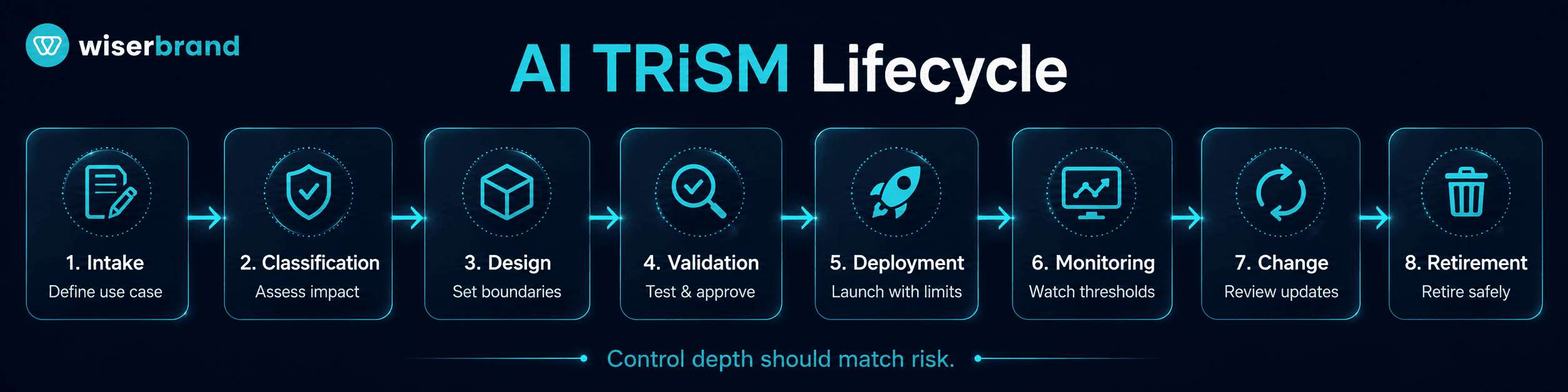
A workable program follows the AI system from idea to retirement.
| Lifecycle Stage | Main Question | Evidence or Control |
|---|---|---|
| Intake | Should AI be used for this problem? | Use-case brief, owner, expected benefit, alternatives |
| Classification | What could go wrong and who may be affected? | Risk tier, data class, regulatory review, impact assessment |
| Design | Which boundaries belong in the architecture? | Data flow, permission model, human review, threat model |
| Validation | Does the system meet release criteria? | Evaluation results, security tests, bias checks, approval record |
| Deployment | Can the system operate only within approved limits? | Scoped credentials, runtime policies, logging, rollback |
| Monitoring | Is performance or risk changing? | Thresholds, alerts, business metrics, incident queue |
| Change | Does an update alter the risk profile? | Version review, regression tests, change approval |
| Retirement | Can the system and its data be removed safely? | Access removal, data disposition, archive, user notice |
The lifecycle should be risk-based. An AI readiness assessment can identify gaps in data governance, security, ownership, infrastructure, monitoring, and operational controls before a system moves into production. A low-risk internal summarizer does not need the same evidence as an agent that approves payments or a model that influences employment decisions. Every use case still needs an owner, a defined purpose, approved data access, basic testing, and a way to stop the system.
Example: Managing Risk for a Customer Support Agent
Consider an AI agent that reads support tickets, checks order data, drafts a response, and can issue a return label for eligible orders.
The workflow begins when a ticket enters the helpdesk. The agent reads the message, retrieves the customer’s order, checks the published return policy, and prepares the next action.
The risk is not limited to answer quality. The agent may expose another customer’s order, follow malicious text inside an attachment, misread the policy, issue an unauthorized refund, or create repeated return labels after an API retry.
A practical control design would include:
| Workflow Element | Control |
|---|---|
| Customer lookup | Identity match and record-level access restriction |
| Ticket and attachment input | Prompt injection and malware checks |
| Policy retrieval | Approved sources with version and effective date |
| Drafted response | Grounding check, prohibited-claim filter, source trace |
| Return eligibility | Deterministic policy rule outside the model |
| Label creation | Tool limited to eligible order and one label per return |
| Refund or exception | Human approval above defined thresholds |
| Tool execution | Idempotency key, timeout, retry limit, audit log |
| Low confidence or conflict | Escalation to a support specialist |
| Monitoring | Resolution quality, override rate, policy errors, tool failures |
The model handles language and context. Deterministic code handles eligibility, permissions, transaction limits, and irreversible gates. A person owns exceptions and customer-impact decisions outside the approved path.
This separation is central to production AI risk management. Trust should not depend on a prompt asking the agent to behave responsibly. It should come from architecture, permissions, testing, monitoring, and accountable review.
A Risk-Based Control Matrix
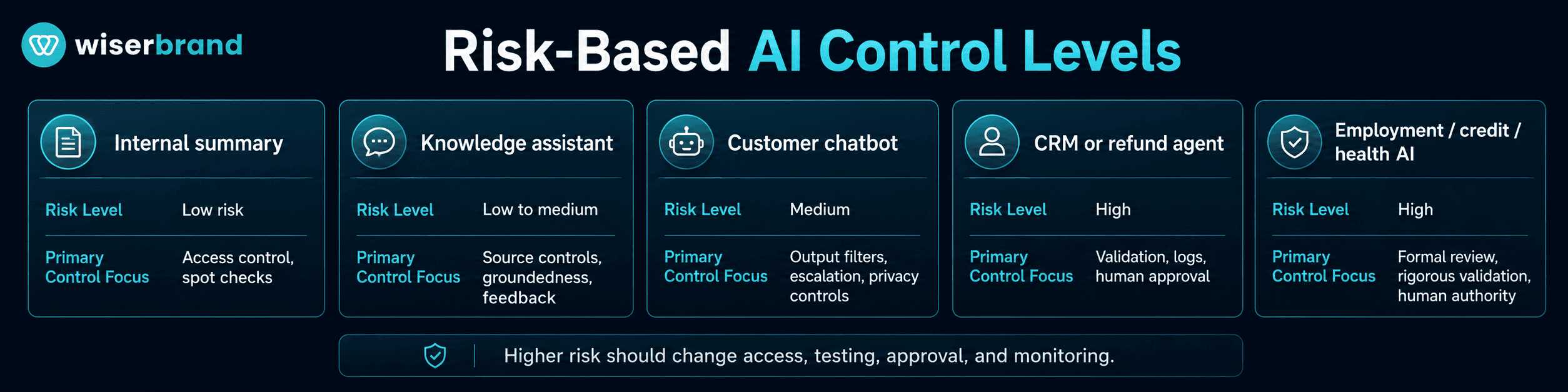
Use impact, autonomy, and reversibility to set the control level.
| Use Case | Typical Risk | Recommended Control Model |
|---|---|---|
| Internal meeting summary | Low | Approved data, access control, spot checks |
| Knowledge assistant with citations | Low to medium | Source controls, groundedness evaluation, feedback |
| Customer-facing chatbot | Medium | Output filters, escalation, privacy controls, monitoring |
| Agent that updates CRM records | Medium | Field-level permissions, logs, validation, rollback |
| Agent that issues refunds or credits | High | Deterministic limits, human approval, transaction audit |
| AI used in employment, credit, health, or safety decisions | High | Formal impact review, legal assessment, rigorous validation, human authority |
A higher risk tier should change more than the number of documents. It should affect architecture, data access, evaluation depth, approval, monitoring, and incident response.
Metrics and Protection Levels
AI risk metrics need an accepted range. Gartner uses the concept of protection-level agreements to connect outcome-driven metrics with agreed protection levels. Without a threshold, a metric provides observation but not a decision rule.
A practical scorecard can include:
| Control Objective | Example Metric | Example Decision Rule |
|---|---|---|
| Reliability | Task success rate | Pause expansion if success falls below the approved baseline |
| Groundedness | Unsupported claim rate | Route high-risk outputs to review above threshold |
| Fairness | Error-rate difference by relevant segment | Investigate when disparity exceeds the approved tolerance |
| Privacy | Confirmed sensitive-data leakage events | Disable affected workflow and start incident response |
| Security | Successful prompt injection rate in testing | Block release until critical paths pass |
| Agency | Unauthorized or out-of-scope tool calls | Stop execution and revoke the affected credential |
| Oversight | Human override rate | Review rules or model when overrides rise materially |
| Operations | Tool failure and retry rate | Open an engineering incident above threshold |
| Cost | Cost per completed task | Change model or workflow when cost exceeds business value |
| Adoption | Accepted outputs and repeat users | Reassess fit if the workflow creates rework or avoidance |
Thresholds should be based on the use case, baseline, legal obligations, and risk tolerance. A single unsupported statement may be tolerable in an internal brainstorming tool and unacceptable in a medical or legal output.
Implementation Blueprint
- Create an AI inventory. Record approved and discovered AI systems, including embedded vendor capabilities and employee tools.
- Assign business and technical owners. One person should own the outcome, and another should own operation and remediation.
- Classify use cases by impact. Consider affected people, data sensitivity, autonomy, reversibility, financial exposure, and legal context.
- Map the full system. Include data, models, prompts, retrieval, tools, vendors, human steps, and downstream actions.
- Separate model judgment from hard rules. Keep permissions, calculations, policy thresholds, and irreversible gates in deterministic controls where possible.
- Define release evidence. Specify the evaluations, security tests, documentation, and approvals required for the risk tier.
- Apply least-privilege access. Limit each model, agent, service, and user to the minimum data and actions required.
- Add runtime controls. Inspect inputs, outputs, retrieval, and tool calls when policy needs active enforcement.
- Set metrics and thresholds. Link every critical signal to an owner, response, and stopping rule.
- Prepare incident and rollback procedures. The team should be able to disable the system, revoke access, trace affected actions, and restore a safe state.
- Review changes as new releases. Model, prompt, vendor, data, and tool updates can change the risk profile.
- Retire unused AI. Remove credentials, integrations, retained data, and user access when the system no longer has an owner or purpose.
Start with one important workflow. As more systems enter production, a managed AI model can provide ongoing monitoring, evaluation, incident response, change control, and operational oversight across deployed AI applications.
Common Failure Modes
| Failure Mode | Why It Happens | Better Approach |
|---|---|---|
| Governance stays in a document | Policies are not connected to runtime systems | Translate critical rules into access, validation, approval, and monitoring controls |
| Every use case receives the same checklist | The program ignores impact and autonomy | Use risk tiers with different evidence and approval requirements |
| Teams monitor only model accuracy | Failures also occur in retrieval, tools, data, and workflows | Monitor the end-to-end application and business outcome |
| Critical rules live only in prompts | Prompts can be ignored, changed, or attacked | Put hard limits in code, policy engines, and permission systems |
| Vendor AI remains outside inventory | SaaS features enter without review | Include purchased, embedded, and employee-used AI |
| Alerts have no response owner | Monitoring detects issues but changes nothing | Attach an owner, threshold, runbook, and stopping rule |
| Human review is ceremonial | Reviewers lack evidence or authority | Show sources, proposed action, risk flags, and clear approval rights |
| Controls cannot be tested | The team cannot prove they work | Add repeatable evaluation, adversarial tests, and control validation |
| The system cannot be rolled back | Actions and versions are not traceable | Use versioning, logs, idempotency, and disable procedures |
The best program is not the one with the most controls. It is the one where important risks have controls that operators can test and use.
When the Framework Can Be Overbuilt
A small, low-risk pilot can become stuck if the organization demands the same evidence required for a high-impact production system. The answer is not to skip governance. It is to scale governance to the risk.
For a bounded internal experiment, the minimum may be:
- named owner;
- approved purpose;
- non-sensitive or controlled data;
- limited users;
- no autonomous external action;
- basic quality and security testing;
- usage logging;
- clear end date;
- manual review of outputs.
More controls should be added when the use case reaches customers, processes sensitive data, changes records, makes recommendations that affect people, or can initiate financial or operational actions.
The program should also test the decision not to use AI. NIST’s AI RMF Playbook notes that organizations should weigh AI risks against benefits and decide if AI is appropriate for the business problem. A deterministic workflow, conventional software, or a human process may be safer and less expensive.
FAQ
What Does AI TRiSM Stand For?
AI TRiSM stands for AI trust, risk, and security management. It covers the governance and technical capabilities used to keep AI systems trustworthy, monitored, secure, and aligned with policy throughout their lifecycle.
Who Developed the Framework?
Gartner developed and continues to update the concept. Current Gartner material describes it as a framework and technical capability set for continuous monitoring, validation, governance enforcement, trust, risk, security, and data protection.
How Does It Differ From AI Governance?
AI governance defines roles, policies, risk appetite, approval, and accountability. The framework adds the technical and operational capabilities that apply those decisions in production, including monitoring, access restrictions, evaluation, runtime inspection, and policy enforcement.
How Does It Relate to NIST AI RMF?
NIST AI RMF is a broad, voluntary risk-management framework organized around Govern, Map, Measure, and Manage. AI TRiSM focuses more directly on the technical capabilities and operating controls used to support trustworthy and secure AI deployments. Organizations can use the two together.
Which AI Systems Need These Controls?
Every production AI system needs some level of ownership, testing, access control, and monitoring. The control depth should rise with impact, data sensitivity, autonomy, and difficulty of reversing an action. Customer-facing, regulated, security-sensitive, and agentic systems usually need stronger controls.
Who Owns the Program?
Ownership is shared. Business leaders own purpose and acceptable risk. Product and engineering teams own design and operation. Security owns threat and access controls. Data teams own data quality and governance. Legal, privacy, compliance, and internal audit contribute based on the use case. One named executive or committee should own the overall program.
What Is the First Implementation Step?
Create an inventory of AI systems and assign owners. Then classify each system by impact, data, autonomy, and reversibility. This gives the organization enough visibility to prioritize deeper assessment and controls.
Final Thoughts
This framework turns AI governance from a policy exercise into an operating capability. The practical rule is to match control strength to the system’s impact, autonomy, data exposure, and reversibility.
Start by inventorying AI, assigning owners, and mapping one production workflow. Keep critical business rules outside the model, limit tool access, define release evidence, monitor the full application, and prepare a stopping path before expanding autonomy.
We help organizations connect AI strategy, system architecture, integration, MLOps, security, and governance across the production lifecycle. WiserBrand’s AI and machine learning services