AI Google Ads Management: What to Automate and What to Keep Human


AI Google Ads management can reduce repetitive account work, but it should not replace the decisions that define profitable advertising. Google AI can evaluate auction signals, adjust bids, expand matching, generate asset variations, flag anomalies, and summarize performance. It cannot decide which customers matter most, which conversions deserve value, how much margin the business can give up, or when a short-term performance gain conflicts with brand or growth strategy.
The practical question is no longer if automation belongs in the account. Google Ads already depends heavily on automated systems. The real decision is where automation has enough data and clear rules to act reliably, and where a marketer still needs to define the objective, review the evidence, and accept the business risk.
This guide explains which parts of paid search management are strong automation candidates, which decisions should stay human-owned, how native and third-party Google Ads AI tools fit together, and how to build a controlled operating model around them.
What AI Google Ads Management Actually Means
AI Google Ads management combines professional PPC management with machine learning, generative AI, automated rules, scripts, and connected tools that analyze or modify advertising activity. The work can range from a low-risk recommendation to an automatic budget or targeting change.
These systems do not all operate at the same level:
| Automation Level | What the System Does | Example |
|---|---|---|
| Assistance | Explains data or drafts an output | Summarizes why CPA changed |
| Recommendation | Proposes a change for review | Suggests negative keywords |
| Controlled execution | Applies a defined action within limits | Pauses an ad after a policy or performance rule |
| Platform optimization | Adjusts delivery continuously | Sets auction-time bids |
| Cross-system workflow | Uses data from several platforms | Imports qualified lead outcomes from a CRM |
The distinction matters because the control model should match the action. Drafting five headline options is different from changing a target ROAS across a large account. A system may be accurate enough to assist with both, but the cost of a wrong action is not the same.
The Core Rule: Automate Calculation, Keep Accountability Human
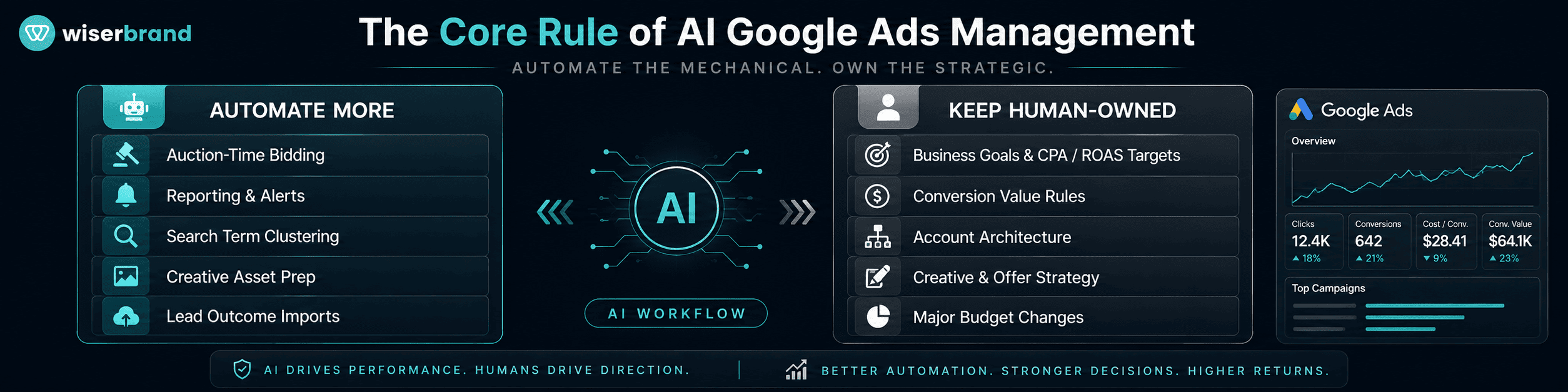
Google Ads AI is strongest when the platform has frequent feedback, structured objectives, and enough data to compare outcomes. Humans are strongest when the decision depends on business context that the ad platform cannot fully see.
Use this division as a starting point:
| Automate More | Keep Human-Owned |
|---|---|
| Auction-time bid adjustments | Revenue goals and acceptable acquisition cost |
| Recurring reports and alerts | Conversion definitions and value rules |
| Search term clustering | Account and campaign architecture |
| Draft asset variations | Brand positioning and offer strategy |
| Budget pacing alerts | Major budget reallocation |
| Lead outcome imports | CRM stage definitions and lead quality policy |
| Data checks and anomaly detection | Experiment hypotheses and interpretation |
| Reversible bulk updates | High-impact or hard-to-reverse changes |
The human role is not to make every micro-adjustment. It is to give the automated system a valid objective, clean feedback, useful constraints, and a review process.
What to Automate in Google Ads
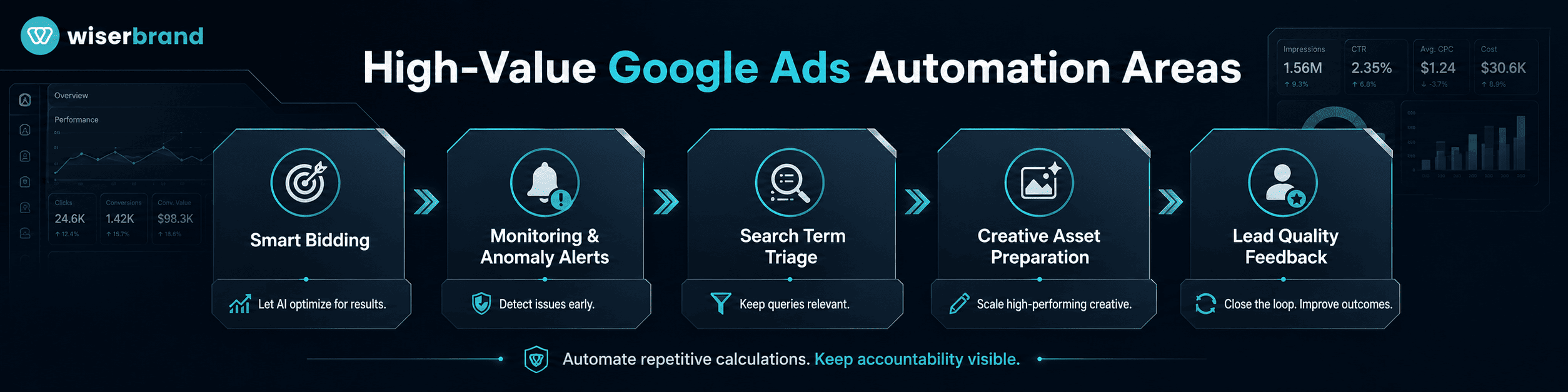
Auction-Time Bidding
Bidding is one of the clearest automation candidates. A person cannot manually evaluate every auction, device, query, location, time, audience signal, and predicted conversion probability.
Google Smart Bidding uses Google AI to optimize for conversions or conversion value at auction time. Current strategies include Maximize conversions, Target CPA, Maximize conversion value, and Target ROAS. Google began updating how some strategy labels appear in June 2026, but the underlying bidding behavior did not change. A separate change is scheduled for August 17, 2026. Google states that budget-limited campaigns using Target CPA or Target ROAS will deliver more closely to the target the advertiser entered, so an account that has been outperforming a target nobody revisited may see its actual CPA or ROAS move toward that number. Review stale targets before the date. Google's Bid Target Adjustment Tool, available from July 6, 2026, shows recent performance against the entered target.
Automation works best when the campaign is optimizing toward a useful signal. If every form submission counts equally, Smart Bidding may pursue cheap low-quality leads. If conversion values reflect margin, qualified pipeline, or closed revenue, the system receives a better objective.
Automate bid calculation. Keep these inputs human-owned:
- the primary conversion goal;
- the value assigned to each outcome;
- the acceptable CPA or ROAS range;
- the time horizon for evaluation;
- the response to seasonality, margin changes, or capacity limits.
Monitoring, Reporting, and Anomaly Detection
Routine reporting is a poor use of expert time. Data extraction, period comparisons, budget pacing, disapproval checks, missing conversion alerts, and performance change summaries can run automatically.
The output should answer a specific operational question:
- Which campaigns changed beyond the normal range?
- Is spend pacing above or below plan?
- Did conversion volume fall because traffic changed or tracking failed?
- Which campaigns are limited by budget?
- Which search terms or placements need review?
- Did performance change after a bid, asset, feed, or landing page update?
Google Ads scripts can programmatically query and manage account data, schedule recurring tasks, work across manager accounts, and connect to external APIs. They are useful for deterministic monitoring where the logic can be written clearly.
Generative AI can then summarize the findings. It should not invent the diagnosis. The data query, comparison window, threshold, and source records should remain visible.
Search Term and Negative Keyword Triage
AI tools for Google Ads can group search terms by intent, find repeated irrelevant patterns, and prepare negative keyword candidates. This is useful when an account produces thousands of queries that would take hours to review manually.
The safer pattern is triage, not blind exclusion:
- Export or query search terms.
- Classify them by intent and relevance.
- Flag high-cost or repeated irrelevant themes.
- Show the affected campaigns and conversions.
- Prepare exact, phrase, or account-level negative candidates.
- Send ambiguous cases to a marketer.
A human should review negatives that may block valuable long-tail demand, product research, branded variants, or early-funnel searches. The agent or script can find patterns. The marketer decides which traffic the business wants to buy.
Creative Variation and Asset Preparation
Google Ads AI tools can draft headlines, descriptions, image concepts, and combinations faster than a team can build every variation manually. This is valuable for ideation, localization support, character-limit checks, and adapting approved messaging to different campaigns.
AI Max for Search campaigns includes search term matching and asset optimization. Google describes it as an optimization layer within existing Search campaigns, not a separate campaign type. Its features can include text customization and final URL expansion, alongside controls for brands and locations.
Automation should prepare options from approved inputs:
- product facts;
- offer terms;
- landing page content;
- brand vocabulary;
- prohibited claims;
- required legal language;
- geographic limits.
A human should review final assets for accuracy, tone, policy exposure, and message-market fit. Generated copy may fit the format and still weaken the offer.
Budget Pacing and Routine Safeguards
Budget pacing can be automated because the calculation is repetitive. A script or third-party platform can compare spend against the monthly plan, account for elapsed days, detect sharp changes, and notify the owner.
Low-risk automated actions may include:
- pausing a campaign after a confirmed tracking failure;
- reducing exposure when a daily safety threshold is breached;
- labeling campaigns with unusual cost movement;
- alerting the team before a shared budget is exhausted;
- scheduling approved seasonal changes;
- reverting a temporary rule at a fixed time.
Large budget reallocations should stay human-approved. Spend can move because demand changed, conversion lag increased, a feed broke, a competitor entered the auction, or the business changed its target. The account data may show the effect without showing the full cause.
Conversion Data and Lead Quality Feedback
Bidding quality depends on conversion quality. For lead generation, a form submission is often only the beginning. The useful outcome may be a qualified lead, sales opportunity, booked appointment, approved application, or closed deal.
Through AI integration, the workflow can send qualified lead, opportunity, revenue, or margin outcomes from the CRM and other business systems back to Google Ads. In 2026, Google unified enhanced conversion settings and moved current and future offline lead uploads toward Data Manager-based workflows. Enhanced conversions use hashed first-party data to improve matching and measurement.
The technical sync can run automatically. Humans still need to define:
- which CRM stage represents real business value;
- how duplicate or reopened opportunities are handled;
- which revenue or margin value is sent;
- how long the sales cycle lasts;
- which consent and customer-data rules apply;
- how failed uploads are detected and retried.
This is one of the highest-value areas of AI Google Ads management because it improves the signal that every downstream optimization uses.
What to Keep Human
Human ownership should stay where the decision depends on commercial context, brand judgment, uncertain evidence, or a large downside.
| Decision Area | Why Human Judgment Matters |
|---|---|
| Business goals and conversions | The platform cannot decide which customer outcomes are profitable or strategically important |
| Account architecture | Campaign boundaries depend on margins, markets, inventory, teams, and control needs |
| Creative and offer strategy | More asset variations do not create a stronger reason to buy |
| Experiments | Test results need a hypothesis, business threshold, and interpretation |
| High-impact recommendations | Matching, bidding, budget, and goal changes can redirect spend quickly |
| Landing pages and post-click experience | Conversion rate must be judged alongside lead quality, margin, capacity, and customer experience |
The platform cannot decide what success means for the company. Consumer data intelligence can connect advertising activity with customer quality, purchasing behavior, retention, and revenue data, but marketers still need to define the commercial objective. A low CPA can still be unprofitable. A high ROAS can hide limited growth. More leads can create a larger sales backlog without producing more revenue. Marketing, sales, finance, and analytics should define the primary conversion goals, value rules, margin assumptions, payback period, and capacity limits.
Campaign structure also encodes business choices. AI can identify fragmentation or recommend consolidation, but a person should decide if campaigns need separate control because of different margins, geographies, sales teams, legal restrictions, stock levels, or brand strategy. Over-consolidation can remove useful control. Over-fragmentation can limit the data available to automated bidding.
Creative strategy needs the same separation. AI can produce headlines, descriptions, and images from approved inputs. Humans should define the customer problem, offer, proof, differentiation, brand voice, promotion rules, and claims. Generated assets may fit the format while weakening the message or creating policy exposure.
Google Ads experiments can compare proposed campaign changes against an original. Google recommends avoiding several simultaneous experiments when they may interfere with one another, because overlapping changes can make results less reliable. AI can prepare hypotheses and summaries, but a marketer should define the question, success metric, test window, commercial threshold, and response to conversion lag.
High-impact recommendations also need approval. Google Ads can apply selected recommendations automatically, and account owners can review active recommendation types and change history. Google notes that recommendation types change over time. Routine maintenance may be suitable for auto-apply. Changes to matching, conversion goals, bidding, final URL expansion, or large budgets deserve review.
Landing pages and offers sit outside the platform’s full context. Google Ads may show that one page converts more often, but a person still needs to assess lead quality, pricing, discount rules, delivery promises, sales capacity, legal requirements, and the experience after conversion.
Native Google AI vs Third-Party Google Ads AI Tools
Google’s native automation has the deepest access to auction and delivery signals. Third-party tools can add cross-account workflows, custom alerts, business data, independent reporting, and review layers.
| Tool Layer | Best Fit | Main Limitation |
|---|---|---|
| Smart Bidding | Auction-time bid optimization | Depends on conversion goals and data quality |
| AI Max for Search | Matching and asset optimization inside Search | Broader reach needs active query, URL, and brand review |
| Performance Max | Cross-channel campaign delivery | Requires careful goal, feed, asset, and channel analysis |
| Ask Advisor | Account questions, troubleshooting, and proposed changes | Beta availability and human validation still apply |
| Automated rules and scripts | Clear deterministic checks and actions | Logic must be maintained and tested |
| Third-party PPC platforms | Cross-account monitoring and workflow support | Vendor logic may not match your business model |
| General AI assistants | Summaries, drafts, analysis support | Data completeness, context, and output accuracy vary |
| Custom AI agents | Business-specific analysis across Ads, CRM, and finance data | Higher implementation and governance requirements |
Ask Advisor is a Gemini-based conversational experience in Google Ads that can analyze performance, help troubleshoot issues, and suggest changes. Google states that proposed changes are implemented with the advertiser’s approval, and the advertiser remains responsible for validating accepted suggestions.
The best stack is usually smaller than a typical tool list. Choose a tool because it owns a specific job, not because it adds another AI dashboard.
A Risk-Based Automation Matrix
Use impact and reversibility to decide the control level.
| Impact | Easy to Reverse | Hard to Reverse |
|---|---|---|
| Low | Automate and log | Automate with validation |
| Medium | Automate within thresholds | Require approval |
| High | Require approval and monitor | Keep human-owned |
Examples:
- A daily pacing alert is low impact and easy to reverse.
- A campaign label based on an anomaly rule is low impact.
- Adding a negative keyword is usually reversible, but it can block demand and deserves review.
- Changing a primary conversion goal can redirect bidding across the account and should have senior approval.
- Publishing unreviewed claims or changing a major budget can create financial or brand damage and should remain human-owned.
This matrix is more useful than dividing tasks into “AI” and “manual.” The same task may use different controls at different spend levels.
An Implementation Blueprint for Controlled AI Management
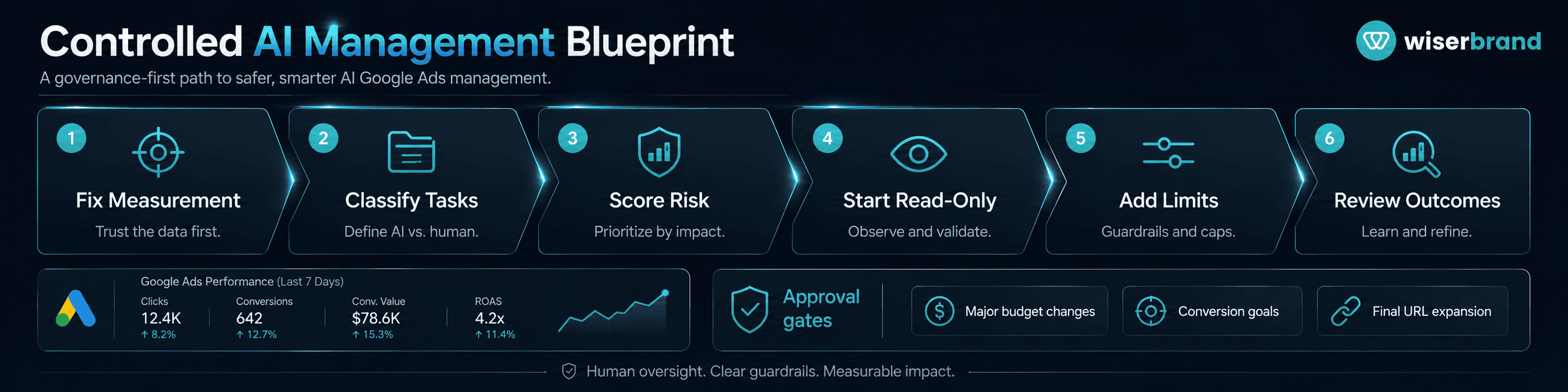
- Map the current workflow. A controlled AI Google Ads management program starts with recurring account tasks, owners, tools, decision points, and failure modes.
- Fix measurement first. Confirm conversion actions, values, attribution inputs, consent, CRM stages, and offline outcome imports.
- Classify each task. Mark it as assistance, recommendation, controlled execution, platform optimization, or cross-system automation.
- Score risk. Evaluate spend impact, customer impact, reversibility, data sensitivity, and time to detect an error.
- Start with read-only automation. Automate reporting, pacing, anomaly detection, query grouping, and draft recommendations before enabling writes.
- Add explicit limits. Define budgets, campaigns, fields, change sizes, schedules, and conditions that the system cannot exceed.
- Test one change at a time. Use experiments or a limited campaign set, and define the success metric before launch.
- Log every action. Record the input, rule or prompt version, proposed change, approver, execution time, and rollback path.
- Review business outcomes. Track lead quality, margin, qualified pipeline, or revenue, not only platform conversions.
- Expand only after stability. Add more accounts or actions after the workflow produces reliable results and the team can diagnose failures.
Teams that need connections across Google Ads, CRM, reporting, and internal approval systems may benefit from marketing automation consulting rather than another isolated advertising tool. WiserBrand’s marketing automation consulting and AI integration services cover that workflow and systems layer.
Governance and Change Control
AI management needs named ownership. The tool provider does not own the business result.
Assign responsibility for:
| Area | Owner |
|---|---|
| Commercial targets | Marketing or revenue leader |
| Conversion taxonomy | Marketing, sales, and analytics |
| Campaign architecture | PPC lead |
| Tracking implementation | Analytics or engineering |
| Creative approval | Brand or marketing owner |
| Automated rules and scripts | Technical owner |
| Data permissions | Security and system owner |
| Incident response | PPC lead plus technical support |
| Monthly review | Business and channel owners |
Every automated write action should have a change history and rollback plan. Alerts need a recipient and response expectation. Scripts and custom agents need version control, test accounts, error notifications, and scoped credentials.
Avoid giving a general AI assistant unrestricted write access to the full account. Read-only access and prepared bulk changes are safer starting points.
What Not to Automate Yet
Do not automate a task only because it is time-consuming. Keep it manual or assisted when:
- the conversion signal is unreliable;
- the business goal changes every week;
- there is no clear owner;
- the account lacks enough data for meaningful evaluation;
- the action can create large spend quickly;
- brand or policy interpretation is central;
- the system cannot explain which data produced the recommendation;
- there is no rollback path;
- the team cannot monitor failures;
- a deterministic rule would solve the task more safely than AI.
Some teams need better tracking, naming, feeds, landing pages, or sales feedback before they need more automation. AI cannot repair an account that is optimizing toward the wrong outcome.
How to Measure AI Google Ads Management
Measure the operating model, not the amount of automation.
| Metric | What It Shows |
|---|---|
| Qualified conversion rate | If optimization attracts valuable outcomes |
| Cost per qualified lead or sale | Commercial efficiency beyond raw form fills |
| Conversion value or margin per ad dollar | Quality of value-based optimization |
| Search term waste rate | Share of spend on irrelevant demand |
| Budget pacing variance | Control of spend against plan |
| Change acceptance rate | Usefulness of AI recommendations |
| Human override rate | Where automated judgment remains weak |
| Tracking failure detection time | Monitoring quality |
| Automation error rate | Reliability of scripts, rules, or agents |
| Time spent on recurring account work | Operational capacity gained |
| Experiment adoption rate | How often tested improvements reach production |
| Revenue or pipeline influenced | Connection between ad activity and business outcomes |
A successful setup does not remove human work completely. It shifts time from repetitive account maintenance toward measurement, creative strategy, offer design, experimentation, and cross-functional decisions.
FAQ
What Is AI Google Ads Management?
AI Google Ads management uses Google’s machine learning, generative AI, scripts, automated rules, or third-party systems to analyze and manage advertising tasks. It may support bidding, search term review, creative drafting, reporting, monitoring, and conversion data workflows. The level of autonomy should match the financial and brand risk of each action.
Which Google Ads Tasks Are Safest to Automate?
Reporting, alerts, budget pacing checks, account labeling, data validation, search term grouping, and draft recommendations are strong starting points. They save time without immediately changing campaign delivery. Bid calculation is also well suited to platform automation when conversion goals and values reflect real business outcomes.
Which Google Ads Decisions Should Stay Human?
Humans should own commercial goals, conversion definitions, campaign structure, creative strategy, offer decisions, major budget changes, experiment interpretation, and high-impact recommendations. These decisions depend on margin, inventory, sales capacity, brand, customer quality, and business priorities that Google Ads may not fully see.
Are Third-Party AI Tools for Google Ads Necessary?
Not always. Native Google automation already covers bidding, matching, asset generation, recommendations, and cross-channel delivery. Third-party tools are useful when a team needs custom monitoring, account-level workflows, CRM context, independent reporting, or agency-wide operations. Add a tool only when it solves a defined job.
Can AI Manage Google Ads Without a PPC Specialist?
AI can handle many calculations and routine checks, but it still needs human ownership of objectives, data quality, controls, creative direction, and exceptions. Smaller accounts may operate with less daily intervention. Complex or high-spend accounts still need a qualified person to evaluate business impact and risk.
How Should a Team Evaluate Google Ads AI Tools?
Start with the task. Check data access, write permissions, explainability, approval controls, change logs, rollback, account coverage, pricing, security, and measurable time saved. Test the tool in read-only mode or on a limited campaign set before giving it broader authority.
What Is the Best First Step?
Audit conversion tracking and lead or revenue feedback before adding more AI. Automation learns from the goals and values supplied to it. Once measurement is credible, automate reporting, anomaly detection, pacing, and recommendation preparation before enabling higher-impact changes.
Final Thoughts
AI Google Ads management works best as a controlled partnership between platform automation and human judgment. A mature AI Google Ads management model automates frequent calculations while keeping commercial accountability visible. Let Google AI calculate bids and process auction signals. Use scripts and AI tools for Google Ads to monitor accounts, organize data, prepare assets, and surface decisions. Keep people responsible for the objective, the customer, the offer, and the risk.
The strongest operating model has clean conversion data, narrow permissions, review thresholds, experiments, action logs, and metrics tied to qualified revenue rather than platform activity alone.
If your account needs both day-to-day PPC expertise and a stronger automation layer, we can help connect paid search management, measurement, CRM data, reporting, and controlled AI workflows. Our PPC management and AI integration work can support the full path from audit to implementation.