How to Prepare Your Product Catalog for AI Shopping


AI shopping is changing how people find products online. Shoppers can ask for “a non-slip yoga mat for hot yoga under $80,” and an AI shopping agent can compare options across price, features, reviews, availability, and seller trust.
That makes the product catalog more important than a list of SKUs. If product data is incomplete, inconsistent, or too generic, AI systems may skip a relevant item because they cannot understand when to recommend it.
Preparing your catalog for AI shopping means giving AI agents clear, structured, and useful product information they can match to real buyer intent.
What AI Shopping Means for eCommerce Brands
AI shopping changes product discovery from search results to guided recommendations. A shopper no longer has to know the exact product name, category, or filter path. They can describe what they need in plain language, and an AI shopping agent can narrow the options for them.
This matters because AI in eCommerce reads catalogs differently than a classic site search bar. It may compare products by use case, price range, size, material, reviews, delivery options, and return terms. It may also factor in the shopper’s previous questions, preferences, and buying context.
For brands, this creates a new visibility challenge. A product page can rank well in traditional search but still perform poorly in AI powered shopping if the product data is thin or unclear. The AI system needs enough detail to understand what the product is, who it fits, when it should be recommended, and how it compares to similar options.
AI in online shopping rewards catalogs that are easy to interpret. Clear attributes, accurate feeds, helpful descriptions, strong reviews, and consistent product data all help AI shopping agents make better recommendations.
AI Shopping Optimization Factors
AI systems need more than product names and short descriptions. They need structured, consistent, and context-rich data that explains what the product is, who it is for, how it compares, and when it should be recommended.
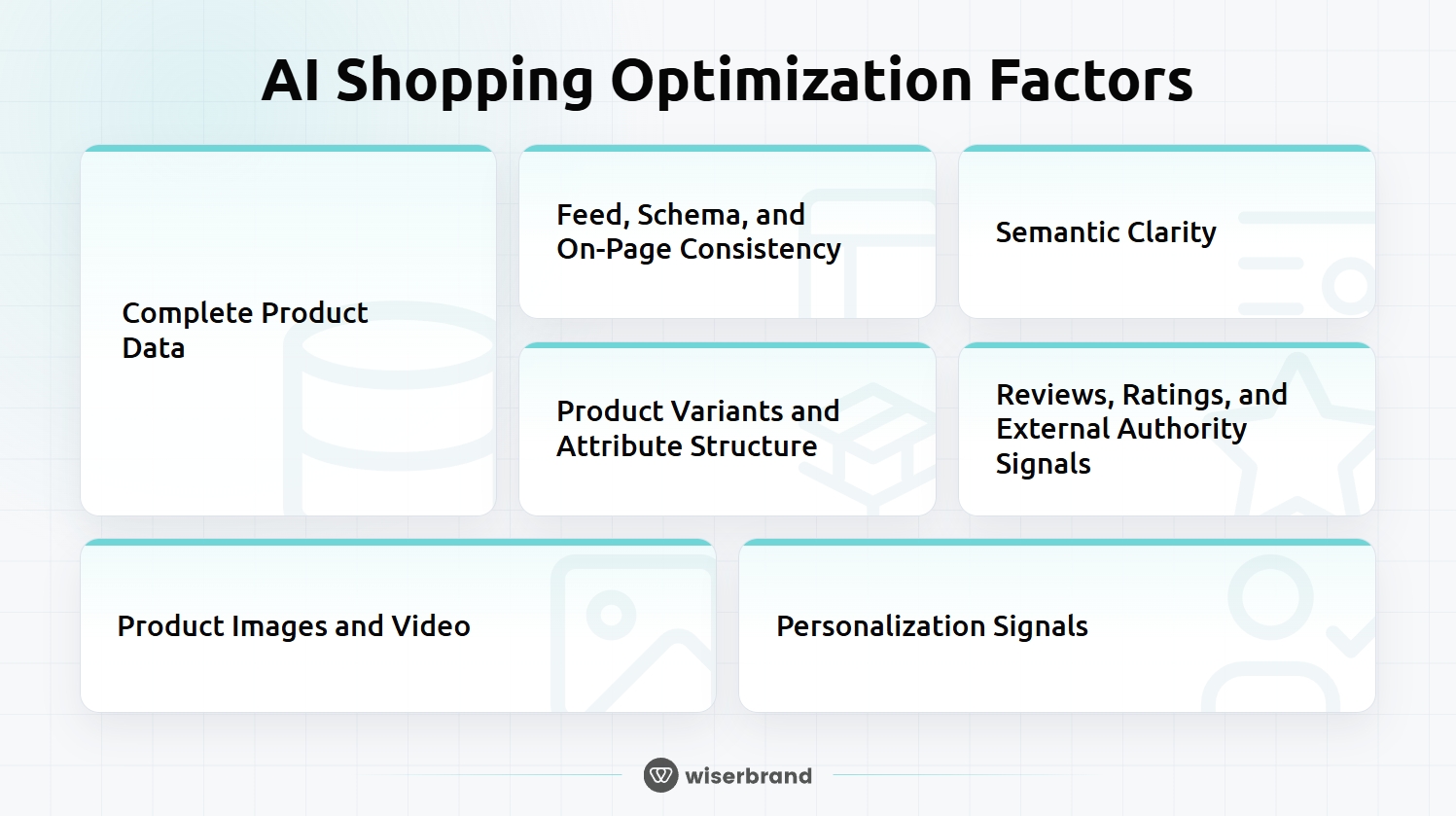
1. Complete Product Data
Complete product data gives AI shopping agents the basic facts they need to match products with shopper intent. Missing details can make a product look less relevant, even when it fits the request.
Core product data should include:
- Product title
- Brand
- SKU, GTIN, MPN, or other product identifiers
- Category and subcategory
- Price and availability
- Color, size, material, and dimensions
- Product variants
- Compatibility details
- Shipping, returns, and warranty information
Product data should also answer practical buying questions. A shopper may ask for a sofa that fits through a narrow doorway, a laptop stand compatible with a specific device, or a jacket suitable for rainy weather. If the catalog does not include those details, the product may be left out of AI recommendations.
2. Feed, Schema, and On-Page Consistency
AI shopping optimization depends on how product data is delivered. Product feeds, structured data, and product pages should tell the same story.
If the feed says a product is in stock, the page says it is unavailable, and the schema shows an old price, the system has to decide which source to trust. That can hurt visibility and create poor shopping experiences.
Key data sources should stay aligned:
- Merchant Center feeds
- Product structured data
- OpenAI product feeds
- Product detail pages
- Pricing and promotion data
This is where many eCommerce teams lose quality at scale. Product pages may be updated manually, feeds may come from a PIM or ERP, and schema may be generated by a plugin or custom code. AI shopping agents read these signals together, so mismatches can create confusion.
3. Semantic Clarity
AI shopping agents need clear product meaning, not keyword repetition. They need to understand the product type, use case, audience, benefits, limits, and buying context.
A title like “Premium Yoga Mat” gives little direction. A clearer version would be: “Non-Slip Yoga Mat for Hot Yoga, High-Sweat Workouts, and Joint Support.” This gives the AI system more context and helps it match the product to a specific need.
Strong product content should explain:
- What the product is
- Who it is for
- What problem it solves
- What makes it different
- What it works with
- What it may not be ideal for
This matters because shoppers often ask in natural language. They may search for “a rug that works with pets,” “a standing desk for a small home office,” or “a moisturizer for dry winter skin.” Catalog content should help AI systems connect those requests to the right products.
4. Product Variants and Attribute Structure
Product variants can create confusion when they are not organized well. AI shopping agents need to understand the relationship between the main product and its options.
A parent product may have several child variants based on size, color, material, scent, flavor, quantity, or compatibility. If those variants are unclear, an AI system may recommend the wrong option or skip the product.
Common variant issues include:
- Size or color listed only in the title
- Variant pages competing with each other
- Bundles mixed with single products
- Multipacks missing unit details
- Compatibility details stored in images instead of attributes
5. Reviews, Ratings, and External Authority Signals
AI shopping agents do not rely only on the product page. They may look at reviews, marketplace listings, brand mentions, comparison articles, forums, and other third-party sources to judge trust and relevance.
Product reviews are especially useful when they include details about real use. “Good quality” is less helpful than “fits a small apartment,” “comfortable for long workdays,” or “held up after six months of daily use.”
External signals help AI systems understand how people describe the product outside the brand’s own website. They also help answer trust-based questions, such as “Is this brand reliable?” or “Which product is better for daily use?”
6. Product Images and Video
AI shopping is increasingly visual. This matters for fashion, furniture, beauty, jewelry, home decor, and other categories where the shopper needs to judge style, scale, texture, color, or fit.
Strong visual content helps AI systems and shoppers understand the product faster. A single studio photo may not be enough when the buyer wants to compare size, materials, or real-life use.
Useful visual assets include:
- High-quality product photos
- Multiple angles
- Close-ups of texture, finish, and details
- Lifestyle images that show scale and use
- Variant-specific images
- Short product videos
- Clear alt text that describes the product accurately
For example, a furniture product page should show the item from different angles, include room context, and make dimensions easy to understand. A jewelry page should show close-up detail, scale on the body, and material information. These details help AI shopping agents connect visual content with buyer intent.
7. Personalization Signals
AI search is often more personalized than traditional eCommerce search. A shopper may ask follow-up questions, compare options, mention a budget, describe a lifestyle, or share a specific use case. The AI system can use that context to refine recommendations.
Product catalogs should support this behavior with attributes that go beyond basic product facts. A product may need to be understood by budget level, audience, occasion, climate, room type, activity, style, or life stage.
Examples of useful personalization signals include:
- Budget range
- Use case
- Skill level
- Style preference
- Occasion
- Climate or season
- Room type
- Age group or audience
- Lifestyle fit
A shopper looking for “a low-maintenance sofa for a home with pets” needs different product signals than someone looking for “a formal living room sofa in velvet.” Both may search in the same category, but the recommendation logic is different.
Personalization works best when product data is specific. AI shopping agents need enough context to match products to the way people describe their needs.
How To Optimize Your Product Catalog for AI Shopping Agents
AI shopping optimization starts with product data, but it should not stop there. The catalog needs a clear structure, consistent delivery, useful content, and proof that supports the recommendation.
1. Audit Your Current Product Data
Start by finding the gaps that make products harder to understand. This includes missing attributes, duplicate titles, thin descriptions, unclear categories, broken variant logic, schema gaps, feed errors, and outdated pricing or availability.
A practical audit should answer a few direct questions:
- Can each product be understood without looking at the image?
- Are important attributes missing from high-value categories?
- Do product titles describe the product clearly?
- Do variants have their own correct data?
- Do feed, schema, and PDP content match?
The audit should also separate catalog-wide issues from category-specific issues. Apparel, furniture, jewelry, beauty, automotive parts, and electronics all need different attribute depth. A single generic checklist will miss details that matter for AI product matching.
2. Create an AI-Ready Attribute Map
An AI-ready attribute map defines what product details matter by category. It gives teams a clear standard for product enrichment, feed cleanup, and PDP content.
For apparel, important attributes may include size, fit, material, color, care, season, occasion, and style. For furniture, the map should cover dimensions, material, room type, style, assembly, shipping, weight capacity, and care. For automotive parts, compatibility, model year, part type, placement, fitment, and installation details become critical.
This map helps prevent random enrichment. Teams know which fields are required, which are optional, and which ones should be written into product descriptions for shoppers.
3. Rewrite Product Content Around Buyer Intent
Many product descriptions describe the item but do not help the buyer decide. AI shopping agents need content that connects the product to real shopping questions.
Instead of writing only about features, add details that explain use cases, comparison points, compatibility, limits, and buying context.
For example, a weak description might say:
“This desk is modern, durable, and perfect for any room.”
A stronger version would explain:
“This compact writing desk fits small bedrooms, apartments, and home offices. The narrow frame works for laptops, notebooks, and basic work setups, but it is not built for multiple monitors or heavy desktop equipment.”
That second version gives the AI system more useful signals. It also helps the shopper make a faster decision.
4. Align Product Feeds, Structured Data, and Landing Pages
Product data should stay consistent across every place an AI shopping system may read it. That includes the product feed, structured data, visible PDP content, inventory source, and pricing system.
This matters because AI systems compare signals. If the product feed says one thing and the product page says another, the product becomes harder to trust.
Check for mismatches in:
- Product name
- Price
- Sale price
- Availability
- Brand
- Product identifiers
- Variant details
Structured data should reflect what customers can see on the page. If schema includes a price, rating, or availability status, that same information should be visible to the shopper. Product data should also be present in the HTML returned by the server, not added only after JavaScript loads.
The same rule applies to feeds. A Merchant Center feed, OpenAI product feed, or marketplace feed should not become a separate version of the catalog. It should be a reliable distribution layer for the same product truth.
5. Strengthen Reviews and Third-Party Proof
AI shopping agents need trust signals before they recommend a product. Product reviews, seller reputation, expert mentions, and external citations help support that recommendation.
Start with product reviews. Generic feedback does not add much value. Detailed reviews help AI systems understand how the product performs in real situations.
For example, “great sofa” is weak. “Comfortable for daily use, firm seat, fits a small apartment, and the fabric handled pet hair better than expected” gives more useful context.
Third-party proof also matters. Marketplace listings, buying guides, comparison articles, Reddit discussions, YouTube reviews, and niche publications can all help AI systems understand how people talk about the product outside your own website.
For stronger AI shopping visibility, build proof around priority categories first. Focus on products with good margins, strong demand, and enough inventory to support growth.
Timeline Expectations
AI shopping optimization is not a one-time content update. The timeline depends on catalog size, data quality, number of categories, feed complexity, and how much work needs to happen inside the PIM, CMS, ERP, or custom admin panel.
| Stage | Timeline | What Happens |
|---|---|---|
| Catalog audit | 1–2 weeks | Identify missing data, feed issues, schema gaps, thin PDPs, and priority categories. |
| Data model and attribute mapping | 2–4 weeks | Define required attributes by category and fix taxonomy, variants, and product relationships. |
| Product data enrichment | 4–8 weeks | Improve descriptions, attributes, images, reviews, schema, and feed consistency. |
| AI visibility tracking | Ongoing | Monitor AI shopping prompts, product appearances, feed health, and traffic quality. |
Where eCommerce Teams Usually Need Technical Support
Most catalog teams can improve product titles, descriptions, and attributes. The harder work starts when product data lives across several systems.
An AI-ready catalog often needs technical support with:
- Feed automation
- Product data cleanup
- Schema implementation
- Catalog enrichment at scale
- AI-powered product tagging
- Image classification
- Variant and taxonomy fixes
- Reporting dashboards
This is where AI in eCommerce becomes operational work. A strong AI product catalog needs clean data flows, not only better copy. Product feeds, structured data, PDP content, and inventory systems should stay connected so AI shopping agents receive the same product facts from every source.
Gen AI optimization for shopping can also reduce manual catalog work. AI can help classify images, tag products by use case, detect missing attributes, group similar products, and flag inconsistent descriptions. Human review still matters, especially for high-value categories, regulated products, and brand-sensitive content.
For larger catalogs, the goal is to build a repeatable system. New products should enter the catalog with the right attributes, clean variant logic, useful descriptions, accurate schema, and feed-ready data from the start.
AI Product Catalog FAQ
An AI product catalog is a product database structured so AI systems can understand, compare, and recommend products based on shopper intent. It includes product facts, attributes, variants, images, reviews, schema, and feed data in a consistent format.
Traditional eCommerce search often depends on keywords, filters, and category navigation. AI shopping agents interpret natural-language requests and compare products based on attributes, reviews, price, availability, seller trust, and shopper context.
The most important data includes product titles, descriptions, categories, attributes, variants, price, availability, shipping, returns, images, reviews, and structured data. Category-specific details matter too, such as dimensions for furniture, fit for apparel, or compatibility for automotive parts.
In many cases, yes. The feed needs to be complete, accurate, and aligned with the product page. Missing attributes, outdated stock status, unclear variants, or conflicting prices can reduce product visibility.
A basic audit can take 1–2 weeks. Larger catalog cleanup and enrichment projects usually take several weeks or months, depending on catalog size, data quality, category complexity, and the systems involved.