AI for Insurance Agents: Practical Tools and Workflows That Save Time

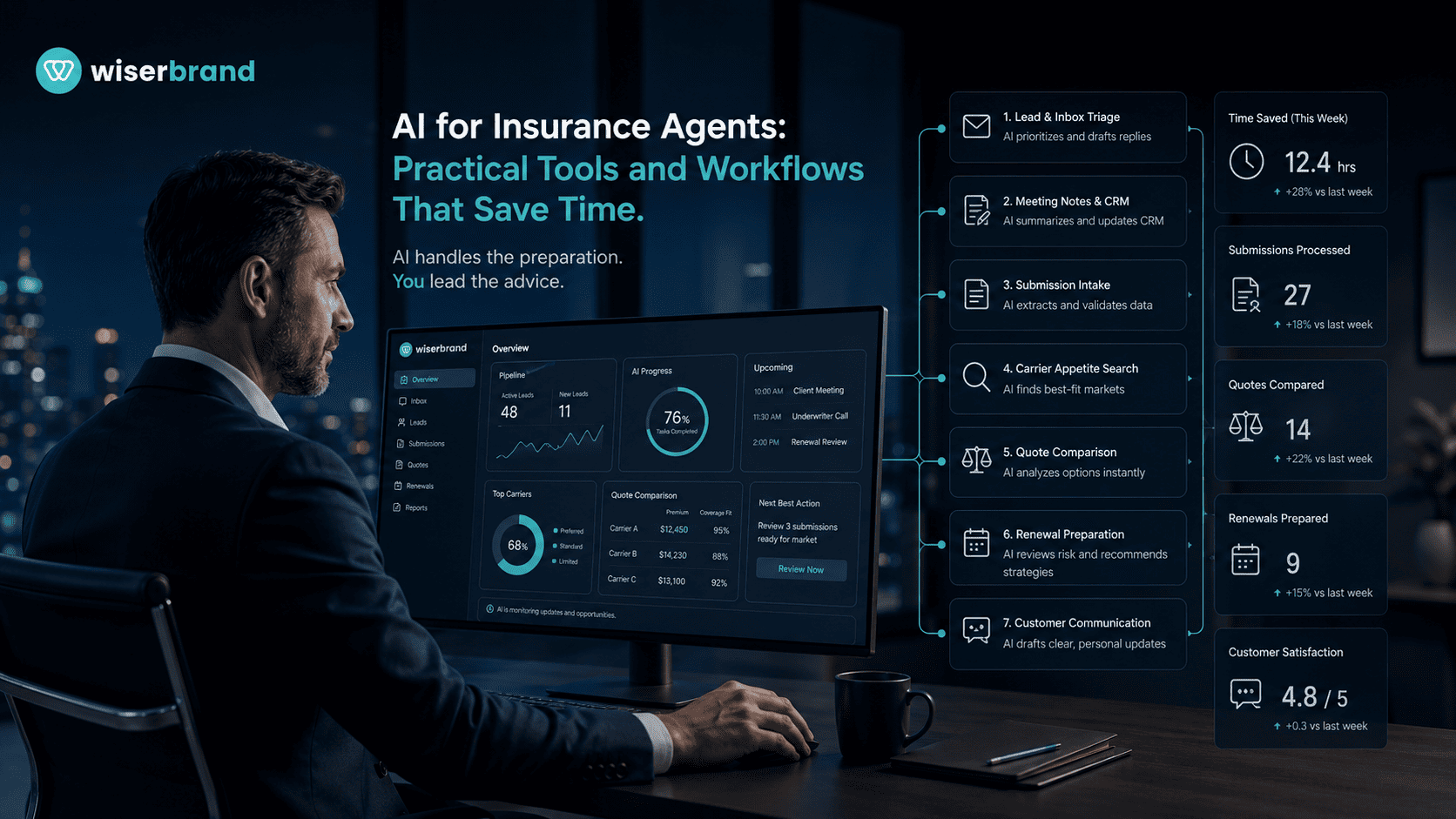
AI for insurance agents is most useful when it removes administrative work around selling, servicing, and renewing policies while the licensed professional remains responsible for advice, client relationships, and consequential decisions. The technology can organize inboxes, summarize calls, update CRM records, extract submission data, search carrier guidelines, prepare quote comparisons, and flag renewal tasks.
The phrase can be confusing because an insurance agent is a person, while an AI agent is a software system that can pursue a goal and use connected tools. This article focuses on AI used by human insurance agents, brokers, producers, account managers, and agency service teams.
The practical goal is not maximum autonomy. It is faster preparation, fewer repeated entries, better follow-up, and clearer handoffs. This guide explains which tools fit common agency workflows, what should stay human-owned, how the systems connect, and how to measure time saved without creating new compliance or customer risks.
What AI for Insurance Agents Means
AI for insurance agents covers software that interprets information, prepares work, or performs bounded actions inside agency workflows. It may be built into a CRM, agency management system, email platform, meeting tool, document processor, knowledge base, or custom workflow.
The category includes several different technologies:
| Tool Type | What It Does | Agency Example |
|---|---|---|
| Generative AI copilot | Searches, summarizes, drafts, or explains | Drafts a follow-up email from approved notes |
| Document AI | Extracts fields from forms and attachments | Reads an application, schedule, or loss run |
| Predictive model | Estimates a defined probability or score | Flags accounts with elevated nonrenewal risk |
| Workflow automation | Moves records through rules and approvals | Creates a renewal task when a policy enters the review window |
| RPA | Repeats actions in a legacy interface | Copies approved data into a portal without an API |
| AI agent | Selects steps and uses tools within defined limits | Collects missing submission data and prepares the package for review |
These tools do not carry an insurance license or professional accountability. In the United States, producer licensing remains state-based, and NIPR provides electronic licensing and compliance services plus centralized producer credential information. An agency can automate reminders and verification, but the licensed person and business entity still need to meet applicable requirements.
Where AI Saves Time Without Replacing Agent Judgment
The best automation candidates are frequent, information-heavy, and easy to verify. The weakest candidates require advice, negotiation, interpretation of ambiguous coverage, or authority that the system does not have.
| Work Category | AI Can Prepare or Perform | Human Remains Responsible For |
|---|---|---|
| Prospect intake | Classify the request, extract details, create a CRM record | Deciding fit, priority, and next conversation |
| Client meetings | Transcribe, summarize, and prepare tasks | Confirming accuracy and relationship context |
| Submissions | Extract fields, check completeness, assemble documents | Confirming representations and submitting the final package |
| Carrier research | Search approved appetite and underwriting sources | Interpreting fit and discussing uncertain cases |
| Quotes | Normalize terms and create a comparison draft | Advice, tradeoffs, disclosures, and recommendation |
| Renewals | Build the review pack and flag changes | Retention strategy, negotiation, and client discussion |
| Service requests | Classify, draft, and route routine work | Coverage-sensitive or unusual requests |
| Claims support | Collect first-notice information and route the case | Coverage statements, advocacy, and disputed issues |
| Compliance administration | Track licenses, appointments, consent, and review dates | Legal interpretation and final compliance decisions |
AI should shorten preparation time. It should not hide the evidence or make the agent approve a result they cannot inspect.
Practical Tools and Workflows
Lead and Inbox Triage
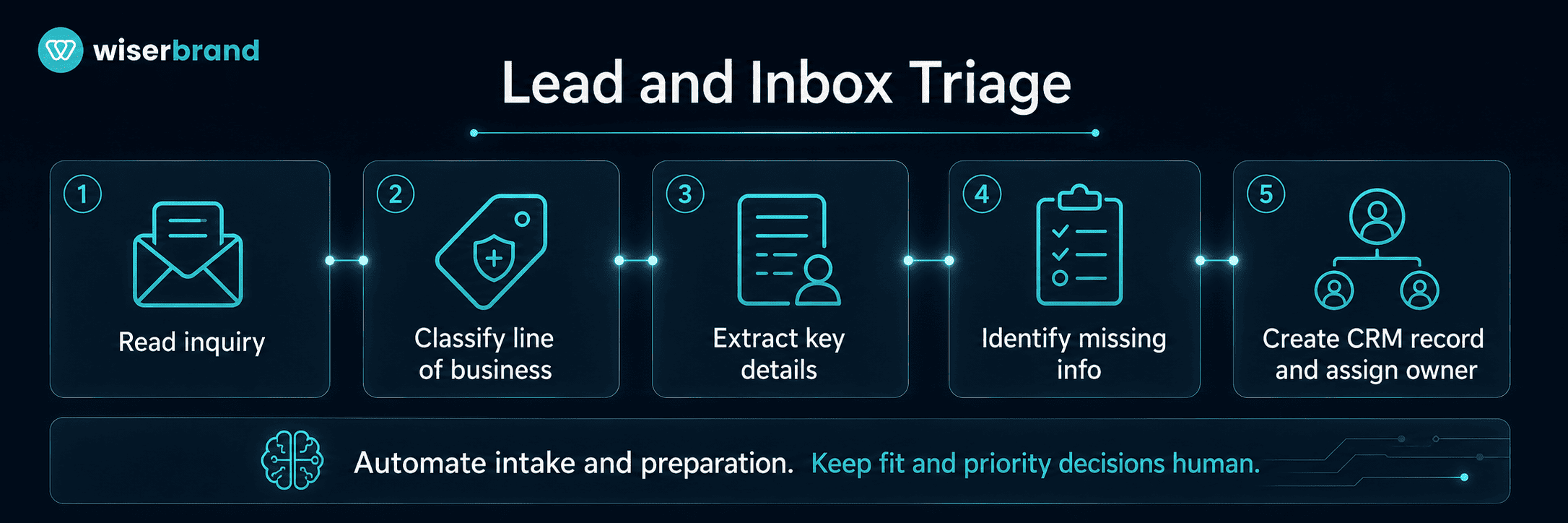
Insurance agencies receive inquiries through website forms, email, referral partners, call notes, and carrier portals. Staff often read each message, identify the line of business, collect contact details, find the renewal date, and decide who should respond.
A practical AI for insurance agents workflow can start with intake:
- Read the message and attachments.
- Classify personal, commercial, life, health, benefits, or another supported line.
- Extract the named insured, location, requested coverage, renewal date, and contact information.
- Identify missing information.
- Create or update the CRM record.
- Assign the lead according to territory, expertise, or workload.
- Draft an acknowledgment for review.
The workflow should not reject a prospect solely from a generated summary. A rules layer can apply clear geographic, product, or appointment constraints. An agent should review ambiguous fit, sensitive information, and high-value opportunities.
Meeting Notes and CRM Updates
Producers and account managers spend time turning calls into notes, tasks, renewal reminders, and follow-up messages. Meeting tools can transcribe a conversation, identify decisions, and draft structured CRM updates.
A controlled workflow should separate suggestions from committed records. The AI prepares:
- a concise summary;
- client goals and concerns;
- promised follow-ups;
- requested documents;
- policy or exposure changes mentioned;
- tasks with proposed owners and dates;
- a follow-up email.
The agent reviews the summary before it enters the system of record. This step matters because transcription can confuse names, limits, dates, and insurance terms. The system should preserve the original transcript, the edited summary, and the person who approved it.
Submission Intake and Document Extraction
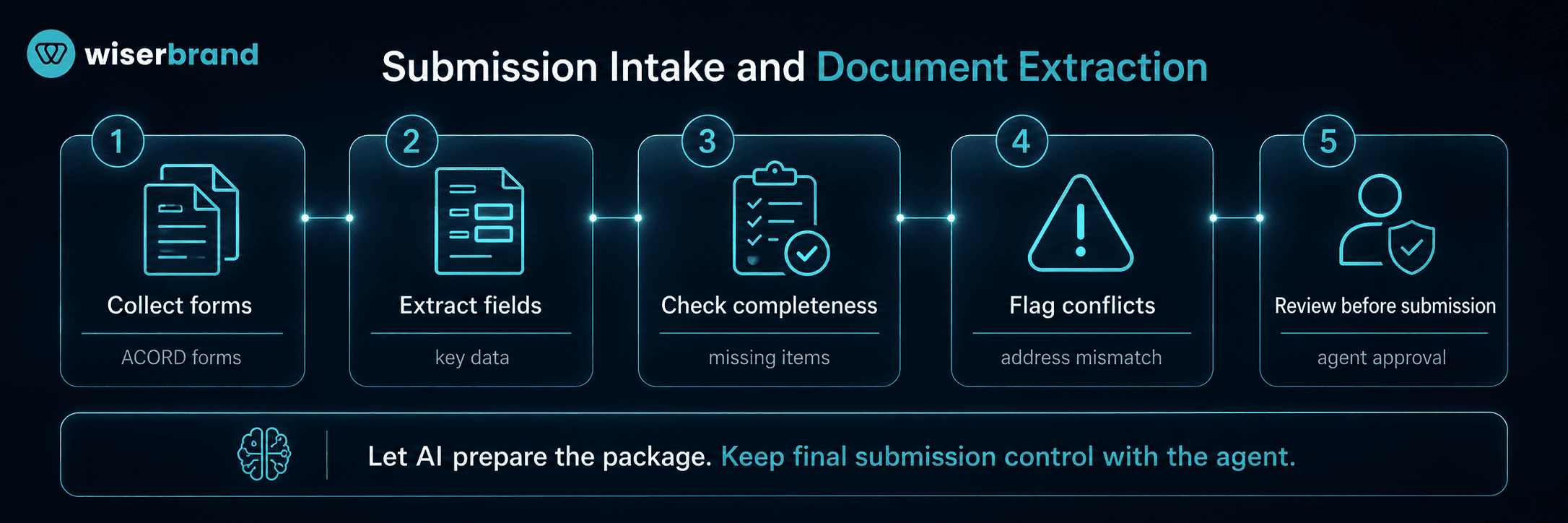
Commercial submissions may include ACORD forms, loss runs, property schedules, vehicle lists, payroll records, questionnaires, and prior policy documents. Data is often copied into an agency management system and then entered again into carrier portals. Fintech software development can connect these systems through APIs, document-processing workflows, validation services, and controlled data exchange.
Document AI can extract structured fields and compare them with existing account records. A useful workflow can flag:
- missing signatures or dates;
- inconsistent addresses;
- duplicate vehicles or locations;
- conflicts between the application and prior policy;
- incomplete loss history;
- unsupported file types;
- low-confidence extracted values.
ACORD maintains data standards used across policy, accounting, claims, and distribution workflows. Its P&C standards include formats used to exchange policy and commission information between insurer and agency systems. Using shared data definitions can reduce mapping ambiguity, but every integration still needs field validation and ownership.
The agent or account manager should confirm the final data. The model should leave an uncertain value blank rather than infer a fact about a client’s operations, property, drivers, employees, or prior losses.
Carrier Appetite and Knowledge Search
Finding the right market can require reading underwriting guides, appetite summaries, bulletins, product manuals, emails, and portal content. A retrieval-based assistant can search an approved carrier knowledge set and return the relevant passage with its source and effective date.
The assistant may answer questions such as:
- Which carriers consider this class and state?
- Which submissions need a supplemental application?
- What limits or exposures trigger referral?
- Which documents does the carrier request?
- Has the carrier changed its appetite since the prior renewal?
- Who is the current underwriting contact for this program?
This is a knowledge-retrieval workflow, not an underwriting decision. The assistant should not say that a risk will be accepted or quote a binding condition unless the carrier has confirmed it. Carrier appetite changes, underwriter discretion, and incomplete risk data make a human check necessary.
Quote Comparison and Proposal Preparation
Quote comparison is one of the most useful applications of AI for insurance agents because the work requires both extraction and explanation. Quotes may use different wording, limits, deductibles, endorsements, exclusions, fees, and payment terms.
A comparison tool can normalize the received documents into a review table:
| Comparison Area | Extracted Details |
|---|---|
| Carrier and product | Named carrier, program, policy form |
| Premium and fees | Base premium, taxes, fees, installment terms |
| Limits | Per-occurrence, aggregate, sublimits |
| Deductibles | Amount and basis |
| Covered locations or assets | Included and excluded items |
| Endorsements | Added, removed, or changed forms |
| Exclusions | Material restrictions identified for review |
| Conditions | Inspections, subjectivities, documents, deadlines |
Generative AI can draft a plain-language proposal from the reviewed table. The licensed agent should verify every material term, explain tradeoffs, follow applicable disclosure and suitability requirements, and avoid reducing the discussion to price alone.
Renewal Preparation and Book Review
Renewals become difficult when exposure changes, claims, carrier notices, billing issues, missing documents, and client conversations sit in different systems. AI can assemble a renewal brief before the producer or account manager starts the review.
The brief may include:
- expiring policy terms;
- prior and current premium;
- open claims or loss information available to the agency;
- changes recorded during the year;
- unresolved service requests;
- missing applications or schedules;
- carrier appetite or documentation changes;
- account profitability and service workload, where appropriate;
- proposed client and carrier follow-ups.
Business process automation can trigger renewal workflows based on policy dates and agency service standards, create tasks, route exceptions, and track completion across the team. AI summarizes the account and identifies possible gaps. The agent decides the renewal strategy, market approach, and client conversation.
Book-level analysis can also group accounts by upcoming workload, missing data, carrier concentration, or potential service risk. Do not use an opaque score as the sole basis for deprioritizing a client.
Policy Service and Customer Communication
Routine service work includes address changes, vehicle changes, certificates, billing questions, document requests, named-insured updates, and coverage questions. AI can classify the request, retrieve account context, draft a response, and create a task in the correct queue.
The system needs clear status language. A draft request is not an endorsed policy change. A certificate request is not proof that the requested wording is authorized. A message sent to a carrier is not confirmation that coverage changed.
Use deterministic services and carrier confirmations for actual policy updates. Route requests involving coverage interpretation, additional-insured wording, cancellation, nonrenewal, claims, complaints, or unusual authority to a licensed employee.
Claims Intake and Client Handoff
Agents often help clients report a loss and understand the next administrative step. AI can collect first-notice information, identify the policy, organize attachments, prepare a summary, and route the notice to the carrier or claims contact through an approved process.
The workflow can ask for:
- date, time, and location;
- people or property involved;
- a factual description of the event;
- police, fire, medical, or incident report details;
- available photos and documents;
- preferred contact information;
- immediate safety or mitigation steps already taken.
The assistant should not state that a loss is covered, estimate the final payment, assign fault, or tell the client to omit information. Those matters belong to qualified claims professionals and the applicable process.
Licensing and Compliance Administration
An agency may need to track individual and business-entity licenses, appointments, continuing education, state requirements, and carrier access. AI can help reconcile records, summarize notices, and create renewal tasks.
NIPR provides licensing and compliance tools and a centralized Producer Database that can be used to verify producer licensing information across participating jurisdictions.
A useful workflow can compare internal producer records with authoritative data, flag discrepancies, and route them to the compliance owner. AI should not interpret a complex licensing status or conclude that an individual may transact business without review of the relevant state and line requirements.
Marketing and Retention Support
AI can draft newsletters, renewal reminders, educational content, referral follow-ups, and cross-sell preparation from approved product and client data. It can also group customer feedback or identify accounts that have not received a planned review.
The system should use approved facts, consent status, contact preferences, and channel rules. A person should review product claims, comparisons, personalized recommendations, and messages that could be viewed as advice.
The safest early workflow is drafting and scheduling preparation. Automated outreach becomes higher risk when it selects products, uses sensitive customer data, or changes the meaning of a regulated disclosure.
Copilot, Automation, or AI Agent?
Not every time-saving tool needs an AI agent.
| Approach | How It Works | Strong Fit for an Agency |
|---|---|---|
| Copilot | Prepares an answer, summary, or draft for a person | Meetings, email, quote narratives, knowledge search |
| Workflow automation | Executes defined triggers, rules, and system actions | Renewal tasks, routing, reminders, status updates |
| Document AI | Extracts and validates information from files | Applications, schedules, policies, loss runs |
| Predictive model | Produces a score or forecast from defined data | Retention risk or service-volume prediction |
| AI agent | Selects steps and calls several tools inside a bounded workflow | Submission preparation or service-case resolution |
Choose a copilot when the agent wants faster research or drafting but remains in direct control. Choose workflow automation when the process is stable. Use AI agent development when the workflow varies enough to require interpretation, tool selection, multi-step execution, and exception handling across agency systems.
An API lookup is a tool call, not a separate AI agent. Checking a policy record, license status, or carrier contact often needs deterministic retrieval rather than another reasoning component.
Architecture and Integrations
A production solution usually depends on AI integration across CRM, agency management systems, email, calendars, document repositories, carrier portals, and workflow services.
| Layer | Responsibility |
|---|---|
| User interface | CRM panel, agency management screen, inbox, portal, or chat |
| Identity and permissions | User role, agency, client, state, and record access |
| Workflow orchestration | Triggers, task state, routing, timers, and approvals |
| Knowledge retrieval | Carrier manuals, agency procedures, product material, and templates |
| Integration services | CRM, AMS, carrier portals, document storage, email, and calendar |
| Rules and policy | Authority, required fields, state rules, deadlines, and prohibited actions |
| AI services | Extraction, classification, summarization, generation, and scoring |
| Human work queues | Review, correction, approval, and escalation |
| Observability | Logs, model output, tool calls, errors, latency, and costs |
Critical insurance rules should not live only in prompts. Put required fields, authority limits, status changes, and external transactions in code or configured workflow rules.
The system should record which source supported an output and which employee approved a customer-facing or system-changing action.
What Should Stay Human-Owned
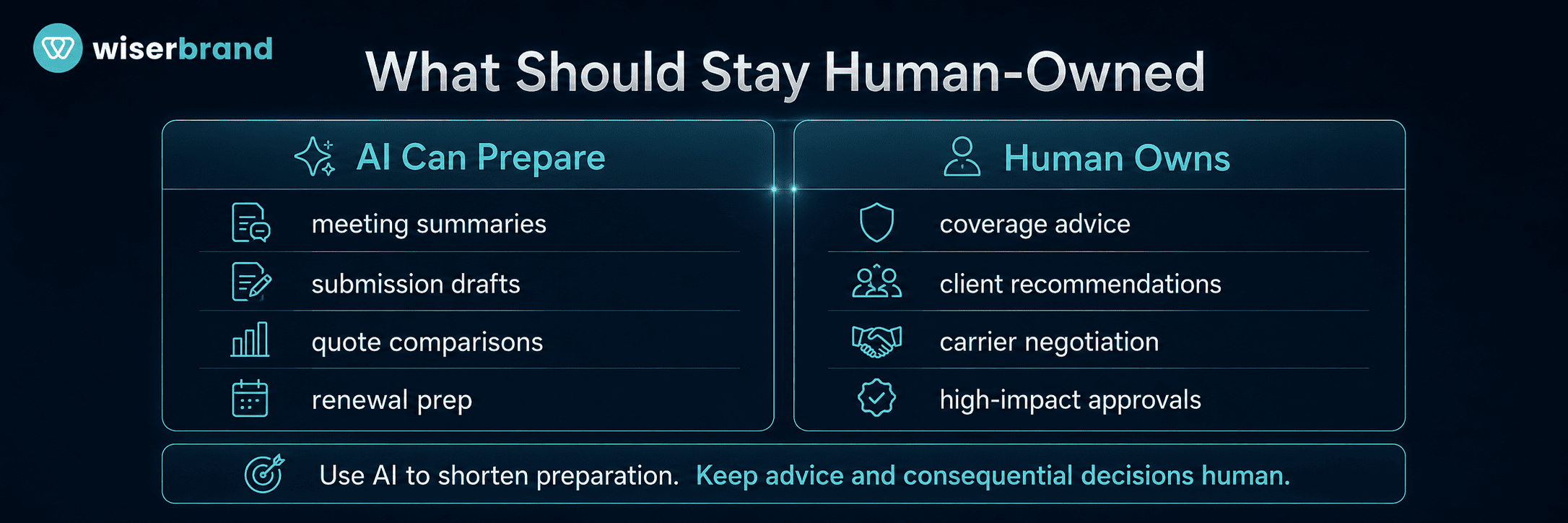
AI can prepare work, but several responsibilities should remain with licensed or authorized professionals:
- understanding the client’s needs and risk context;
- discussing coverage differences and limitations;
- recommending products or limits;
- confirming representations submitted to a carrier;
- negotiating with underwriters;
- handling complaints and disputed facts;
- giving a coverage-sensitive response;
- deciding how to manage a relationship;
- approving unusual, high-value, or difficult-to-reverse actions;
- interpreting licensing, regulatory, or legal requirements.
The boundary should be based on impact. A draft note and a bound policy change do not need the same control.
Data, Privacy, and Regulatory Risk
Insurance agency data may include financial information, health details, driving records, property data, business operations, claims, and identity information. AI tools should receive only the data required for the task.
Before approving AI for insurance agents, review:
- which data enters the system;
- where data is processed and stored;
- if prompts or outputs are used for model training;
- retention and deletion;
- vendor sub-processors;
- access controls;
- encryption;
- audit logs;
- incident notification;
- model and feature changes;
- export and exit options.
The NAIC notes that insurance AI is used across underwriting, pricing, customer service, claims, marketing, and fraud detection. Its Model Bulletin states that consumer-impacting decisions made or supported by AI remain subject to applicable insurance laws and describes expectations for governance, risk management, validation, documentation, and third-party oversight.
The bulletin directly addresses insurers, but agencies may still be affected by state law, carrier contracts, delegated authority, vendor requirements, and the nature of the service they provide. A legal or compliance owner should map the rules for each jurisdiction and workflow.
For European insurance organizations and intermediaries, EIOPA’s 2025 opinion describes a risk-based approach that covers data governance, record keeping, fairness, cybersecurity, explainability, and human oversight.
NIST’s AI Risk Management Framework and Generative AI Profile provide cross-sector guidance for governing, mapping, measuring, and managing AI risks across the lifecycle. They are useful references for tool inventory, evaluation, monitoring, and incident planning.
Implementation Blueprint
- Select one time-consuming workflow.
Start with a recurring AI for insurance agents workflow such as meeting follow-up, submission intake, renewal preparation, or knowledge search. Record the current volume, active work time, waiting time, and correction rate.
- Map the process and authority.
Document the trigger, source data, systems, employee decisions, required approvals, exceptions, and final record. Mark actions that require a producer, account manager, compliance owner, or carrier confirmation.
- Choose the smallest suitable tool.
Use workflow rules for predictable actions, document AI for extraction, a copilot for drafting, and an AI agent only for bounded variable work.
- Prepare approved data.
Clean templates, carrier guides, contact lists, policy categories, client identifiers, and document versions. Set owners and review dates.
- Start in read-only or draft mode.
Let the system prepare summaries, fields, and tasks without sending messages or changing records automatically. Capture corrections and unsupported cases.
- Add controlled integrations.
Connect the CRM, AMS, email, calendar, document store, and carrier systems through APIs where practical. Use RPA only for justified legacy gaps.
- Test realistic failure cases.
Include missing files, contradictory data, old carrier guidance, incorrect transcription, unsupported requests, duplicate actions, permission failures, and unavailable systems.
- Add approval and rollback.
Require review for customer communication, coverage-sensitive work, submissions, record changes, and external actions. Keep logs and a correction path.
- Measure workflow outcomes.
Compare time per completed case, correction rate, backlog, response time, and employee acceptance against the baseline.
- Expand only after the first workflow is stable.
Reuse identity, logging, retrieval, evaluation, and integration components. Recheck authority and data needs for every new process.
How to Choose AI Tools for an Insurance Agency
Evaluate tools against the workflow rather than the length of the feature list.
| Criterion | Questions to Ask |
|---|---|
| Workflow fit | Does the tool solve a frequent task with a clear owner? |
| Data access | Can it use the CRM, AMS, documents, email, and carrier data needed? |
| Accuracy controls | Can users inspect sources and correct outputs? |
| Permissions | Can access be limited by role, client, field, and action? |
| Integration | Are APIs available, and how are failed writes handled? |
| Human review | Can the agency require approval before sending or updating? |
| Auditability | Are prompts, sources, actions, and approvals logged? |
| Security | What are the hosting, retention, encryption, and incident terms? |
| Vendor change | How are model or feature changes communicated and tested? |
| Cost | What is the cost per user and completed workflow, including review time? |
Buy a packaged tool when the workflow is common and the integration fits. Customize when a product covers most of the work but needs agency-specific rules or connectors. Build a custom system when the workflow creates competitive value, spans unusual systems, or needs tighter control than the available products provide.
Common Mistakes
- Buying an AI assistant before mapping the workflow.
- Treating every carrier or state rule as model knowledge.
- Giving a general chatbot access to the full client database.
- Allowing meeting summaries to update the CRM without review.
- Comparing quotes by premium while missing exclusions or conditions.
- Treating a carrier-appetite answer as a commitment.
- Sending generated client advice without a licensed review.
- Using an AI agent for a simple API lookup or fixed rule.
- Measuring generated drafts instead of completed work.
- Ignoring exception queues and failed integrations.
- Expanding to more workflows before users trust the first one.
- Keeping a tool after maintenance and review cost exceeds the time saved.
How to Measure Time Saved and Business Value
Measure the full workflow, including corrections and review.
| Workflow | Useful Metrics |
|---|---|
| Lead intake | Time to assignment, missing-data rate, response time |
| Meeting follow-up | Minutes per meeting, correction rate, overdue tasks |
| Submission preparation | Active preparation time, incomplete submission rate, re-entry |
| Carrier research | Time to sourced answer, outdated-source rate |
| Quote comparison | Preparation time, material correction rate, review completion |
| Renewals | Accounts prepared on time, missing information, retention workflow completion |
| Service requests | Time to correct queue, resolution time, repeat contact |
| Licensing administration | Unresolved discrepancies, renewal completion, manual checks |
| AI operations | Acceptance rate, override rate, failed tool calls, cost per completed task |
A time-saving claim should include the baseline, measurement period, sample, and human review time. Do not treat model response speed as process speed if an employee still spends the same time correcting the output.
When AI Is Not the Right Next Step
Pause the project when the process has no agreed owner, the source data is unreliable, carrier information has no version control, or the agency cannot restrict access by employee and client.
The better first investment may be:
- cleaning CRM and AMS records;
- consolidating carrier and procedure documents;
- adding missing integrations;
- defining renewal and service workflows;
- creating standard templates;
- clarifying approval authority;
- measuring the current process.
A simple rule or form can outperform AI when the task is predictable. Use AI only where interpretation or generation provides enough value to justify review and governance.
FAQ
What Is the Best AI for Insurance Agents?
The best AI for insurance agents is the tool that solves a defined workflow with reliable data and clear review controls. For many agencies, the strongest starting points are meeting summaries, document extraction, submission preparation, carrier knowledge search, and renewal briefs rather than a broad autonomous agent.
Can AI Replace an Insurance Agent?
AI can reduce research, documentation, data entry, and follow-up work. It does not replace the licensed professional’s responsibility for client advice, coverage discussions, representations, negotiation, and regulated decisions. The useful design keeps the person in control of consequential work.
Can AI Compare Insurance Quotes?
AI can extract and organize premiums, limits, deductibles, endorsements, exclusions, conditions, and fees. An agent should verify the comparison and explain material differences. Quote documents vary, and a generated comparison can miss context or misread a provision.
Can AI Update an Agency Management System?
Yes, through supported APIs, workflow connectors, or RPA for a justified legacy system. Start with draft fields or reversible updates. Require validation and review for client details, policy changes, submissions, and other records that affect coverage or external communication.
Is Client Data Safe in an AI Tool?
Safety depends on the product, configuration, access model, hosting, retention, vendor data use, and agency controls. Review the contract and technical setup before sending client data. Limit each tool to the minimum records needed for its workflow.
How Should a Small Agency Start?
Choose one frequent task with a clear baseline. Run the tool in draft mode, measure corrections and time saved, and expand after employees trust the output. Meeting follow-up or renewal preparation can be practical starting points because the employee reviews the result before action.
What Is the Difference Between an AI Assistant and an AI Agent?
An AI assistant usually searches, summarizes, drafts, or recommends while the user directs the work. An AI agent can choose steps and call tools to complete more of a bounded workflow. Product labels vary, so agencies should evaluate actual permissions, actions, approvals, and failure handling.
Final Thoughts
AI for insurance agents should give producers and service teams more time for client conversations, market strategy, and complex cases. The most practical tools handle preparation: they organize messages, extract documents, retrieve current guidance, draft comparisons, build renewal briefs, and prepare system updates.
Start with one workflow. Keep the source visible, the permissions narrow, and the licensed professional responsible for advice and consequential actions. Measure completed work after review, not the number of generated drafts.
We help organizations connect AI assistants and controlled agents with CRM, document, communication, and workflow systems. WiserBrand’s AI agent development and business process automation services cover use-case selection, system integration, permissions, evaluation, and monitored deployment.