Intelligent Automation in Insurance: Use Cases From Claims to Underwriting

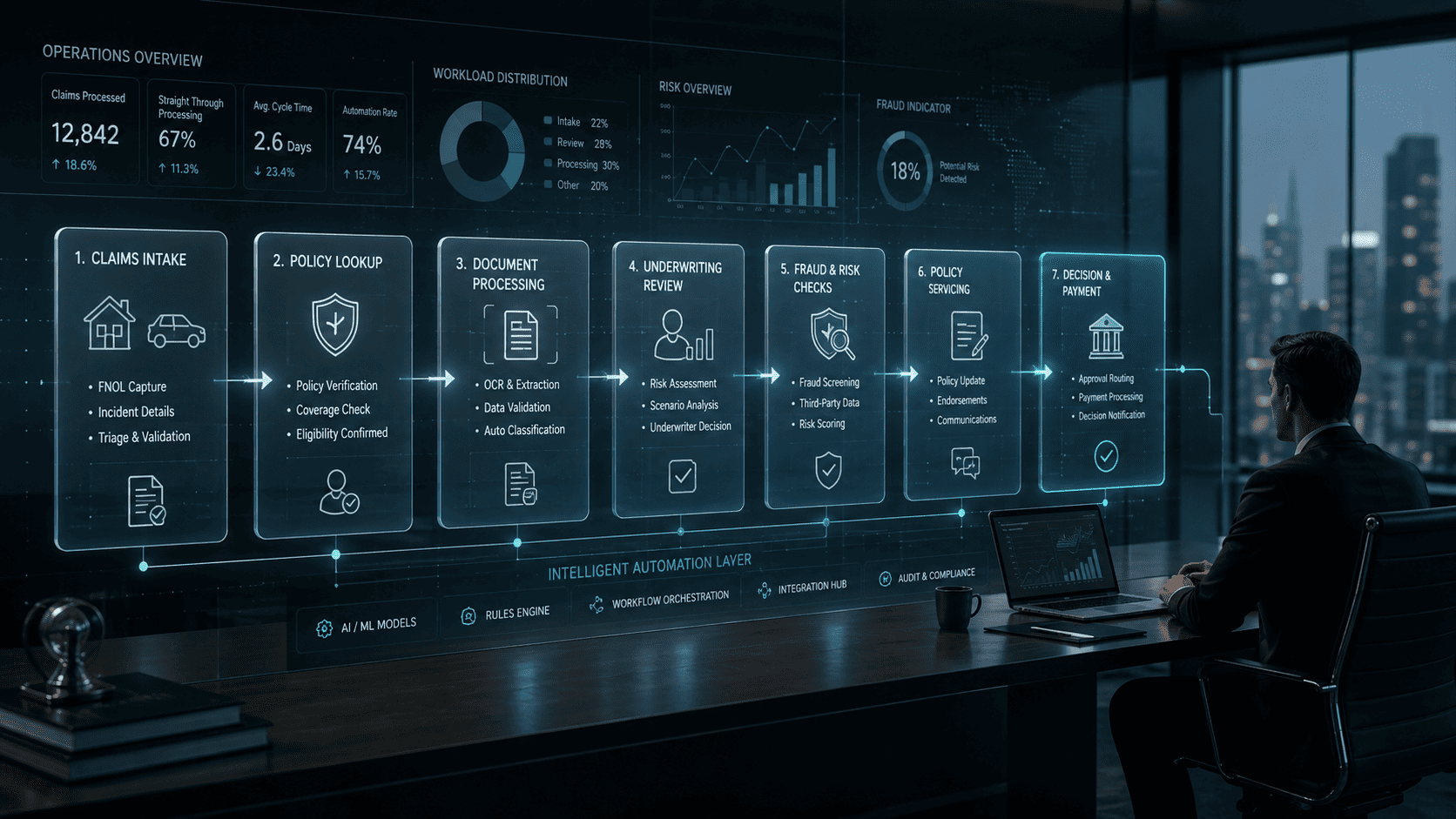
Intelligent automation in insurance combines workflow orchestration, system integration, robotic process automation, document processing, machine learning, and selected generative AI capabilities. It helps insurers move routine work through claims, underwriting, policy servicing, distribution, and compliance while keeping consequential decisions under accountable human control.
The best insurance automation does not ask one model to run an entire process. It assigns each part of the workflow to the most suitable component. Rules validate coverage. Document AI extracts evidence. Predictive models estimate defined risks. APIs update core systems. Generative AI summarizes records or drafts communication. Employees review exceptions, disputed facts, consumer-impact decisions, and actions that are difficult to reverse.
This guide explains practical use cases across the insurance value chain, the architecture behind them, the risks that need stronger controls, and a staged implementation approach.
What Is Intelligent Automation in Insurance?
In insurance, business process automation can combine workflow orchestration, integrations, rules, RPA, document processing, and selected AI capabilities across claims, underwriting, policy servicing, and back-office operations. In insurance, the term usually covers a broader technical stack:
- workflow and case management;
- APIs and event-driven integrations;
- RPA for legacy applications;
- optical character recognition and document extraction;
- rules and decision engines;
- predictive machine learning;
- computer vision;
- generative AI copilots;
- AI agents with limited tool access;
- human review and approval.
The technology mix should follow the process. A claims intake workflow may use document extraction, policy lookup, rules, fraud scoring, and an adjuster queue. An underwriting workflow may collect submission data, enrich it from approved sources, calculate risk factors through validated models, and prepare a case summary for the underwriter.
NAIC materials updated in April 2026 describe insurer use of AI across underwriting, pricing, customer service, claims handling, marketing, and fraud detection. They also distinguish automation that augments human decisions from models that support or make consumer-impacting decisions.
Why Insurance Needs More Than RPA
RPA is useful when employees repeat stable actions inside systems that lack practical APIs. A bot can open an email, copy data into a policy administration platform, download a document, or update a status field.
RPA alone cannot interpret every submission, assess ambiguous evidence, resolve policy conflicts, or manage a long-running claim with several participants. Our earlier process automation in insurance guide covers the narrower role of process automation and RPA across common insurance workflows.
A broader intelligent automation design separates five kinds of work:
| Work Type | Best Primary Mechanism | Insurance Example |
|---|---|---|
| Stable transaction | Workflow, API, or rule | Route a complete application to the next queue |
| Legacy interface task | RPA | Enter approved data into a mainframe screen |
| Document interpretation | OCR and document AI | Extract fields from a loss notice or medical bill |
| Prediction or scoring | Validated machine learning | Estimate claim severity or fraud risk |
| Language and knowledge work | Retrieval-grounded generative AI | Summarize a submission for underwriter review |
A successful intelligent automation in insurance program uses this separation because each component has different testing, monitoring, and governance needs. A deterministic coverage rule can be tested against exact expected outputs. A claim severity model needs statistical validation and drift monitoring. A generative summary needs source grounding, factuality checks, and employee review.
How the Insurance Automation Stack Works
An end-to-end workflow usually crosses several systems:
| System | Role in the Workflow |
|---|---|
| Customer or broker portal | Collects notices, applications, files, and confirmations |
| CRM or agency system | Stores contacts, opportunities, and distribution activity |
| Policy administration system | Holds policy terms, endorsements, dates, and status |
| Claims management system | Holds claim parties, reserves, activities, payments, and notes |
| Rating or underwriting engine | Applies approved rating and eligibility logic |
| Document repository | Stores forms, reports, images, correspondence, and evidence |
| Data platform | Supplies historical, external, and analytical data |
| Fraud or risk service | Produces alerts or scores for defined use cases |
| Workflow or case platform | Routes tasks, approvals, timers, and exceptions |
| Payment service | Executes approved disbursements and records status |
The automation layer connects these systems through APIs, events, managed connectors, and RPA where required. AI integration adds model-driven extraction, classification, summarization, or decision support without bypassing core insurance systems and deterministic controls. It also maintains workflow state, records which source supported a decision, and routes failures to an owner.
Insurance data standards can reduce integration ambiguity. ACORD maintains data dictionaries, process guides, and digital messaging standards across areas such as policy, accounting, and claims. Its 2025 GRLC update included work on claims handling and orchestration standards intended to support digital claims processing. Standards do not remove mapping and governance work, but they can provide shared terminology and message structures.
Claims Automation Use Cases
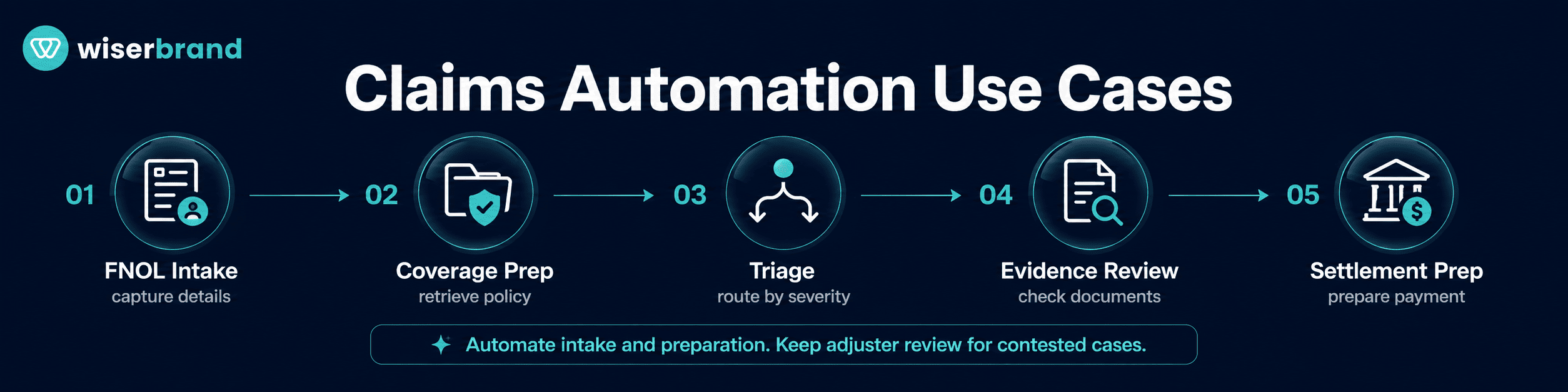
Claims contain high-volume administrative work and high-impact decisions. The right design automates evidence collection, validation, routing, and preparation while preserving adjuster authority for disputed, complex, or consequential cases.
First Notice of Loss and Intake
First notice of loss may arrive through a portal, mobile app, contact center, email, broker, or third party. The intake workflow can:
- identify the policyholder and policy;
- collect incident details;
- extract information from uploaded files;
- check required fields;
- create the claim;
- classify the line and event type;
- assign the correct queue;
- confirm receipt to the claimant.
Document AI can read forms, reports, invoices, and supporting evidence. A language model can turn a free-text account into structured fields or prepare a concise narrative. Deterministic checks should validate identity, policy status, incident date, and mandatory data before the claim is created.
Missing or conflicting information should create a clear exception rather than a guessed value.
Coverage and Eligibility Preparation
Coverage analysis often requires policy terms, endorsements, exclusions, dates, limits, deductibles, and incident facts. Automation can retrieve the relevant policy version, identify potentially applicable clauses, and prepare a coverage worksheet.
The system should distinguish retrieval from interpretation. It can show the exact clause and connect it to the reported facts. A qualified claims professional should own contested interpretations, reservation-of-rights decisions, denials, and other communication with legal or material consumer impact.
A generated explanation should link to the policy source and record the version used. Policy documents and generated summaries cannot be treated as interchangeable.
Triage, Routing, and Severity Estimation
Claims can be routed by product, geography, loss type, reported severity, injury indicator, litigation risk, catastrophe event, fraud signal, and required expertise.
A predictive model may estimate severity or complexity. Rules can apply assignment thresholds. A case platform can route the file to straight-through handling, desk adjustment, field inspection, specialist review, or a senior adjuster.
EIOPA has described AI use in claims for triage, complexity, urgency, fraud risk, document extraction, coverage verification, and settlement support. These are separate capabilities. A fraud score should not automatically prove fraud, and a severity estimate should not become a final reserve without the approved claims process.
Damage Assessment and Evidence Review
Computer vision can support vehicle or property damage assessment from images when the use case has suitable training data and validation. Document extraction can process repair estimates, invoices, medical records, police reports, and adjuster notes.
Generative AI can organize the evidence, identify missing documents, compare reports, or prepare questions for an adjuster. It should not manufacture a causal explanation or declare that an image proves the reported event.
The workflow should preserve the original evidence, model output, confidence, employee correction, and final decision.
Settlement and Payment Preparation
Automation can calculate approved deductibles and limits through rules, prepare settlement documentation, validate payment fields, request approval, and submit an authorized payment.
The workflow needs explicit states:
- proposed amount;
- reviewed amount;
- approved amount;
- payment submitted;
- payment confirmed;
- payment failed or reversed.
A conversational interface or AI agent should not blur these statuses. High-value payments, unusual recipients, changed bank details, and policy exceptions need step-up review. Duplicate prevention and idempotency controls are essential when systems retry a failed request.
Subrogation, Recovery, and Closure
Automation can identify potential recovery indicators, collect related records, create tasks, and track deadlines. It can also check that required documents, reserves, payments, and activities are complete before closure.
The system can prepare a closure summary. The claims owner should review unresolved liabilities, legal actions, open recoveries, and customer commitments before the case is closed.
Underwriting Automation Use Cases
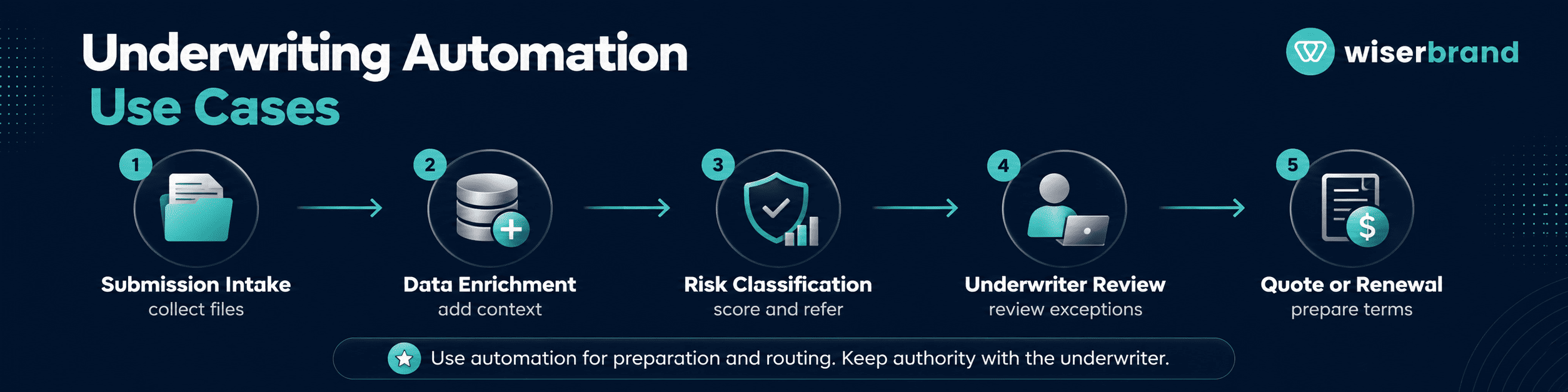
Underwriting automation should reduce preparation and administration while keeping risk appetite, pricing authority, referral rules, and exceptions controlled.
Submission Intake and Clearance
Commercial and specialty submissions often arrive through broker emails with attachments, spreadsheets, schedules, and loss runs. An automation workflow can:
- identify the broker and insured;
- extract applicant and exposure data;
- classify the line of business;
- compare the submission with existing accounts;
- check required documents;
- create the opportunity or submission record;
- route incomplete cases for follow-up.
Document processing and generative AI can turn unstructured submissions into a structured case. Entity matching and duplicate checks should use controlled data services rather than a model’s text similarity alone.
Data Enrichment and Risk Preparation
Underwriters may need property, business, vehicle, geographic, financial, claims, telematics, inspection, or catastrophe data. Automation can request approved data, map it to the submission, and flag conflicts.
The workflow should show:
- source and retrieval date;
- field-level confidence;
- conflicts with applicant data;
- missing values;
- use restrictions;
- which values entered rating or eligibility logic.
External data should not be treated as automatically correct. Consumer-impacting data needs governance, permitted-use review, and a correction process.
Risk Classification and Referral
Validated models and rule engines can support risk classification, appetite checks, referral triggers, and pricing inputs. The underwriter should see the relevant factors, model version, and reason for referral.
A practical control model is:
| Case Type | Automation Level |
|---|---|
| Complete, low-complexity case inside clear appetite | Automatic preparation and approved straight-through path |
| Case near a threshold | Underwriter review with decision support |
| Conflicting or missing evidence | Exception queue |
| High-value, unusual, or sensitive case | Specialist or committee review |
| Model outside its validated scope | No automated recommendation |
For EU operations, the AI Act classifies AI used for risk assessment and pricing in life and health insurance as high-risk. EIOPA’s August 2025 opinion separately clarifies insurance-sector governance expectations for other AI systems and emphasizes data governance, record keeping, fairness, cybersecurity, explainability, and human oversight.
Quote, Bind, and Renewal Preparation
Automation can gather current exposure, loss, payment, inspection, and policy data before quote or renewal review. It can compare changes against prior terms, prepare a summary, and generate approved documents after a decision.
Rules should control:
- product eligibility;
- required approvals;
- discount authority;
- minimum and maximum terms;
- effective dates;
- bind authority;
- mandatory disclosures.
Generative AI can draft broker questions or explain changes, but it should not invent a reason for a premium change or state that coverage is bound before the core system confirms it.
Policy Administration and Servicing
Policy administration includes issuance, endorsements, billing, cancellations, reinstatements, renewals, and document delivery. Many steps are deterministic but cross several systems.
Useful automation includes:
- validating endorsement requests;
- comparing requested changes with policy data;
- generating approved documents;
- updating billing schedules;
- sending reminders;
- routing exceptions;
- reconciling policy and payment status;
- recording consent and delivery;
- preparing renewal files.
Customer or broker requests received in natural language can be classified and converted into a structured service request. The policy system and rules engine should decide which fields are valid, which documents are required, and which changes need approval.
Cancellation, nonrenewal, reinstatement, and coverage-change communication may carry legal deadlines and notice requirements. The workflow needs jurisdiction-specific rules and evidence that the correct notice was generated and delivered.
Distribution and Customer Operations
Intelligent automation can support agents, brokers, call-center teams, and policyholders without replacing licensed or authorized judgment.
Use cases include:
- product and policy knowledge search;
- application status;
- quote intake;
- lead and broker routing;
- conversation and call summaries;
- next-step task creation;
- document reminders;
- complaint classification;
- customer communication drafts;
- producer onboarding and credential checks.
A retrieval-grounded assistant can help employees locate current product rules and policy language. Customer-facing bots should stay inside approved service journeys and provide a direct human path when the issue involves a complaint, disputed decision, vulnerability, cancellation, or unclear coverage.
Automation can prepare a recommendation. Suitability, disclosure, advice, and licensing responsibilities remain with the authorized person and the insurer’s approved process.
Fraud Detection and Investigation Support
Fraud automation can combine rules, network analysis, anomaly detection, claim history, image analysis, and external data. Its proper role is to identify cases that deserve review, not to label a claimant as fraudulent without investigation.
A controlled workflow can:
- calculate a score or trigger a rule;
- show the contributing signals;
- collect relevant linked claims, parties, providers, or assets;
- prepare an investigation brief;
- assign the case to a special investigations team;
- record the investigator’s disposition;
- feed validated outcomes back into model evaluation.
False positives create customer harm and unnecessary investigative cost. Teams should monitor alert precision, investigation yield, differences across relevant groups, employee overrides, and the effect of model changes.
Compliance, Audit, and Regulatory Reporting
Automation can collect evidence, validate required fields, monitor deadlines, prepare reports, and maintain audit records. It can help with complaints, producer licensing, policy notices, model inventories, consent, third-party reviews, and market-conduct examinations.
The NAIC Model Bulletin on the Use of Artificial Intelligence Systems by Insurers calls for a written AI systems program proportionate to risk and reminds insurers that consumer-impacting decisions supported by AI remain subject to applicable insurance laws. It also describes documentation regulators may request during an examination or investigation.
Compliance automation should not be reduced to generating a report. The source data, control owner, policy version, exception, review, and final disposition need to remain traceable.
What to Automate and What to Keep Human
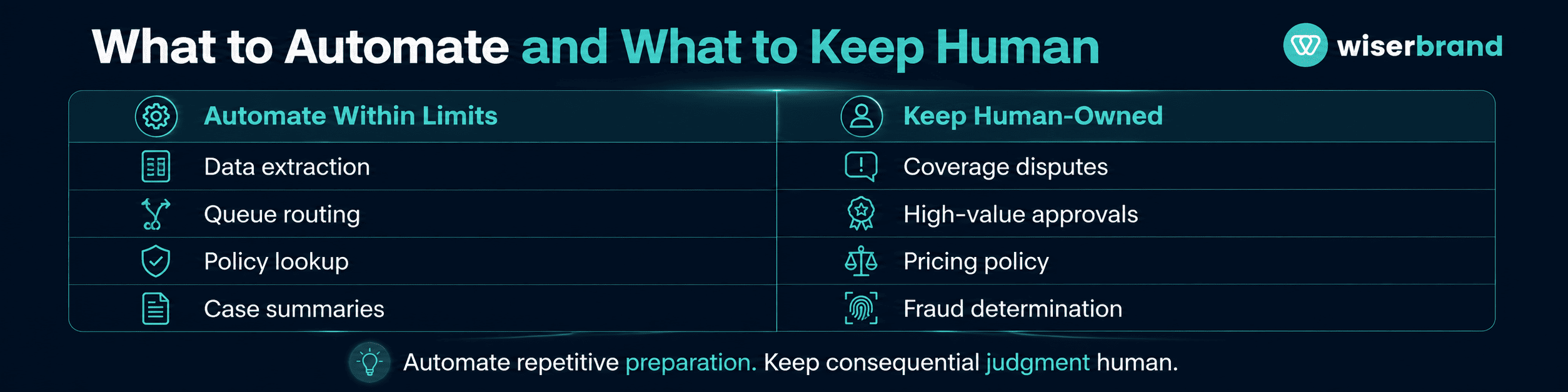
The decision should follow impact, ambiguity, and reversibility.
| Automate Within Defined Limits | Keep Human-Owned or Human-Approved |
|---|---|
| Data extraction and completeness checks | Contested coverage interpretation |
| Queue routing and task creation | Claim denial or material reduction |
| Policy and account lookup | High-value settlement approval |
| Approved calculations and document generation | Underwriting exceptions outside authority |
| Duplicate and consistency checks | Risk appetite and pricing policy |
| Case and submission summaries | Fraud determination |
| Low-risk reminders and status updates | Complaint resolution with legal implications |
| Reversible record updates | Sensitive or difficult-to-reverse consumer decisions |
Human review is useful only when the reviewer has the evidence, authority, time, and clear decision criteria. Sending every case to an employee after the model has already selected the outcome creates ceremonial oversight.
Architecture for Intelligent Automation in Insurance
The architecture for intelligent automation in insurance needs clear boundaries between probabilistic models and controlled transaction systems. Fintech software development can provide the portals, APIs, workflow services, data integrations, transaction controls, and auditability required around the automation layer.
| Layer | Purpose |
|---|---|
| Experience | Customer, broker, adjuster, underwriter, or operations interface |
| Identity and access | Role, entity, jurisdiction, case, and data permissions |
| Workflow and case management | State, timers, routing, tasks, approvals, and exceptions |
| Integration | APIs, events, connectors, batch exchange, and RPA |
| Document intelligence | OCR, classification, extraction, and validation |
| Decision services | Rules, rating, eligibility, calculations, and authority limits |
| AI and analytics | Prediction, computer vision, semantic retrieval, and generation |
| Human work queues | Review, investigation, correction, and approval |
| Observability | Logs, traces, model metrics, failures, cost, and business outcomes |
| Governance | Inventory, owners, versions, testing evidence, incidents, and retirement |
Critical business rules should not live only in prompts. A prompt can guide how a summary is written. It should not be the only control preventing a payment, denial, pricing change, or unauthorized data access.
Each external action should use scoped credentials, validation, a confirmed response, and a rollback or correction path.
Data Readiness and Integration
Insurance automation depends on consistent policy, claim, party, producer, product, and coverage data. Generative AI can hide poor data behind polished language, so source quality needs active controls.
Review:
- policy and endorsement versioning;
- party and entity matching;
- product and coverage codes;
- claim cause and status taxonomies;
- document ownership and retention;
- source timestamps;
- jurisdiction and language;
- external data contracts and permitted uses;
- API and batch reconciliation;
- missing and conflicting values;
- historical outcome quality;
- access by role and case;
- model and rule lineage.
Do not connect every repository at once. A claims intake pilot may need policy lookup, a controlled document set, claim creation, and a routing queue. It does not need unrestricted access to every historical claim.
Governance and Regulatory Controls
Governance for intelligent automation in insurance should use a risk-based control model that covers both AI and conventional automation.
NIST’s AI Risk Management Framework provides voluntary guidance for governing, mapping, measuring, and managing AI risk across design, development, deployment, and use. Insurance-specific controls then need to reflect the applicable product, jurisdiction, decision, and regulator.
A practical governance program includes:
- an inventory of models, bots, agents, rules, and third-party services;
- named business, technical, data, and risk owners;
- use-case classification by consumer and financial impact;
- approved data and purpose;
- testing against representative and adverse cases;
- fairness and outcome analysis where relevant;
- explainability suited to the decision;
- human authority and escalation;
- security and privacy controls;
- vendor model and data oversight;
- production monitoring;
- incident, correction, and rollback procedures;
- periodic review and retirement.
EIOPA’s 2025 opinion follows a risk-based and proportionate approach for insurer AI governance. It notes data governance, record keeping, fairness, cybersecurity, explainability, and human oversight as key considerations.
A Practical Implementation Blueprint
- Select one measurable workflow.
Choose a process with clear volume, manual effort, ownership, and outcome. Claims document intake, submission clearance, renewal preparation, or policy service triage can be practical starting points.
- Map the current process.
Document the trigger, systems, roles, decisions, documents, waiting time, rework, exceptions, and final outcome. Include unofficial spreadsheets and email steps.
- Remove avoidable process waste.
Fix duplicate reviews, unclear fields, outdated rules, and unnecessary transfers before automating them.
- Define the automation boundary.
List what the system may read, extract, calculate, draft, update, submit, and approve. Mark high-impact decisions that stay human-owned.
- Choose the smallest suitable technology set.
Use rules for stable decisions, APIs for system exchange, RPA for justified legacy gaps, document AI for extraction, predictive models for defined estimates, and generative AI for knowledge or language work.
- Prepare data and permissions.
Assign source owners, reconcile identifiers, set access, document permitted uses, and define how missing or conflicting values are handled.
- Build a read-only or draft-first release.
Start with extraction, validation, summaries, recommendations, and task routing. Keep difficult-to-reverse actions disabled during early evaluation.
- Test realistic and adverse cases.
Include incomplete submissions, conflicting policy records, duplicate claims, changed bank details, unsupported documents, model uncertainty, system outages, permission failures, and adversarial text.
- Pilot with one bounded group.
Limit the first release by product, region, claim type, broker segment, or operations team. Compare performance with the baseline.
- Add controlled execution.
Introduce reversible updates before payments, denials, binding, or other high-impact actions. Add confirmation, authority limits, audit records, and rollback.
- Monitor the entire workflow.
Track model quality, extraction corrections, rules, integrations, human decisions, customer outcomes, exceptions, latency, and cost.
- Expand through governed releases.
Treat each new product, data source, jurisdiction, model, or action permission as a change that needs testing and approval.
How to Choose the First Use Case
Score candidate workflows using business value and production readiness. AI strategy consulting can help compare insurance use cases by process stability, data readiness, consumer impact, integration effort, risk, and measurable value before implementation.
| Criterion | Strong Candidate | Weak Candidate |
|---|---|---|
| Frequency | High recurring volume | Rare specialist work |
| Manual effort | Repeated search, entry, or comparison | Little administrative effort |
| Process stability | Agreed path and ownership | Rules vary by employee |
| Data readiness | Accessible, current, and governed sources | Conflicting or inaccessible data |
| Exception rate | Exceptions are identifiable and routable | Almost every case is unique |
| Risk | Mistakes are reversible or reviewed | Immediate material consumer harm |
| Measurement | Cycle time, quality, or cost has a baseline | No owner or outcome metric |
| Integration | Stable API, event, or controlled RPA path | Unmonitored access to fragile systems |
The first use case should prove an operating pattern, not the most ambitious vision.
Build, Buy, or Customize?
| Approach | Strong Fit | Main Tradeoff |
|---|---|---|
| Core-platform automation | Standard workflows inside one policy or claims system | Limited cross-platform control |
| Low-code workflow platform | Department processes and common integrations | Governance and licensing complexity at scale |
| Insurance-focused product | Mature claims, underwriting, document, or fraud use case | Product fit and vendor dependency |
| RPA platform | Legacy user-interface tasks | Maintenance when screens or access change |
| Custom solution | Differentiated process, data, or decision logic | Higher engineering and operating responsibility |
| Hybrid architecture | Packaged capabilities with custom orchestration and controls | Component boundaries must remain clear |
Evaluate data access, interoperability, testing evidence, configuration limits, model transparency, security, regulatory support, incident terms, change notification, and exit options.
A demo that processes one clean document is not enough. Test the vendor against actual policy versions, claim files, exceptions, role permissions, and failure scenarios.
How to Measure Success
Measure workflow completion, quality, risk, and business impact.
| Area | Example Metrics |
|---|---|
| Claims | Time from notice to assignment, touchless intake, reopen rate, payment errors |
| Underwriting | Submission-to-decision time, cases per underwriter, referral quality, rework |
| Policy service | Completion time, failed changes, repeat contacts, notice accuracy |
| Documents | Extraction accuracy, correction time, unsupported document rate |
| Fraud | Alert precision, investigation yield, false-positive burden |
| Customer | Time to useful response, complaint rate, repeat contact, escalation quality |
| Automation | Straight-through completion, exception rate, tool failure, duplicate action |
| AI quality | Human acceptance, override rate, groundedness, drift |
| Economics | Cost per completed case, backlog, capacity released, loss or leakage avoided |
| Governance | Unresolved incidents, model review status, audit evidence completeness |
Do not optimize straight-through processing alone. An insurer can raise automation rates by pushing more cases through a weak path. The result is only useful when accuracy, fairness, customer outcomes, and financial control remain acceptable.
Common Implementation Mistakes
- Starting with a broad end-to-end promise instead of one bounded workflow.
- Treating RPA, predictive AI, generative AI, and agents as interchangeable.
- Placing critical underwriting or claims rules inside prompts.
- Connecting AI directly to core systems with broad credentials.
- Automating a process before policy and operations agree on the rules.
- Ignoring broker, adjuster, underwriter, and customer exceptions.
- Training models on historical outcomes without reviewing bias or data quality.
- Treating a fraud score as proof.
- Measuring activity instead of completed and corrected outcomes.
- Launching without clear employee escalation.
- Allowing vendor or model changes into production without regression testing.
- Expanding before monitoring and rollback work in real conditions.
When Insurance Automation Is Not Ready
Pause or narrow the project when:
- policy and claim systems do not reconcile;
- core rules have no named owner;
- historical outcomes are incomplete or unreliable;
- source documents lack version control;
- access cannot be limited by role and case;
- the workflow has no exception owner;
- a wrong action cannot be reversed;
- the team cannot explain the basis of a consumer-impacting decision;
- integration failures cannot be detected;
- there is no baseline for value;
- a process redesign would remove more work than automation.
The right first investment may be data cleanup, API development, document governance, or process redesign.
FAQ
What Is Intelligent Automation in Insurance?
Intelligent automation in insurance combines workflows, integrations, RPA, document processing, rules, analytics, and AI to move insurance work through claims, underwriting, policy servicing, distribution, fraud, and compliance. The architecture should use deterministic controls for exact rules and human approval for high-impact or disputed decisions.
How Is Intelligent Automation Different From RPA?
RPA imitates repeated user actions in software interfaces. Intelligent automation is broader. It may include RPA, but it also connects workflow orchestration, APIs, document AI, predictive models, generative AI, rules, and human work queues across an end-to-end insurance process.
Which Insurance Processes Are Best for Automation?
Strong candidates include claims intake, document extraction, submission clearance, renewal preparation, policy service routing, case summaries, data validation, and compliance evidence collection. The best first use case has stable rules, accessible data, recurring volume, measurable effort, and a clear exception path.
Can Insurance Claims Be Fully Automated?
Some simple claims can follow a highly automated path when coverage, evidence, amount, fraud indicators, and payment conditions fall inside approved rules. Complex, disputed, high-value, injury, fraud, litigation, or unclear coverage cases need qualified human review.
Can AI Make Underwriting Decisions?
AI can prepare data, score defined risks, apply approved rules, and support underwriter review. The permitted level of automation depends on the product, jurisdiction, model scope, consumer impact, and governance. Exceptions and consequential decisions need accountable authority.
What Are the Main Risks?
The main risks include inaccurate extraction, biased model outcomes, unsupported generated content, weak explainability, privacy exposure, prompt injection, excessive system access, duplicate actions, third-party model changes, and failed human escalation.
How Should an Insurer Start?
Select one bounded workflow, establish a baseline, map systems and exceptions, define which decisions stay human-owned, and build a read-only or draft-first release. Add transaction authority only after the workflow passes realistic testing and can be monitored and rolled back.
Final Thoughts
Intelligent automation in insurance creates value when it removes administrative friction without hiding responsibility. Claims teams can receive cleaner files and faster triage. Underwriters can spend less time assembling submissions. Policy service and compliance teams can process routine work through controlled workflows.
The architecture should match each task. Use APIs and rules for exact transactions, RPA for justified legacy gaps, document AI for extraction, predictive models for defined estimates, and generative AI for summaries and knowledge work. Keep contested, sensitive, and difficult-to-reverse decisions under qualified human authority.
We help insurers map workflows, integrate core and legacy systems, build document and AI components, add governed automation, and monitor production results. WiserBrand’s fintech software development and business process automation services cover underwriting support, claims workflows, data integration, custom portals, AI implementation, and ongoing improvement.