Summary
A US electrical contractor with its own field crews builds commercial projects for general contractors and developers. After each contract win, job details moved from estimating to the field through email, Dropbox, spreadsheets, and phone calls.
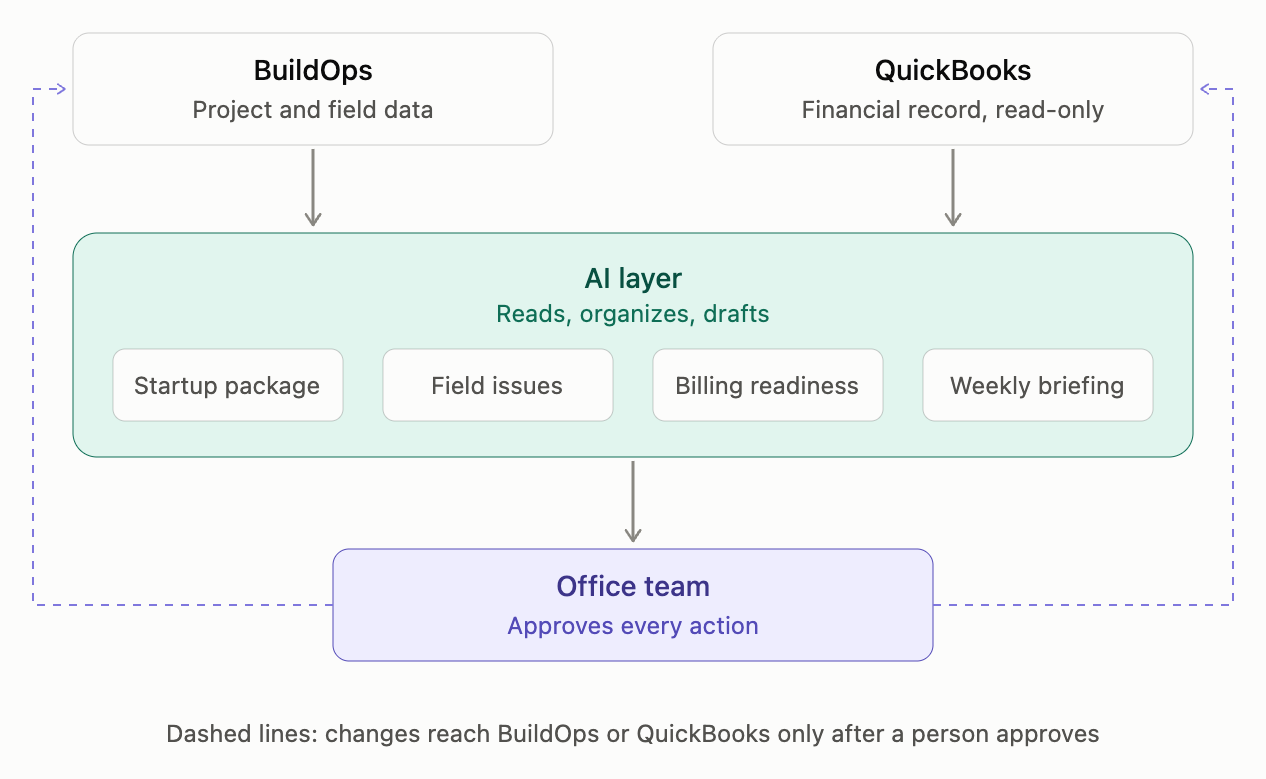
We designed four AI agents that work inside QuickBooks and BuildOps, the operations platform the company had just bought. The agents prepare each job’s startup package, sort issues from the field, and get billing ready. The office team approves every step.
Cooperation Period
Ongoing
Location
Industry
Service Provided

Business Challenge
The company won work steadily. The harder part came after the contract was signed. The crew building a job needed everything behind the winning bid: the scope, what the estimate assumed, the contract terms, and which materials and subcontractors were planned. No single place held all of it. The office team split estimating, project management, and the books between them, and the handoffs had no dedicated owner.
Most of the friction sat where work passed from one team to the next:
- Estimating to the field. Details from the bid were passed along by hand, so some could get lost on the way to the crew.
- Field to office. Crew questions (RFIs) and on-site commitments traveled by phone and text, so the office sometimes heard about them later than it needed to.
- PM to accounting. Job costs were matched to QuickBooks by hand at month-end, so billing depended on catch-up work.
The company had bought BuildOps as a home for its project data and needed a standard startup package and clear approval rules to go with it.
What We Did
1
Designed four agents: three for the handoffs, one for the owner’s view
- Startup: Builds a draft job package with scope, contract terms, owners, and due dates. Flags missing items for PM approval.
- Field issues: Sorts crew questions and logs by job and cost code, then proposes an owner and flags late orders.
- Billing: Compares job costs and invoices with QuickBooks, preparing a billing pack and listing gaps for accounting.
- Weekly briefing: Summarizes job status and prioritized risks, with figures linked to their sources.
2
Kept people in charge
- The PM, ops lead, accounting, and owner each approve the actions in their area. When one person holds several roles, approvals follow the role.
- Every flag goes to a named owner, so nothing sits in a queue nobody checks.
- The AI never posts in QuickBooks, issues an invoice, or contacts crews, subcontractors, or GCs on its own.
3
Planned a phased rollout
- Everything runs inside BuildOps and QuickBooks. Procore is used only when a GC requires it.
- The pilot runs for 13 weeks. It begins with the startup package agent, and the field, billing, and briefing agents are added one at a time, each only after the previous one meets its targets.
Project Results
What the pilot is designed to change:
Jobs start with what the bid promised
Every job the company wins opens with one package in BuildOps, with an owner and a due date on every task. Gaps surface before the crew arrives on site, while fixing them still takes a phone call.
Invoices stop waiting for month-end
Costs are checked against QuickBooks as they come in. At month-end, accounting reviews a short list of open items and bills from a pack with supporting documents already attached.
The office stops chasing
Hours spent tracking down handoffs and matching records by hand go back to estimating and running jobs.