Enterprise AI Adoption Strategy: From Readiness to Scaled Implementation

An enterprise AI adoption strategy is a set of decisions about where AI belongs in the business, who owns each initiative, what evidence justifies expanding it, and which controls apply at each risk level. It is not a technology selection exercise, and platform documentation cannot substitute for it, because the hard parts are portfolio choice, data ownership, funding, and accountability rather than model access. This guide walks through readiness assessment, use-case portfolio design, delivery model selection, data foundations, risk-tiered governance, operating model, stage gates from pilot to scale, and the measures that show the program is working. The sequence is vendor-neutral and works the same way on a Microsoft, Google, AWS, or Salesforce stack, or on a mix of all four.
What the Strategy Has to Decide
A document that lists AI ambitions is not a strategy. An enterprise AI adoption strategy is judged by the decisions it closes, not by the ambitions it states. A usable enterprise AI adoption strategy answers eight questions in writing, and every later argument in the adoption program traces back to one of them.
- Which business outcomes AI is expected to move, and against which baselines.
- Which use cases enter the portfolio, in which order, and on what evidence.
- Who owns each initiative on the business side and on the technical side.
- Which delivery model applies per use case: licensed feature, configured platform, or custom build.
- What data must be governed, connected, or cleaned before the priority use cases can work.
- Which controls apply at each risk tier, and which actions never run without human approval.
- How initiatives are funded, and what a stage gate requires before more money is released.
- What gets measured, by whom, and what result would cause the program to stop something.
If a leadership team cannot answer these eight questions, the constraint is not model capability. Adding another platform will not resolve it.
Why Enterprise Programs Stall Between Pilot and P&L
Survey evidence on the gap between AI use and AI profit is consistent and uncomfortable. In McKinsey’s 2026 global survey of 1,719 respondents, 80 percent reported that AI improved their individual productivity, while 37 percent said it contributed to enterprise EBIT, a share unchanged from the prior year. Among large organizations above $1 billion in revenue, 40 percent reported scaling agents in at least one function, up from 27 percent. Adoption is moving. Financial attribution is not.
The mechanism behind that gap is structural rather than technical. Individual productivity accrues to individuals: a manager drafts a memo faster and absorbs the saved time. Enterprise results require the process itself to change, which means fewer handoffs, fewer manual touches, shorter waiting time between steps, and fewer cases returning for rework. In the same McKinsey survey, the high performers, about 6 percent of respondents, are distinguished less by tooling than by redesigning workflows and committing leadership attention.
An enterprise AI adoption strategy that funds tool access without funding process redesign reproduces this gap at scale. Budget the redesign as a line item alongside the license, and assign it to the business owner who controls the process.
Step 1: Assess Readiness Across Six Dimensions
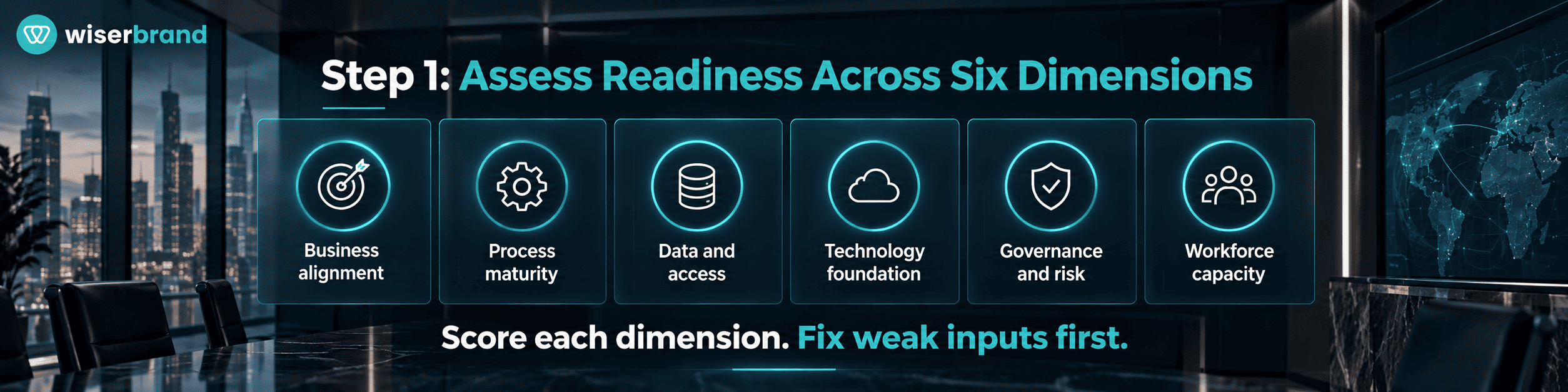
An enterprise AI adoption strategy starts with readiness, and readiness is not a technical audit. Score each of the six dimensions below from 1 to 5 for the business areas in scope, using one shared scale so business units can be compared. Treat any dimension below 3 as a dependency that enters the roadmap ahead of the use cases relying on it, because a use case cannot outperform its weakest input.
| Dimension | What a low score looks like | What a high score looks like |
|---|---|---|
| Business alignment | AI goals stated as ambition, no baselines recorded | Named outcomes with measured current performance and an executive sponsor |
| Process maturity | Work varies by individual, exceptions undocumented | Processes documented, exception paths known, one owner per process |
| Data and access | Records duplicated across systems, unclear source of truth | Defined systems of record, quality monitored, permission model in place |
| Technology foundation | Integration through exports and manual uploads | APIs, event handling, identity, and environments available to build against |
| Governance and risk | No inventory of AI in use, policy by prohibition | Use-case intake, risk classification, documented oversight, incident path |
| Workforce capacity | No available time from process experts | Named participants, protected hours, change and training capability |
Two patterns are worth anticipating. Unapproved AI tools are usually already in use, so design the inventory step to surface them rather than to confirm an approved list, and catalogue what is running, what data it touches, and which workflows depend on it before setting policy. Engineering capacity is also rarely the binding constraint. The scarcer input is time from the people who understand the process well enough to specify correct behavior and judge if an output is right, and that time has to be protected in advance rather than requested when a pilot starts.
Organizations that need this assessment run as a comparable exercise across several business units can use AI adoption services to produce the readiness scores, the use-case inventory, and the dependency backlog in one pass.
Step 2: Build a Portfolio, Not a Wish List
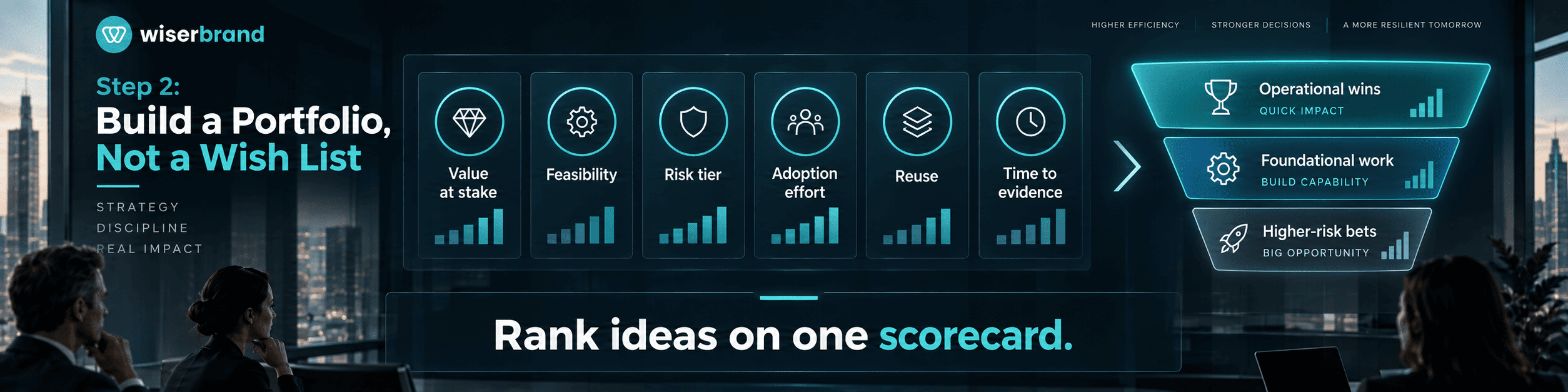
Enterprises rarely suffer from too few AI ideas. They suffer from evaluating each request in isolation, which produces duplicate pilots in three business units and no comparable evidence. Scoring every candidate against the same criteria makes the queue rankable and makes duplicates visible.
- Value at stake: volume multiplied by the cost or revenue effect per case, against a recorded baseline.
- Feasibility: data availability, integration effort, and how much of the task requires interpretation rather than calculation.
- Risk tier: reversibility of the actions, regulatory exposure, and customer or employee impact. The four tiers and their required controls are defined in Step 5.
- Adoption effort: how many people change how they work, and how much training that requires.
- Reuse: how far the data connections, controls, or patterns built here serve later initiatives.
- Time to evidence: how quickly the initiative can produce a defensible measurement.
Balance the portfolio rather than funding the ranked list from the top until the budget runs out. One workable starting allocation is roughly half the delivery capacity on near-term operational wins with measurable baselines, about a third on foundational work that later initiatives depend on, and the remainder on one or two higher-risk bets with kill criteria written before funding. Adjust the split to the readiness scores: weak data and access scores call for more foundational capacity.
Publish the ranking and the criteria behind it. When the queue is unranked, teams cannot contest a sequencing decision on evidence, so the argument moves to seniority and budget access instead.
Step 3: Choose the Delivery Model per Use Case
Delivery model selection should follow the requirement rather than a platform preference. Pick the cheapest option below that meets the requirement, and move up only when a limit is actually hit rather than anticipated.
| Delivery model | Fits when | Cost and control trade-off |
|---|---|---|
| Feature in software you already license | The vendor ships the capability and your requirement sits inside its configuration limits | Lowest cost and fastest, least control over behavior and roadmap |
| Configured low-code agent or assistant platform | Workflow crosses a few systems the platform already connects to | Moderate cost, business teams can maintain it, limits appear with complex logic |
| Custom build on a managed AI platform | System-specific logic, write access, validation, and controls the product does not expose | Higher build cost, full control of behavior, evaluation, and data handling |
| Self-managed infrastructure and models | Data residency, latency, or licensing requirements that managed services cannot meet | Highest operational ownership, justified only by a hard constraint |
Two governance decisions belong with this choice. Standardize the evaluation method across all four models, because a configured agent and a custom build cannot be compared on business results if each is scored differently. And settle portability early: agree which prompts, evaluation sets, and integration logic remain the organization’s property if the vendor changes.
Step 4: The Data Strategy That AI Adoption Actually Needs
An enterprise data strategy for AI adoption is narrower than a general data program and should be scoped to the use-case portfolio rather than to the whole estate. Four questions govern it.
Which system is the source of truth for each field the priority use cases read, and who owns that field? What quality level does each use case require, since a routing classifier tolerates noise that a pricing calculation does not? How current must retrieved content be before an answer becomes wrong, and what process keeps it current? And which records must stay outside model context for privacy, contractual, or regulatory reasons?
The practical output is a short list of remediation projects tied to specific use cases: deduplicating customer records, restructuring a knowledge base written for human readers rather than retrieval, adding scoped service accounts, or building an event queue where a source system offers no webhook. Fund these as portfolio items with named owners, not as background hygiene. WiserBrand’s data and AI consulting engagements treat readiness as a deliverable for this reason: a model deployed over unresolved data problems produces confident answers that are wrong in ways nobody notices for a quarter.
Step 5: Make Governance Proportional to Risk
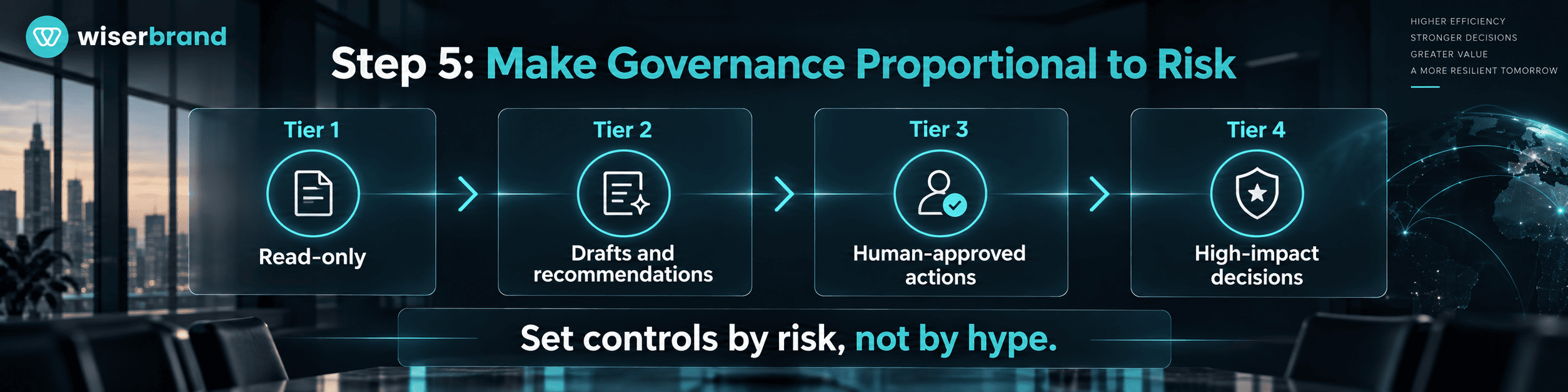
Governance inside an enterprise AI adoption strategy should scale with impact. Uniform governance fails in both directions. It slows harmless drafting tools and under-protects systems that touch money, employment, or customers.
Classify each use case into one of four tiers and attach controls to the tier rather than negotiating them per project.
| Tier | Example | Required controls |
|---|---|---|
| Low | Internal drafting, summarization, search over public content | Acceptable-use policy, logging, spot checks |
| Medium | Customer-facing drafts, classification and routing, internal data retrieval | Human review before send, permission scoping, evaluation set, monitoring |
| High | Financial transactions, pricing, eligibility, employment or credit decisions | Human approval per action, documented risk assessment, audit trail, named accountable owner, rollback plan |
| Prohibited | Actions the organization will not automate at all | Blocked at the tool layer, not by policy text alone |
Two External References That Keep the Tier Model Defensible
Internal risk tiers hold up better in an audit when they map to an external framework and to the regulation that applies. The NIST AI Risk Management Framework organizes the work into govern, map, measure, and manage functions and is voluntary and sector-agnostic, which makes it a workable spine for internal policy. NIST has said version 1.0 is being revised, so check the current release before writing it into standards.
For organizations operating in the European Union, the European Commission’s AI Act guidance sets both the categories and the timeline. The Act sorts systems into prohibited practices, high-risk systems listed in Annex III, high-risk AI embedded in products already regulated under Annex I, systems carrying transparency duties under Article 50, and everything else. General application began on 2 August 2026, including the Article 50 transparency duties. Following the Digital Omnibus, which entered into force on 27 July 2026, high-risk obligations apply from 2 December 2027 for stand-alone Annex III systems and from 2 August 2028 for AI embedded in regulated products. Map your use cases onto those five categories now, because the evidence needed to defend a classification takes months to assemble.
Step 6: Operating Model, Ownership, and Funding
Programs decay when accountability is spread evenly across a committee, because a shared responsibility has no one who can be asked to fix a specific failure or authorized to stop a specific initiative.
A workable structure has three layers. A small central function owns standards: intake, risk classification, evaluation methodology, shared platform decisions, and the AI system register. Business units own outcomes and process change, with a named business owner per initiative. Engineering, central or embedded, owns integration, deployment, and operations, with a named technical owner per system.
Funding should follow evidence rather than annual ambition. Release money in stages tied to the gates in Step 7: a small assessment budget, then a pilot budget, then a scaling budget contingent on measured results. Staged release lets the organization stop a weak initiative after the assessment or pilot spend rather than after the full build, which is the main financial benefit of running a portfolio at all.
Workforce Enablement Is Part of the Strategy, Not a Communications Task
People who perform the work must participate in specifying correct behavior, validating output, and defining exception paths. Training built around a specific role tends to change behavior more than general AI literacy sessions, because the question employees actually have is what changes in their job and what they remain responsible for, and a generic session answers neither. Say plainly which judgments stay human. Ambiguity on that point produces either quiet non-use or unsafe over-reliance, and both are expensive.
Step 7: Run Explicit Stage Gates From Pilot to Scale
Each initiative moves through eight gates, and the initiative cannot pass a gate until the named owner can show the evidence that gate requires.
- Assessment. The business owner records the baseline, the team identifies data dependencies, the central function assigns a risk tier, and business and technical owners are named.
- Design. The team writes down the trigger, inputs, systems, model responsibilities, deterministic rules, actions, approval points, and failure paths.
- Offline evaluation. The team measures performance on historical cases, including malformed inputs, ambiguous requests, and cases the current process handles badly.
- Controlled pilot. The workflow runs on live volume in one segment with full logging, human review on every consequential action, and a documented rollback path.
- Evidence review. The business owner and the central function compare results against the baseline and the acceptance criteria, and choose one of four options: expand, refine, pause, or stop.
- Production rollout. Monitoring, an incident path, cost tracking, and support ownership are in place before wider release.
- Control relaxation. The risk owner loosens review thresholds one at a time, per case category, based on measured override and error rates.
- Portfolio feedback. The team publishes reusable patterns, evaluation assets, and integrations for the next initiative.
Gate 5, the evidence review, is where discipline is tested. A program that has never stopped an initiative at the evidence review is not running gates; it is running approvals.
Measuring the Adoption Program
Measure the adoption program at three levels, and pair every efficiency measure with a quality counterweight so a gain in speed cannot hide a loss in correctness.
| Level | Metrics | Question answered |
|---|---|---|
| Initiative | Workflow completion rate, manual touch rate, cycle time, reviewer override rate, error escape rate | Did this process actually change |
| Program | Initiatives past the evidence review, time from intake to production, reuse rate of shared components, incident count | Is the machine for delivering initiatives working |
| Business | Cost per completed workflow, SLA compliance, rework rate, capacity released and where it went, revenue effect where attributable | Is the portfolio worth its cost |
Two disciplines protect the credibility of those numbers. Released capacity is not saved cost until the organization reallocates or reduces the hours, so state which of the two happened. And do not attribute a business result to AI simply because it followed deployment; where a controlled comparison is not possible, report that the result was associated with the change and describe the mechanism that would explain it.
Control the Unit Economics Before You Scale
Cost behavior changes at scale in ways pilots hide, and an enterprise AI adoption strategy should set the unit economics before rollout rather than after. Token spend grows with volume and context size, retrieval infrastructure grows with corpus size, and human review capacity grows with throughput until controls are relaxed. A pilot running a few hundred cases a week rarely exposes any of this, so the unit economics have to be modeled before rollout rather than observed after it.
Five controls keep the model honest. Track cost per completed workflow rather than cost per call. Set model choice per step rather than per system, since most steps do not need the largest model. Cap context size and retrieval breadth deliberately. Put budget alerts and rate limits on agent workflows before rollout. And review the top three cost drivers monthly. A workflow that is cheaper than the manual process at pilot volume can invert at production volume if nobody watches the denominator.
Seven Failure Modes in Enterprise AI Adoption Programs
Enterprise AI adoption programs fail in recognizable patterns, and most of those patterns are sequencing or governance errors rather than model errors. Seven recur often enough to design against explicitly.
Platform-first sequencing. The organization buys a license, then reverse-engineers a use case to justify it. The use case inherits the platform’s constraints instead of the workflow’s requirements.
Pilots without recorded baselines. A pilot that never captured pre-AI cycle time, manual touch rate, or error rate cannot be compared against anything, so it never concludes and never gets stopped.
A central function that reviews every request. When central approval becomes the slowest step, business teams route around it into unapproved tools, and the organization loses the visibility the review was meant to create.
Multi-agent architecture for a sequential process. Splitting a fixed sequence across several agents adds handoffs, state management, latency, and debugging cost. Where the steps are ordered and the rules are stable, a single agent or a deterministic workflow completes the same work with fewer failure paths.
Approval gates removed under schedule pressure. Relaxing a control because a launch date moved, rather than because measured override and error rates justify it, turns a risk decision into a calendar decision.
Untracked prompts, policies, and model versions. When behavior changes and nobody can identify which prompt, policy, or model version changed, the team cannot reproduce the previous behavior or explain the current one to an auditor.
No decommissioning path. Assistants that outlive their use case keep running with live system permissions. Retirement criteria and an owner should be assigned when the initiative is approved, not when someone notices the system later.
A Twelve-Month Sequence for the First Wave
The sequence below assumes a large organization with existing systems, no prior AI program, and two or three initiatives in the first wave. Adjust the durations to the Step 1 readiness scores; weak data scores push remediation earlier and extend the middle of the sequence.
- Months 1 to 2. The program sponsor commissions the readiness assessment and the AI inventory, including unapproved tools already in use, and decision rights are agreed in writing.
- Months 2 to 3. The central function scores and ranks the portfolio, publishes the risk tiers and control standards, and defines the evaluation methodology once for all initiatives.
- Months 3 to 5. Two or three initiatives go through design and offline evaluation, and the first data remediation project starts in parallel.
- Months 5 to 8. Controlled pilots run with recorded baselines and full logging. The first evidence review takes place, and at least one initiative is stopped or reshaped.
- Months 8 to 10. Initiatives that passed the evidence review move to production rollout, with monitoring and cost tracking live and runbooks and owners in place.
- Months 10 to 12. The second portfolio wave starts using reusable components, controls are relaxed where measured evidence supports it, and program metrics are reported to the sponsor.
Roughly twelve months is realistic at this scope, because each stage depends on the one before it and the pilot needs enough live volume to produce a defensible comparison. Compressing the sequence usually means skipping baselines, which removes the ability to prove anything later.
FAQ
How Is an Enterprise AI Adoption Strategy Different From an AI Technology Strategy?
A technology strategy selects platforms, models, and architecture patterns. An enterprise AI adoption strategy decides which business outcomes matter, which use cases enter the portfolio, who owns them, how they are funded and governed, and what evidence justifies scaling. Technology choices sit inside it as one step. Programs that start with the technology strategy tend to produce capable platforms with weak utilization.
Should We Centralize AI or Let Business Units Run Their Own Initiatives?
Both, with a clear split. Centralize standards, intake, risk classification, evaluation methodology, shared data and platform foundations, and the AI system register. Decentralize outcome ownership and process change to the business units, since they hold the process knowledge and absorb the disruption. A central team that approves every prompt becomes a bottleneck, and teams route around bottlenecks into unapproved tools.
How Many Use Cases Should an Enterprise Run in the First Wave?
Few enough to evaluate properly. Two or three initiatives per business unit is a common working limit, because each one needs a baseline, an evaluation set, a reviewer group, and an owner with protected time. Running a dozen at once produces activity reporting rather than evidence, and makes it impossible to attribute results to any single change.
What Belongs in an Enterprise Data Strategy for AI Adoption?
Scope it to the portfolio: sources of truth for the fields the priority use cases read, quality thresholds per use case, freshness requirements for retrieved content, permission and isolation rules, and a remediation backlog with named owners. A general data modernization program is a valid initiative on its own, but making it a prerequisite for all AI work delays every use case behind the slowest dependency.
How Do We Handle Unapproved AI Tools Already in Use?
Inventory before you legislate. Find what is in use, what data it touches, and which workflows depend on it, then offer an approved path that is easier than the workaround. Blanket bans move usage out of view rather than out of existence. Where an unapproved tool is doing something genuinely useful, the practical response is often to bring it under governance rather than replace it.
When Should an Initiative Be Stopped Rather Than Improved?
Stop when the evidence review shows the workflow effect is small against the baseline, when the error profile creates risk the controls cannot economically contain, when the data dependency cannot be resolved in a reasonable horizon, or when adoption fails because the design does not fit how people actually work. Stopping cheaply at a gate is the portfolio working correctly, not a failure of the program.
Final Thoughts
Sequence beats ambition. Assess readiness honestly, rank the portfolio in public, tie funding to gates, set controls by risk tier, and measure workflow outcomes against recorded baselines rather than model demonstrations. An enterprise AI adoption strategy built that way survives leadership changes and vendor changes, because the decisions it records are about the business rather than the stack.
For an organization starting or resetting a program, a scoped readiness and portfolio assessment is the practical first step. WiserBrand runs that as a standalone engagement and delivers the resulting initiatives through custom AI development and AI agent development work when the portfolio calls for it.