AI Chatbots in Banking: Use Cases, Benefits, Risks, and Implementation

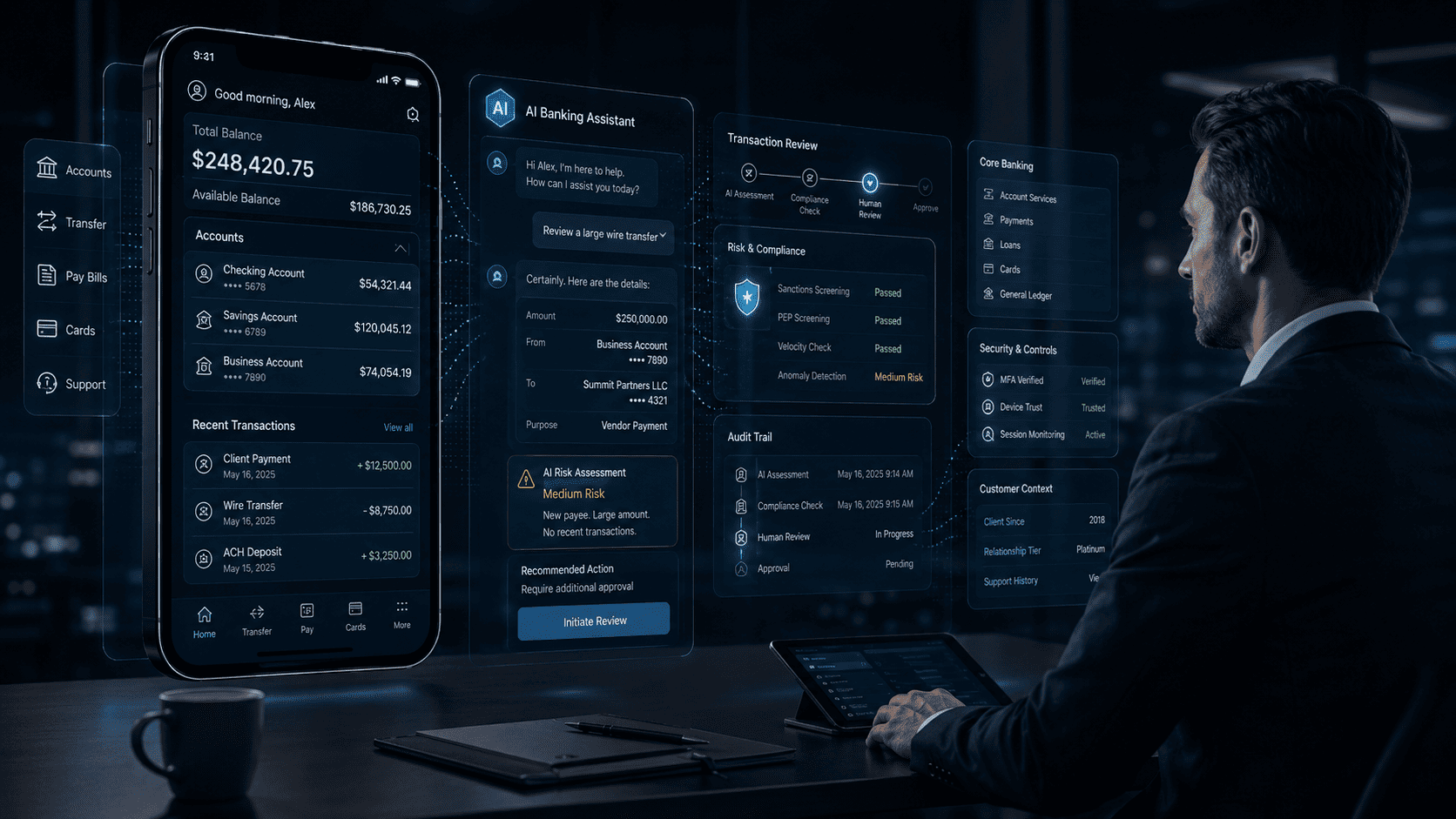
An AI chatbot banking project can give customers faster access to routine account information while reducing repetitive work for service teams. The strongest systems answer bounded questions, retrieve verified data, complete low-risk tasks, and transfer complex or sensitive cases to a qualified employee with the conversation context attached.
A banking chatbot should not become a barrier between a customer and the bank. Financial questions can involve disputed transactions, possible fraud, fees, debt, account access, or legal rights. The Consumer Financial Protection Bureau has warned that deficient chatbots can provide inaccurate information, block timely human support, expose sensitive data, and create consumer harm. Banks remain responsible for meeting their legal and customer-service obligations when the interaction is automated.
This guide explains how banking chatbots work, where they create practical value, which risks need stronger controls, and how to move from a narrow pilot to a monitored production service.
What Is an AI Chatbot in Banking?
AI chatbot development for banking combines conversational interfaces with approved knowledge, authentication, integrations, workflow logic, and controlled access to customer or operational systems. It may operate in a mobile banking app, website, messaging channel, contact center, or internal employee portal.
The term covers several architectures:
| Chatbot Type | How It Works | Suitable Banking Tasks |
|---|---|---|
| Rule-based bot | Follows predefined menus, keywords, and decision trees | Branch hours, routing, simple FAQ flows |
| Retrieval-based chatbot | Finds answers in an approved knowledge base | Product terms, policy explanations, employee procedures |
| Generative AI chatbot | Produces natural-language responses from instructions and retrieved context | Conversation summaries, guided explanations, response drafts |
| Transactional chatbot | Calls approved banking services after authentication | Card lock, payment-date lookup, address-change intake |
| Agentic assistant | Plans several steps and uses multiple tools under defined limits | Case preparation, service triage, internal operations support |
A chatbot can use generative AI without receiving permission to take action. It can also complete a transaction through deterministic APIs without deciding the transaction rules itself. Banking teams should separate language generation from authentication, eligibility, calculations, approvals, and core banking updates.
Where Banking Chatbots Fit
A banking chatbot can support customers, contact-center employees, relationship managers, operations teams, and compliance functions. The right scope depends on data access, transaction risk, channel security, and the cost of a wrong answer.
Customer-facing bots are most useful for high-volume service journeys. Internal bots often have a safer starting point because an employee can review the output before it reaches a customer or changes a record.
Bank of America provides one public example of deployment at scale. In August 2025, the bank reported that Erica had supported nearly 50 million users and passed 3 billion client interactions since launch. Those figures describe one bank's implementation, not a general benchmark for chatbot performance.
Banking Chatbot Use Cases
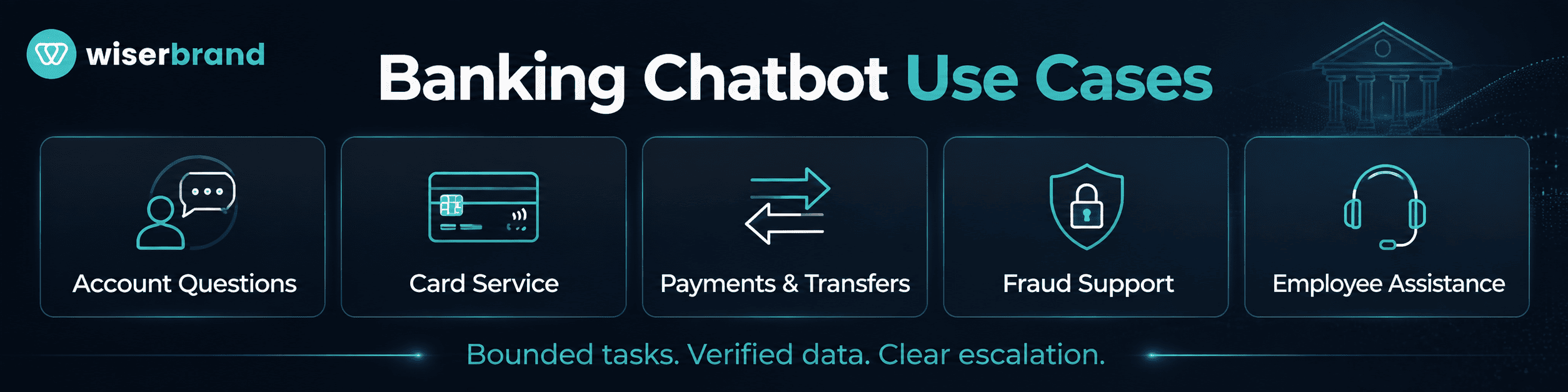
The best use cases have a clear trigger, approved data, bounded actions, and an escalation path. They solve a frequent service or operational problem without asking the model to make an unreviewed financial judgment.
Account and Transaction Questions
A chatbot can answer authenticated questions about balances, recent transactions, payment due dates, deposit status, statement availability, and account details. The response should come from live bank systems or a verified service layer rather than from the model's general knowledge.
A typical workflow is:
- The customer signs in through an approved channel.
- The chatbot confirms the requested account or transaction.
- A service retrieves the current record.
- The chatbot presents the result in plain language.
- An unusual, disputed, or unavailable transaction moves to a specialist.
The chatbot may explain what a posted or pending status means. It should not invent the reason for a delay or state that a transaction is legitimate when the bank has not established that fact.
Card Service
Common card journeys include activation guidance, card-lock requests, replacement intake, travel-related questions, payment-date lookup, and suspected fraud escalation.
Low-risk actions can be automated after strong authentication and confirmation. A card lock, for example, should use a defined API and return a recorded status. A fraud claim, fee dispute, or request involving an unauthorized transaction needs a controlled case flow and access to a person when required.
The bot should distinguish between temporary card control and formal dispute handling. Customers should not leave the conversation believing they filed a dispute when the system only locked the card.
Payments and Transfers
A banking chatbot can help customers find payment instructions, review scheduled payments, understand transfer limits, or prepare a transfer request. Direct movement of money requires stronger controls than informational support.
For transactional use, the system needs:
- authenticated identity and session checks;
- explicit confirmation of amount, recipient, date, and source account;
- deterministic validation of limits and account status;
- step-up authentication when policy requires it;
- duplicate-action protection;
- a clear receipt and audit record;
- a safe failure message that does not imply completion.
The language model can guide the conversation. Payment authorization and execution should remain in controlled banking services. Fintech software development can provide the APIs, transaction workflows, authentication, auditability, and system integrations required around the conversational layer.
Product Discovery and Onboarding Support
A chatbot can explain product categories, collect onboarding information, answer document questions, schedule appointments, and route a prospect to the right team. It may also compare published features when the comparison criteria and source data are approved.
The bot should avoid presenting a product as suitable based only on a short conversation. Recommendations involving credit, investments, insurance, or material financial commitments may trigger additional legal, suitability, disclosure, or review requirements depending on the market and product.
A safer design helps the user understand options, gathers relevant information, and transfers the case to the appropriate licensed or authorized employee when judgment is needed.
Loan and Mortgage Application Support
Chatbots can guide applicants through process steps, document requirements, application status, appointment scheduling, and requests for missing information. Internal assistants can summarize application files or prepare a case for an employee.
The chatbot should not make an unsupported promise about approval, interest rate, closing date, or eligibility. Credit decisions and adverse-action processes need formal rules, evidence, notices, and accountable review. The assistant can explain published process information and collect data, but decision logic should remain in approved systems.
Fraud Alerts and Security Support
A chatbot can help a customer respond to a suspicious-activity alert, lock a card, review recent transactions, or reach the fraud team. It can also give channel-specific instructions after the customer reports a phishing message.
The bank must design for impersonation risk. Attackers can create fake banking bots, copy brand language, and ask customers for credentials or payment information. The CFPB has highlighted impersonation, phishing, insecure chat logs, and sensitive-data exposure as material concerns in financial chatbot deployments.
The legitimate bot should state what information it will never request, avoid collecting secrets in free text, and provide a visible route to verified bank support.
Disputes and Complaint Intake
A bot can collect the basic facts of a dispute or complaint, identify the affected account or transaction, generate a case number, and route the record to the correct queue. It can also tell the customer which documents may be needed.
This workflow needs careful language. The customer should know when a formal case has been opened, which date applies, and what happens next. The bot must recognize phrases that may invoke customer rights or signal urgent harm, then route the case according to the bank's approved process.
A customer should not have to repeat the full story after handoff. The employee should receive the transcript, authenticated customer context, records already retrieved, and the reason for escalation.
Internal Employee Assistance
An internal banking chatbot can help contact-center agents, branch staff, relationship managers, and operations teams search procedures, summarize cases, draft replies, and locate current policy content.
This is often a strong first implementation because the employee remains responsible for the final answer or action. The assistant can reduce search time while providing source links and effective dates for review.
The internal knowledge base still needs access controls. A branch employee should not receive confidential investigation material, and a general support employee should not gain access to restricted customer or HR data through the chatbot.
Benefits of AI Chatbots in Banking
The benefits come from specific workflow changes, not from the presence of a conversational interface.
| Benefit | Operational Mechanism | Suitable Metric |
|---|---|---|
| Faster routine service | Immediate access to verified answers and account data | Time to first useful response |
| Higher self-service completion | Customers finish bounded tasks without changing channels | Containment and task-completion rate |
| Lower repetitive workload | Common questions and data lookups move away from employees | Human-handled contacts per transaction |
| Better handoffs | The bot passes context, records, and intent to an employee | Repeat-information rate and transfer time |
| More consistent information | Responses use approved policy and product sources | Policy-answer accuracy and correction rate |
| Broader service availability | Supported journeys remain available outside contact-center hours | Successful off-hours sessions |
| Better operational insight | Conversation topics reveal recurring customer friction | Contact reason trends and product issue rate |
A high containment rate is not automatically a good result. A chatbot can keep customers inside the automated channel while failing to solve the issue. Banks should measure successful completion, repeat contacts, complaints, abandonment, and downstream corrections alongside containment.
Risks That Need Bank-Level Controls
Banking chatbots operate around financial records, identity data, regulated processes, and customers who may be under stress. Risk controls should be designed into the workflow before launch.
Incorrect or Unsupported Answers
Generative models can produce fluent text that is not supported by the bank's data or policies. In banking, an incorrect statement about a fee, transaction, payment, dispute, eligibility rule, or deadline can create direct harm.
The system should use approved sources, show the effective policy version, restrict answers to the intended domain, and route uncertain cases to a person. High-impact answers need stronger evaluation than general FAQ content.
Failed Human Escalation
A chatbot becomes harmful when it keeps a customer in a loop after the automated path has failed. Escalation should depend on intent, risk, repeated misunderstanding, customer request, and confidence rather than a fixed number of messages alone.
The CFPB has advised financial institutions to avoid making chatbots the primary service channel when the technology is clearly unable to meet the customer's needs.
A production bot should provide visible access to human support, preserve the conversation context, and prioritize urgent matters such as suspected fraud, loss of account access, disputes, and financial hardship.
Privacy and Sensitive Data Exposure
Chat transcripts may contain account details, identity data, financial circumstances, complaint facts, and authentication clues. The bank needs rules for collection, masking, retention, employee access, vendor use, deletion, and incident investigation.
Data minimization matters. The bot should request only what the workflow needs. Passwords, full card credentials, security codes, and authentication secrets should not enter general conversation logs.
Prompt Injection and Tool Misuse
A generative banking chatbot may process customer text, uploaded documents, retrieved pages, or internal knowledge. Malicious instructions can be hidden in those inputs and attempt to alter the model's behavior.
OWASP identifies prompt injection, sensitive information disclosure, improper output handling, and excessive agency among major risks for LLM applications. Excessive agency becomes especially serious when a chatbot can call transaction or account-management tools.
Controls should include input isolation, approved retrieval sources, narrow tool permissions, deterministic validation, transaction limits, explicit confirmation, and human approval for high-impact actions.
Fraud and Impersonation
Customers may struggle to distinguish a real bank bot from a convincing imitation. The bank should keep chatbot entry points inside verified channels, use consistent identity cues, publish anti-fraud guidance, and avoid teaching customers to share secrets in chat.
The bot should also detect suspicious conversation patterns, repeated attempts to access several identities, unusual tool requests, and social-engineering language. Detection should route the event to security controls rather than asking the model to judge fraud alone.
Bias, Language, and Accessibility
A banking chatbot may perform differently across languages, dialects, disabilities, devices, and levels of financial literacy. Testing only short, well-formed English prompts can hide failures that appear in real service conditions.
Evaluation should include supported languages, speech or text variations, accessibility testing, ambiguous requests, and customer groups likely to face difficulty with digital channels. The system should use plain language and make alternative support channels easy to find.
Third-Party and Concentration Risk
A bank may depend on a model provider, cloud platform, chatbot vendor, voice provider, analytics tool, or integration partner. A vendor update can change behavior, data handling, availability, or cost.
The European Banking Authority's June 2026 risk assessment notes AI-related concerns that include operational failure, bias, data quality, cyberattacks, third-party reliance, legal risk, and concentration. It also states that banks should integrate AI tools into relevant ICT risk, incident, resilience, and third-party oversight processes.
Vendor review should cover data use, sub-processors, hosting, model changes, testing evidence, incident notification, service continuity, audit rights, and exit planning.
What to Automate and What to Keep Human
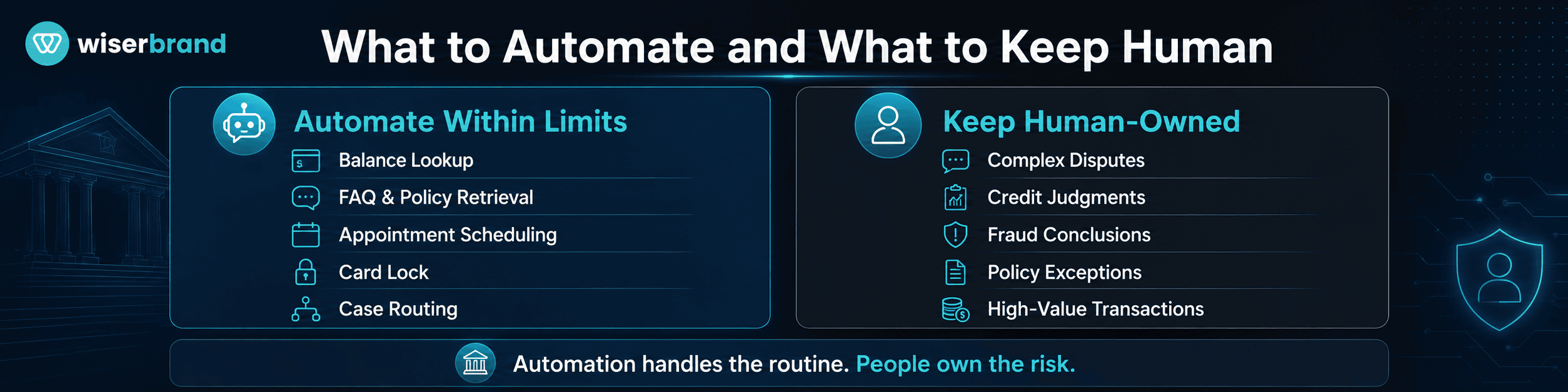
A bank should automate work that is frequent, bounded, reversible, and supported by trusted data. Human ownership should remain where the decision involves rights, financial harm, unusual circumstances, or interpretation of incomplete evidence.
| Automate Within Defined Limits | Keep Human-Owned or Human-Approved |
|---|---|
| Balance and transaction lookup | Complex disputes and complaints |
| Published FAQ and policy retrieval | Legal-rights interpretation |
| Appointment scheduling | Credit and suitability judgments |
| Card lock after authentication | Fraud conclusions and account closure |
| Missing-document reminders | Exceptions to fees, limits, or policy |
| Case classification and routing | Financial hardship arrangements |
| Conversation summary | High-value or irreversible transactions |
| Draft response for employee review | Sensitive customer communication outside approved scripts |
The decision should be based on risk, not on technical capability. A model may be able to generate a response or call a tool. That does not mean the bank should give it final authority.
Banking Chatbot Architecture
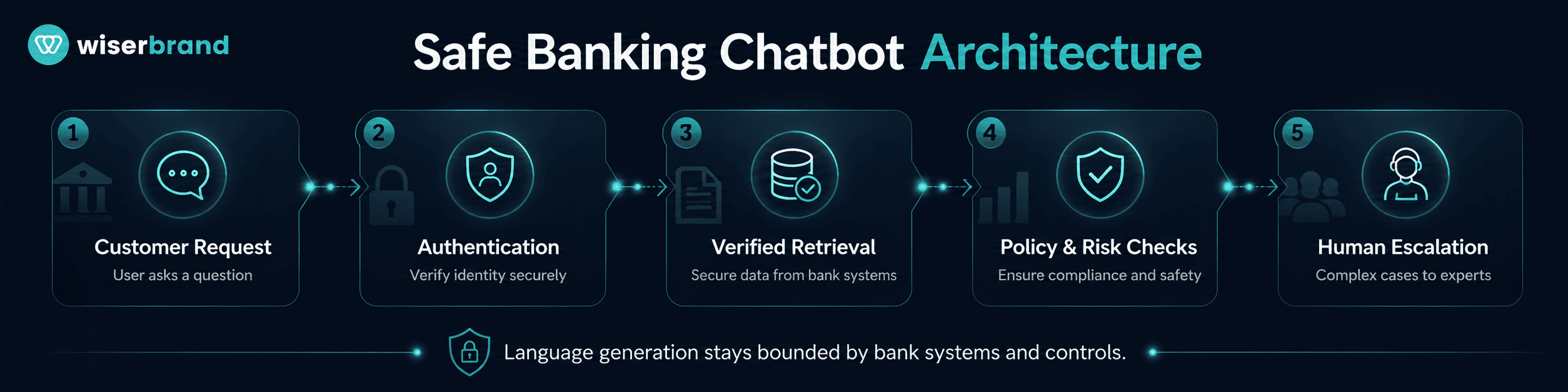
A production banking chatbot needs more than a language model and a chat window. AI integration connects the conversational layer with identity services, core banking systems, CRM, payments, case management, and governed knowledge sources.
| Architecture Layer | Purpose |
|---|---|
| Channel and interface | Mobile app, authenticated web, messaging, voice, or employee portal |
| Identity and session | Authentication, device and session context, role and customer permissions |
| Conversation orchestration | Intent routing, state, prompts, confidence, escalation logic |
| Knowledge retrieval | Approved product, policy, procedure, and help content |
| Service integration | Core banking, cards, payments, CRM, case management, scheduling |
| Policy and decision layer | Eligibility, limits, calculations, approvals, and prohibited actions |
| Human handoff | Queue selection, priority, transcript, retrieved records, and reason |
| Security controls | Data filtering, secrets protection, tool permissions, abuse detection |
| Observability | Logs, traces, quality evaluation, failures, overrides, latency, cost |
| Governance | Owners, versions, release evidence, change approval, incident response |
Critical calculations and business rules should live in deterministic services where possible. The chatbot can translate a customer request into a structured action, but the banking service should validate the action before execution.
Authentication and Transaction Controls
Authentication should match the requested action. A public visitor asking about branch hours does not need the same checks as a customer requesting an account change.
Use risk-based steps:
- Keep public information separate from authenticated account services.
- Bind the conversation to an approved session and customer identity.
- Recheck authorization before every sensitive tool call.
- Require explicit confirmation for transactional details.
- Use step-up authentication for higher-risk actions.
- Add limits, idempotency, and duplicate detection.
- Return a clear success or failure status from the banking service.
- Log the request, validation, action, and final result.
The chatbot should not treat knowledge of personal information as proof of identity. It should not expose sensitive records because the user mentioned an account number or supplied convincing contextual details.
Regulatory and Governance Considerations
A chatbot does not sit outside the rules that apply to the bank's products, service processes, records, customer communications, privacy, complaints, and third parties.
In the European Union, Article 50 of the AI Act requires providers of AI systems intended to interact directly with people to design them so users are informed that they are interacting with AI, unless that is already obvious in context.
For risk management, NIST's AI Risk Management Framework and Generative AI Profile provide cross-sector guidance for governing, mapping, measuring, and managing AI risks across the lifecycle. The Generative AI Profile addresses risks that need evaluation and control beyond conventional software testing.
A bank's implementation should map applicable obligations by country, product, channel, customer group, and action. The project team needs legal, compliance, privacy, security, model risk, customer service, product, data, and engineering participation where relevant.
Implementation Blueprint
- Select a bounded use case.
Start with a frequent journey that has reliable data and low action risk. Product FAQs, authenticated balance lookup, appointment scheduling, employee policy search, and support triage are common candidates.
Avoid starting with a broad bot that promises to answer every banking question or complete any transaction.
- Map the current workflow.
Document the trigger, customer intent, data sources, systems, employee steps, required disclosures, failure modes, and escalation path. Measure current contact volume, handling time, repeat contact, transfer rate, errors, and customer satisfaction.
- Define the chatbot's authority.
List what the bot may read, explain, draft, update, and initiate. List prohibited actions separately. Define which actions need authentication, confirmation, or employee approval.
- Prepare approved knowledge.
Create a governed source set with owners, effective dates, product scope, regional scope, and review cycles. Remove duplicate or conflicting policies. Retrieval should favor current approved content and preserve source references.
- Design authentication and access.
Give the bot access only to the records and functions required for the selected journey. Separate customer permissions, employee roles, and service credentials. Do not reuse broad administrator access for convenience.
- Build handoff before autonomy.
The first production version should know when and how to stop. Create queues for fraud, disputes, complaints, vulnerability, technical failure, and general specialist review. Pass the transcript and gathered context so the customer does not restart the process.
- Test real and adversarial scenarios.
Testing should include:
- correct and incomplete requests;
- unsupported products and outdated policies;
- ambiguous transaction descriptions;
- frustrated or vulnerable customers;
- supported languages and accessibility needs;
- prompt injection and data-extraction attempts;
- identity and permission failures;
- unavailable APIs and delayed systems;
- duplicate transaction attempts;
- cases where the correct behavior is refusal or escalation.
- Launch with limited scope.
Start with one product, channel, customer segment, or employee team. Keep write actions disabled or tightly limited until the team has evidence from real use.
- Monitor the full workflow.
Track model output, retrieval, tools, handoffs, customer outcomes, employee corrections, complaints, and system failures. A managed AI approach can support ongoing evaluation, monitoring, incident response, model and prompt changes, and production oversight after launch. Monitoring only response time or conversation volume will miss the failures that matter most.
- Expand through approved releases.
Treat every new product, language, data source, tool, transaction, or model version as a change to the risk profile. Run regression tests and update documentation before release.
Build, Buy, or Customize?
The right delivery model depends on how much bank-specific data, integration, and control the use case needs.
| Approach | Best Fit | Main Limitation |
|---|---|---|
| Platform chatbot | Simple FAQs and common service flows | Limited control over complex banking logic |
| Banking-focused vendor | Prebuilt intents and financial integrations | Vendor dependency and fit gaps |
| Custom chatbot | Differentiated journeys, core integrations, strict controls | Higher build and maintenance effort |
| Hybrid approach | Vendor channel or model with custom orchestration and policy services | Requires clear ownership across components |
A proof of concept may use a managed model and a narrow knowledge base. A production system still needs the bank's identity, policy, integration, monitoring, and governance layers.
Vendor selection should consider security architecture, data residency, retention, model training policy, integration options, supported languages, evaluation evidence, change notification, incident response, accessibility, logs, and exit strategy.
How to Measure a Banking Chatbot
Measurement should combine customer outcomes, operational value, risk, and system performance.
| Metric Area | Example Metrics |
|---|---|
| Customer outcome | Task completion, first-contact resolution, repeat contact, abandonment |
| Service quality | Answer accuracy, policy accuracy, complaint rate, escalation quality |
| Operations | Handling time, employee search time, transfer time, contact volume |
| Risk | Unauthorized actions, privacy incidents, harmful answer rate, missed escalation |
| Reliability | Availability, latency, retrieval failure, tool failure, duplicate action rate |
| Adoption | Eligible users, repeat use, employee acceptance, channel shift |
| Cost | Cost per completed task, infrastructure cost, human review cost |
Measure against a baseline. A reduction in employee-handled conversations is useful only when successful completion and customer outcomes remain acceptable.
Review metrics by intent, product, language, channel, and customer group. Aggregate results can hide a bot that works well for balance questions but fails for disputes or non-native language requests.
Common Implementation Mistakes
- Starting with every product and service instead of one bounded journey.
- Connecting the model directly to core systems without a policy and validation layer.
- Treating a confident answer as an accurate answer.
- Measuring containment without measuring successful resolution.
- Hiding access to a person behind repeated bot failures.
- Using public website content as the only source for authenticated service questions.
- Allowing sensitive data to remain in general conversation logs.
- Giving the bot broad transaction permissions.
- Skipping testing across languages, accessibility needs, and vulnerable customer scenarios.
- Letting vendor or model changes reach production without regression testing.
- Launching without an owner who can pause the service and lead incident response.
FAQ
What Is an AI Chatbot in Banking?
An AI chatbot in banking is a conversational system that interprets customer or employee requests, retrieves approved information, and may start bounded banking workflows. It can support account questions, card service, onboarding, application status, complaints, fraud escalation, and internal knowledge search.
What Is the Difference Between a Banking Chatbot and a Virtual Assistant?
The terms often overlap. A chatbot may focus on text conversation and limited intents. A virtual assistant may support more channels, retain more context, connect to account services, and complete multi-step tasks. The product name does not define the risk. Data access and action authority do.
Are Banking Chatbots Safe?
They can be safe for defined tasks when the bank applies strong authentication, data minimization, source controls, narrow tool permissions, testing, human escalation, monitoring, and incident procedures. A bot with broad access, weak validation, or no human path creates avoidable risk.
Can a Banking Chatbot Make Payments?
A chatbot can guide or initiate a payment flow, but the payment service should validate identity, authorization, limits, account status, recipient details, and confirmation. Higher-risk payments may need step-up authentication or human review.
Can Chatbots Replace Bank Customer Service Employees?
A chatbot can handle many routine questions and prepare cases for employees. It should not replace human support for complex disputes, financial hardship, fraud, complaints, vulnerable customers, legal rights, or cases outside its approved scope.
What Is the Best First Banking Chatbot Use Case?
A strong first use case is frequent, narrow, measurable, and low risk. Examples include authenticated account lookup, appointment scheduling, employee policy search, product FAQs, or service triage with a clear human handoff.
How Long Does Banking Chatbot Implementation Take?
The timeline depends on scope, channel, authentication, data quality, integrations, languages, security review, and regulatory requirements. A narrow pilot can move faster than a transactional chatbot connected to several core systems. The delivery plan should be based on architecture and release evidence rather than a generic estimate.
Final Thoughts
An AI chatbot banking program succeeds when it solves a defined service problem without weakening customer access, data protection, or accountability. Start with verified information and low-risk workflows. Keep financial judgments, sensitive exceptions, and irreversible actions under human authority.
The production system needs more than conversation quality. It needs authentication, deterministic banking rules, narrow permissions, human handoff, audit records, evaluation, monitoring, and a practical way to stop or roll back the service.
We build conversational AI and fintech software around these operational requirements. WiserBrand's AI chatbot development services cover conversation design, integration, analytics, and post-launch improvement, while our fintech software development practice supports secure customer portals, banking workflows, APIs, and data systems.