AI Adoption Strategy for Marketing: Where to Start and How to Scale


An AI adoption strategy for marketing decides which parts of the marketing workflow change, who approves what, and how the team proves the change was worth it. Most marketing organizations skipped that step. They bought seats, watched content volume rise, and cannot now say which number moved. Volume is the easy part, and it is also the part search engines and customers discount fastest. This guide covers where AI genuinely changes marketing economics, how to map use cases to the workflow rather than to job titles, the approval boundaries that protect brand and legal exposure, the search and disclosure rules that apply to AI-assisted content, and the measurement that separates a productive rollout from an expensive one.
What the Strategy Has to Decide
An AI adoption strategy for marketing carries a specific risk: marketing teams adopt AI faster than most functions and govern it less. Six decisions keep the rollout coherent.
- Which workflow stages change: research, planning, production, review, distribution, or analysis.
- What the model produces versus what a person owns: draft, variant, classification, recommendation, or published asset.
- Which claims, offers, and creative can never ship without human sign-off.
- Which customer data may enter a prompt, and under which consent basis.
- What gets measured beyond output volume, against a recorded baseline.
- Who owns quality when production speed triples, since review capacity becomes the new bottleneck.
The last point is where most rollouts break. Tripling draft output without expanding review capacity moves the queue rather than the outcome.
Where AI Actually Moves Marketing Numbers
Marketing is one of the few functions with reported top-line effects. In McKinsey's 2026 global survey, respondents most often attributed revenue gains to AI use in marketing and sales, ahead of product development and software engineering. The same survey found only 37 percent of respondents reporting any enterprise EBIT effect from AI, unchanged year over year, against 80 percent reporting personal productivity gains.
Read together, those two findings define the opportunity and the trap. Marketing sits where measurable revenue effects are most commonly reported, and marketing also produces the easiest-to-fake productivity story: more assets, more variants, more posts, none of it tied to pipeline. An AI adoption strategy earns its budget by connecting the workflow change to a funnel metric, not to an output count.
Map the Workflow Before Picking Tools
Build the AI adoption strategy around the chain, not the org chart. Marketing work runs research, brief, produce, review, launch, measure, iterate. AI compresses different links in that chain at different rates, and the bottleneck is rarely production.
For most teams the actual constraints are the brief and the review. Briefs are thin, so drafts miss. Review is a senior-person queue, so approved output stays flat regardless of how many drafts arrive. A strategy that automates production and leaves those two untouched produces frustration and a larger backlog.
Start by timing your own chain for one campaign type. Record hours per stage, wait time between stages, and rework rate. That baseline is what makes any later claim defensible, and it takes about two weeks to collect.
Use Cases by Marketing Function
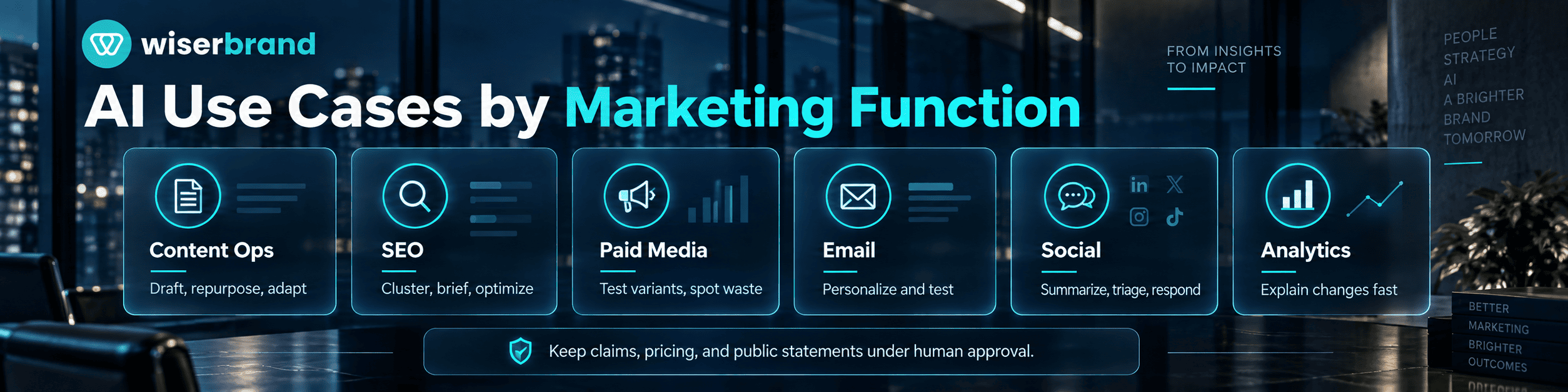
| Function | Highest-value AI task | What stays with a person | Metric to watch |
|---|---|---|---|
| Content operations | First drafts from a structured brief, format adaptation, internal repurposing | Angle, claims, expert input, final edit | Editor edit rate, approved assets per week, time from brief to publish |
| SEO | Query clustering, gap analysis, internal link suggestions, metadata drafting | Topic selection, originality, expertise signals | Non-brand clicks, pages with genuine engagement, refresh cycle time |
| Paid media | Ad variant generation, audience hypotheses, anomaly detection on spend | Budget shifts, claims, targeting policy | Cost per qualified lead, variant win rate, wasted-spend detection time |
| Lifecycle and email | Segment-specific variants, send-time and subject testing, journey drafting | Offer approval, suppression rules, tone | Conversion per send, unsubscribe rate, revenue per recipient |
| Social and community | Draft replies, listening summaries, escalation triage | Public statements, crisis response, community policy | First-response time, escalation accuracy, sentiment trend |
| ABM and sales support | Account research, personalization inputs, meeting prep briefs | Commitments, pricing, relationship judgment | Meeting-to-opportunity rate, research hours saved and reallocated |
| Analytics and reporting | Data summarization, anomaly explanation drafts, report assembly | Attribution decisions, forecast sign-off | Reporting cycle time, decision latency |
| Creative production | Concept variants, resizing and localization, asset tagging | Brand direction, model and rights clearance, final art | Assets per campaign, review passes per asset, rights incidents |
Notice the pattern in column three. Claims, offers, pricing, public statements, and rights clearance stay human in every row. Those are the categories where an error is expensive and hard to reverse.
Four Levels of Adoption, and When to Move Up
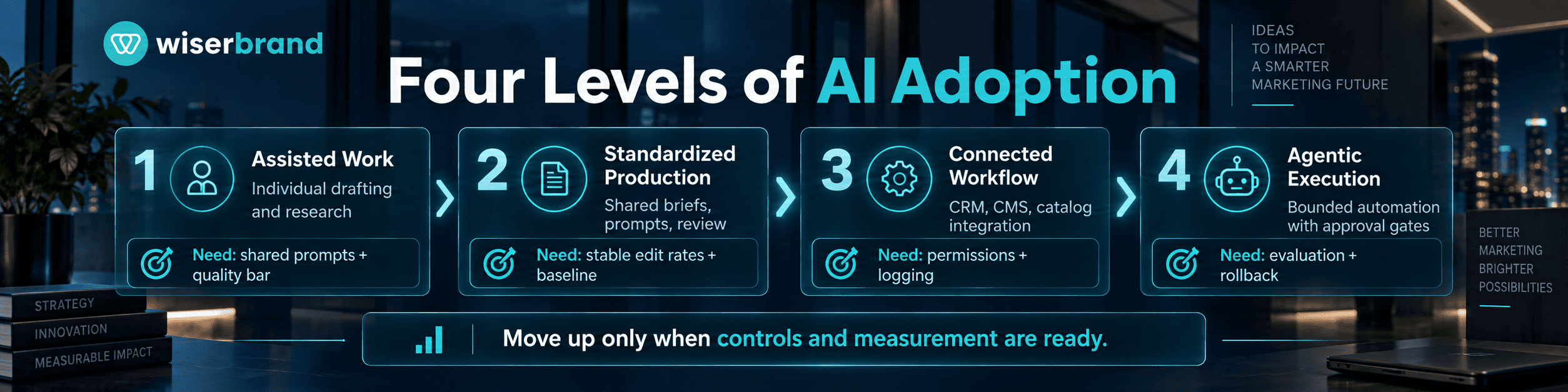
| Level | What it looks like | Prerequisite for moving on |
|---|---|---|
| 1. Assisted work | Individuals use tools for drafting, summarizing, and research with no shared process | Shared prompts, a style reference, and a quality bar the team agrees on |
| 2. Standardized production | Briefs, prompts, and review checklists are shared assets; output is consistent enough to measure | Edit rates stable and falling; baseline recorded |
| 3. Connected workflow | AI steps sit inside the martech stack, reading the CRM, CMS, or product catalog and writing drafts back | Data access, permissions, and logging in place |
| 4. Agentic execution | An agent completes bounded tasks end to end, such as refreshing product copy or triaging inbound replies, with approval gates on anything published | Evaluation set, override tracking, rollback path, named owner |
Most teams should be at level 2 before they buy anything for level 3. Level 4 is justified by volume and repetition, not by ambition; an agent that runs twice a month costs more to maintain than it saves.
Brand, Claims, and the Approval Boundary
Every AI adoption strategy needs one boundary written down and applied at the tool level rather than in a policy document nobody rereads.
Permanent human sign-off belongs on: product and performance claims, pricing and offer terms, regulated categories such as health, finance, and children's products, comparative claims about competitors, customer quotes and case results, executive communications, and anything with legal review history. Everything else can move to sampling review once the correction log shows a stable low error rate for that asset type.
Two mechanisms make this durable. Keep a claims source of truth, a single approved list of what the company may say about performance, compliance, and results, and ground drafting tools in that document rather than in the open web. And log corrections by category, because the pattern in your edits tells you which asset types are ready for lighter review and which are not.
Search Visibility Rules for AI-Assisted Content
Publishing volume without judgment is the fastest way to damage an owned channel. Google's guidance on generative AI content states that using such tools to generate many pages without adding value for users may violate its spam policy on scaled content abuse, and directs publishers to meet Search Essentials and spam policy standards. The guidance also asks for accuracy in generated metadata, including titles, descriptions, structured data, and image alternate text, and suggests giving readers context about how content was created. For ecommerce, Merchant Center policies require AI-generated images to carry IPTC DigitalSourceType TrainedAlgorithmicMedia metadata, with AI-generated product titles and descriptions labeled as such.
The practical translation for a marketing team: AI can research, structure, and draft, but each published page still needs original value that a person contributes: first-hand experience, proprietary data, expert review, or a genuinely better explanation. Publishing cadence should be capped by review capacity, not by generation capacity. Our marketing automation consulting work usually starts by fixing that ratio, since it is the single change that protects an organic channel during a rollout.
Disclosure and Compliance
Three obligations affect most marketing teams.
Interaction disclosure: under the EU AI Act, Article 50 transparency duties became applicable on 2 August 2026, covering systems that interact directly with people and generative systems whose output must be marked as artificially generated. Deployers producing deep-fake image, audio, or video content must disclose it, and text published to inform the public on matters of public interest carries a similar duty, subject to specified exceptions.
Advertising claims: existing advertising and consumer protection law applies unchanged to AI-generated copy. Substantiation requirements do not soften because a model wrote the sentence.
Personal data: consent basis, retention, and vendor terms govern what customer data may enter a prompt. Confirm that your plan excludes inputs from vendor training, and keep identifiers out of prompts when the task does not need them.
Data and Martech Readiness
The value of AI in marketing is capped by the data it can reach. Before level 3 adoption, confirm four things: which system holds the authoritative customer record, how consent and suppression states propagate to any tool that drafts outbound messages, how product and pricing data are read programmatically rather than copied, and which content library is current enough to ground retrieval.
Most marketing stacks fail on the second and fourth. A tool that drafts personalized email from a stale segment will send confidently wrong messages faster than the old process did. Fixing suppression and content currency is unglamorous and belongs in the roadmap before any agentic use case.
Measuring the Rollout

Judge the AI adoption strategy on paired measures rather than output counts.
| Layer | Metric | Why it matters |
|---|---|---|
| Production | Time from brief to approved asset, editor edit rate, rework rate | Shows if the chain got faster or only louder |
| Quality | Error escape rate, claim corrections, brand-guideline violations caught in review | The counterweight to speed |
| Channel | Non-brand organic clicks and engaged sessions, email conversion per send, ad cost per qualified lead | Channel-level effect of the change |
| Pipeline | Qualified leads, meeting-to-opportunity rate, pipeline created per campaign | Effect on marketing outcomes |
| Cost | Tool and model spend per approved asset, review hours per asset | The denominator behind any efficiency claim |
Set the baseline before the rollout and segment by asset type. Aggregate averages hide the useful signal, which is usually that one or two content types improved sharply and the rest did not.
Team Design and Cost
Roles shift more than headcount under an AI adoption strategy. Editing and quality control expand, briefing becomes a formal skill, and someone has to own prompts, shared assets, and the claims source of truth. Teams that assign that ownership to nobody in particular find their prompt library rotting within a quarter.
On cost, the tool subscriptions are minor next to two other lines: review time, which rises with volume until controls relax, and rework, which is invisible in most reporting. Track spend per approved asset rather than per seat, since that ratio exposes rollouts producing volume nobody can ship.
A 90-Day Rollout
- Weeks 1 to 2: pick two workflows, record the baseline for each, and inventory tools already in use across the team.
- Weeks 3 to 4: build the shared assets, which are the brief template, the claims source of truth, the style reference, and the review checklist.
- Weeks 5 to 6: run assisted production on real work, logging every correction by category.
- Weeks 7 to 8: fix the top three failure patterns, usually thin briefs, missing product facts, and undocumented tone rules.
- Weeks 9 to 10: connect one tool to a real data source, such as the product catalog or the CRM, with scoped permissions.
- Weeks 11 to 12: report against the baseline, decide which asset types move to sampling review, and choose the next two workflows.
Two workflows, not eight. A marketing team can evaluate two changes properly and cannot evaluate eight.
Failure Modes to Design Against
- Measuring adoption by output volume, which rewards flooding the review queue.
- Publishing at generation speed on an owned channel, then losing organic visibility that took years to build.
- Personalization built on segments the team cannot verify, producing confidently wrong messages at scale.
- Prompt libraries with no owner, which drift until nobody trusts the output.
- Automating the brief instead of improving it, which multiplies the original ambiguity.
- Treating AI-assisted claims as pre-approved because the tone sounds official.
- Skipping the baseline, which makes every later result a matter of opinion.
FAQ
Where should a marketing team start with AI adoption?
Start where volume is high, the input is text, and a person still reviews the output before it reaches a customer: repurposing approved material, drafting variants for testing, summarizing research, and preparing reports. Record the baseline first. Those tasks recur weekly, mistakes are caught in review, and the results are measurable within a quarter.
Does AI-generated content hurt SEO?
Google's position is that quality and value matter rather than production method, but generating many pages without adding value for users may violate its scaled content abuse policy. The practical rule is to cap publishing at the rate you can genuinely review and improve, add original value to every page, and keep generated metadata accurate. Volume without added value is the risk, not assistance during production.
How do we keep brand voice consistent?
Give the tools a source of truth rather than instructions alone: an approved claims list, a style reference with real examples of accepted and rejected copy, and a set of briefs specific enough to constrain the angle. Then track editor edit rate by asset type. Consistency problems usually trace back to thin briefs, not to the model.
Should marketing use agents or assistants?
Assistants suit most teams for the first year, because a person holds the decision and the value comes from faster, better-grounded drafts. Agents make sense for high-frequency bounded tasks such as refreshing product copy across a catalog or triaging inbound replies, and only once evaluation, permissions, logging, and an approval gate on publication are in place.
What should we measure to prove the strategy works?
Pair speed with quality and connect both to a channel result: time from brief to approved asset, editor edit rate, error escape rate, and then non-brand organic clicks, conversion per send, or cost per qualified lead depending on the workflow. Add cost per approved asset. Output volume on its own proves nothing.
Do we need to disclose AI use in marketing content?
Legal disclosure duties depend on jurisdiction and content type, and in the EU the AI Act's Article 50 transparency rules apply to interactive systems, machine-readable marking of generated output, and deep fakes. Beyond legal minimums, telling readers how content was created is a trust signal that Google also encourages, and it costs little.
Final Thoughts
Cap the rollout by review capacity, ground the tools in an approved claims source, keep offers and public statements behind human sign-off, and measure against a baseline you recorded before the first prompt. An AI adoption strategy built on those four rules produces fewer assets than the vendor demonstrations promise and considerably more that reach a customer.
If you want help sequencing it, our AI adoption team runs a workflow assessment that ends with a baseline, a prioritized use-case list, and the approval boundaries written down, and our custom AI development work covers the connected and agentic stages once the fundamentals hold.